
Technical Resources
Custom Biochemical Analyzer Filter
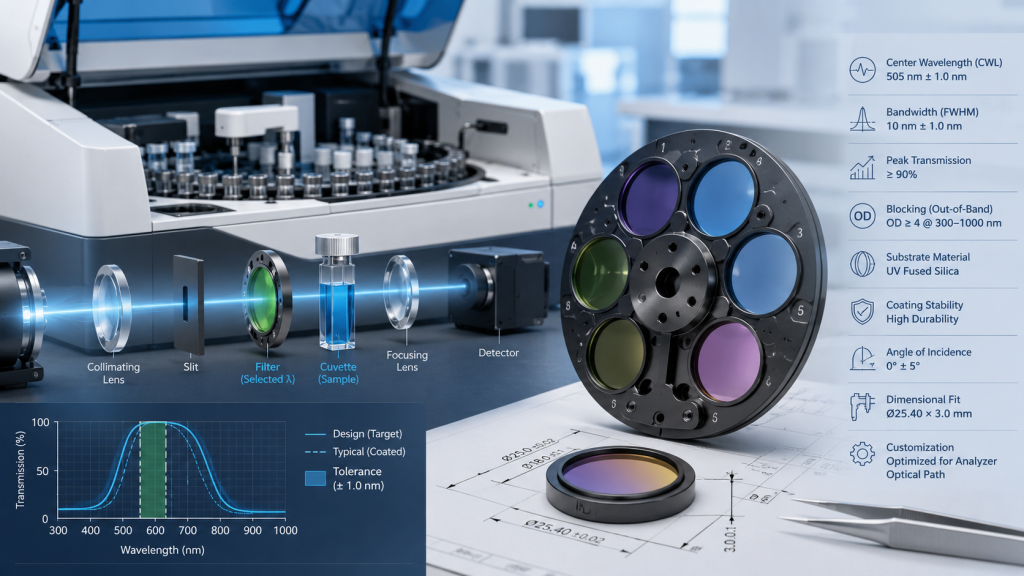
A custom biochemical analyzer filter is an optical filter designed for a specific analyzer optical path, reagent wavelength, detector response, mechanical size, and performance requirement. In biochemical analyzers, clinical chemistry instruments, ELISA readers, and filter photometers, the filter helps isolate the wavelength used for absorbance or colorimetric measurement. The right filter specification is not only about choosing 340 nm, 405 nm, 546 nm, or another channel. Engineers also need to confirm center wavelength tolerance, half bandwidth, peak transmission, out-of-band blocking, substrate material, coating stability, angle of incidence, and dimensional fit. For analyzer OEMs and procurement teams, custom filters are often necessary when standard catalog parts do not match the optical design, filter wheel, cuvette geometry, detector, or required measurement stability.
What Is a Custom Biochemical Analyzer Filter?
A custom biochemical analyzer filter is a precision optical component that transmits a defined wavelength band while blocking unwanted wavelengths outside the measurement band. In many biochemical and clinical chemistry instruments, these filters are used in photometric or colorimetric optical paths to support absorbance-based measurement.
GIAI Photonics lists biochemical analyzer optical filters as customized optical glass components and shows application channels such as 340 nm, 380 nm, 405 nm, 505 nm, 546 nm, 600 nm, 630 nm, 660 nm, 700 nm, 750 nm, and 800 nm. The same product page also describes optical indicators such as center wavelength deviation, peak transmittance, OD5 or above blocking, and 8–10 nm half bandwidth, depending on the channel and design.
Simple definition:
A custom biochemical analyzer filter is a wavelength-selective optical filter made to match the instrument’s assay wavelength, optical path, mechanical structure, and measurement requirements.
Why Filter Selection Matters in Biochemical Analyzers
In a biochemical analyzer, the filter is part of the measurement chain. Light from a lamp or LED passes through the optical path, interacts with the sample or reagent, and reaches the detector. The filter helps define which wavelength reaches the detector.
If the filter is not properly specified, several issues may occur:
- The transmitted wavelength may not match the reagent method.
- Out-of-band light may increase background signal.
- Low transmission may reduce signal level.
- Incorrect bandwidth may affect measurement sensitivity.
- Angle shift may move the passband away from the intended wavelength.
- Poor environmental stability may cause long-term drift.
- Mechanical mismatch may cause alignment or assembly problems.
Clinical chemistry literature has long recognized that wavelength error can matter when substances have sharp absorption bands, and that reliable wavelength definition supports accurate photometric analysis.
Common Wavelength Channels for Biochemical Analyzer Filters
The exact wavelength set depends on the analyzer design and test menu. However, many filter-based photometric instruments use discrete UV and visible wavelength channels. For example, one semi-automatic clinical chemistry photometer specifies a filter wheel with standard interference filters at 340 nm, 405 nm, 492 nm, 546 nm, 578 nm, and 623 nm, with optional filter positions available.
| Wavelength range | Typical role in analyzer optics | Filter selection note |
|---|---|---|
| 340 nm | UV absorbance channel in some biochemical methods | Substrate and coating must be suitable for UV transmission |
| 380–405 nm | Near-UV / violet detection channels | Confirm transmission and blocking against lamp or LED spectrum |
| 492–505 nm | Visible absorbance channel | Match reagent method and detector response |
| 546–578 nm | Common visible photometric channels | Check CWL tolerance and bandwidth carefully |
| 600–660 nm | Red visible channels | Useful for certain colorimetric or turbidity-related measurements |
| 700–800 nm | Longer visible / near-IR channels | Confirm detector sensitivity and unwanted background light |
For GIAI’s biochemical analyzer optical filter page, listed application channels include 340 nm through 800 nm, with different transmittance and tolerance requirements depending on channel.
Key Specifications for a Custom Biochemical Analyzer Filter
When requesting a custom biochemical analyzer filter, engineers should avoid specifying only the nominal wavelength. A complete specification should include optical, mechanical, coating, and inspection requirements.
| Parameter | Why it matters | Practical selection guidance |
|---|---|---|
| Center wavelength, CWL | Defines the main transmitted wavelength | Confirm the assay wavelength and allowable tolerance |
| Half bandwidth / FWHM | Controls how narrow or broad the transmitted band is | Narrower is not always better; match the method and light source |
| Peak transmission | Affects detector signal strength | Higher transmission can improve signal, depending on blocking and coating design |
| Optical density / blocking | Reduces unwanted out-of-band light | Confirm required blocking range, not only OD value |
| Substrate material | Affects UV transmission, thermal behavior, and durability | Use UV-capable materials when working near 340 nm |
| Coating design | Determines passband shape, blocking, reflection, and stability | Confirm coating type based on environment and lifetime requirements |
| Angle of incidence | Can shift the passband | Specify actual AOI in the optical path, not only normal incidence |
| Clear aperture | Determines usable optical area | Match the beam diameter and mechanical mount |
| Diameter / thickness | Controls assembly compatibility | Provide drawings or sample dimensions |
| Environmental stability | Affects long-term instrument consistency | Confirm operating temperature, humidity, cleaning, and storage conditions |
GIAI’s optical filter category describes optical filters as devices that selectively transmit, absorb, or reflect specific wavelengths and notes use across optical instrument systems including industrial and medical applications.
Bandpass, Narrow Bandpass, and Related Filter Choices
Most biochemical analyzer filters are functionally bandpass filters: they transmit a controlled wavelength band and block wavelengths outside that band. GIAI’s bandpass filter category defines a bandpass filter as a filter that allows a specific range of wavelengths or frequencies to pass while blocking or attenuating wavelengths outside that range.
For analyzer design, the choice usually depends on the wavelength channel and detection method:
| Filter type | When it may be used | Engineering consideration |
|---|---|---|
| Bandpass filter | Standard absorbance channels | Balance transmission, bandwidth, and blocking |
| Narrow bandpass filter | Channels requiring tighter spectral isolation | Check signal level because narrower bandwidth may reduce throughput |
| Neutral density filter | Signal attenuation or calibration-related optical control | Confirm optical density and wavelength range |
| Beamsplitter / dichroic component | Multi-path optical systems | Confirm transmission/reflection ratio and AOI |
| Collimating lens | Analyzer optical path before or after cuvette/reaction cup | Confirm diameter, curvature, thickness, and alignment needs |
For related products, engineers can review bandpass filters for analytical instruments, narrow bandpass filters, and custom optical filters.
How to Specify a Custom Biochemical Analyzer Filter
A strong RFQ should make the optical requirement easy to review. This reduces back-and-forth communication and helps the supplier identify whether the requirement can be met with an existing design, a modified design, or a fully custom coating.
Practical Selection Checklist
Use this checklist before sending an inquiry:
- Define the analyzer type: biochemical analyzer, ELISA reader, clinical chemistry analyzer, photometer, or custom optical module.
- List every required wavelength channel.
- Specify CWL tolerance for each channel.
- Specify bandwidth or FWHM.
- Define peak transmission requirements.
- Define blocking range and required optical density.
- Confirm angle of incidence.
- Confirm beam size and clear aperture.
- Provide mechanical dimensions, including diameter, length, width, thickness, chamfer, and mounting constraints.
- Confirm substrate preference or operating wavelength range.
- Describe operating environment, including temperature, humidity, cleaning exposure, and lifetime expectations.
- Provide drawings, samples, or previous filter specifications when available.
- Confirm whether the filter is for prototype, validation, repair, or mass production.
- Ask for drawing review, sample evaluation, or a custom quote before production.
For optical path components beyond filters, GIAI also lists collimating lenses customized according to customer mold and internal optical path structure, with parameters such as outer diameter, center thickness, edge thickness, eccentricity, aperture, and curvature radius. Engineers can also review optical lenses for analyzer optical paths when the filter is part of a complete light path design.
Common Mistakes When Buying Biochemical Analyzer Filters
Mistake 1: Buying only by wavelength
A filter described as “546 nm” may still be unsuitable if the bandwidth, blocking, transmission, size, or AOI does not match the instrument.
Mistake 2: Ignoring out-of-band blocking
Out-of-band light can influence detector signal, especially when the light source has broad output or when the detector is sensitive across a wide range. The RFQ should define the blocking range and required optical density.
Mistake 3: Not confirming angle of incidence
Interference filters can shift spectrally when used at non-normal incidence. If the analyzer uses angled beams, beamsplitters, or compact folded optics, AOI should be specified.
Mistake 4: Using the wrong substrate for UV channels
For UV or near-UV channels such as 340 nm, substrate and coating selection should be confirmed carefully. Standard glass may not be appropriate for every UV transmission requirement.
Mistake 5: Treating prototype and mass-production needs the same
A prototype filter may be acceptable for optical verification, but production requires attention to batch consistency, dimensional tolerance, inspection method, packaging, and long-term supply.
Mistake 6: Not sending drawings or samples
For replacement filters or OEM analyzer components, a drawing or physical sample can clarify diameter, thickness, edge treatment, coating side, orientation, and installation constraints.
When to Choose Custom Optical Components
Choose a custom biochemical analyzer filter when the application cannot be solved reliably with a standard catalog filter.
Custom optical components are usually appropriate when:
- The analyzer has a non-standard filter size.
- Multiple wavelength channels must be matched across one product family.
- The filter must fit an existing filter wheel or compact optical module.
- The required CWL tolerance, bandwidth, or blocking range is not standard.
- The instrument uses UV or near-IR channels that require specific substrate selection.
- The filter is used at a defined non-zero angle of incidence.
- A beamsplitter, dichroic element, or collimating lens must be matched with the filter.
- The customer needs drawing review, sample replacement, or production consistency.
GIAI Photonics presents itself as a manufacturer of optics and precision optical components, including optical filters, multi-element lenses, and lens coatings, supported by optical fabrication equipment and metrology. For company background, visit GIAI Photonics optical manufacturing capability.
Procurement Considerations for Medical and Laboratory Instrument Projects
For medical device manufacturers, clinical laboratory equipment suppliers, and biochemical analyzer OEMs, procurement should not focus only on unit price. The filter affects optical performance and can influence analyzer repeatability, so the purchasing process should include both technical and supply-chain review.
Key procurement questions include:
- Can the supplier review drawings or samples?
- Can the supplier support custom wavelength channels?
- Can the same coating design be produced consistently?
- What inspection data can be provided?
- What is the expected lead time for sample and batch production?
- Are dimensions and tolerances compatible with the analyzer housing?
- Is the coating suitable for the expected operating environment?
- Are packaging and handling suitable for coated optical components?
For high-requirement applications in medical, automotive, aerospace, laser, or regulated environments, final suitability should always be confirmed according to the actual system design, validation method, test conditions, and applicable compliance requirements.
E. FAQ
FAQ: Custom Biochemical Analyzer Filter
1. What is a custom biochemical analyzer filter?
A custom biochemical analyzer filter is a wavelength-selective optical filter designed for a specific biochemical analyzer, clinical chemistry analyzer, ELISA reader, or photometric instrument. It is customized according to wavelength channel, bandwidth, transmission, blocking, substrate, coating, size, and optical path requirements.
2. Which wavelengths are commonly used in biochemical analyzer filters?
Common wavelength channels may include 340 nm, 380 nm, 405 nm, 492 nm, 505 nm, 546 nm, 578 nm, 600 nm, 630 nm, 660 nm, 700 nm, 750 nm, and 800 nm, depending on the analyzer and assay method. GIAI’s biochemical analyzer optical filter page lists channels from 340 nm to 800 nm.
3. Is a biochemical analyzer filter usually a bandpass filter?
Yes, in many photometric biochemical analyzers, the wavelength selection component is commonly a bandpass or narrow bandpass filter. It transmits the target wavelength band and blocks unwanted wavelengths outside that band.
4. What specifications should I provide for a custom biochemical analyzer filter?
You should provide center wavelength, wavelength tolerance, FWHM or half bandwidth, peak transmission, optical density, blocking range, substrate, coating requirements, AOI, clear aperture, dimensions, thickness, edge treatment, and operating environment. Drawings or samples are strongly recommended.
5. Why is optical density important for biochemical analyzer filters?
Optical density describes the filter’s ability to block unwanted light outside the passband. Higher blocking may be needed when background light, source spectrum, or detector sensitivity can affect measurement stability. The required OD should be defined across a specific wavelength range.
6. Can I use a standard optical filter instead of a custom one?
A standard filter may work for early testing if the wavelength, size, bandwidth, transmission, blocking, and AOI are compatible. A custom filter is usually better when the analyzer has specific wavelength channels, a fixed filter wheel, compact optics, UV requirements, or production consistency needs.
7. What information does GIAI Photonics need for a custom quote?
For a practical quote, provide the analyzer application, wavelength list, optical performance requirements, mechanical drawing, sample photos if available, quantity, inspection expectations, and whether the project is for prototype, replacement, or mass production. You can start from GIAI’s custom biochemical analyzer optical filters page or request a custom optical filter quote.