
Technical Resources
Custom Bandpass Interference Filter
A custom bandpass interference filter is designed to transmit a defined wavelength band while blocking unwanted wavelengths outside that range. It is commonly used when a standard optical filter cannot meet the required center wavelength, bandwidth, blocking level, substrate size, angle of incidence, coating durability, or mechanical integration needs. For optical engineers and procurement teams, the key is not only choosing a wavelength. A reliable specification should also define transmission, FWHM, optical density, blocking range, substrate material, surface quality, operating angle, environmental conditions, and inspection requirements. In many imaging, sensing, fluorescence, laser, medical, and industrial optical systems, the filter must be matched to the light source, detector response, lens design, working environment, and assembly constraints.
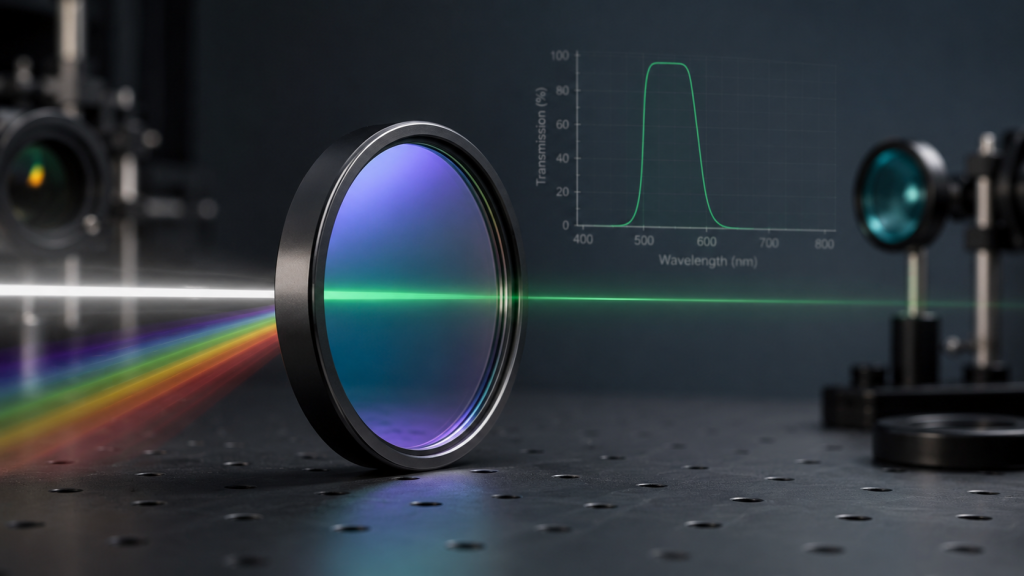
What Is a Custom Bandpass Interference Filter?
A custom bandpass interference filter is an optical filter made with multilayer thin-film coatings that transmit a selected wavelength range and attenuate wavelengths outside that passband.
In practical optical system design, “custom” usually means one or more filter specifications are adjusted beyond a standard catalog option. These may include:
- Center wavelength
- Bandwidth or FWHM
- Peak transmission
- Blocking range
- Optical density
- Substrate material
- Filter diameter or shape
- Thickness and edge treatment
- Coating type
- Angle of incidence
- Environmental durability
- Production quantity and inspection method
For wavelength-specific systems, engineers often compare custom optical filters, bandpass filters, and narrow bandpass filters before confirming the final design.
How a Bandpass Interference Filter Works
A bandpass interference filter uses thin-film coating layers to create constructive and destructive interference. The desired wavelength band is transmitted, while unwanted wavelengths are reflected or attenuated.
This is different from simple absorptive colored glass. Interference filters can provide more controlled spectral performance, especially when the system needs a defined center wavelength, tighter bandwidth, and stronger out-of-band blocking.
However, interference filters are sensitive to system geometry. The specified performance is usually based on defined test conditions, such as normal incidence or a specific angle of incidence. If the filter is used at a different angle, the passband may shift. This is why AOI should be discussed early in the design stage.
Key Specifications for a Custom Bandpass Interference Filter
| Specification | What It Means | Why It Matters |
|---|---|---|
| Center wavelength | The main wavelength the filter is designed to transmit | Must match the light source, emission line, laser wavelength, or detection target |
| FWHM / bandwidth | Width of the transmitted spectral band | Controls signal selectivity and background rejection |
| Peak transmission | Maximum transmission within the passband | Affects signal strength and system efficiency |
| Blocking range | Wavelength range outside the passband that must be rejected | Prevents stray light and unwanted spectral interference |
| Optical density | Blocking strength outside the passband | Important for fluorescence, laser, and high-contrast detection |
| AOI | Angle between incoming light and filter surface normal | Can shift the transmitted band and change filter behavior |
| Substrate material | Glass or optical material supporting the coating | Affects transmission range, thermal stability, and mechanical strength |
| Surface quality | Scratch-dig, flatness, or cosmetic requirements | Important for imaging, laser, and precision detection systems |
| Environmental stability | Resistance to temperature, humidity, cleaning, and handling | Important for industrial, outdoor, medical, and sensing applications |
| Mechanical size | Diameter, square size, thickness, chamfer, or mounted format | Must fit the optical assembly and production process |
Choosing Center Wavelength and Bandwidth
The center wavelength should be selected according to the actual optical signal that needs to pass through the system. This may come from an LED, laser, fluorescence emission, sensor response curve, or measurement wavelength.
Bandwidth should be selected based on how much spectral separation the system needs.
A narrower bandwidth improves spectral selectivity, but it may reduce total transmitted signal and can be more sensitive to angle, temperature, and manufacturing tolerance. A broader bandwidth allows more light through, but it may also pass more unwanted background.

For fluorescence and analytical instruments, narrow bandpass filters are often used to separate excitation and emission wavelengths. For general machine vision illumination, a broader bandpass may be acceptable depending on the camera, light source, and contrast requirement.
Transmission, Blocking, and Optical Density
Transmission and blocking should be reviewed together. A filter with high peak transmission is useful only if unwanted wavelengths are blocked strongly enough for the detector and application.
Optical density describes how strongly unwanted light is attenuated. Higher blocking may be required when:
- The signal is weak compared with the background
- The detector is sensitive outside the target band
- The system uses laser or high-intensity light
- Fluorescence emission must be separated from excitation light
- Ambient light may affect measurement stability
- The optical path includes reflective surfaces or stray light
For critical systems, the blocking range should not be described vaguely. It is better to specify the exact wavelength range where blocking is required.
Why Angle of Incidence Matters
For a custom bandpass interference filter, angle of incidence is one of the most important design inputs.
When an interference filter is tilted, the transmitted passband may shift toward shorter wavelengths. The degree of shift depends on the coating design, wavelength, substrate, polarization, beam geometry, and AOI.
This matters in systems such as:
- Machine vision cameras with wide-angle lenses
- Fluorescence imaging modules
- LiDAR and sensing optics
- Laser detection systems
- Optical instruments with converging or diverging beams
- Compact optical assemblies with limited mounting space
If the filter will not operate at normal incidence, the required AOI should be included in the drawing or technical request. For precision optical systems, it is also useful to describe whether the beam is collimated, converging, or diverging.
Substrate Material and Coating Considerations
The substrate and coating design should match the wavelength range, mechanical requirements, and working environment.
Common selection factors include:
- UV, visible, NIR, or IR transmission range
- Required optical flatness
- Thermal stability
- Filter size and thickness
- Cleaning and handling requirements
- Coating adhesion and durability
- Mounting stress
- Long-term environmental exposure
For visible and near-infrared applications, optical glass substrates are often considered. For infrared filters, substrate selection must be matched to the required transmission band. When the filter is part of a sealed or protective optical assembly, optical windows for protective assemblies may also need to be reviewed with the filter design.
Application Scenarios for Custom Bandpass Interference Filters
| Application | Typical Filter Requirement | Selection Focus |
| Machine vision | Improve contrast under controlled illumination | Center wavelength, bandwidth, transmission, camera response |
| Fluorescence detection | Separate emission signal from excitation light | Narrow bandwidth, high blocking, OD, spectral separation |
| Medical optical devices | Support stable imaging or detection performance | Wavelength accuracy, repeatability, biocompatible system design review where applicable |
| LiDAR and sensing | Isolate target wavelength and reduce ambient light | NIR transmission, blocking, AOI, environmental stability |
| Laser systems | Pass or reject defined laser wavelengths | Laser wavelength, OD, coating durability, AOI |
| Industrial inspection | Improve signal-to-noise ratio in production environments | Mechanical fit, durability, cleaning, repeatability |
| Research instruments | Match experimental wavelength and detector configuration | Custom wavelength, spectral curve, tolerance, documentation |
In systems where imaging quality also depends on lens performance, the filter should be evaluated together with optical lenses for machine vision or other imaging optics in the assembly.
Practical Selection Checklist
Before requesting a custom bandpass interference filter, prepare the following information:
- Target center wavelength
- Required bandwidth or FWHM
- Minimum peak transmission
- Required blocking range
- Required optical density outside the passband
- Operating angle of incidence
- Beam type: collimated, converging, or diverging
- Polarization condition, if relevant
- Substrate preference or wavelength range
- Filter size, thickness, shape, and edge requirements
- Surface quality and flatness requirements
- Working temperature and humidity conditions
- Cleaning, handling, or durability requirements
- Drawing, sample, or existing filter reference
- Estimated quantity and inspection requirements
If some information is not available, the supplier can usually help review the optical design, but the wavelength, blocking need, application background, and mechanical constraints should be clarified as early as possible.
Common Mistakes When Specifying a Custom Bandpass Filter
Only specifying the center wavelength
A center wavelength alone is not enough. The supplier also needs bandwidth, transmission, blocking range, OD, AOI, and size requirements.
Ignoring angle of incidence
A filter specified at normal incidence may not perform the same way when tilted or used in a fast optical system. AOI should be confirmed before coating design.
Using vague blocking requirements
Statements such as “block all other light” are not precise. It is better to define the wavelength range and OD requirement.
Choosing a bandwidth that is too narrow without system review
A very narrow passband may improve selectivity, but it can reduce signal throughput and become more sensitive to AOI and tolerance.
Treating the filter as separate from the optical system
The filter interacts with the light source, detector, lens, housing, and working environment. For stable performance, it should be reviewed as part of the full optical path.
Not confirming environmental conditions
Temperature, humidity, cleaning method, vibration, and outdoor exposure can affect long-term reliability. These should be discussed for industrial and sensing applications.
When to Choose Custom Optical Components Instead of Standard Filters
A standard filter may be suitable for early testing or simple applications. A custom bandpass interference filter becomes more appropriate when the system has specific optical, mechanical, or production requirements.
Choose a custom solution when:
- The required wavelength is not available as a standard filter
- The bandwidth must be adjusted for the detector or light source
- Higher blocking or a wider blocking range is needed
- The filter must work at a specific AOI
- The size, shape, or thickness must fit a compact assembly
- The substrate must support UV, visible, NIR, or IR transmission
- The filter must meet defined environmental requirements
- The project requires repeatable production rather than one-time testing
- The filter needs to be reviewed with lenses, windows, mirrors, or other optical components
For integrated projects, it may be useful to discuss custom optical filters together with infrared filters for sensing systems, optical windows, or other precision components before finalizing the drawing.
Procurement Considerations for Engineering and Purchasing Teams
For procurement managers, price should not be evaluated separately from specification difficulty. A custom filter quotation is affected by coating design, substrate material, tolerance, blocking requirement, size, inspection method, and order quantity.
To reduce communication delays, provide:
- Technical drawing or dimensional sketch
- Spectral curve requirement
- Application background
- Light source and detector information
- AOI and beam geometry
- Environmental requirements
- Sample approval process
- Quantity range
- Packaging or handling requirements
For medical, automotive, laser, aerospace, and other high-requirement applications, performance should be confirmed according to the actual system conditions, testing method, and compliance requirements.
How GIAI Photonics Supports Custom Filter Selection
GIAI Photonics supports optical component selection based on wavelength requirements, drawings, samples, and application needs. For custom bandpass interference filter projects, the discussion can include spectral design, substrate selection, coating requirements, size tolerance, blocking range, sample evaluation, and production feasibility.
When the filter is part of a larger optical assembly, engineers may also review related components such as bandpass filters, narrow bandpass filters, optical lenses, optical windows, prisms, mirrors, or coating requirements.
A clear specification at the beginning of the project helps reduce redesign risk and improves communication between engineering, procurement, and manufacturing teams.
FAQ
1. What is a custom bandpass interference filter?
A custom bandpass interference filter is an optical filter designed to transmit a specified wavelength band while blocking unwanted wavelengths outside that range. It is customized for requirements such as center wavelength, bandwidth, blocking, OD, AOI, substrate, size, and coating durability.
2. When should I use a custom bandpass filter instead of a standard filter?
Use a custom filter when a standard option does not match your wavelength, bandwidth, blocking, AOI, size, substrate, environmental, or assembly requirements. Customization is also useful when the filter must be integrated into a specific optical system.
3. What information is needed for a custom bandpass interference filter quote?
You should provide center wavelength, FWHM, transmission requirement, blocking range, optical density, AOI, substrate preference, size, thickness, tolerance, working environment, application background, drawing or sample, and estimated quantity.
4. Does angle of incidence affect a bandpass interference filter?
Yes. In many interference filter designs, changing the angle of incidence can shift the passband toward shorter wavelengths and may affect spectral performance. AOI should be confirmed before finalizing the coating design.
5. What is the difference between bandwidth and blocking range?
Bandwidth describes the wavelength range that the filter transmits. Blocking range describes the wavelength region outside the passband where unwanted light must be attenuated. Both are important for system performance.
6. Are narrow bandpass filters always better?
Not always. Narrow bandpass filters provide stronger spectral selectivity, but they may reduce signal throughput and require closer review of AOI, tolerance, and system alignment. The right bandwidth depends on the application.
7. Can a custom bandpass interference filter be used in medical or laser systems?
Yes, but the specification should be reviewed according to the actual optical design, safety requirements, test conditions, and compliance needs. Medical, laser, automotive, aerospace, and other high-requirement systems should not rely on generic specifications alone.
8. Can GIAI Photonics review drawings or samples for a custom filter project?
Yes. GIAI Photonics can review drawings, samples, wavelength requirements, tolerance needs, working environment, quantity, and application background to support optical component selection and custom quote evaluation.