
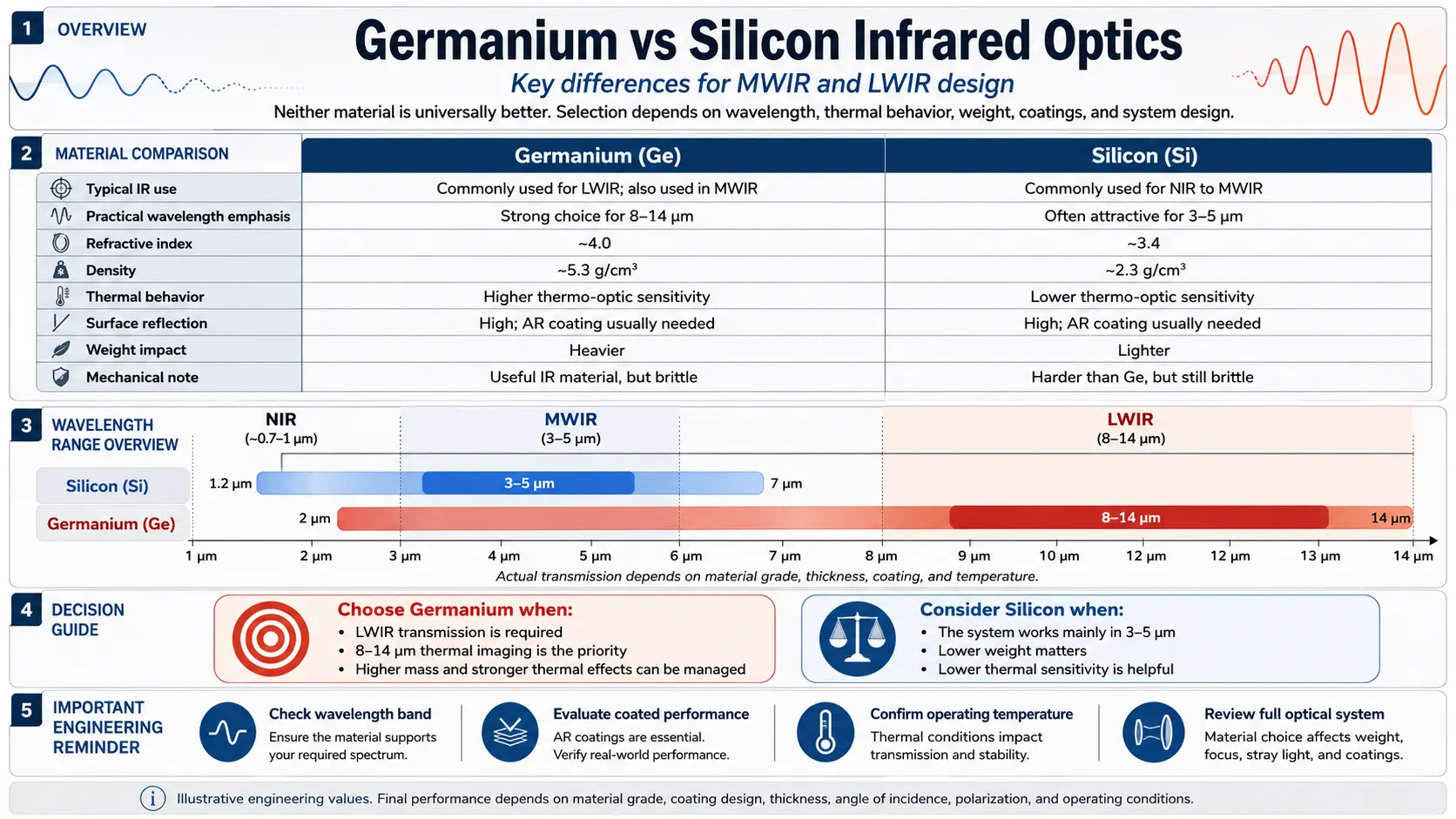
Germanium vs silicon infrared optics is mainly a question of wavelength, thermal behavior, weight, optical design, and material grade—not which material is universally better. Germanium is commonly selected when an optical system must transmit long-wave infrared radiation, particularly in the 8–14 μm region. Silicon is often attractive for near-IR and mid-wave infrared systems, especially around the 3–5 μm atmospheric window, where its lower density and different thermo-optic behavior can be advantageous. Both materials have high refractive indices, both usually benefit from anti-reflection coatings, and neither should be selected from a transmission-range number alone.
Germanium and silicon are similar materials, but not interchangeable
Germanium and silicon are crystalline semiconductor materials that can also function as transmissive infrared optical materials.
Unlike conventional visible optical glasses, they absorb most visible radiation while transmitting selected infrared wavelengths. This makes them useful for infrared lenses, windows, sensor optics, spectroscopy systems, gas-detection optics, thermal imaging systems, and some infrared filter substrates.
Their similarities can make the choice appear simple. Both have:
• high refractive indices compared with ordinary optical glass
• substantial uncoated surface reflection
• useful infrared transmission bands
• good compatibility with precision infrared optical fabrication
• applications as lenses, windows, and substrates
The important differences appear when wavelength, temperature, mass, absorption, coating design, and optical geometry are considered together.
For engineers working on Infrared Lenses, specifying only “IR material” is therefore insufficient. The operating wavelength or spectral band should be established first.
Germanium vs silicon infrared optics at a glance
| Property | Germanium | Silicon | Engineering significance |
|---|---|---|---|
| Commonly used infrared region | Approximately 2 μm into the LWIR region; commonly used through 8–14 μm | Commonly about 1.2–7 μm for standard IR designs; longer-wave behavior depends strongly on material grade | Germanium is usually the more straightforward LWIR choice; silicon is widely used in MWIR |
| Typical refractive index in IR | About 4.0 | About 3.4 | Both produce high Fresnel reflection without suitable coatings |
| Density | About 5.3 g/cm³ | About 2.3 g/cm³ | Silicon can substantially reduce optic mass |
| Thermo-optic response | Relatively high | Lower than germanium | Germanium normally requires more attention to thermal focus shift |
| Typical Knoop hardness | Lower than silicon | Higher than germanium | Silicon can offer mechanical advantages, although both remain brittle materials |
| 3–5 μm use | Suitable | Particularly useful | Both may be candidates; system requirements decide |
| 8–14 μm use | Common | Not a direct general-purpose substitute | Germanium is normally easier to specify for conventional LWIR transmission |
| AR coating need | Important | Important | High index makes surface reflection significant for both |
These values are engineering reference ranges rather than universal specifications. Material grade, doping or resistivity, impurity content, wavelength, thickness, temperature, surface condition, and coating can materially change the final transmission of a finished component.
The wavelength range is usually the first decision
If a system operates in the 8–14 μm long-wave infrared region, germanium has one of its clearest advantages.
Germanium maintains useful transmission across the principal LWIR thermal-imaging region and is consequently widely associated with thermal imaging lenses and windows. GIAI Photonics’ existing Germanium Lenses category likewise places the material in infrared systems extending into this region.
Silicon requires more qualification.
A commonly specified working range for standard infrared silicon is approximately 1.2–7 μm, making it especially relevant to the 3–5 μm MWIR band. However, “silicon stops transmitting at 7 μm” is too simplistic.
Transmission at longer wavelengths depends strongly on the silicon grade, growth process, oxygen content, resistivity, doping, thickness, and spectral region. Certain high-purity or high-resistivity silicon materials can exhibit transmission outside the conventional 1.2–7 μm design window, while particular absorption bands can make other grades unsuitable.
This distinction is important because a material datasheet showing some transmission at a wavelength does not automatically make that material a good imaging lens substrate across a complete operating band.
For a practical design:
At approximately 3–5 μm, both germanium and silicon deserve consideration.
At approximately 8–14 μm, germanium is generally the more conventional transmissive material.
At wavelengths approaching the material absorption edge or an impurity-related absorption band, actual grade-specific spectral data should replace generic transmission-range charts.
Refractive index changes lens design and coating requirements
Germanium has an infrared refractive index near 4, while silicon is roughly 3.4 in commonly used infrared regions. Published measurements show that the exact value changes with wavelength and temperature.
That difference affects more than a material-property table.
Lens optical power depends partly on the refractive-index difference between the material and the surrounding medium. A higher-index material can therefore achieve a required optical power with different surface curvatures than a lower-index material.
This does not mean germanium automatically produces a smaller or better lens. Aberration correction, field of view, aperture, focal length, detector format, number of elements, aspheric surfaces, mechanical packaging, and temperature range all influence the final design.
The other consequence of high refractive index is surface reflection.
At a simple air-to-material interface, both silicon and germanium can reflect a substantial fraction of incident radiation when uncoated. Germanium’s higher index makes this particularly important.
As a result, comparing polished substrate transmission alone can be misleading. A practical system should evaluate the finished optic with its intended anti-reflection coating over the required wavelength range, angle of incidence, polarization conditions, and operating temperature.
Why AR coatings matter for both materials
For both materials, an anti-reflection coating is normally part of the optical design rather than a cosmetic addition.
The coating can be designed to reduce reflection over a specific band such as MWIR or LWIR, but coating performance is never independent of operating conditions.
An engineer specifying a coated germanium or silicon component should identify at least:
• operating wavelength or spectral range
• required transmission
• angle of incidence
• beam cone or numerical aperture where relevant
• polarization if relevant
• substrate material and grade
• operating temperature
• environmental exposure
• surface durability requirements
A coating optimized around normal incidence should not automatically be expected to maintain exactly the same spectral response at a large angle of incidence.
For coated Optical Windows and lenses, substrate and coating therefore have to be evaluated as one optical component rather than as two unrelated specifications.
Thermal behavior is one of the largest differences
Temperature is particularly important in germanium optics.
Measurements of silicon and germanium refractive index over infrared wavelengths show that both materials have positive thermo-optic coefficients, meaning their refractive indices change as temperature changes. Germanium’s coefficient is significantly larger.
One published measurement over the 2.5–12 μm region reported approximate dn/dT values around:
Silicon: 1.5 × 10⁻⁴ K⁻¹
Germanium: 4.0 × 10⁻⁴ K⁻¹
These are measurement-context values rather than universal design constants, but they illustrate why germanium can require greater attention in systems operating across a broad temperature range.
A changing refractive index changes optical power and may contribute to focal shift.
However, the lens material is only part of the thermal problem. A real system may also experience:
• lens spacing changes
• barrel expansion or contraction
• detector movement
• changes in coating behavior
• temperature-dependent absorption
• structural stress
• detector-response variation
Consequently, saying that silicon is simply “temperature stable” and germanium is “temperature unstable” would be inaccurate.
The correct question is whether the complete optical assembly remains within its focus and imaging requirements across the specified operating temperature range.
Athermal optical design may compensate for material behavior using combinations of optical materials, mechanical structure, lens powers, element spacing, or active focus adjustment.
Germanium transmission itself can also become temperature dependent
Germanium has another thermal consideration beyond refractive-index change: infrared absorption can increase as material temperature rises.
This effect can reduce transmission in some infrared regions and becomes especially relevant when a germanium optic operates in a hot environment or absorbs significant radiation.
It should therefore not be assumed that room-temperature transmission data represent performance at every operating temperature.
For thermal imaging, heated instruments, high-temperature process monitoring, or other systems with substantial environmental variation, engineers should confirm spectral transmission at relevant temperature conditions rather than relying only on a room-temperature material chart.
Silicon has a major advantage when weight matters
Density provides a much simpler comparison.
Germanium has a density of roughly 5.3 g/cm³, whereas silicon is approximately 2.3 g/cm³. GIAI Photonics’ own current material information similarly identifies silicon as significantly lighter than germanium.
For a small lens, the difference may be unimportant.
For a large window, multi-element objective, moving optical assembly, airborne instrument, scanning mechanism, or portable optical system, it can become significant.
Lower optic mass can affect:
• mechanical load
• actuator requirements
• balance
• vibration response
• mount design
• total instrument weight
This is one reason silicon deserves careful consideration when the wavelength range permits its use.
Mechanical properties should not be reduced to hardness
Silicon is typically harder than germanium in common optical-material data, but hardness does not mean that either material can be handled like metal.
Both are brittle crystalline optical materials.
Mechanical design still needs to address edge chipping, surface damage, mounting pressure, thermal stress, coating durability, and handling.
A harder substrate may provide an advantage in certain environments, but exposed external windows can still require appropriate protective coatings or mechanical protection depending on abrasion, dust, humidity, cleaning procedures, or other environmental conditions.
Surface quality and surface figure should therefore be specified according to the optical task rather than inferred from the substrate name.
For 3–5 μm MWIR systems, silicon can be especially attractive
The 3–5 μm atmospheric window is one of the strongest application regions for silicon infrared optics.
If both materials satisfy the required spectral transmission, silicon may provide advantages through:
• lower density
• lower thermo-optic coefficient
• high hardness
• established infrared optical processing
• potentially lower material cost
Germanium still remains technically usable in many MWIR systems.
The decision should therefore be based on optical performance rather than on the assumption that germanium is automatically the superior infrared material.
For example, a compact MWIR imaging objective might compare both materials as part of a multi-element design. The final choice could depend on focal length, aperture, aberration correction, element count, mass, operating temperature, coating requirements, and cost simultaneously.
For 8–14 μm LWIR systems, germanium usually has the clearer role
The comparison changes for conventional 8–14 μm thermal imaging.
Germanium’s useful transmission into the LWIR range makes it a common choice for lenses and protective windows in these systems.
Standard silicon should not be substituted purely because silicon is lighter or less expensive.
Silicon’s longer-wave optical behavior depends much more strongly on material grade and absorption characteristics, and a silicon component that performs well at 3–5 μm cannot be assumed to perform similarly at 8–12 μm.
Specialized silicon grades and specialized optical designs exist, but they should be evaluated using actual transmission and absorption data for the material being specified.
This is an important distinction between theoretical material transparency and qualified system performance.
What about infrared filters?
The same germanium-versus-silicon decision can appear in infrared filter design because both materials may be used as substrates.
Here, however, the substrate is only one part of the filter.
The finished spectral response may depend on:
• thin-film coating design
• substrate absorption
• substrate refractive index
• coating stress
• thickness
• angle of incidence
• polarization
• operating temperature
• detector spectral response
For example, choosing germanium because an application operates in LWIR does not by itself define the filter’s passband, blocking range, optical density, or angular response.
Likewise, choosing silicon for MWIR does not determine finished filter transmission.
The complete coating-plus-substrate design must be evaluated against the required system spectrum.
A practical germanium vs silicon selection method
Instead of starting with material preference, start with the optical system.
First, define the spectral requirement.
Specify the actual wavelength or band. “Infrared” is far too broad.
Second, determine whether the component is a lens, window, filter substrate, beamsplitter, or another optical element.
Third, define operating temperature.
This is particularly important when germanium is being considered.
Fourth, evaluate mass constraints.
For large components or moving assemblies, the density difference can materially affect the mechanical design.
Fifth, evaluate the finished coated component.
Do not compare only uncoated material transmission.
Sixth, define image-quality requirements.
For a lens, relevant specifications can include focal length, clear aperture, numerical aperture, centration, surface figure, surface quality, working distance, and wavefront or imaging requirements.
Finally, verify the exact optical grade.
Generic “Si” or “Ge” descriptions are not enough for demanding systems. Purity, resistivity, growth method, absorption, thickness, coating, and inspection criteria may all matter.
Which should you choose?
Choose germanium when the system requires conventional high-performance transmission into the LWIR region and the added density and thermal sensitivity can be accommodated.
Consider silicon when the required wavelength lies within a suitable silicon transmission region—particularly MWIR—and lower mass, hardness, thermal behavior, or material economics provide system-level advantages.
For 3–5 μm systems, both materials may be legitimate candidates.
For conventional 8–14 μm transmissive optics, germanium usually has the stronger practical case.
Most importantly, do not compare them from wavelength range alone. A useful engineering comparison includes wavelength, transmission, refractive index, temperature, optical power, coating, component thickness, material grade, mechanical environment, and the rest of the optical system.
Engineers evaluating custom infrared components may provide wavelength requirements, drawings, material preferences, dimensions, operating temperature, coating requirements, surface specifications, and inspection requirements to GIAI Photonics for component evaluation.
FAQ
Is germanium better than silicon for infrared optics?
No. Germanium is not universally better than silicon. Germanium is especially useful when transmission through the long-wave infrared region is required, while silicon is commonly attractive in the near-IR and 3–5 μm MWIR region. Silicon is also much lighter and has a lower thermo-optic coefficient. The correct material depends on wavelength, temperature, lens design, coatings, mass limits, material grade, and environmental requirements.
Can silicon replace germanium in an 8–14 μm thermal imaging lens?
Not automatically. Standard infrared silicon commonly used in the 1.2–7 μm region should not be treated as a direct replacement for germanium in an 8–14 μm system. Some specialized silicon grades can have different long-wave transmission characteristics, so actual material-grade absorption data are necessary. A successful substitution also requires the lens prescription to be redesigned because silicon and germanium have different refractive indices and thermal properties.
Which material is better for 3–5 μm infrared optics?
Both can be used, but silicon is often particularly attractive in the 3–5 μm MWIR region. Its lower density and lower thermo-optic coefficient can benefit weight-sensitive or temperature-sensitive systems. Germanium may still be selected when its refractive index, optical prescription, coating options, or broader spectral requirement better suits the system. The decision should be made at the complete lens or optical-system level.
Why do germanium and silicon optics need anti-reflection coatings?
Both materials have high refractive indices, which creates substantial Fresnel reflection at an uncoated air-to-optic surface. An appropriate AR coating can reduce these reflection losses over the intended infrared band. The actual coating must be designed for the required wavelength range, incidence angle, polarization conditions, substrate, and environmental requirements rather than treated as a universal coating.
Is silicon more thermally stable than germanium?
Silicon generally has a lower thermo-optic coefficient than germanium, so its refractive index changes less with temperature under comparable conditions. That can be advantageous for infrared lens design. However, complete thermal stability also depends on lens geometry, housing expansion, element spacing, coating behavior, detector position, and other materials. System-level thermal analysis is still necessary.
Does choosing germanium or silicon determine infrared image quality?
No. Material choice contributes to optical performance but does not determine final image quality by itself. Image quality also depends on lens prescription, aberration correction, surface figure, centration, coatings, detector characteristics, focus, mechanical alignment, temperature, calibration, stray light, and operating conditions.