Here we provide articles about popular science and applications of filters, lenses, prisms, reflectors, ND mirrors and other optical components. You are welcome to read! optical engineering articles, optical engineering guides, optical components, optical design, optics technology, photonics engineering
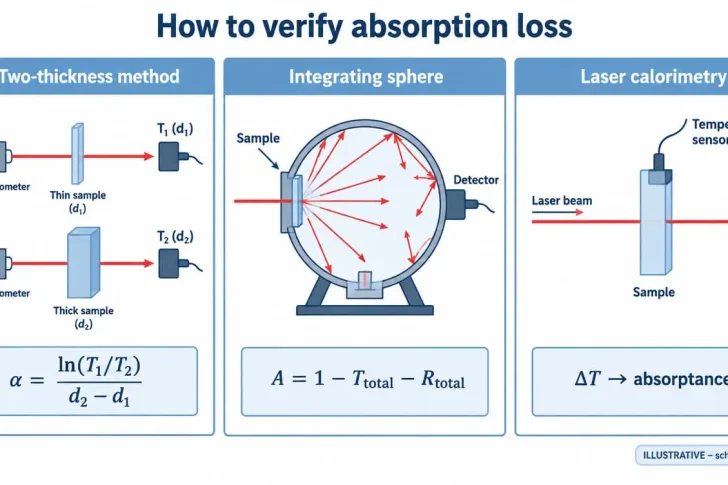
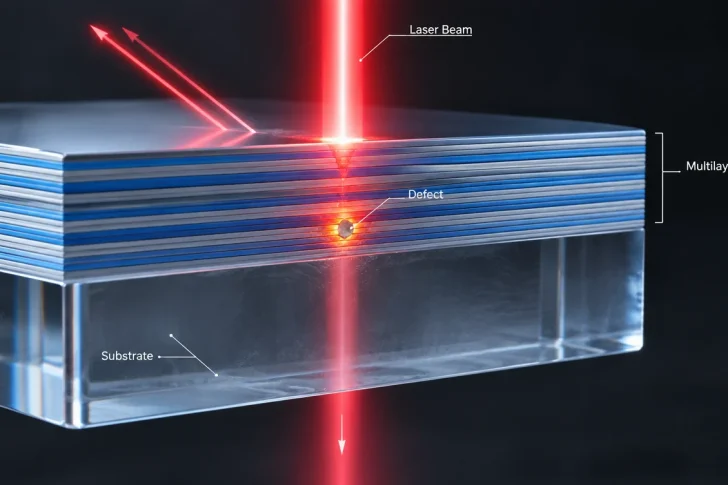
Transmission, reflection, and absorption describe three fundamental ways light interacts with an optical material or component. Transmission is the portion of incident optical power that passes through the component, reflection is the portion returned from its surfaces or optical structure, and absorption is the portion…
Read more
Germanium vs silicon infrared optics is mainly a question of wavelength, thermal behavior, weight, optical design, and material grade—not which material is universally better. Germanium is commonly selected when an optical system must transmit long-wave infrared radiation, particularly in the 8–14 μm region. Silicon is…
Read more
To reduce stray light with optical filters, first identify whether the unwanted radiation differs spectrally or by polarization from the desired signal. A bandpass, longpass, shortpass, notch, neutral density, or polarizing filter can then attenuate the relevant unwanted light before it reaches the detector. The…
Read more
How Lens Mounting Stress Affects Optical Performance Lens mounting stress can deform optical surfaces, alter the refractive index inside the glass, or move a lens away from its intended position. These changes can increase wavefront error, shift focus, introduce astigmatism or coma, reduce image contrast,…
Read more
A beauty device filters manufacturer should do more than supply a colored glass plate or quote a filter from one nominal wavelength. The manufacturer should review the light source, required output spectrum, transmission, blocking range, optical density, angle of incidence, substrate, coating durability, dimensions, operating…
Read more
OPTICAL ENGINEERING GUIDE How to Match Laser Ranging Filters and Sensors Laser ranging filters and sensors must be matched to the source wavelength, detector response, ambient spectrum, angle of incidence, and receiver optics. A filter can transmit the intended return band while suppressing out-of-band background…
Read more
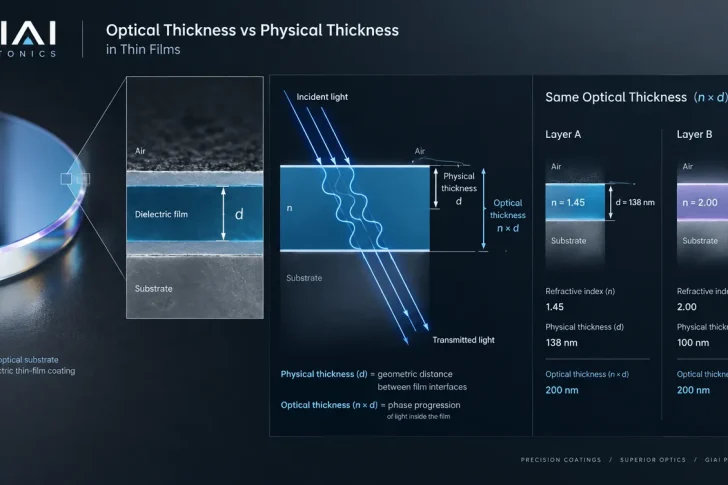
An anti reflection coating manufacturer designs and deposits thin-film layers that reduce unwanted surface reflection from lenses, windows, filters, prisms, and other optical components. Selecting a manufacturer requires more than requesting “high transmission.” The coating must be matched to the operating wavelength, substrate, angle of…
Read more
Laser Scan Optics and Custom Optical Components 1064nm F Theta Lens Manufacturer A technical guide to 1064nm F-theta scan lenses for galvanometer-based laser marking, engraving, drilling, cutting, welding, cleaning and precision material-processing systems. Quick Answer A 1064nm F-theta scan lens is a multi-element focusing objective…
Read more
A custom barcode scanner optical filter is a wavelength-selective component designed to transmit the light used by a scanner while reducing unwanted ambient or out-of-band light reaching the detector. The correct filter depends on the scanner architecture, illumination spectrum, sensor response, barcode material, field of…
Read more
A custom beauty instrument optical filter is a coated optical component designed to transmit, block, attenuate, or reflect selected wavelength ranges inside an IPL, laser, LED, imaging, sensing, or medical-aesthetic device. The correct filter cannot be selected from a cutoff wavelength alone. Medical device manufacturers…
Read more
A custom bandpass interference filter is designed to transmit a defined wavelength band while blocking unwanted wavelengths outside that range. It is commonly used when a standard optical filter cannot meet the required center wavelength, bandwidth, blocking level, substrate size, angle of incidence, coating durability,…
Read more
When looking for a beamsplitter manufacturer China, the most important question is not only whether the supplier can provide a standard beamsplitter. The real question is whether the supplier can match the beamsplitter design to your wavelength range, splitting ratio, polarization state, angle of incidence,…
Read more