Here are the previous GIAI-related industry application solutions. Here we share GIAI’s various optical filters, lenses, prisms and other optical components for application accessories analysis in various fields, covering a variety of industry application solutions!
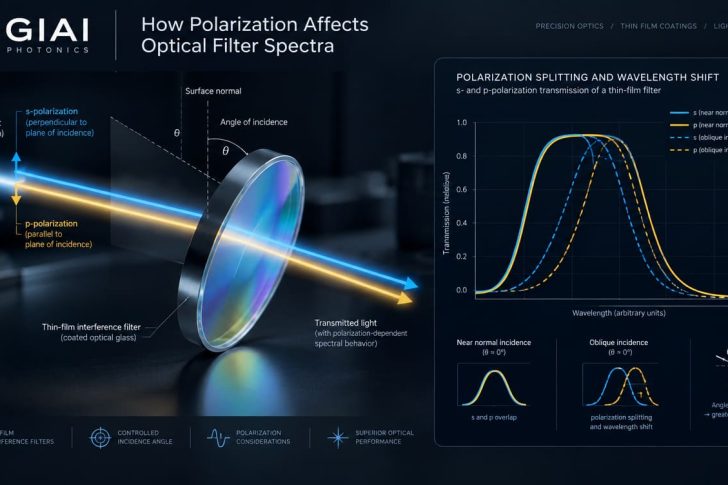
Polarization can change the measured transmission or reflection spectrum of an optical interference filter, especially when the filter operates at a non-normal angle of incidence. At oblique incidence, s-polarized and p-polarized light no longer interact with the multilayer coating in exactly the same way. Their…
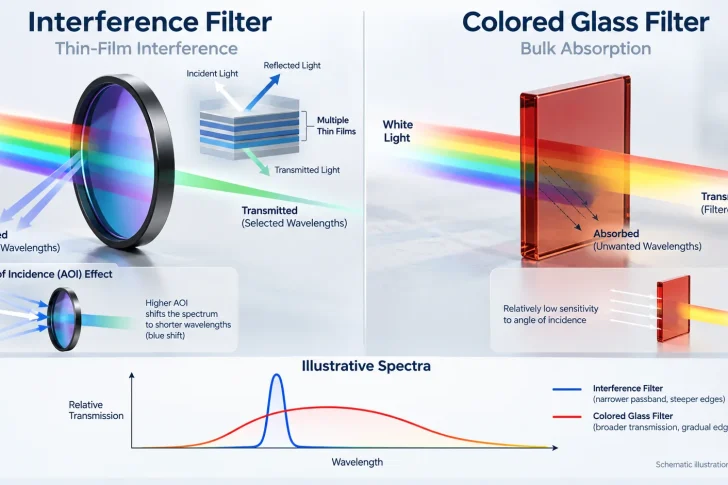
When an optical system needs to transmit one wavelength range and suppress another, both interference filters and colored glass filters may appear to solve the same problem. They do not, however, control light in the same way. A colored glass filter primarily relies on wavelength-dependent…
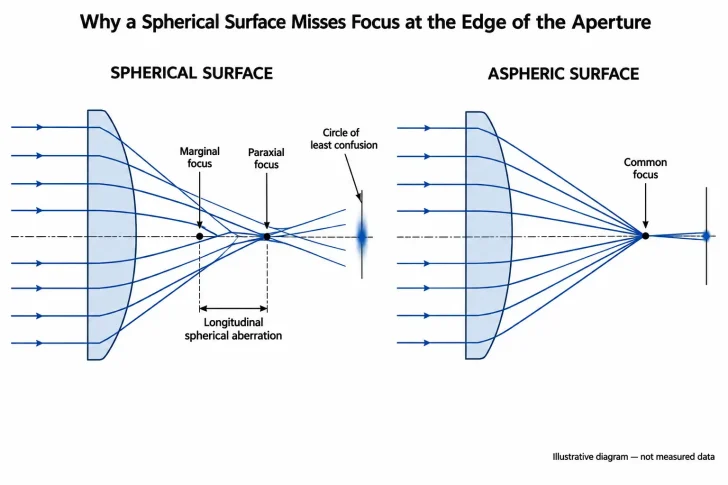
An aspheric lens reduces spherical aberration by changing its surface slope across the clear aperture, so that each annular zone refracts light by exactly the amount needed to reach one common focus. A spherical surface has the same radius everywhere, which makes the outer zones…
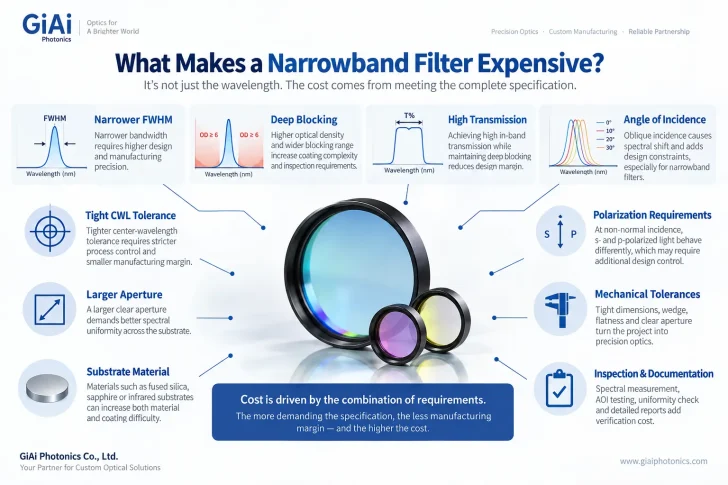
Two narrowband filters may both be described as “850 nm bandpass filters” or “1064 nm narrowband filters,” yet their manufacturing cost can differ substantially. The reason is that center wavelength alone does not define the difficulty of a narrowband filter. A filter becomes more demanding…
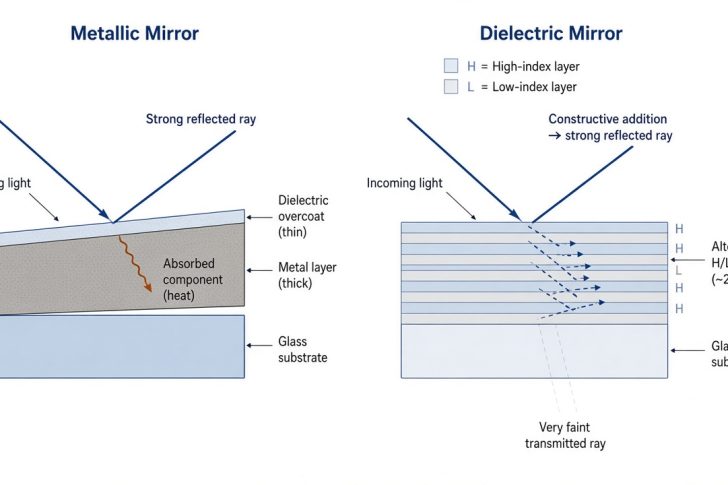
The choice between a metallic mirror and a dielectric mirror comes down to one trade: bandwidth versus reflectance. A metallic mirror reflects moderately well (roughly 90% to 98%) across an extremely wide spectral range and barely cares about angle of incidence. A dielectric mirror reflects…
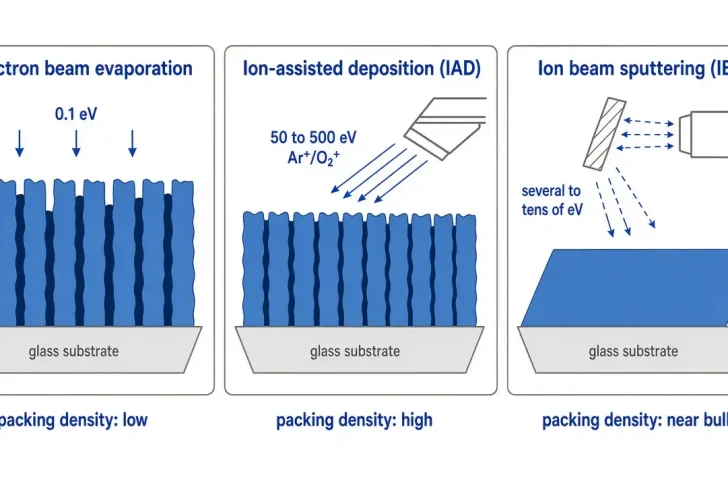
The difference between IBS vs IAD optical coating comes down to how much kinetic energy the film-forming atoms carry when they land, and what that energy buys you. Ion beam sputtering (IBS) delivers sputtered atoms with several to tens of electronvolts, producing amorphous, essentially fully…
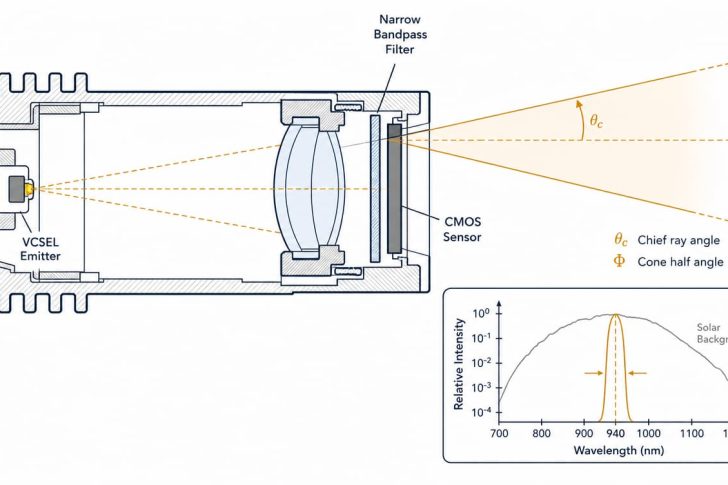
An ambient light rejection filter for a time-of-flight sensor is a narrow bandpass interference filter placed in the receive path that transmits the illuminator wavelength, normally 850 nm or 940 nm, and blocks everything else across the detector’s spectral response. It matters because time-of-flight (ToF)…
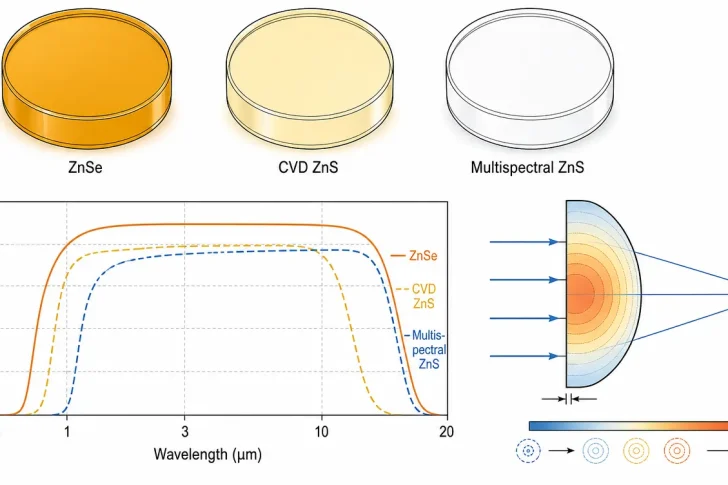
Choose zinc selenide (ZnSe) when the optic sits in a CO2 laser beam or has to transmit past about 14 µm. Choose zinc sulfide (ZnS) when the optic faces weather, sand, or rain, or when visible light and thermal infrared have to share one aperture.…
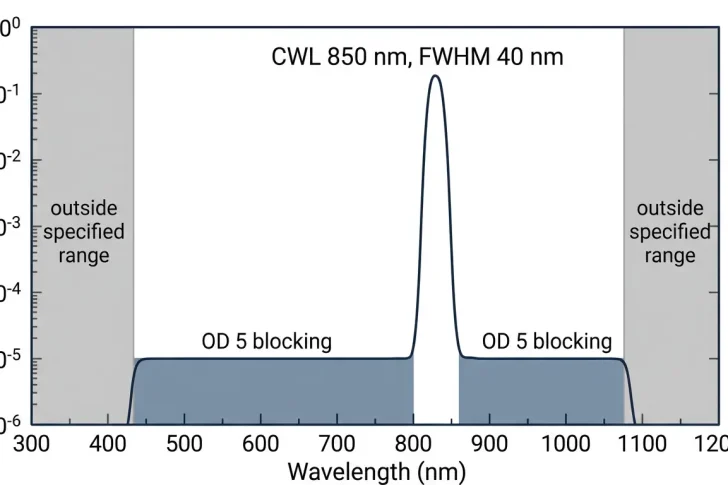
To specify the OD blocking range for a bandpass filter you need two independent numbers, not one: the depth of rejection, given as optical density (OD), and the wavelength interval over which that rejection is guaranteed. The interval is set by your system rather than…
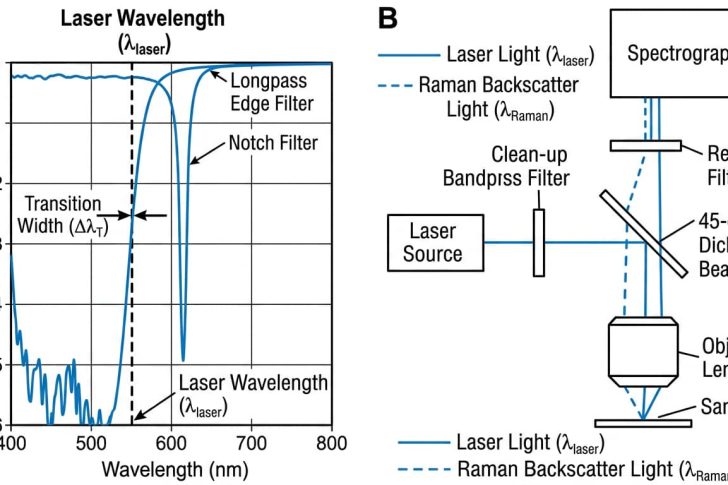
Choose a Raman edge filter when you only need Stokes signal and you want to measure as close to the laser line as physically possible. Choose a notch filter when you need Stokes and anti-Stokes in the same acquisition, or when your excitation wavelength moves…
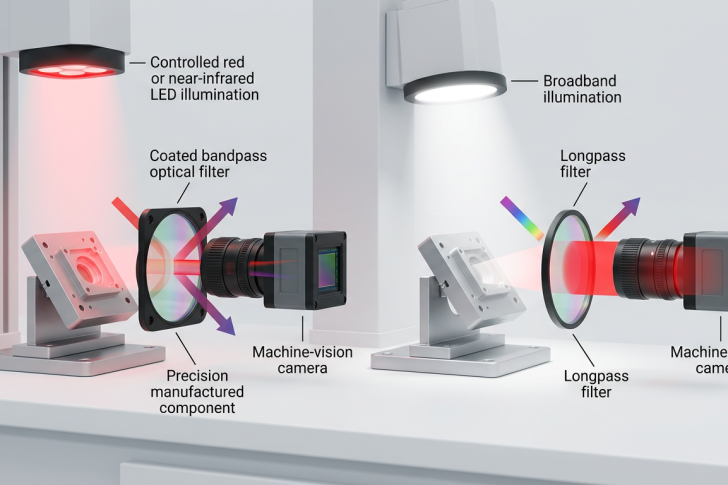
Choosing a bandpass vs longpass filter for machine vision is fundamentally a question of which wavelengths the camera should receive—and which wavelengths must be rejected. A bandpass filter transmits a defined spectral interval while attenuating wavelengths on both sides. A longpass filter blocks shorter wavelengths…
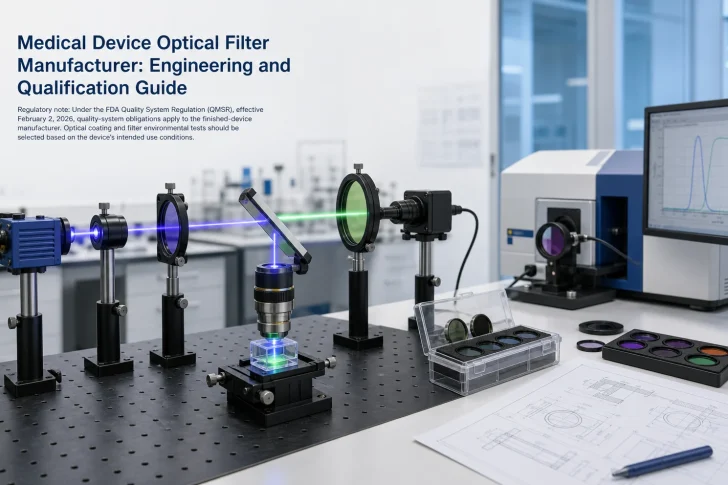
Choosing a medical device optical filter manufacturer is not simply a matter of finding a filter with the correct nominal wavelength. The finished component must work with the device’s light source, detector, optical geometry, operating environment and mechanical assembly. Its performance must also be defined…