Optical industry news, various optical talks from the latest industry fields, optical leading technologies, and the latest developments in optical research are all gathered here. Here you can learn about the latest industry updates, news, etc.
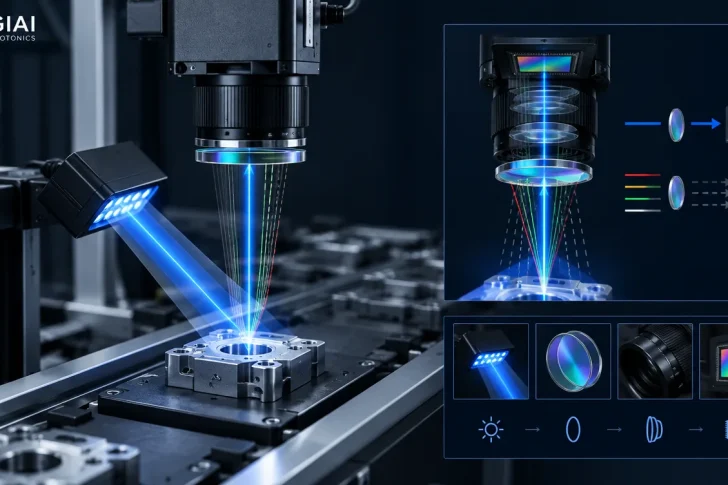
A machine vision filter manufacturer should do more than manufacture a filter around a nominal wavelength. The filter must be evaluated together with the illumination spectrum, camera sensor response, lens geometry, angle of incidence, required blocking range, mechanical integration, and inspection conditions. GIAI Photonics supports…
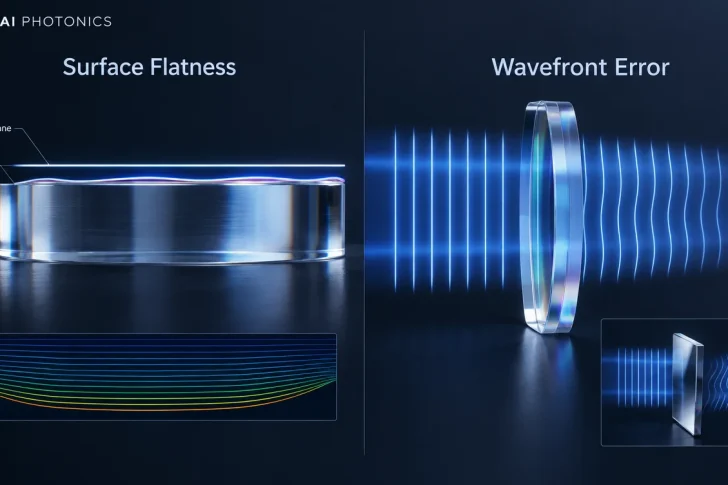
Surface flatness and wavefront error are related, but they are not interchangeable specifications. Surface flatness describes how much a nominally flat optical surface departs from an ideal plane. Wavefront error describes how much an optical component or system changes the shape of an optical wavefront…
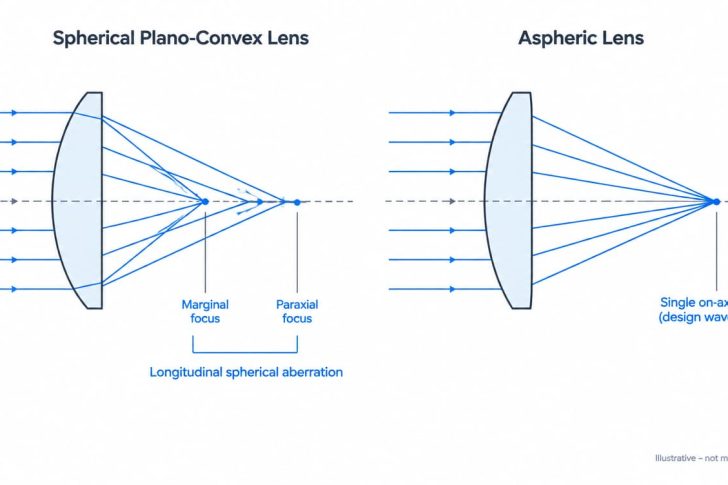
A collimated N-BK7 plano-convex lens with f = 50 mm reaches the 0.07 λ RMS diffraction limit at f/6.4 (computed, 587.6 nm). Face the curved side of a plano-convex lens toward the collimated beam; reversing it quadruples computed longitudinal spherical aberration. An asphere corrects on-axis…
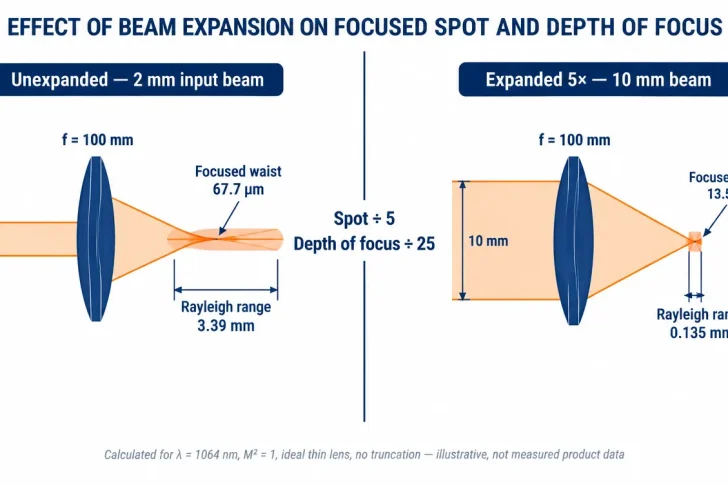
A beam expander is an afocal telescope that scales a collimated beam diameter by M. Far-field divergence scales by 1/M; the diameter-angle product stays fixed at one wavelength. Galilean layouts avoid an internal focus; Keplerian layouts allow pinhole spatial filtering. Focused spot diameter shrinks by…
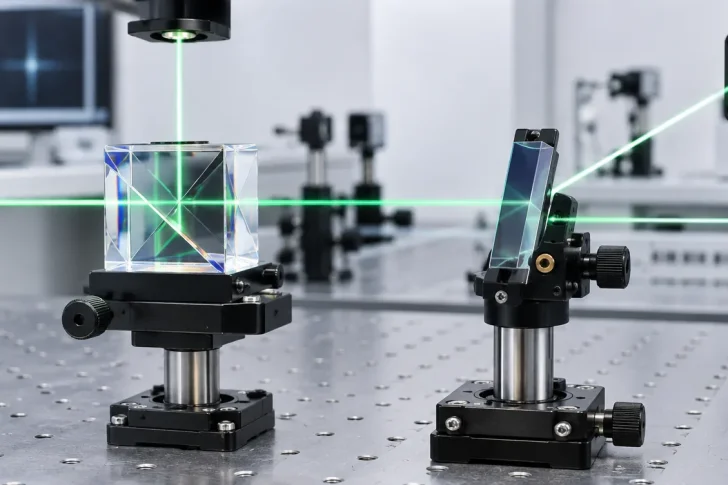
Cube Beamsplitter vs Plate Beamsplitter: Which Design Is Better for Your Optical System? Neither a cube beamsplitter nor a plate beamsplitter is universally better. A cube usually simplifies mechanical alignment and, in its normal-entry geometry, avoids the lateral displacement associated with transmitting through an angled…
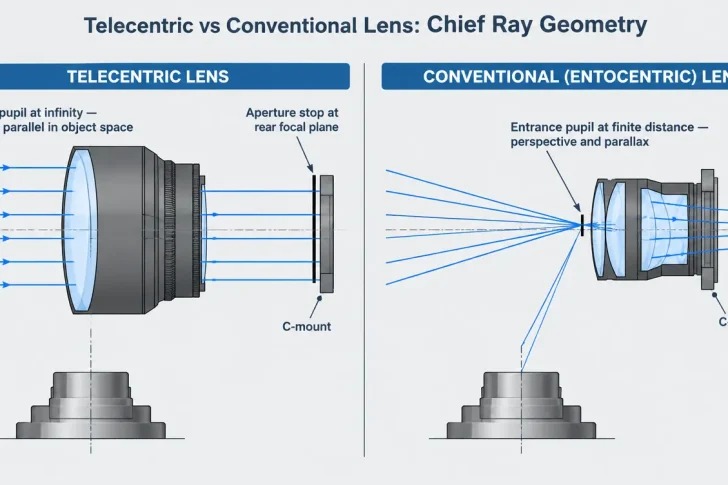
A telecentric lens keeps image magnification essentially constant while the object moves along the optical axis, within a defined telecentric range. A conventional imaging lens does not: as the object moves closer or farther, its image grows or shrinks. That single difference decides most selection…
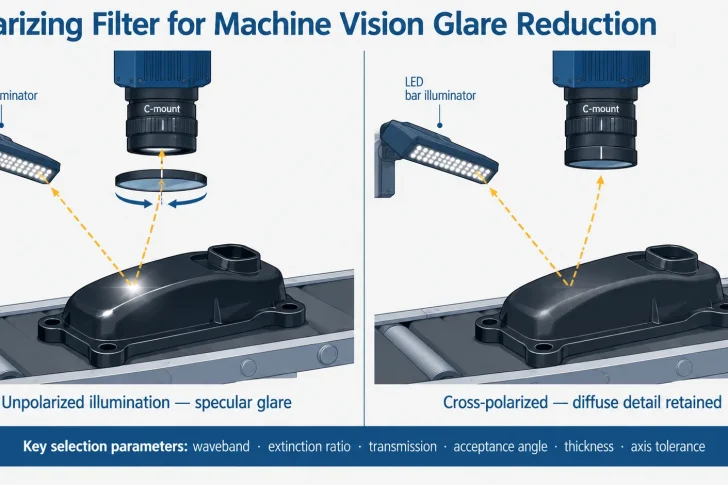
Selecting a polarizing filter for machine vision glare reduction starts with one question that has nothing to do with the filter itself: is the glare a specular reflection from a dielectric surface, or from bare metal? Dielectric glare — plastic, glass, paint, wet surfaces, film…
For a symmetric all-dielectric filter on a non-absorbing substrate, used near normal incidence at low optical power, flipping the part does not change the transmitted spectrum. Transmittance through a non-absorbing multilayer is the same in both propagation directions at the same angle of incidence. Optical…
A dichroic mirror is a wavelength-selective optical component designed to reflect one spectral region while transmitting another. Unlike a conventional mirror that is intended to reflect a broad wavelength range, a dichroic mirror uses a carefully designed multilayer dielectric coating to control how different wavelengths…
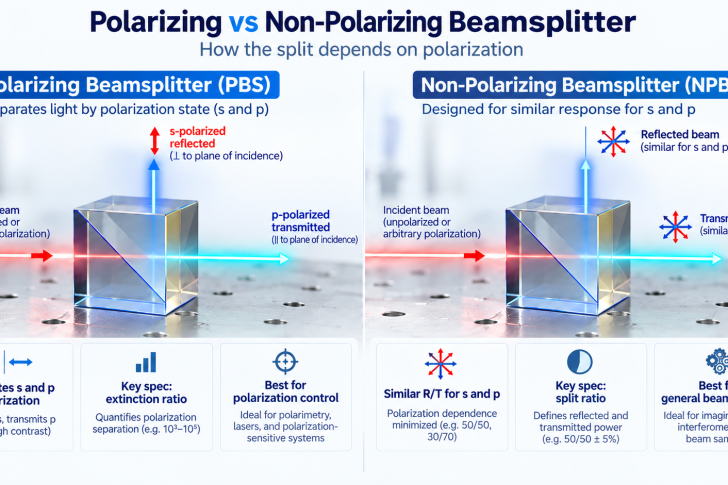
A beamsplitter is often described simply as an optical component that divides one incident beam into transmitted and reflected paths. In an actual optical system, however, an important question comes first: Should the splitting behavior depend on polarization? That question separates two major categories: polarizing…
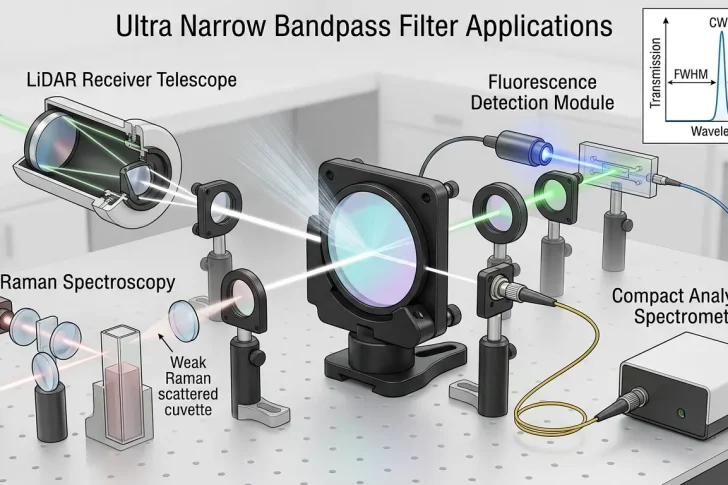
An ultra narrow bandpass filter is used when an optical system needs to transmit a tightly defined wavelength region while strongly attenuating light outside that region. Typical ultra narrow bandpass filter applications include laser-line cleanup, LiDAR and active optical sensing, selected fluorescence channels, analytical spectroscopy,…
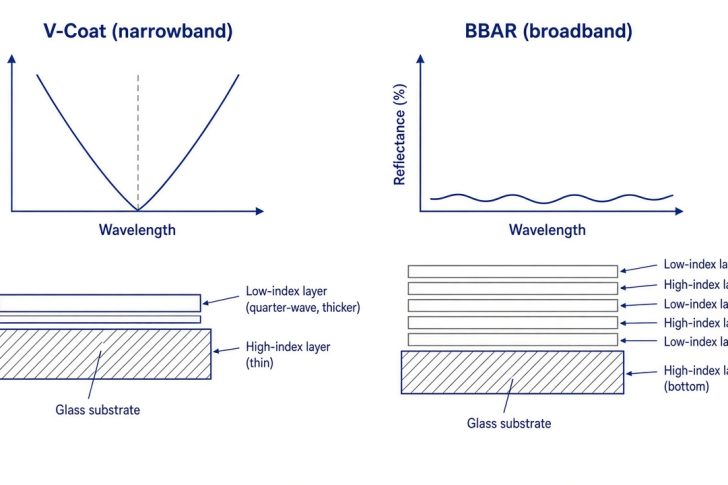
Use a V-coat when the optic sees one laser line and you need the last fraction of a percent of transmission. Use a broadband anti-reflection (BBAR) coating when the optic has to work across a spectral band, or when a second wavelength such as an…