GIAI’s latest optical information display area contains a variety of news and information on popular science explanations, working principles, usage tips, etc. of various optical filters, prisms, lenses and components. There is always one that interests you.
A ghost image in a beamsplitter is a second, weaker image formed by light that reached the detector along an unintended optical path inside the component. In the large majority of cases the path is a reflection from the second surface of a plate beamsplitter,…
Read more
Choosing a ZnSe lens manufacturer comes down to three things you can actually verify: the grade and traceability of the chemical vapor deposition (CVD) zinc selenide blank, the measured bulk absorption at your operating wavelength, and whether the polishing and coating processes hold surface figure…
Read more
An aspheric lens corrects spherical aberration in a single element. An achromatic lens corrects chromatic aberration by combining two glasses with opposing dispersion. The aspheric lens vs achromatic lens decision therefore reduces to one question: is your dominant error source geometry or wavelength? A monochromatic…
Read more
A flat-top bandpass filter holds near-peak transmission across the whole passband and then drops steeply at both edges. A Gaussian bandpass filter reaches maximum transmission only at the center wavelength and falls away gradually on either side. The choice between a flat-top vs Gaussian bandpass…
Read more
Choosing between 905 nm vs 1550 nm LiDAR optical filters is not simply a matter of moving the center wavelength of the same bandpass filter. The two wavelengths are associated with different laser sources, detector materials, eye-safety constraints, ambient-light conditions and receiver architectures. Those differences…
Read more
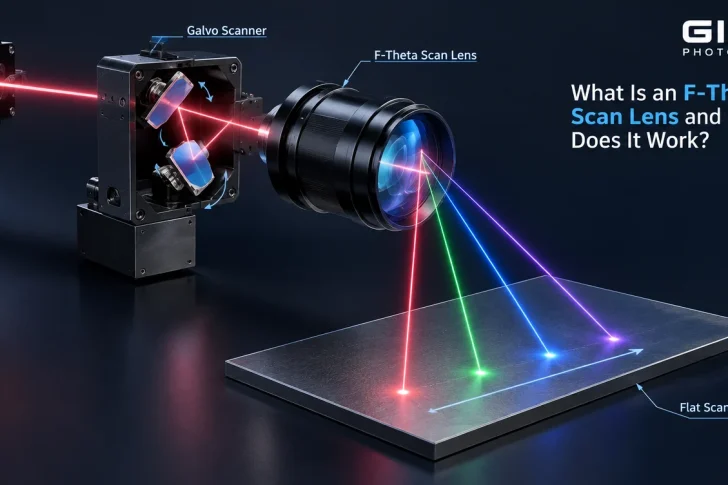
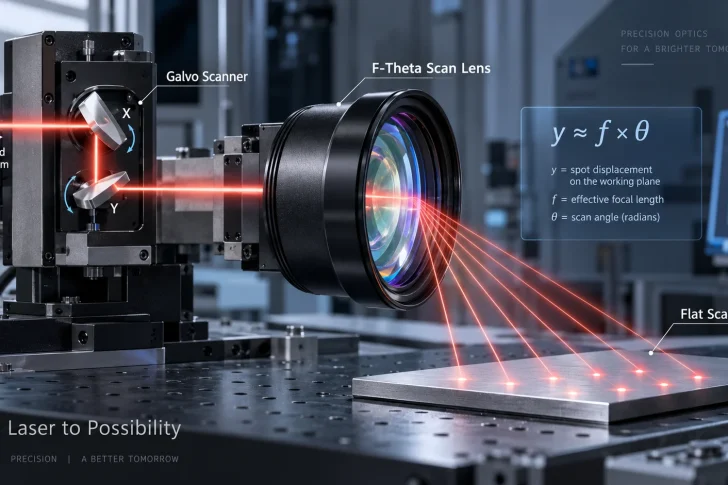
Engineers usually reach the question of how to calculate F-theta scan field size at one of two moments: when a marking field has to cover a part of known dimensions, or when a calculated field does not agree with the number printed on a lens…
Read more
A 1064nm vs 532nm F-theta scan lens comparison starts with a simple rule: the scan lens must be designed for the laser wavelength used by the system. A 532 nm lens is not simply a higher-resolution version of a 1064 nm lens, and a 1064…
Read more
Choose a germanium infrared window when you need a rugged, visible-blocking aperture for an 8 to 14 µm thermal imager that stays below roughly 100 °C. Choose a zinc selenide (ZnSe) window when the aperture has to pass a high-power CO2 laser beam at 10.6…
Read more
Treat the three components as one optical system. To choose excitation, emission, and dichroic filters for fluorescence, start from the fluorophore’s absorption and emission spectra, place the dichroic edge in the crossover region between them, then set the exciter and emitter passbands so their combined…
Read more
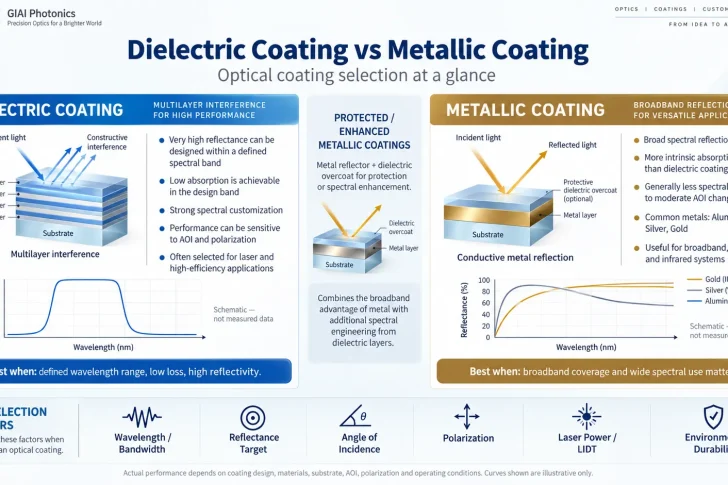
When engineers compare hard coated vs soft coated optical filters, the most important difference is not simply whether one coating feels physically harder than another. The terms describe two broad approaches to thin-film filter construction that differ in coating materials, deposition conditions, film density, environmental…
Read more
A CO2 laser ZnSe lens is an infrared optical component designed for focusing and transmitting CO2 laser energy, typically around the 10.6 μm wavelength. Zinc selenide (ZnSe) has become one of the most widely used materials for CO2 laser optics because of its suitable infrared…
Read more
Knowing how to choose a wavefront error specification means defining more than a number such as λ/4 or λ/10. A complete specification should identify what wavefront is being controlled, whether the limit is PV or RMS, the reference wavelength, the evaluated aperture, which low-order terms…
Read more