
Technical Resources
Achromatic Lens vs Singlet Lens
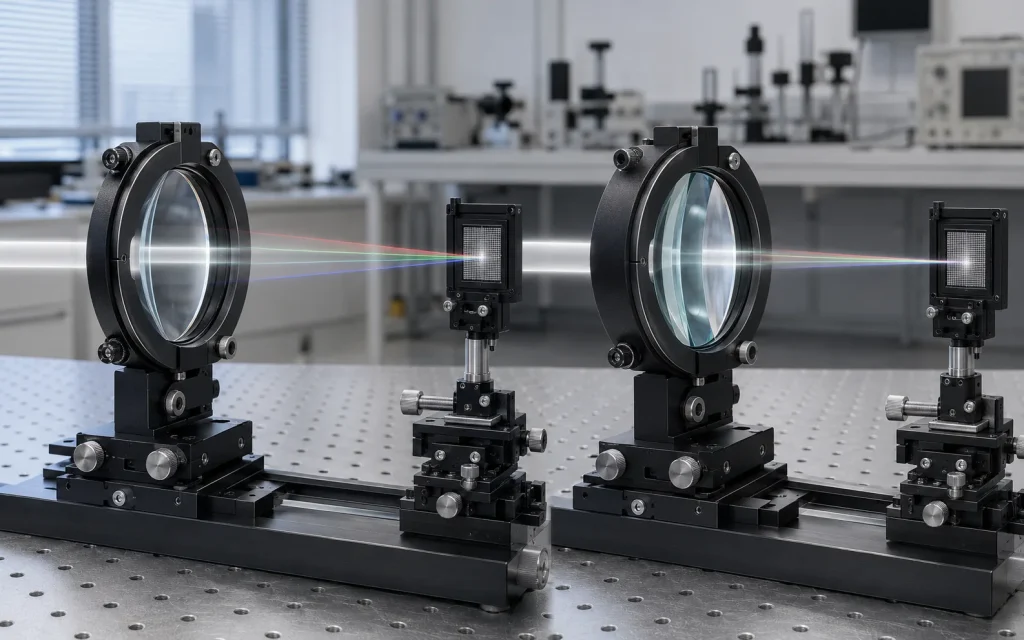
The practical difference in an achromatic lens vs singlet lens comparison is wavelength control. A singlet uses one optical element and is usually adequate for monochromatic light, modest numerical aperture, or applications with relaxed imaging requirements. An achromatic lens normally combines two elements with different dispersions to reduce chromatic focal shift, making it more suitable for broadband imaging, multi-wavelength illumination, and applications that require a stable focus across a defined spectral range.
Neither choice is universally superior. Performance depends on wavelength, aperture, conjugate ratio, lens form, material, coating, field angle, mounting, and the acceptance criteria used for the finished optical system.
Achromatic Lens vs Singlet Lens: Direct Comparison
| Characteristic | Singlet Lens | Achromatic Lens |
|---|---|---|
| Construction | One optical element | Usually two elements, cemented or air-spaced |
| Materials | One optical material | Two materials selected for different refractive index and dispersion |
| Chromatic aberration | Generally significant under broadband illumination | Primary chromatic aberration is substantially reduced over its design band |
| Residual color | Different wavelengths normally focus at different axial positions | Two design wavelengths are commonly brought to a shared focus, but residual secondary spectrum remains |
| Spherical aberration | Depends strongly on form, orientation, aperture, and conjugates | Can usually be optimized more effectively because the designer has additional surfaces and materials |
| Broadband spot size | Usually increases because wavelengths do not share one focal plane | Usually smaller within the specified design band |
| Optical interfaces | Two air-to-material surfaces | A cemented doublet has two external surfaces plus an internal bonded interface; an air-spaced doublet has four air-to-material surfaces |
| Size and mass | Normally lower for a comparable diameter | Normally greater because of the second element and possible housing |
| Manufacturing and alignment | Simpler | Requires control of element centration, wedge, spacing or cement layer, and rotational alignment where relevant |
| Typical use | Single-wavelength focusing, basic collimation, illumination, and cost-sensitive assemblies | Broadband imaging, machine vision, microscopy, multi-color sensing, and precision relay optics |
What Is a Singlet Lens?
A singlet is a lens made from one continuous piece of optical material. Common forms include plano-convex, bi-convex, plano-concave, bi-concave, meniscus, spherical, and aspheric lenses.
The lens focuses or diverges light because its refractive surfaces change the direction of the rays. For a thin lens in air, its approximate optical power depends on the refractive index and surface curvatures:
Here, Φ is optical power, n is the material’s refractive index, and R1 and R2 are the surface radii. Because refractive index changes with wavelength, optical power and focal length also change with wavelength.
A spherical singlet can be optimized for a particular conjugate ratio. For example, a properly oriented plano-convex lens is commonly used to focus a collimated beam, while a bi-convex form may be more appropriate when object and image distances are similar. An aspheric singlet can reduce spherical aberration more effectively, but an ordinary refractive asphere does not automatically correct chromatic aberration.
What Is an Achromatic Lens?
An achromatic lens, or achromat, is a compound lens designed to reduce wavelength-dependent focusing errors. The conventional positive achromatic doublet combines a positive element made from a relatively low-dispersion glass with a negative element made from a higher-dispersion glass.
The positive element supplies more optical power than the negative element, so the assembly retains a positive net focal length. At the same time, the different dispersions allow the chromatic powers of the two elements to oppose each other.
In first-order thin-lens form, an achromatic doublet approximately satisfies:
Φ1/V1 + Φ2/V2 ≈ 0
V1 and V2 are the Abbe numbers of the two materials. A higher Abbe number indicates lower dispersion over the reference spectral interval. These equations explain the first-order principle, but they do not replace a complete optical design that includes element thickness, spacing, surface curvature, aperture, wavelength weighting, field angle, and real glass dispersion data.
Cemented and air-spaced achromats
In a cemented doublet, the two elements are bonded at their matching internal surfaces. This produces a compact assembly and avoids an air gap that would otherwise require two additional air-to-glass transitions. The adhesive, however, must be compatible with the operating wavelength, temperature range, optical power, humidity, and service environment.
An air-spaced doublet avoids an optical adhesive and provides another spacing variable for aberration correction. It may be preferable in some ultraviolet, high-power, thermal, or environmentally demanding systems. Its disadvantages can include more reflective surfaces, tighter mechanical tolerances, and greater sensitivity to element alignment.
Why a Singlet Produces Chromatic Aberration
Optical materials are dispersive: their refractive index is a function of wavelength. In most common optical glasses across the visible region, shorter wavelengths are refracted more strongly than longer wavelengths. A positive singlet therefore tends to focus blue light closer to the lens than red light.
This wavelength-dependent axial focus is called longitudinal chromatic aberration. It may appear as color fringes, reduced contrast, a larger polychromatic spot, or a focus position that changes when the illumination wavelength changes.
Lateral chromatic aberration is different. It is a wavelength-dependent change in image height or magnification, most evident away from the optical axis. A doublet optimized for axial color does not necessarily eliminate lateral color throughout a complete imaging system.
An achromat commonly brings two selected wavelengths to the same focal position and substantially reduces focus error at intermediate wavelengths. It does not bring every wavelength to exactly the same focus. The remaining variation is known as secondary spectrum, and its importance depends on the bandwidth, detector response, focal ratio, and required image quality.
Optical Performance Differences
Broadband focus and image quality
Under white light or multi-wavelength illumination, a singlet may form overlapping wavelength-dependent images rather than one sharply defined image. Refocusing for one color does not correct the others. An achromat reduces this separation and can improve edge definition, contrast, and polychromatic spot size within its design range.
The improvement should be evaluated using relevant system metrics, such as chromatic focal shift, polychromatic spot diagrams, encircled energy, modulation transfer function, or wavefront error. A statement that a lens is “achromatic” does not by itself define its usable resolution.
Spherical aberration and aperture
Spherical aberration occurs even at one wavelength when marginal and paraxial rays do not share the same focus. A doublet provides more curvatures and design variables, so chromatic and monochromatic aberrations can often be balanced more effectively than with a spherical singlet.
This does not mean every doublet outperforms every singlet. A well-designed aspheric singlet can provide excellent monochromatic performance, while an achromat used at the wrong conjugate ratio or orientation can perform below its design capability.
Transmission, reflection, and absorption
An achromat does not automatically have lower transmission simply because it contains two elements. A cemented doublet may have only two external air-to-glass surfaces, although it also contains an internal material and adhesive interface. An air-spaced doublet has more exposed refracting surfaces.
Total transmission depends on Fresnel reflection, anti-reflection coatings, bulk absorption, glass thickness, adhesive absorption, scatter, wavelength, angle of incidence, and polarization where relevant. The substrate transmission range must not be treated as the guaranteed transmission range of the finished coated assembly.
Effective and back focal length
Effective focal length is measured from the system’s principal plane, not necessarily from a physical lens surface. Because an achromat is a thicker compound assembly, its back focal length can differ noticeably from its effective focal length. Mechanical designers should specify the required working distance and reference surface instead of assuming that focal length alone defines the detector or sample position.
When Should You Use Each Lens?
| Application condition | Likely starting choice | Engineering reason |
|---|---|---|
| Single-wavelength laser focusing | Singlet or aspheric singlet | Chromatic correction may provide little benefit; spherical aberration, wavefront quality, coating, absorption, and damage threshold may be more important |
| White-light machine vision | Achromatic lens | Reduced chromatic focal shift supports sharper polychromatic imaging and more consistent focus across color channels |
| Multi-color LED or laser system | Achromatic lens | Useful when the operating wavelengths fall within the actual correction and coating band |
| Simple indicator, collector, or illumination path | Singlet | A compact, economical element may meet the required collection efficiency without precision imaging |
| Broadband relay or collimation system | Achromatic lens | Reduced wavelength-dependent focus can improve relay accuracy and beam collimation |
| High-temperature, deep-UV, or high-power environment | Application-dependent | Material absorption, coating, adhesive, thermal behavior, and damage limits may favor a singlet or an air-spaced design |
How to Select Between an Achromatic and Singlet Lens
- Define the real wavelength range. State the source spectrum, important wavelength lines, and detector sensitivity. A nominal visible achromat may not maintain correction or transmission outside its specified band.
- Identify whether the task is imaging, focusing, collimation, or collection. These functions require different performance metrics and conjugate conditions.
- Set the aperture requirement. Record clear aperture, beam diameter, f-number, and numerical aperture. Aberrations usually become more demanding as aperture increases.
- Define object and image distances. A lens optimized for an infinite conjugate may not provide the same performance in a finite-conjugate imaging system.
- Specify an image-quality metric. Depending on the application, use MTF, spot size, encircled energy, wavefront error, chromatic focal shift, or allowable blur at the detector.
- Check focal references. Distinguish effective focal length, back focal length, flange distance, and working distance.
- Review materials and coatings together. Confirm transmission, reflection, absorption, coating band, angle of incidence, polarization, environmental exposure, and optical power.
- Account for assembly tolerances. Diameter and focal length alone are insufficient. Centration, wedge, surface irregularity, element spacing, clear aperture, and mount-induced stress may affect the result.
Common Misunderstandings
- “Achromatic” means no chromatic aberration. It means primary chromatic aberration has been corrected between selected wavelengths. Residual secondary spectrum remains.
- An achromat is always better for a laser. For a truly single-wavelength source, color correction may not justify the additional materials or assembly constraints.
- One coating works at every wavelength and angle. Coating performance is defined over a specified spectral and angular range and can change with polarization and angle of incidence.
- A singlet cannot produce a sharp image. At low numerical aperture, over a narrow spectral band, or with an aspheric surface, a singlet can provide very good performance.
- The stated focal length fixes the mechanical focus position. The effective focal length and back focal length are different quantities, particularly for a thick doublet.
Conclusion
The decision between an achromatic lens and a singlet should begin with the source spectrum and the allowable wavelength-dependent focus error. Achromats are generally the stronger choice for broadband imaging and multi-wavelength optical systems because they substantially reduce primary chromatic aberration and can also provide additional control of spherical aberration and coma.
Singlets remain appropriate for many monochromatic, low-aperture, compact, lightweight, or environmentally demanding systems. The final selection should be based on spectral range, conjugates, aperture, image-quality target, focal references, material, coating, assembly tolerances, and operating environment—not the lens name alone.
Frequently Asked Questions
Is an achromatic lens always better than a singlet?
No. An achromatic lens is usually better when broadband chromatic focal shift limits imaging or focusing performance. For a single-wavelength source, modest numerical aperture, or non-imaging collection task, a properly selected singlet may meet the requirement with less mass and assembly complexity. Lens form, orientation, coating, wavefront quality, operating environment, and optical power must still be evaluated. The correct comparison is therefore between two designs under the same wavelength, aperture, conjugate, and image-quality conditions.
Can a singlet lens be used with broadband light?
Yes, if the system can tolerate its chromatic focal shift. A singlet may be sufficient when the spectral band is narrow, the aperture is small, the detector pixels are relatively large, or precise image formation is not required. Stopping down the aperture can reduce some monochromatic aberrations, but it does not remove the material’s wavelength-dependent dispersion. For broadband imaging with tight resolution or focus requirements, an achromat is normally a more suitable starting point.
How many wavelengths does an achromatic lens correct?
A conventional achromat is normally designed so that two selected wavelengths share approximately the same focal position. Wavelengths between them usually have much less focal error than they would through a comparable singlet, but they do not all focus at exactly the same plane. This residual error is called secondary spectrum. The actual correction wavelengths and usable band depend on the selected materials, curvatures, spacing, wavelength weighting, and design objective.
Are achromatic lenses suitable for laser systems?
They can be, especially when a system uses multiple laser wavelengths or combines a laser with broadband alignment or imaging light. For a single laser wavelength, an aspheric or spherical singlet may be simpler and equally suitable. Check the coating at the actual wavelength and angle, as well as absorption, wavefront error, pulse duration, beam diameter, power density, adhesive compatibility, and laser damage test conditions. High reflectivity or high transmission alone does not establish laser damage resistance.
What is the difference between a cemented and air-spaced achromat?
A cemented achromat bonds its two elements and is usually compact, mechanically stable, and limited to two external air-to-glass surfaces. Its adhesive must remain suitable for the wavelength, temperature, humidity, and optical power. An air-spaced achromat removes the bonded interface and adds spacing as a design variable, but it introduces more air-to-glass surfaces and tighter alignment requirements. Neither construction is universally better; the operating environment and optical specification determine the choice.