
Technical Resources
Clinical Chemistry Analyzer Filter
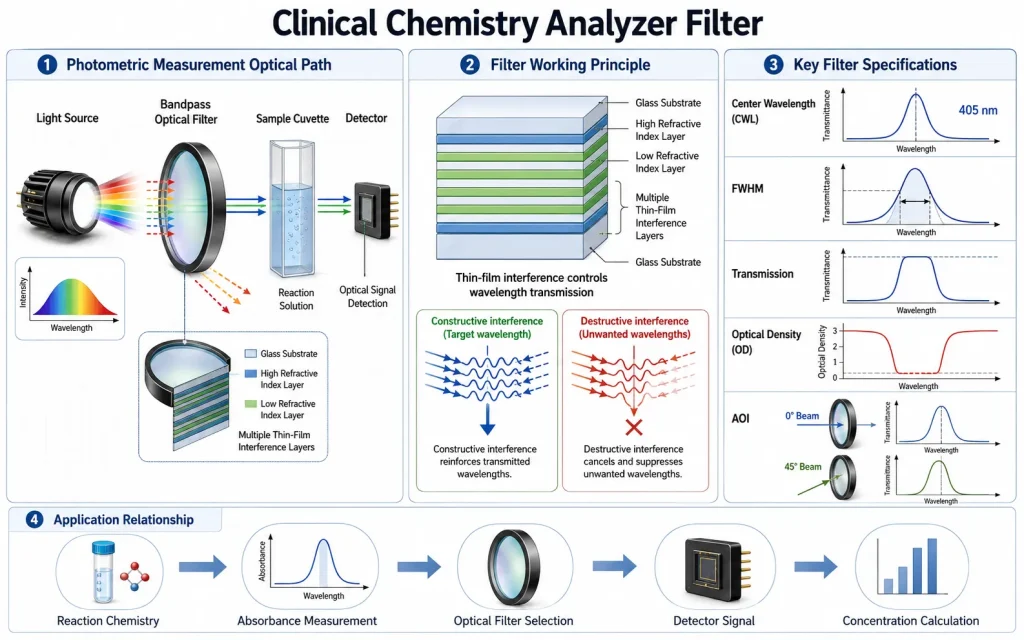
A clinical chemistry analyzer filter is a wavelength-selective optical component used to control which portion of light reaches the detector during photometric measurements. In these instruments, the filter helps isolate the measurement wavelength required for analyzing the optical absorption of a sample or reagent reaction. The filter itself does not perform the chemical analysis; instead, it defines the spectral characteristics of the light used by the complete optical system.
Clinical chemistry analyzers commonly rely on absorbance measurement methods, where a light source passes through a reaction solution and the detector measures the remaining transmitted light. The selected wavelength, optical bandwidth, transmission efficiency, and blocking performance of the filter all influence the quality of the optical signal received by the detector.
For engineers designing analytical instruments, selecting the correct filter requires more than choosing a nominal wavelength. The optical filter must match the light source spectrum, detector response, reaction method, optical path design, and mechanical integration requirements.
What Is a Clinical Chemistry Analyzer Filter?
A clinical chemistry analyzer filter is usually an interference optical filter designed to transmit a specific wavelength range while reducing unwanted wavelengths outside the target band.
In a typical photometric analyzer, the optical path can be simplified as:
Light source → Optical filter → Sample/reaction chamber → Detector
The filter performs wavelength selection before the light interacts with the sample. By allowing the required spectral region to pass while blocking unnecessary radiation, it helps create a more controlled measurement condition.
Many analyzer systems use bandpass or narrow bandpass filters because they provide selective transmission around specific wavelengths. These filters are commonly defined by parameters such as:
- Center wavelength (CWL)
- Full width at half maximum (FWHM)
- Peak transmission
- Optical density (OD) blocking
- Substrate material
- Angle of incidence (AOI)
How Optical Filters Work in Clinical Chemistry Analyzers
Most precision analyzer filters use multilayer thin-film interference coatings. These coatings consist of alternating layers with different refractive indices.
When light enters the coating structure, interference effects determine which wavelengths are transmitted and which wavelengths are reflected or attenuated.
For a bandpass filter:
- The target wavelength range is transmitted.
- Shorter and longer unwanted wavelengths are suppressed.
- The transmission curve is controlled by coating design, substrate properties, and measurement conditions.
The filter performance depends on the relationship between the coating structure and the incoming light.
For example, the same filter may show different spectral behavior if the angle of incidence changes significantly. Therefore, engineers should define the expected optical geometry rather than assuming laboratory normal-incidence data will always represent the final system condition.
The Role of Bandpass Filters in Absorbance Measurement
Clinical chemistry analyzers often measure concentration through optical absorption.
According to the Beer-Lambert relationship: A=ε×c×l
where:
- A = absorbance
- ε = molar absorptivity
- c = concentration
- l = optical path length
The analyzer measures how much light is absorbed by the sample at a selected wavelength.
A suitable optical filter helps ensure that the detector receives light within the intended spectral region. If the filter bandwidth is too broad, unwanted wavelengths may contribute to the measured signal. If the transmission is too low, the available detector signal may decrease.
However, narrower bandwidth is not automatically better. The optimum bandwidth depends on:
- Light source spectrum
- Detector sensitivity
- Reaction characteristics
- Required signal level
- System optical design
Common Wavelength Channels Used in Analyzer Filters
Clinical chemistry analyzers may use multiple wavelength channels depending on the assay method and instrument design.
Typical optical filter channels include UV, visible, and near-infrared regions. GIAI Photonics lists biochemical analyzer filter applications covering channels such as 340 nm, 380 nm, 405 nm, 505 nm, 546 nm, 600 nm, 630 nm, 660 nm, 700 nm, 750 nm, and 800 nm.
| Wavelength Region | Typical Optical Purpose | Engineering Consideration |
|---|---|---|
| Around 340 nm | UV absorbance measurement | Requires suitable substrate transmission and coating performance |
| 380–405 nm | Near-UV / violet channels | Verify detector response and blocking requirements |
| 500–550 nm | Visible colorimetric measurement | Match reagent absorption characteristics |
| 600–700 nm | Longer visible wavelengths | Consider background suppression and detector sensitivity |
| 700–800 nm | Near-infrared channels | Confirm system wavelength compatibility |
The selected wavelength is determined by the analytical method rather than by the filter alone.
Key Specifications for Clinical Chemistry Analyzer Filters
Center Wavelength (CWL)
The center wavelength defines the middle point of the filter transmission band.
For example, a filter designed around 405 nm is intended to transmit light near that wavelength.
CWL tolerance is important because even a small wavelength shift may affect measurement conditions when the target absorption region is narrow.
FWHM (Full Width at Half Maximum)
FWHM describes the width of the transmission band measured at 50% of peak transmission.
A smaller FWHM generally provides tighter wavelength selection, but it may also reduce the amount of transmitted optical energy.
Engineers should balance spectral selectivity and available signal level.
Peak Transmission
Peak transmission indicates the maximum transmission efficiency within the passband.
Higher transmission can provide more optical signal to the detector, but transmission alone should not be evaluated without considering blocking performance and bandwidth.
Optical Density Blocking
Optical density describes how effectively the filter suppresses unwanted wavelengths.
The relationship between optical density and transmission is: OD=−log10(T)
where T represents transmission.
For example, stronger blocking means less unwanted light reaches the detector.
However, required OD performance depends on the application, light source, and system design.
Angle of Incidence
Interference filters are sensitive to incident angle.
When light enters at an angle, the effective optical path through the coating layers changes, which can shift the transmission spectrum.
Therefore, specifications should consider:
- Normal incidence
- Converging beam conditions
- Filter wheel geometry
- Optical aperture angle
Common Mistakes When Selecting Analyzer Filters
Selecting Only by Nominal Wavelength
A wavelength number alone does not define complete filter performance.
A 405 nm filter, for example, may have different characteristics depending on:
- Bandwidth
- Transmission
- Blocking range
- Coating design
- Substrate
Ignoring the Light Source Spectrum
The filter must work together with the actual illumination source.
LEDs, lamps, and other sources may have different spectral distributions.
Assuming Filter Data Applies to Every Installation
Optical measurements depend on test conditions.
Important factors include:
- AOI
- Temperature
- Mechanical mounting
- Detector response
- System alignment
Confusing Transmission With Measurement Accuracy
The optical filter is only one part of the analyzer system.
Final system performance also depends on:
- Light source stability
- Detector characteristics
- Electronics
- Calibration
- Mechanical design
- Environmental conditions
Custom Filter Considerations for Analyzer Integration
Standard filters may not always match a specific analyzer design.
Customization may be considered when requirements involve:
- Non-standard wavelength channels
- Special bandwidth requirements
- Defined AOI conditions
- Specific mechanical dimensions
- Special substrate requirements
- Integration with existing optical modules
Engineers evaluating a custom filter typically provide information such as wavelength requirements, transmission targets, blocking requirements, dimensions, substrate preference, operating environment, and inspection requirements.
Conclusion
A clinical chemistry analyzer filter is a precision optical component that defines the spectral characteristics of the measurement light path. Its performance depends not only on wavelength selection but also on bandwidth, transmission, blocking, optical geometry, and integration conditions.
For analyzer designers, the correct filter specification should be developed as part of the complete optical system rather than selected as an isolated component. Understanding these optical parameters helps engineers achieve consistent and reliable measurement conditions.
FAQ
What type of filter is commonly used in clinical chemistry analyzers?
Many clinical chemistry analyzers use bandpass or narrow bandpass optical filters to isolate specific measurement wavelengths. The filter allows the required spectral region to reach the detector while reducing unwanted wavelengths.
Why is FWHM important for analyzer optical filters?
FWHM defines the width of the transmitted wavelength band. It affects spectral selectivity and must be balanced with available optical signal strength and measurement requirements.
Does a higher transmission filter always provide better analyzer performance?
Not necessarily. Higher transmission can increase signal level, but the complete filter performance also depends on blocking, bandwidth, wavelength accuracy, and system design.
Why does angle of incidence matter for interference filters?
Interference filters can experience spectral shifts when light enters at different angles. Analyzer designs should consider the actual optical geometry during filter specification.