
Technical Resources
CO2 Laser ZnSe Lens Manufacturer
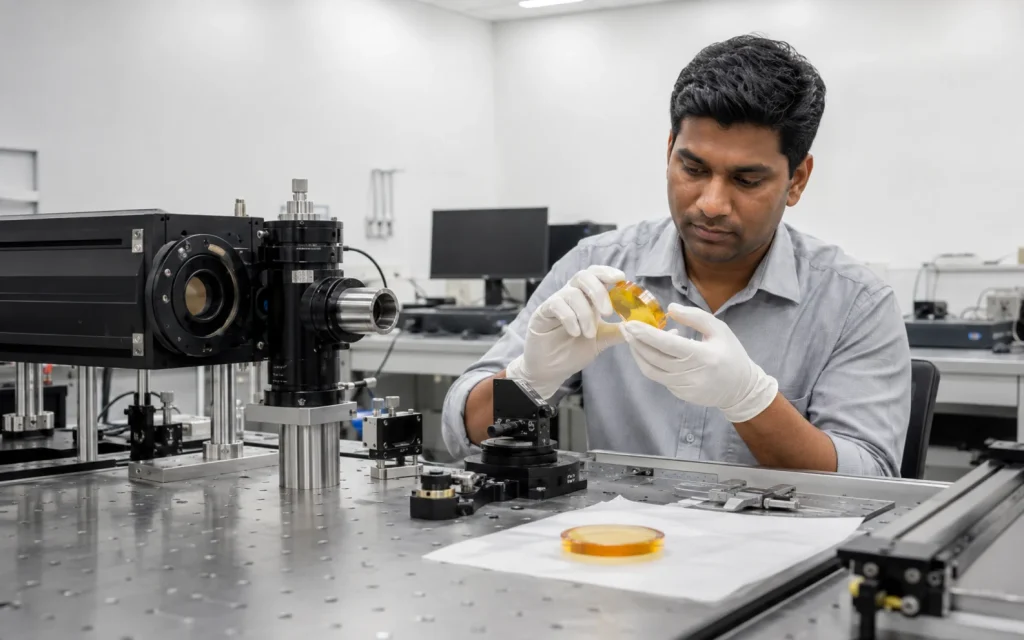
A CO2 laser ZnSe lens is an infrared optical component designed for focusing and transmitting CO2 laser energy, typically around the 10.6 μm wavelength. Zinc selenide (ZnSe) has become one of the most widely used materials for CO2 laser optics because of its suitable infrared transmission characteristics and practical optical properties.
For engineers selecting laser focusing optics, the lens material is only one part of the system. Optical coating, focal length, surface quality, wavefront performance, contamination control and operating conditions all influence the final laser processing result.
ZnSe provides suitable infrared transmission for CO2 laser applications, but the performance of a finished lens depends on the complete optical design and manufacturing quality, not only the substrate material.
What Is a CO2 Laser ZnSe Lens?
A CO2 laser ZnSe lens is a focusing optical element manufactured from zinc selenide material and optimized for infrared laser wavelengths. It is commonly installed in laser cutting, engraving, marking and processing systems to focus the laser beam onto the working surface.
CO2 lasers typically operate near 10.6 μm, which is outside the transmission range of conventional optical glass. Materials used for visible-light optics cannot simply be applied to CO2 laser systems because infrared absorption becomes a major limitation.
Why ZnSe Is Used for CO2 Laser Optics
Infrared Transmission Performance
The primary reason ZnSe is selected for CO2 laser applications is its ability to transmit infrared radiation in the long-wave infrared region. This allows laser energy to pass through the lens with relatively low absorption compared with unsuitable optical materials.
Lower absorption helps reduce thermal loading inside the optical element, which is especially important in industrial laser systems operating at higher power levels.
Suitable Optical Properties
ZnSe provides useful refractive properties for designing practical focusing lenses. Depending on the optical requirements, engineers may select different lens geometries such as plano-convex, meniscus or custom optical designs.
How a ZnSe Lens Works in a CO2 Laser System
A simplified CO2 laser optical path can be described as:
CO2 Laser Source → Beam Delivery Optics → ZnSe Focusing Lens → Material Surface
The curved surface of the ZnSe lens changes the direction of the incoming beam through refraction. The optical design determines where the rays converge and how much energy is concentrated at the focal point.
The final focused spot size depends on several system factors:
- Laser wavelength
- Beam quality (M² factor)
- Input beam diameter
- Lens focal length
- Optical alignment accuracy
- Mechanical stability of the laser system
Important Parameters When Selecting a CO2 Laser ZnSe Lens
| Parameter | Meaning | Why It Matters |
|---|---|---|
| Wavelength | Design operating wavelength | Determines whether the lens is suitable for the laser source |
| Focal Length | Distance from lens to focal point | Affects working distance and focused spot characteristics |
| Transmission | Percentage of optical energy passing through | Indicates optical efficiency under specified test conditions |
| Surface Quality | Scratch-dig specification | Affects scattering and optical cleanliness |
| Flatness | Deviation of optical surface from ideal plane | Influences wavefront performance |
| AR Coating | Anti-reflection coating applied to the surface | Reduces reflection loss at the operating wavelength |
The Role of Anti-Reflection Coating on ZnSe Lenses
Although ZnSe itself provides infrared transmission capability, the optical surface can still reflect part of the incoming laser energy. Anti-reflection coatings are applied to improve transmission and reduce unwanted reflection.
Coating performance depends on several factors, including wavelength range, angle of incidence, polarization condition, coating design and manufacturing process.
For example, optical performance measured at normal incidence cannot automatically represent performance at larger angles of incidence. Engineers should evaluate coating specifications according to the actual laser optical path.
Choosing the Correct CO2 Laser ZnSe Lens
Focal Length Selection
The focal length directly affects the relationship between working distance and focused spot size. Shorter focal lengths can provide smaller spots, while longer focal lengths offer greater working distances.
Surface Accuracy and Beam Quality
A laser lens must maintain sufficient surface accuracy to avoid unnecessary wavefront distortion. Surface quality, flatness and wavefront error describe different optical characteristics and should not be considered interchangeable.
Laser Power and Thermal Conditions
For high-power CO2 laser systems, engineers should consider absorption, coating durability, contamination and thermal management.
High transmission alone does not guarantee high laser damage resistance. Damage performance depends on multiple factors, including optical defects, coating quality, contamination and operating environment.
Applications of CO2 Laser ZnSe Lenses
CO2 laser ZnSe lenses are commonly used in:
- Laser cutting systems
- Laser engraving equipment
- Laser marking machines
- Industrial material processing systems
- Custom infrared laser optical assemblies
CO2 Laser ZnSe Lens Manufacturer Selection Considerations
When evaluating a CO2 laser ZnSe lens manufacturer, engineers should consider more than product availability. Important factors include optical material selection, coating capability, dimensional accuracy, inspection methods and the ability to support application-specific requirements.
A reliable optical partner should understand how the lens integrates into the complete laser system, including wavelength requirements, beam characteristics and mechanical installation conditions.
Conclusion
A CO2 laser ZnSe lens is a precision infrared optical component designed around the specific requirements of 10.6 μm laser systems. ZnSe material provides the foundation for infrared transmission, while coating technology, optical accuracy and system integration determine the final performance.
For laser engineers and equipment developers, selecting the correct ZnSe lens requires evaluating wavelength, focal length, transmission, surface quality and operating conditions together rather than relying on a single specification.