
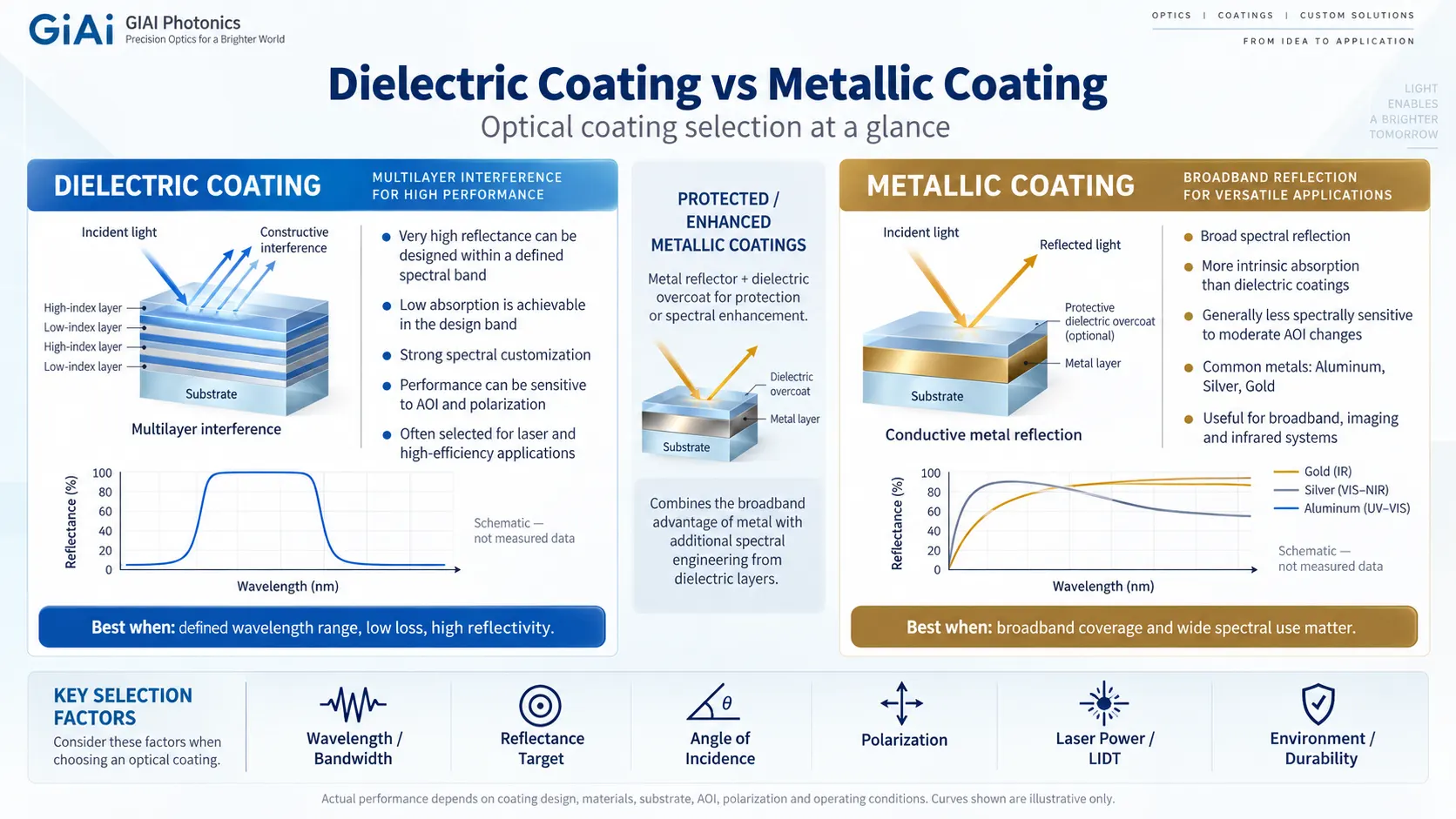
When specifying a mirror, beamsplitter, filter, or other coated optical component, choosing between a dielectric coating and a metallic coating is not simply a question of which one has higher reflectivity.
The two coating families produce optical behavior through different physical mechanisms. Metallic coatings are generally attractive when a system needs reflection over a broad wavelength range, while multilayer dielectric coatings can provide very high reflectance, low absorption, or carefully controlled spectral behavior within a designed wavelength and angle range.
The correct choice depends on the complete optical requirement: wavelength, bandwidth, angle of incidence, polarization, optical power, environmental exposure, substrate, and acceptable loss.
Dielectric Coating vs Metallic Coating at a Glance
| Engineering Factor | Dielectric Coating | Metallic Coating |
|---|---|---|
| Reflection mechanism | Multilayer thin-film interference | Optical response of a conductive metal layer |
| Typical materials | Alternating high- and low-index dielectric materials | Aluminum, silver, gold and related metallic systems |
| Spectral bandwidth | Designed for a defined spectral region; broadband designs are possible | Usually broad spectral response |
| Maximum reflectance | Can be extremely high in the design band | Limited by intrinsic absorption in the metal |
| Absorption | Can be very low in a properly designed band | Inherent absorption is present |
| AOI sensitivity | Often significant | Usually less spectrally sensitive to moderate AOI changes |
| Polarization sensitivity | Can become important at oblique incidence | Generally less pronounced, but not negligible |
| Laser applications | Often preferred where low loss and high damage resistance are required | Absorption may cause thermal loading |
| Infrared use | Depends strongly on coating materials and design | Gold and other metallic coatings are widely used for broadband IR reflection |
| Spectral customization | Highly flexible | More limited without additional dielectric layers |
These are general tendencies rather than universal specifications. Actual performance must be evaluated at the specified wavelength, AOI and polarization. Dielectric mirrors, for example, can exceed 99% reflectance within a designed band, while metallic mirrors trade some peak reflectance for much wider spectral coverage.
How a Dielectric Coating Works
A dielectric reflective coating is normally constructed from multiple layers of transparent materials with different refractive indices.
The optical thicknesses of these layers are engineered so that reflected waves from multiple interfaces interfere constructively over the required wavelength range. By changing the materials, layer thicknesses and layer sequence, the coating designer can control reflection, transmission and spectral edge behavior.
This principle is used for far more than mirrors. Multilayer dielectric structures can be designed as:
high-reflection coatings, anti-reflection coatings, bandpass and edge filters, dichroic coatings, beamsplitters and wavelength-selective optical elements.
For a high-reflector design, one of the major advantages is that the required reflection can be obtained with very little absorption inside the operating band. This is one reason dielectric mirrors are frequently used in laser cavities and other optical systems where optical loss and thermal loading matter.
The trade-off is that the response is fundamentally spectral. A coating optimized for one wavelength range and angle cannot automatically be assumed to behave the same way at another wavelength or AOI.
How a Metallic Coating Works
Metallic coatings rely on the interaction between incident electromagnetic radiation and the free electrons in a conductive metal.
Common optical mirror metals include aluminum, silver and gold. Their spectral behavior differs substantially, which means that “metallic coating” is not a complete specification by itself.
A major advantage is broadband reflection. Compared with many conventional dielectric mirror designs, metallic mirrors can maintain useful reflectance across a much wider wavelength interval. Their reflectance is also generally less sensitive to changes in incidence angle than a wavelength-selective dielectric stack.
The principal limitation is absorption. Some incident optical power is absorbed by the metal rather than reflected. That produces both optical loss and heat.
This becomes increasingly important in high-power laser systems, where even a relatively small absorption fraction can create temperature rise, coating damage, surface deformation or beam distortion.
Reflectivity: Higher Is Not Always Better
If a system operates at one laser wavelength, maximizing reflectance around that wavelength may be the dominant requirement.
A dielectric high-reflector can be engineered for very high reflectance in such a defined band. Commercial dielectric mirror designs above 99% reflectance are common examples of what multilayer interference can achieve, although that number should never be assumed for an unspecified coating.
A broadband imaging system has a different problem.
Suppose the same mirror must redirect visible light and near-infrared radiation. A narrow dielectric design with excellent performance at one wavelength may be inappropriate because its reflectance outside that design region can change substantially.
In that case, the flatter and wider spectral response of an appropriate metallic coating may be more useful than achieving the highest possible peak reflectance.
The system requirement should therefore define reflectance versus wavelength, not simply “high reflectivity.”
Bandwidth Is One of the Biggest Differences
Metallic mirrors are particularly useful where a wide spectral interval must be reflected by the same component.
This can matter in spectroscopy, broadband illumination, imaging, infrared instrumentation and some ultrafast optical systems.
Dielectric coatings are inherently more design-specific. Conventional quarter-wave reflector structures operate over a finite high-reflection band, although modern multilayer designs can substantially broaden that range. It is therefore inaccurate to say that dielectric coatings are always narrowband; rather, wider bandwidth generally requires a more sophisticated coating design.
The engineering question is not:
“Which coating has a wider bandwidth?”
It is:
“How much bandwidth does the system actually require, and what reflectance must be maintained throughout that band?”
AOI and Polarization Can Change the Answer
Angle of incidence is particularly important for dielectric coatings.
When the AOI changes, the optical path through the coating layers changes as well. The spectral response can shift, and the behavior of s- and p-polarized light can separate increasingly at oblique incidence.
A coating that performs correctly at near-normal incidence therefore cannot automatically be used at 45°.
This is particularly relevant to:
dichroic mirrors, beam steering optics, fluorescence systems, laser systems and beamsplitters.
Metallic coatings normally show a more gradual spectral response with changing incidence angle, although their reflectance and phase behavior can still depend on AOI and polarization.
For either coating family, the specification should state the actual operating angle rather than relying only on a normal-incidence curve.
GIAI’s project quality reference uses the same principle for wavelength-selective coatings: spectral verification should correspond to the final application conditions, and AOI is part of the coating specification rather than an optional detail.
What Happens in High-Power Laser Systems?
Absorption becomes especially important when optical power increases.
Because metallic coatings intrinsically absorb part of the incident energy, the absorbed power produces localized heating. At sufficiently high average or peak powers, this can affect coating lifetime, surface figure or beam quality.
Properly designed dielectric high-reflection coatings can achieve much lower absorption within their design band and are therefore frequently preferred for demanding laser applications. RP Photonics similarly notes that metal-coated mirrors generally have lower optical damage thresholds than dielectric mirrors because of absorption-related heating.
However, laser damage threshold should never be assumed from the coating family alone.
LIDT depends on factors including wavelength, pulse duration, repetition rate, beam diameter, coating technology, substrate, contamination and testing method.
For a real laser project, those conditions should be part of the coating specification.
Aluminum, Silver and Gold Are Not Interchangeable
Selecting a metallic coating still requires a material decision.
Aluminum is commonly considered when broad reflection extending toward the UV and visible region is required.
Silver can provide strong broadband reflection through much of the visible and near-infrared spectrum, but environmental protection is important because silver can tarnish.
Gold is particularly useful in infrared systems but is generally not selected when high visible reflectance is the principal requirement.
This is why an optical drawing should preferably specify the required spectral behavior rather than simply stating “metal mirror.”
A coating designer can then evaluate whether aluminum, silver, gold or another coating architecture is appropriate.
Protected and Enhanced Metallic Coatings Create a Third Option
The comparison is not always purely “metal versus dielectric.”
Metallic mirrors frequently include dielectric overcoats.
A protected metallic coating may use a dielectric layer primarily to reduce environmental or mechanical degradation of the metal.
An enhanced metallic coating goes further. Additional dielectric layers can modify the spectral response and increase reflectance in a selected wavelength region.
The resulting structure combines characteristics of both technologies: the broadband foundation of a metal reflector with additional spectral engineering from dielectric thin films.
This hybrid approach is useful when a system needs more bandwidth than a conventional dielectric HR coating but higher performance in a selected region than a simple metallic layer provides.
Durability Depends on More Than the Coating Name
Environmental requirements should be defined before selecting the coating.
Bare metallic films may be vulnerable to oxidation, tarnishing, abrasion or contamination. Protective overcoats can improve robustness, but the exact behavior depends on the metal, overcoat system and service environment.
Dielectric coatings are often mechanically durable, but they are not automatically immune to thermal cycling, moisture, cleaning damage or coating stress.
The substrate also matters.
A coating deposited on fused silica, optical glass, silicon or another material creates a complete optical-mechanical system. Film stress and differences in thermal expansion can influence surface figure, particularly on thin or large optics.
For precision systems, it can therefore be important to specify surface figure after coating, rather than only before deposition.
Which Coating Should You Choose?
Use the system requirement as the starting point.
A dielectric coating is often the better direction when the optical system has a clearly defined wavelength range, requires extremely high reflectance, needs low absorption, or operates at laser power levels where thermal loss matters.
A metallic coating is often preferred when broad spectral coverage is more important, the system spans several wavelength regions, infrared performance is required, or the coating must remain useful across a wider range of angles and wavelengths.
A protected or enhanced metal coating can be considered when the application sits between these two cases.
None of these decisions should be made from coating type alone.
What Should Be Included in a Coating RFQ?
For a useful engineering review, provide:
- operating wavelength or full spectral range;
- required reflection and/or transmission;
- angle of incidence and angular range;
- polarization state where relevant;
- substrate material and dimensions;
- clear aperture and coated area;
- laser wavelength, pulse parameters and power when applicable;
- environmental or cleaning requirements;
- required surface figure after coating where relevant;
- inspection method, acceptance criteria and expected quantity.
These are consistent with the project-level coating review inputs used for GIAI custom optics, where wavelength range, substrate, AOI, polarization, spectral targets, geometry and inspection requirements are evaluated together rather than independently.
Dielectric Coating vs Metallic Coating: The Practical Rule
There is no universal winner.
If the system requires maximum efficiency over a defined spectral region, a dielectric coating is often the more appropriate architecture.
If it requires broadband reflection across a large wavelength range, a metallic coating may provide a simpler and more practical solution.
Once AOI, polarization, laser power, environment and bandwidth are included, however, the choice can change quickly.
For that reason, a coating should be specified as an optical performance requirement—not merely as a material name.
Custom Optical Coating Evaluation at GIAI
GIAI supports optical coating for filters, lenses, mirrors, windows, prisms and other project-specific coated optical components. The manufacturing route is reviewed according to the drawing or sample, substrate, geometry, coating conditions and inspection criteria.
For a custom project, provide the wavelength range, transmission or reflection target, substrate, dimensions, AOI, polarization where relevant, coated area and acceptance criteria. GIAI can then evaluate the appropriate coating and manufacturing route at the project level rather than assuming that one coating architecture fits every application. GIAI’s controlled project guidance explicitly requires this project-specific review rather than claiming that any arbitrary specification can be manufactured.
FAQ
Is dielectric coating always more reflective than metallic coating?
Not under every condition. Dielectric coatings can achieve extremely high reflectance within their design range, while metallic coatings usually provide broader wavelength coverage. The relevant comparison must be made at the specified wavelength, AOI and polarization.
Is metallic coating better for broadband optics?
Often, yes. Metallic mirrors generally provide broader reflection bandwidth than conventional dielectric mirrors, although broadband dielectric coating designs are also possible.
Which coating is better for lasers?
For a defined laser wavelength and demanding optical power, dielectric mirrors are frequently preferred because low absorption and high reflectance can be designed into the operating band. The actual decision still requires laser power, pulse conditions and LIDT requirements.
Does dielectric coating change with angle of incidence?
Yes. The spectral characteristics of interference coatings can shift with AOI, and s/p polarization differences may become important at oblique angles.
Can a metallic mirror also contain dielectric layers?
Yes. Protected and enhanced metallic mirrors commonly combine a metal reflector with one or more dielectric layers for protection or spectral enhancement.