
Choosing an F-theta scan lens manufacturer is not simply a matter of matching a lens to a laser wavelength.
An F-theta lens works as part of a complete scanning system. Its practical performance depends on the laser wavelength, input beam diameter, effective focal length, galvanometer geometry, scan angle, required field size, working distance, distortion, telecentricity, coating conditions and mechanical integration.
For OEM laser equipment and precision material-processing systems, these parameters should be reviewed together before the scan lens is selected or customized.
GIAI Photonics supplies precision optical components and lists F-theta scan lenses within its optical-component portfolio. Custom projects can be evaluated from drawings, specifications, samples and application requirements. GIAI’s controlled project reference also identifies precision optical components and custom optics as the company’s current English-market positioning.
What Does an F-Theta Scan Lens Actually Do?
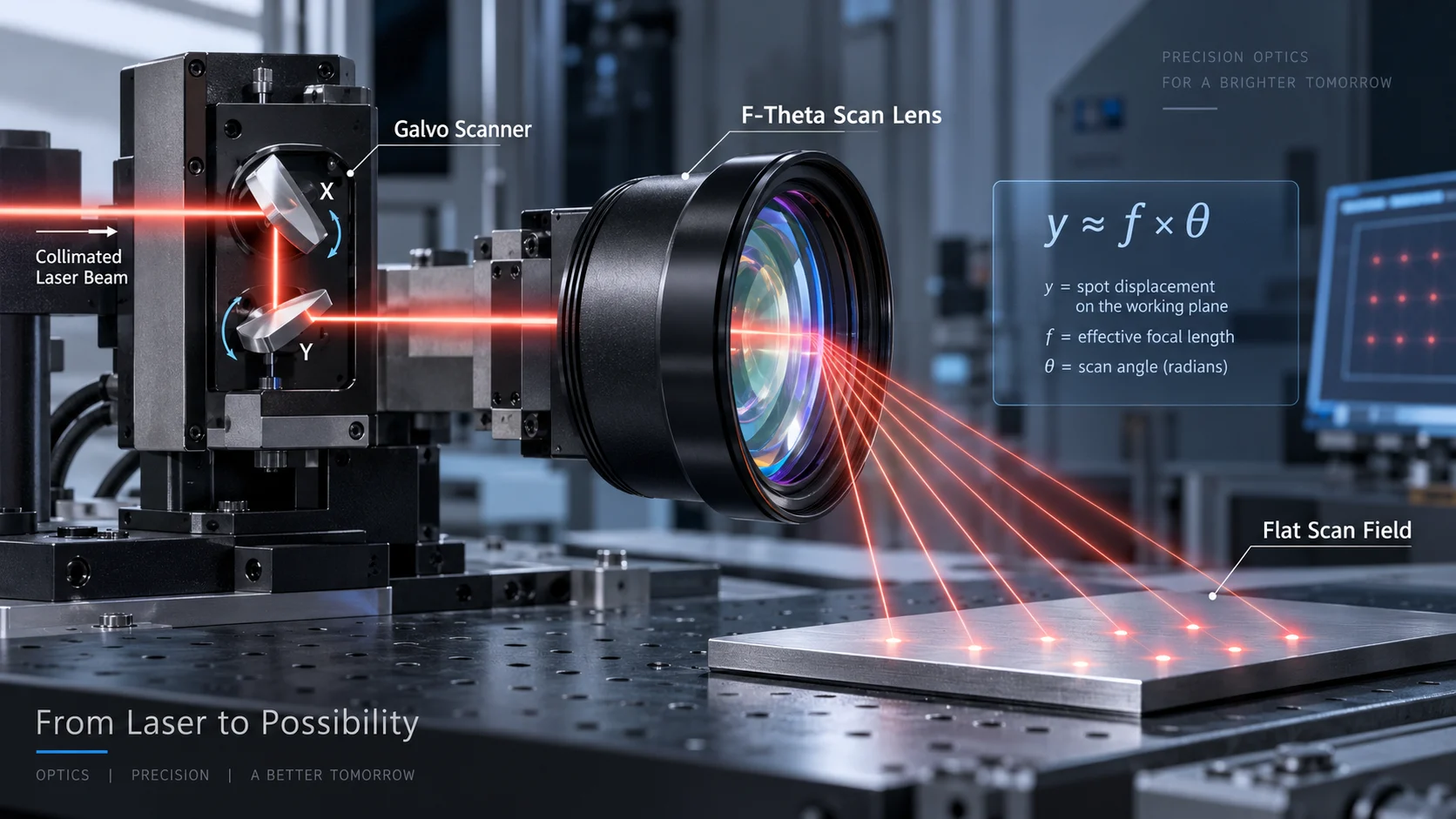
An F-theta scan lens is normally used after a galvanometer scanner or another angular beam-steering mechanism. Instead of focusing only along the optical axis, the lens must focus a moving beam over a substantially flat working field.
A conventional flat-field lens can produce a relationship closer to:
y = f × tan(θ)
whereas an F-theta lens is designed so that the image position follows an approximately linear relationship:
y ≈ f × θ
where:
y = spot displacement on the working plane
f = effective focal length
θ = optical scan angle in radians
This approximately linear mapping simplifies the relationship between scanner angle and beam position. In practice, however, a real F-theta lens still has residual distortion, aberrations and field-dependent performance that must be considered in the system design. F-theta scan lenses are normally multi-element optical systems rather than single lenses.
Flat field and F-theta distortion should also not be treated as the same specification. A lens may keep the focus close to a flat work plane while still having coordinate error relative to the ideal F-theta mapping.
Why the Scan Lens Must Be Matched to the Galvanometer System
One of the most common specification mistakes is to evaluate an F-theta lens independently from the scanner.
In an XY galvanometer system, the two scanning mirrors are physically separated. As the mirrors rotate, the beam does not enter the scan lens from one perfectly fixed pivot point. The beam moves across the lens aperture, particularly at larger scan angles.
As a result, mirror spacing, scanner-to-lens distance, beam diameter and scan angle can influence usable field size, vignetting, spot performance and telecentricity.
Changing the scanner or increasing the distance between the scanner and the lens can therefore change the practical performance of a scan lens even when its nominal focal length remains unchanged. Sill Optics, for example, notes that scanner geometry and aperture-stop position affect field size, vignetting and telecentricity in practical F-theta systems.
For this reason, an F-theta scan lens manufacturer should ask about the scan head—not only the laser.
Key Specifications for an F-Theta Scan Lens
A useful RFQ should define the optical system rather than provide only a wavelength and desired field size.
| Specification | Why It Matters |
|---|---|
| Laser wavelength / spectral range | Determines optical design, material selection and AR coating requirements |
| Laser operating mode | CW, nanosecond, picosecond and femtosecond systems can place different requirements on the optics |
| Input beam diameter | Influences diffraction-related spot size and required lens aperture |
| Beam quality M² | Affects achievable focused spot size |
| Effective focal length (EFL) | Closely related to scan field, spot size and system geometry |
| Required scan field | Defines the usable X-Y processing area |
| Optical scan angle | Helps determine required field coverage and aperture |
| Galvo aperture and mirror spacing | Influences beam clearance, vignetting and system-level scan performance |
| Working distance | Critical for mechanical integration and process clearance |
| Target spot size | Should include the spot definition and the field position at which it applies |
| F-theta distortion | Defines deviation from the intended angle-to-position mapping |
| Telecentricity | Important where beam incidence angle must remain close to normal across the field |
| Coating requirements | Must correspond to wavelength and operating conditions |
| Mechanical interface | Housing dimensions, thread, flange and reference surfaces affect integration |
| Inspection criteria | Defines how optical and mechanical conformity will be verified |
Spot size should never be evaluated from focal length alone. For a Gaussian-like beam, the diffraction-related focused spot scales broadly with wavelength and focal length and inversely with usable input beam diameter. Increasing beam diameter may reduce the theoretical spot, but it also consumes more scanner and lens aperture and can increase the risk of clipping at large scan angles.
Standard vs Telecentric F-Theta Scan Lenses
Not every laser scanning system requires a telecentric lens.
A standard F-theta lens can provide flat-field focusing and controlled scan mapping, while the focused beam becomes progressively more oblique toward the edge of the field.
A telecentric F-theta design adds another requirement: the chief ray or focused beam axis should remain closer to perpendicular to the working plane over the specified field.
This can matter in applications where incidence angle affects the process, such as certain drilling, cutting, deep-structure processing or precision operations involving workpiece height variation.
Telecentricity does not, by itself, guarantee a smaller spot, lower F-theta distortion or better field flatness. These are separate performance characteristics. Telecentric designs also generally require larger optical apertures as field size increases.
The correct question is therefore not simply:
“Do I need a telecentric lens?”
It is:
“What maximum chief-ray angle or telecentricity error can my process tolerate across the required scan field?”
What Should an F-Theta Scan Lens Manufacturer Verify?
For a demanding laser scanning project, a manufacturer evaluation should go beyond checking focal length and wavelength.
The engineering review should consider whether the requested field can be achieved without unacceptable vignetting; whether the spot remains suitable at the center, edges and corners; how much residual F-theta distortion is acceptable; whether field curvature affects focus across the work plane; and whether telecentricity is required by the process.
The mechanical definition matters as well. Effective focal length, back focal length and mechanical working distance are different quantities and should not be treated as interchangeable dimensions.
For laser applications, coating requirements should also be defined against the actual operating wavelength and laser conditions rather than by simply requesting a generic “high-transmission AR coating.”
Manufacturing and Inspection Matter as Much as Optical Design
An F-theta scan lens is a multi-element optical assembly. Its final performance depends not only on the nominal optical prescription but also on optical fabrication, coating, element geometry, assembly and inspection.
GIAI’s currently verified manufacturing scope includes optical lenses and drawing-, specification- and sample-based custom optics. Its published manufacturing route can include material preparation, grinding, precision grinding, optical polishing, cleaning, edging, geometry processing, optical coating, inspection/metrology and assembly where applicable.
For custom components, GIAI defines inspection according to the individual component drawing, optical specification and project requirements rather than applying one universal inspection plan to every optic. This corresponds with the project-controlled quality reference, which states that requirement review, process inspection, optical verification and final inspection should be tied to the agreed part specification.
No generic F-theta lens tolerance should therefore be assumed to represent every GIAI scan-lens project. Optical, mechanical, coating and inspection requirements need to be confirmed against the actual project specification.
When Is a Custom F-Theta Lens Worth Considering?
A standard scan lens may be sufficient when the required wavelength, field, focal length, beam diameter, working distance and mounting interface already match an available configuration.
Customization becomes more relevant when several system constraints must be satisfied simultaneously.
Examples include a specific galvo mirror spacing combined with a restricted housing envelope, a large field with a particular input beam diameter, an angle-sensitive process requiring controlled telecentricity, a non-standard operating wavelength, or a mechanical interface that cannot be changed in an existing OEM platform.
The decision should be based on the complete optical system rather than on whether the lens has an unusual focal length.
What to Send with an RFQ
For an efficient technical review, provide the information that defines the real scanning system.
At minimum, this normally includes the laser wavelength and operating mode, beam diameter and M² where available, galvanometer aperture and mirror spacing, required scan field, effective focal length or working-distance constraint, optical scan angle, target spot requirement, distortion limit, telecentricity requirement where applicable, mechanical interface and expected quantity.
For pulsed laser systems, pulse duration, pulse energy, repetition rate and average power should also be provided when they affect coating or optical evaluation.
This approach is consistent with GIAI’s custom-optics workflow, which begins by reviewing optical function, material, geometry, coating conditions, inspection criteria and project requirements before defining the manufacturing route.
Why Work with GIAI Photonics for F-Theta Scan Lens Projects?
GIAI Photonics has been involved in precision optical components since 2008 and currently supports optical lenses, filters, prisms, windows, mirrors, beamsplitters, infrared optics and related custom optical components. F-theta scan lenses are also listed as a dedicated product category on the current English website.
For an F-theta scan lens project, GIAI can review the requirement against the available drawing or specification together with the optical function, geometry, coating requirements and inspection criteria before the manufacturing route is confirmed.
The useful starting point is therefore not simply:
“We need an F-theta lens.”
A much better starting point is:
“This is our laser, scanner geometry, beam diameter, required field, working distance and acceptance criteria.”
That information allows the scan lens to be evaluated as part of the system in which it will actually operate.
F-Theta Scan Lens Manufacturer FAQ
What is the main difference between an F-theta lens and a normal focusing lens?
An F-theta lens is optimized for a scanning beam. It is designed to maintain focus over a substantially flat work plane while producing an approximately linear relationship between optical scan angle and focused spot position. A conventional focusing lens is not normally optimized for this type of wide-field angular scanning.
Does a longer focal length always give a larger scan field?
A longer focal length generally increases the first-order displacement produced by a given scan angle, but actual usable field also depends on lens aperture, scanner geometry, input beam diameter, vignetting and acceptable edge performance. Focal length alone does not define the usable field.
Does a larger input beam always improve the F-theta lens?
No. A larger collimated beam can reduce the diffraction-related focused spot, but it also requires more aperture. At large scan angles, insufficient scanner or lens aperture can cause clipping or degraded edge performance.
Is a telecentric F-theta lens always more accurate?
No. Telecentricity primarily controls beam incidence angle across the field. F-theta distortion, field curvature, spot size and calibration accuracy are separate parameters. A standard F-theta lens may be entirely appropriate for many flat-surface laser marking and engraving systems.
What information should I send to an F-theta scan lens manufacturer?
Send the laser wavelength, operating mode, beam diameter, beam quality if available, galvo aperture and mirror spacing, required scan field, focal length or working-distance requirement, scan angle, target spot, distortion and telecentricity requirements, mechanical interface, application and quantity. A drawing or existing sample is especially useful for replacement or OEM integration projects.
Discuss Your F-Theta Scan Lens Requirements
If your project already has a scanner specification, optical layout, existing scan lens, mechanical drawing or target processing field, send those details together with the laser wavelength, beam parameters and acceptance requirements.
GIAI Photonics can review the available information before confirming the appropriate custom-optics manufacturing route. The company’s controlled claim policy specifically allows project-level evaluation based on drawings, specifications or existing samples rather than implying that every specification is universally available.