
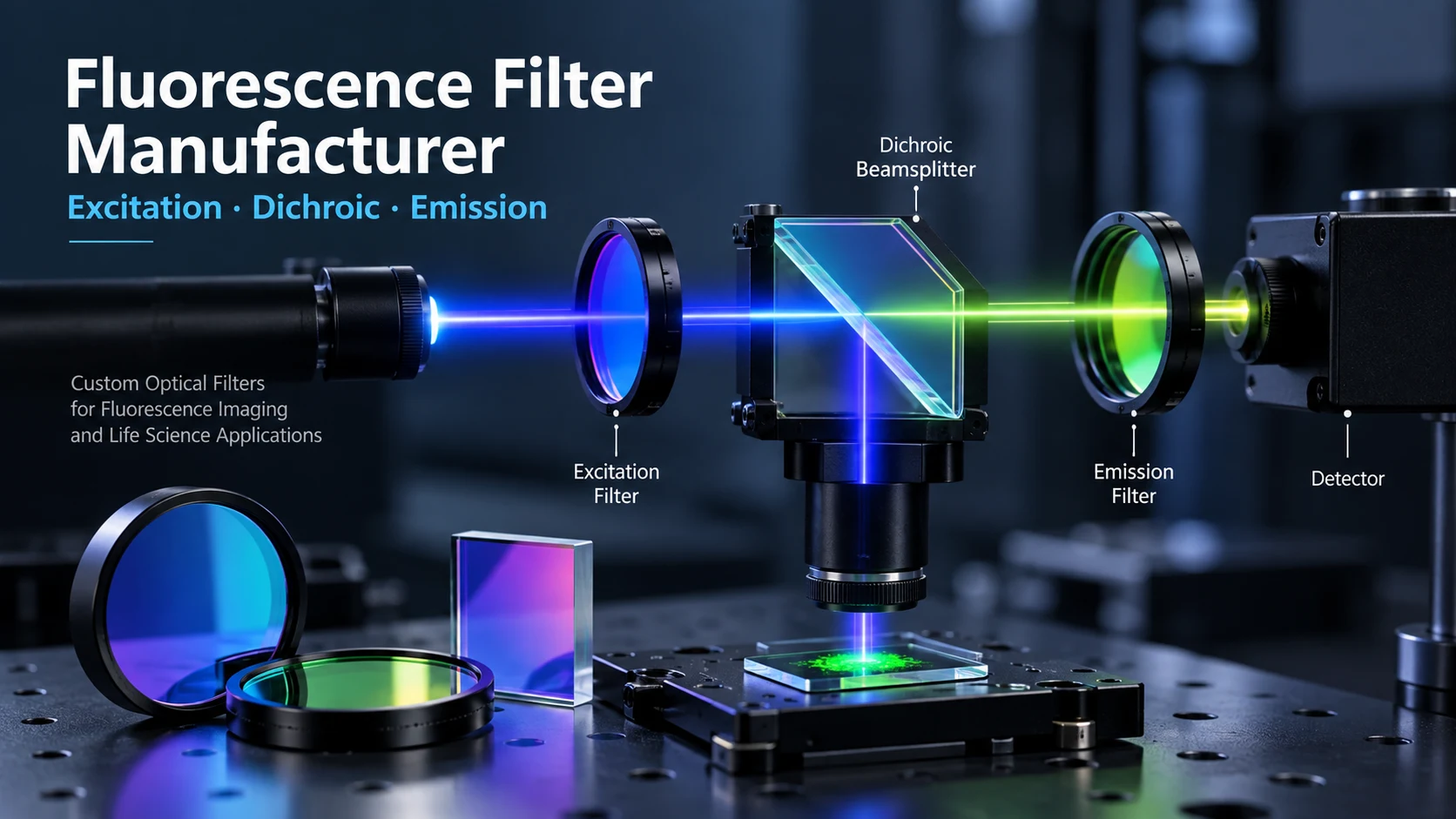
Choosing a fluorescence filter manufacturer is not simply a matter of ordering a filter at a nominal wavelength. A fluorescence optical system must separate relatively strong excitation light from the fluorescence signal that the detector is intended to measure. The required filter therefore has to work with the light source, fluorophore, detector response, optical geometry and mechanical package as a complete system.
GIAI Photonics supports custom optical filter projects based on drawings, optical specifications, existing samples and application requirements. For fluorescence applications, the engineering review can include excitation and emission bands, blocking requirements, angle of incidence, substrate, dimensions, coating conditions and inspection criteria before the manufacturing route is defined. GIAI’s controlled project guidance specifically requires such requirements to be evaluated at project level rather than treating one product specification as a universal capability.
A Fluorescence Filter Is Part of an Optical System
In a typical fluorescence detection system, three wavelength-selective optical elements often work together.
The excitation filter selects the wavelength band delivered to the sample. Its job is to transmit useful excitation energy while suppressing spectral components that could increase background or interfere with detection.
A dichroic beamsplitter separates the excitation and emission optical paths. Depending on the system architecture, it may reflect the excitation band toward the sample while transmitting the longer-wavelength fluorescence signal toward the detector.
The emission filter, sometimes called a barrier filter, selects the fluorescence band reaching the detector and provides additional rejection of residual excitation light, scattered illumination and unwanted spectral background. This excitation–dichroic–emission architecture is widely used in fluorescence microscopy and related fluorescence instruments.
For this reason, specifying only an excitation wavelength such as “470 nm” or “525 nm” is usually not enough to define a fluorescence filter project.
What Should Be Specified to a Fluorescence Filter Manufacturer?
The filter specification should begin with the optical system rather than a catalog label.
| Specification | Why It Matters |
|---|---|
| Excitation wavelength or band | Defines the spectral region used to excite the fluorescent material |
| Emission wavelength or band | Defines the fluorescence signal that should reach the detector |
| CWL / passband / FWHM | Controls the spectral window transmitted by a bandpass filter |
| Blocking range | Defines where unwanted illumination or background must be suppressed |
| Optical density requirement | Quantifies blocking where OD is part of the specification |
| Spectral edge position | Important where excitation and emission bands are closely separated |
| Angle of incidence (AOI) | Can affect the spectral response of interference filters |
| Cone angle / numerical aperture | A distribution of incident angles can broaden or shift system response |
| Polarization | May become relevant at non-normal incidence or in polarization-sensitive systems |
| Substrate | Influences optical, mechanical and environmental behavior |
| Clear aperture and dimensions | Must match the optical beam and mechanical assembly |
| Detector response | Determines which transmitted wavelengths contribute useful signal |
| Inspection conditions | Establish how finished filters will be verified and accepted |
GIAI’s current engineering framework similarly treats wavelength, transmission, reflection, blocking, substrate, AOI, polarization, clear aperture and operating conditions as project-dependent coating inputs rather than fixed specifications for every filter.
Passband Width Is a Signal-to-Background Decision
A wider fluorescence passband can collect more optical energy, but it may also admit more background light. A narrower passband can improve spectral selectivity, yet narrowing the band excessively can reduce useful signal or make the system more sensitive to spectral tolerances and operating geometry.
The correct bandwidth therefore depends on the actual fluorescence spectrum, excitation leakage, detector sensitivity and required signal-to-background performance.
This is particularly important when excitation and emission bands are close together. In such cases, passband position, edge steepness and out-of-band blocking need to be considered together rather than specified independently.
Blocking Requirements Need a Defined Wavelength Range
“High OD” alone does not fully define a fluorescence filter.
A useful specification identifies where the blocking is required. The critical region may include the excitation source, neighboring fluorescence channels, unwanted illumination wavelengths or wavelengths to which the detector remains highly sensitive.
Extending deep blocking across an unnecessarily large spectral range can increase coating complexity without necessarily improving system performance. Conversely, inadequate blocking near a strong excitation source may allow leakage to dominate a weak fluorescence signal.
The practical specification is therefore a combination of passband transmission, blocking level and blocking wavelength range.
Why AOI Matters in Fluorescence Filters
Many narrowband and wavelength-selective fluorescence filters are interference filters. Their spectral response depends on the optical thickness of the coating stack and the geometry of incident light.
When the angle of incidence changes from the design condition, the passband of an interference filter can shift. A converging beam also contains a range of incident angles rather than one single AOI, which can affect the effective spectrum seen by the system.
For fluorescence instruments, this means the filter specification should ideally include not only the desired wavelength but also its mounting angle and relevant beam geometry.
GIAI’s internal manufacturing and quality guidance specifically requires AOI and measurement conditions to be connected to the final application specification when wavelength-selective coated optics are evaluated.
Excitation, Dichroic and Emission Filters Should Be Designed Together
A common mistake is to optimize each component independently.
For example, increasing excitation-filter transmission appears beneficial when considered alone. But if the transmitted spectrum extends too close to the fluorescence detection band, the dichroic and emission filters may require much stronger rejection.
Likewise, moving the emission-filter edge to collect additional fluorescence can increase detected signal while also increasing excitation leakage, autofluorescence or neighboring-channel crosstalk.
A better approach is to compare the complete spectral chain:
Light source → excitation filter → sample → dichroic element → emission filter → detector
The resulting filter set should be evaluated against the source spectrum, fluorescence spectrum and detector response rather than simply matching nominal wavelength labels.
Fluorescence Filter Applications
Fluorescence filtering is used across a broad range of optical instruments, including fluorescence microscopy, fluorescence imaging, quantitative fluorescence instruments, PCR-related optical detection, biochemical analysis, flow-cytometry-type optical systems, laboratory analyzers and other life-science or material-fluorescence detection platforms.
The exact optical architecture varies. Some systems use discrete excitation and emission filters with a dichroic beamsplitter, while others use filter wheels, multiple channels or different beam-routing arrangements.
GIAI’s current English website identifies Fluorescence & Life Sciences as one of its application areas, and its optical-filter product family currently includes fluorescence-oriented wavelength-selective components.
Custom Fluorescence Filter Manufacturing at GIAI
For a custom fluorescence filter, GIAI reviews the component against the actual drawing, optical requirement, substrate, geometry, coating conditions and inspection criteria before defining a manufacturing route.
Depending on the component, the publicly documented manufacturing workflow can include material preparation, initial shaping, grinding, precision grinding, optical polishing, cleaning, edging, geometry processing, optical coating and inspection. Not every component necessarily passes through every operation; the route depends on the part specification.
For wavelength-selective filters, visible appearance alone is not sufficient to establish optical performance. Spectral characteristics such as transmission, reflection, blocking, CWL, FWHM or cut-on/cut-off behavior are evaluated according to the requirements defined for the specific project.
GIAI therefore does not treat one OD value, bandwidth or transmission specification as a universal capability for every fluorescence filter. Exact performance should be confirmed against the required wavelength range, geometry, coating and measurement conditions.
From Prototype Requirement to Production Specification
A fluorescence-filter project often begins before the optical specification is completely finalized.
An engineering team may already know the fluorophore, LED or laser wavelength, detector and mechanical envelope, but still need to determine appropriate passbands or blocking ranges. In other cases, an existing filter or instrument sample is available and a replacement or revised component needs to be evaluated.
GIAI supports drawing-, specification- and sample-based custom optical projects. The project path is built around requirement review, manufacturing feasibility, coating definition and inspection against the agreed component specification. This corresponds to GIAI’s documented custom-optics workflow and current manufacturing model.
What to Send With an RFQ
For an efficient technical review, provide the available excitation and emission spectra or target wavelength bands, fluorophore information where applicable, light-source type, detector or sensor information, CWL and FWHM targets if already defined, transmission requirements, blocking range and OD requirement, AOI and beam geometry, substrate preference, external dimensions, thickness, clear aperture, environmental conditions, required quantity and inspection or documentation requirements.
If a complete optical specification is not yet available, an existing sample, target spectral curve or system-level requirement can also provide a useful starting point.
Frequently Asked Questions
Can GIAI manufacture custom fluorescence filters?
GIAI can review custom optical-filter requirements based on drawings, specifications, samples and application conditions. Manufacturing feasibility and the final filter specification are confirmed for the individual project rather than assumed from a generic product family. This is consistent with GIAI’s published custom-optics and manufacturing approach.
Is higher optical density always better for fluorescence detection?
Not necessarily. Blocking should be specified where it is required by the source, detector and system architecture. Extending extremely deep blocking into wavelengths that are irrelevant to the system can add unnecessary coating constraints.
Does angle of incidence affect a fluorescence filter?
It can. Interference-filter spectra are angle dependent, so AOI and beam geometry should be considered when defining wavelength-sensitive fluorescence filters.
Should excitation and emission filters be selected separately?
They should be evaluated as part of the complete optical system together with the dichroic element, fluorophore spectrum, source and detector. Optimizing one component independently can produce unwanted leakage or reduce useful signal.
Can the same filter set be used for different fluorescence channels?
Only when the spectral requirements are genuinely compatible. Different excitation and emission spectra generally require different wavelength windows or multi-channel optical designs.