
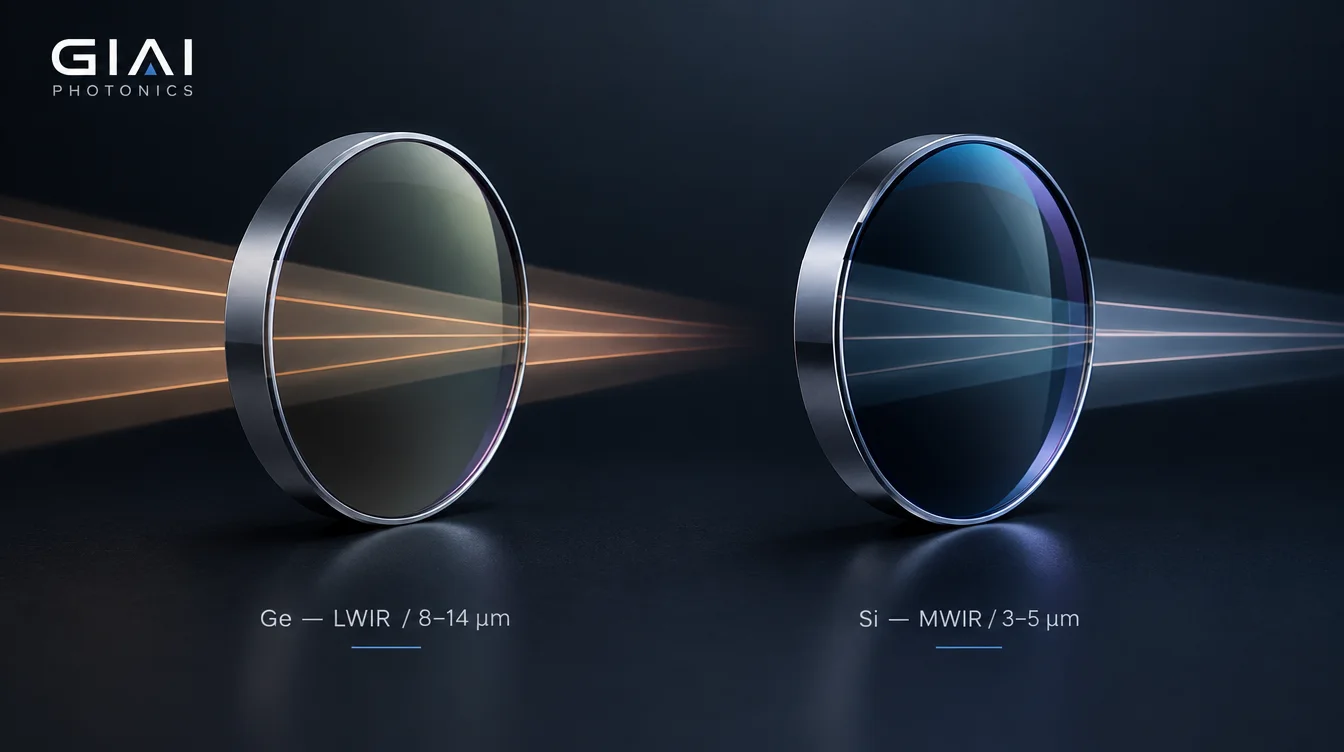
Germanium vs silicon infrared optics is not a question of which material is universally better. The first decision is the operating wavelength. Silicon is particularly useful in many 3–5 μm MWIR systems, while germanium is a more conventional choice when transmission through the 8–14 μm LWIR region is required. Refractive index, temperature, mass, material grade, coatings, geometry, and detector response can all change the final material choice. Crystran
Both germanium and silicon are crystalline semiconductor materials that can also be used as transmissive infrared optical materials. Both have relatively high refractive indices, both can produce significant Fresnel reflection when uncoated, and both are used in lenses, windows, filters, and other infrared optical components.
However, they should not be treated as interchangeable substrates.
Germanium vs Silicon Infrared Optics at a Glance
| Engineering factor | Germanium (Ge) | Silicon (Si) | Why it matters |
|---|---|---|---|
| Common practical IR use | MWIR through LWIR; especially important in 8–14 μm systems | NIR/MWIR; particularly common around 3–5 μm | Operating band is normally the first selection criterion |
| Representative refractive index | About 4.0 in the IR | About 3.4 in the IR | Both create substantial uncoated reflection |
| Density | About 5.33 g/cm³ | About 2.33 g/cm³ | Silicon can reduce optic and assembly mass |
| Thermo-optic coefficient | Higher | Lower than germanium | Affects thermal focus shift and athermalization |
| Knoop hardness, representative data | ~780 | ~1150 | Silicon is harder, although both materials remain brittle |
| 3–5 μm MWIR | Suitable | Particularly attractive | Both may be candidates |
| 8–14 μm LWIR | Commonly used | Requires much more material-grade qualification | Silicon should not be treated as a direct general replacement |
| AR coating | Normally important | Normally important | High refractive index causes surface reflection |
These are reference material properties, not finished-component specifications. Published data show approximately 5.33 g/cm³ density and an index near 4 for germanium, versus about 2.33 g/cm³ and an index near 3.42 for silicon. Actual transmission depends on material grade, thickness, wavelength, temperature, impurity content, doping or resistivity, surface condition, and coating. Crystran
Start With the Wavelength Band, Not the Material Name
The most useful first question is:
What wavelength range must the finished optical component transmit?
Germanium covers the conventional 8–14 μm thermal-imaging band well and is widely used for LWIR lenses and windows. Published material data also show useful germanium transmission extending well beyond this band, although a broad bulk-material transmission range should never be interpreted as guaranteed finished-optic performance. Crystran
Silicon requires more qualification.
Silicon is particularly important for infrared optics around the 3–5 μm MWIR atmospheric window. Published data can show a considerably wider intrinsic transmission region, but this does not mean every grade of optical silicon performs equally across that complete range.
For example, Czochralski-grown silicon can contain oxygen that produces an absorption feature near 9 μm. Float-zone silicon, resistivity, doping, thickness, and impurity concentration can produce substantially different long-wave behavior. Crystran
This leads to an important specification rule:
Do not select silicon or germanium from a single published “transmission range.” Evaluate the actual material grade across the complete operating band of the system.
3–5 μm MWIR: Both Materials May Be Candidates
For a 3–5 μm infrared imaging or sensing system, both germanium and silicon may be technically viable.
Silicon can be especially attractive because it combines useful MWIR transmission with substantially lower density than germanium. Published reference data also indicate higher thermal conductivity and a lower thermo-optic coefficient than germanium. Crystran
That can matter in systems such as:
- MWIR imaging objectives
- infrared sensor optics
- spectroscopy systems
- gas-detection instruments
- weight-sensitive optical assemblies
- moving or scanning optical systems
Germanium should not automatically be excluded from MWIR designs. Its higher refractive index can be useful within a particular lens prescription, and the final decision may depend on focal length, aperture, field of view, aberration correction, element count, temperature, coating design, mechanical packaging, and cost.
The material should therefore be evaluated as part of the complete optical prescription, not as an isolated specification.
8–14 μm LWIR: Germanium Has a Clearer Conventional Role
The comparison changes substantially in a conventional 8–14 μm thermal-imaging system.
Germanium is widely used in this spectral region and covers the principal LWIR thermal band. This is one reason germanium remains common in thermal-imaging lenses, infrared windows, and other LWIR transmissive components. Crystran
Silicon should not be substituted simply because it is lighter or potentially less expensive.
Some silicon grades show longer-wave transmission, but absorption features, growth method, impurity content, resistivity, and component thickness can become critical. An optical-grade silicon component that works well at 3–5 μm therefore cannot automatically be expected to perform adequately across 8–14 μm.
If silicon is being considered outside its conventional MWIR role, engineers should request grade-specific spectral and absorption data rather than relying on a generic material chart.
Refractive Index Affects Both Lens Design and Reflection
Germanium and silicon are both high-index optical materials.
Germanium has a refractive index close to 4 in commonly used infrared regions, while silicon is approximately 3.4. The exact index varies with wavelength, temperature, and material characteristics. Crystran
A high refractive index influences lens design because optical power depends partly on the index difference between the lens material and the surrounding medium.
But higher index also creates another problem: Fresnel reflection.
An uncoated germanium or silicon surface can reflect a substantial fraction of incident infrared radiation. With two optical surfaces, these losses can become significant enough that polished-substrate transmission alone is not a useful measure of finished-system performance.
For most imaging applications, the substrate and AR coating should therefore be designed together.
An infrared AR-coating specification should normally define the required spectral range together with relevant operating conditions such as AOI, beam geometry, polarization where applicable, operating temperature, environmental exposure, and durability requirements.
Thermal Behavior Is One of the Largest Differences
Temperature deserves particular attention when comparing germanium vs silicon infrared optics.
A published Applied Optics measurement covering 2.5–12 μm reported approximate thermo-optic coefficients of:
Silicon: 1.5 × 10⁻⁴ K⁻¹
Germanium: 4.0 × 10⁻⁴ K⁻¹
These values came from specific measurement conditions and should not be treated as universal constants for every material lot, but they clearly show that germanium’s refractive index can be considerably more temperature-sensitive. Optica Publishing Group
NASA measurements of silicon and germanium also emphasize that refractive index depends on both wavelength and temperature, and that accurate optical design may require data appropriate to the actual material being used. NASA Technical Reports Server
A temperature-driven change in refractive index can change optical power and move the focal plane.
However, this does not mean that silicon is simply “thermally stable” while germanium is “thermally unstable.”
A complete infrared assembly may also experience:
- barrel expansion or contraction
- changes in lens spacing
- detector movement
- mount deformation
- coating changes
- temperature-dependent material absorption
- structural stress
Thermal performance should therefore be evaluated at the complete lens or system level.
Germanium Also Requires Attention to Temperature-Dependent Absorption
Germanium has another important thermal characteristic.
Published material references report that germanium absorption can increase significantly as its temperature rises. Consequently, transmission measured at room temperature should not automatically be extrapolated to a hot infrared optical system. Crystran
This is particularly relevant for systems used in high-temperature process monitoring, heated instruments, exposed sensor assemblies, or applications where the optic itself absorbs significant radiation.
If temperature variation is substantial, the specification may need to define optical performance across an operating temperature range rather than at only one laboratory condition.
Silicon Has a Significant Weight Advantage
Density is one of the simplest differences between the two materials.
Germanium is approximately 5.33 g/cm³, while silicon is approximately 2.33 g/cm³. Crystran
For a small singlet this difference may have little practical consequence.
For a large infrared window, multi-element objective, scanning assembly, gimbal-mounted sensor, or portable instrument, however, optic mass can affect the complete mechanical design.
Lower mass can reduce:
- structural loading
- actuator requirements
- inertia
- mount requirements
- vibration sensitivity
- overall instrument weight
When both materials satisfy the spectral requirements, silicon’s lower density can therefore become an important system-level advantage.
Mechanical Properties Should Not Be Reduced to Hardness
Published Knoop hardness values are approximately 1150 for silicon and 780 for germanium. Silicon is therefore harder according to this particular material metric. Crystran
That does not mean silicon can be handled like a structural metal.
Both silicon and germanium are brittle crystalline materials. Optic design and manufacturing still need to consider edge chipping, mounting stress, scratches, surface damage, thermal stress, coating durability, and handling procedures.
Surface figure, surface quality, edge geometry, clear aperture, and coating durability should therefore be specified from the optical and environmental requirements rather than inferred from the substrate alone.
What About Germanium and Silicon as Infrared Filter Substrates?
The same material comparison also appears in infrared filter design.
Both silicon and germanium can function as substrates for infrared optical components, and both materials are within GIAI’s publicly documented infrared-material scope. 01_GIAI_Master_Reference
But selecting the substrate does not define the finished filter.
The spectral response can also depend on the coating design, substrate absorption, thickness, AOI, polarization, operating temperature, blocking range, detector response, and measurement conditions.
A germanium substrate does not automatically guarantee a particular LWIR passband, just as a silicon substrate does not define MWIR transmission by itself.
The specification must apply to the finished coated component.
A Practical Germanium vs Silicon Selection Method
For most custom infrared projects, use this sequence:
- Define the actual wavelength band. Replace “IR” with a real range such as 3–5 μm or 8–14 μm.
- Identify the optical function. Lens, window, filter substrate, prism, or another component.
- Define the detector and source spectrum. Material transmission outside the useful detector band may provide no system benefit.
- Specify operating temperature. This is particularly important for germanium.
- Evaluate mass and mechanical constraints.
- Specify the coating together with the substrate.
- Confirm the exact material grade. For silicon, growth method, resistivity, impurities, and absorption may be important.
- Define optical and mechanical acceptance criteria. Surface figure, surface quality, dimensions, centration, clear aperture, and spectral verification should match the actual function of the optic.
GIAI’s controlled manufacturing reference follows the same project-level logic: material, wavelength, geometry, coating conditions, environmental requirements, and inspection criteria should be reviewed together rather than assuming one material specification applies to every component. 03_GIAI_Manufacturing_Quality
Custom Germanium and Silicon Infrared Optics at GIAI Photonics
GIAI Photonics’ current public material scope includes both silicon and germanium, together with other infrared optical materials. Custom optical projects may be evaluated from drawings, specifications, or samples, with the manufacturing route defined according to the actual substrate, geometry, coating, and inspection requirements. 03_GIAI_Manufacturing_Quality
For a germanium or silicon infrared project, useful RFQ inputs include the wavelength range, component drawing, dimensions, material or acceptable material alternatives, operating temperature, coating requirements, AOI or beam geometry where relevant, surface requirements, inspection criteria, and expected quantity.
The material choice should be confirmed before finalizing the optical and coating design, especially when the project operates near a material absorption region or across a wide temperature range.
FAQ
Is germanium better than silicon for infrared optics?
Neither material is universally better. Germanium is particularly important when conventional LWIR transmission through approximately 8–14 μm is required. Silicon is often attractive in MWIR systems, especially around 3–5 μm, where lower density and a lower thermo-optic coefficient may benefit the design.
Can silicon replace germanium in an 8–14 μm thermal imaging lens?
Not as a general drop-in replacement. Silicon’s long-wave behavior depends strongly on material grade and absorption characteristics. Even when suitable silicon material exists, its different refractive index means the optical prescription normally needs to be re-evaluated rather than simply replacing the germanium element.
Which material is preferable for 3–5 μm optics?
Both can be considered. Silicon is particularly attractive in this region because of its useful MWIR transmission, lower density, and lower thermo-optic coefficient. Germanium may still be selected when its refractive index, lens prescription, coating requirements, or broader spectral requirements better suit the system.
Do germanium and silicon optics require AR coatings?
In many transmissive imaging systems, yes. Both materials have high refractive indices and consequently significant Fresnel reflection at uncoated surfaces. The appropriate coating must be designed for the required wavelength range, substrate, AOI, polarization conditions where relevant, and operating environment.
Is a published material transmission range enough to select an IR substrate?
No. Material grade, thickness, impurities, doping or resistivity, temperature, surface condition, and coating all influence finished-optic performance. Selection should be based on transmission across the actual system band under relevant operating conditions.