
- ZnSe is a standard transmissive material for CO2 laser lenses, windows and output couplers at 10.6 µm because its bulk absorption there is very low.
- Published data gives ZnSe a 0.6–21 µm transmission range, so one part can pass a red alignment beam and long-wave infrared.
- Uncoated ZnSe reflects 17.0% per surface at 10.6 µm (calculated), so nearly every application needs an AR coating.
- ZnSe is soft (Knoop 120), attacked by acids and toxic as dust, which limits exposed and chemically harsh uses.
- Specify grade, absorption, coating band, AOI and the test wavelength for surface form, not only dimensions.
Zinc selenide (ZnSe) is an infrared optical material used mainly for CO2 laser optics at 10.6 µm, long-wave infrared (LWIR) imaging and FTIR spectroscopy components. It transmits from the red end of the visible spectrum to beyond 20 µm and absorbs very little at 10.6 µm. It also passes a visible red alignment beam, which germanium and silicon cannot.
Those properties come with limits. ZnSe is soft, its high refractive index makes each uncoated surface reflect 17.0% at 10.6 µm, and its dust and acid reaction products are toxic. Whether ZnSe is the right choice depends on wavelength, laser power, operating environment, and how the part will be mounted, cleaned and handled.
What properties make zinc selenide useful in optics?
ZnSe combines a very wide transmission window, low absorption at 10.6 µm, a moderate thermo-optic coefficient and optical isotropy. Most ZnSe optics are cut from polycrystalline material grown by chemical vapor deposition (CVD) from zinc vapor and hydrogen selenide.
The values below come from published material data. They describe the bulk material, not a finished or coated component.
- Transmission range: 0.6–21 µm in one manufacturer’s data sheet; other sources quote 0.45–21.5 µm. The stated limits depend on sample thickness and the transmission level used to define cut-off.
- Band gap: 2.7 eV at 25 °C, which puts the absorption edge at 459 nm (calculated from λ = hc/E). Blue and violet light are absorbed and red light transmits, which is why ZnSe looks yellow.
- Bulk absorption: 0.0005 cm−1 at 10.6 µm for CVD material in published data. The value for a specific blank depends on grade and supplier.
- Refractive index: 2.4028 at 10.6 µm, rising to 2.4892 at 1.0 µm.
- dn/dT: +61 × 10−6 K−1 at 10.6 µm and 298 K.
- Crystal structure: cubic (zincblende), so the material has no intrinsic birefringence. Mounting stress can still induce some.
For material-level background on other IR substrates, see the optical materials and infrared resource hub.
Where is ZnSe used in optical systems?
ZnSe is used wherever an optic must transmit infrared light with low absorption, especially near 10.6 µm. The main uses are CO2 laser beam delivery, LWIR imaging, infrared spectroscopy and multispectral systems that share one optical path between a visible beam and an IR beam.
| Application | ZnSe parts | Why ZnSe | Main watch-out |
|---|---|---|---|
| CO2 laser processing | Focusing lenses, output couplers, windows, beam combiners | Low absorption at 10.6 µm; lower dn/dT than Ge | Contamination raises absorption and shifts focus |
| LWIR thermal imaging | Lens elements, internal windows | Transmits 8–12 µm; dispersion complements Ge | Too soft for exposed, abrasive locations |
| FTIR spectroscopy | Windows, ATR crystals | Wide mid-IR range; practically insoluble in water; n ≈ 2.4 | Etched by acidic samples |
| Visible + IR systems | Beam combiners, viewports | Transmits red visible light and LWIR | Coating must be designed for both bands |
| Mid-IR laser research | Cr- or Fe-doped ZnSe gain media | Tunable mid-IR emission | Separate material specification from passive optics |
CO2 laser beam delivery
Cutting, welding, marking and engraving systems built around 10.6 µm CO2 lasers use ZnSe for the transmissive parts of the beam path: plano-convex or meniscus focusing lenses, partially reflecting output couplers, and protective windows that separate the optics from the process zone. Mirrors in the same path are usually metal or silicon substrates with reflective coatings, because they do not need to transmit. Related parts are grouped under laser beam delivery components.
Long-wave infrared imaging
ZnSe transmits the full 8–12 µm atmospheric window used by uncooled thermal cameras. Germanium dominates LWIR lens design because its index of 4.0 gives more power per surface, but ZnSe is more dispersive across 8–12 µm, which makes it a common partner to Ge for color correction. Its softness usually keeps it behind a harder front window rather than exposed to the environment. See the infrared optics family for related components.
FTIR spectroscopy and ATR
ZnSe windows cover most of the mid-infrared fingerprint region and are practically insoluble in water, unlike KBr or NaCl windows. In attenuated total reflection (ATR) accessories, its index of 2.4 supports total internal reflection against most organic samples. ATR accessory makers commonly give a working range of pH 5 to 9, because acidic samples etch the crystal.
Visible alignment and beam combining
Because ZnSe passes red light, a technician can align an IR system with a red diode or HeNe beam through the same lenses and windows. A dichroic-coated ZnSe beam combiner can transmit 10.6 µm and reflect a visible aiming beam onto the same axis, or the reverse, depending on the coating design and AOI.
Why do CO2 laser optics favor ZnSe over germanium?
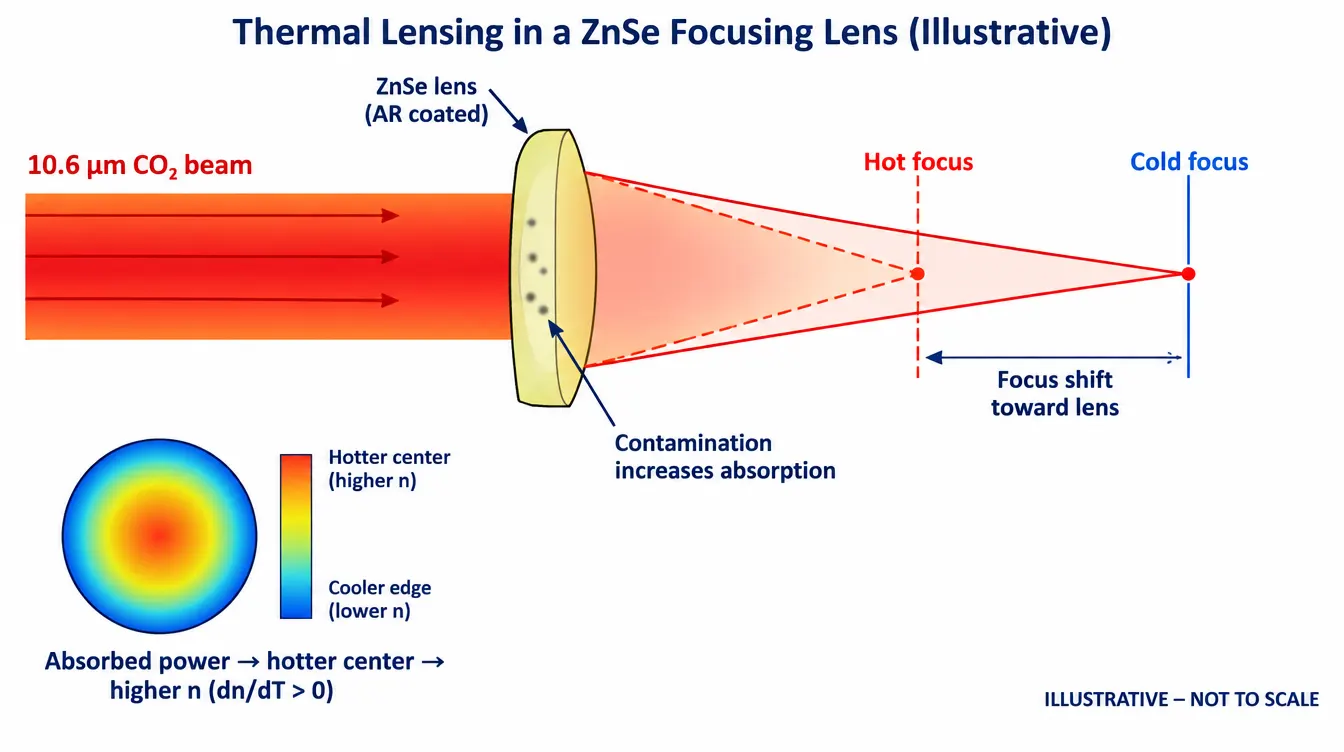
CO2 laser optics favor ZnSe because it absorbs less power at 10.6 µm and its refractive index changes less with temperature. Together these reduce thermal lensing, so the focal position stays more stable as laser power rises.
In one manufacturer’s published data, CVD ZnSe has a bulk absorption coefficient of 0.0005 cm−1 at 10.6 µm, while the typical figure for germanium is given as below 0.027 cm−1. The dn/dT of germanium, +396 × 10−6 K−1, is 6.5 times that of ZnSe. Germanium’s absorption also increases with temperature as thermally generated free carriers build up, which can lead to thermal runaway in a high-power beam.
The mechanism is straightforward. Absorbed power heats the center of the optic more than the edge. With a positive dn/dT, the hotter center has a higher index, and the element acts as an added positive lens. The focal length shortens and the focus moves toward the lens. Spatter, smoke residue or a degraded coating increases local absorption, which is why a contaminated ZnSe lens can show focus drift before visible damage appears.
How does ZnSe compare with germanium and zinc sulfide?
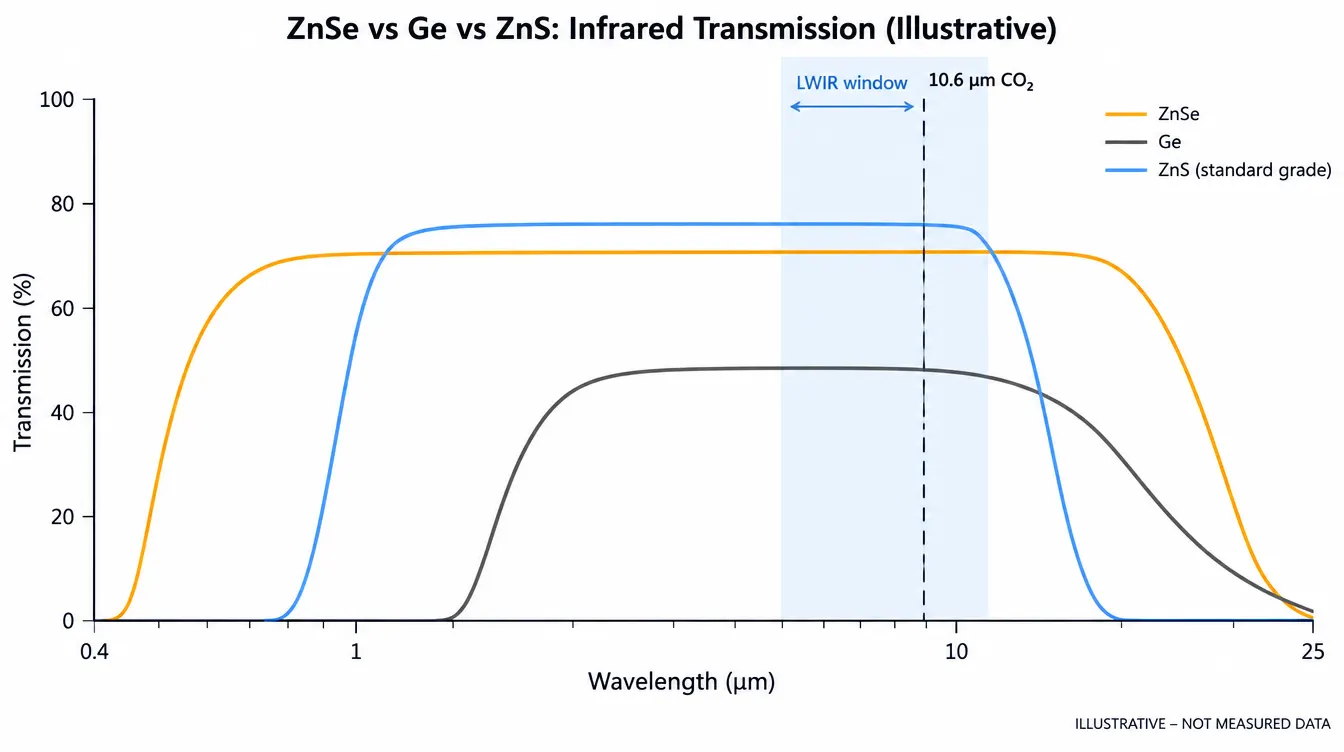
ZnSe has the widest transmission range of these materials, transmits visible red light, and has the lowest published absorption at 10.6 µm. Germanium offers higher index and far greater hardness, while zinc sulfide is harder than ZnSe but cuts off at 13 µm in published data.
| Material | Range (µm)* | n at 10.6 µm | R per surface** | Visible | Knoop hardness |
|---|---|---|---|---|---|
| ZnSe (CVD) | 0.6–21 | 2.403 | 17.0% | Red transmits; yellow | 120 |
| Germanium | 1.8–23 | 4.003 | 36.0% | Opaque | 780 |
| ZnS, standard grade | 1.0–13 | 2.192 | 13.9% | Limited, translucent | Higher than ZnSe |
| ZnS, multispectral | 0.37–13.5 | 2.201 (at 10 µm) | 14.1% (at 10 µm) | Water-clear | Lower than standard ZnS |
*Published material manufacturer data; range limits depend on thickness and cut-off criterion. **Calculated Fresnel reflectance for an uncoated surface at normal incidence, R = ((n − 1)/(n + 1))², no absorption. Calculated values, not measured product data. Hardness values are from published data and were measured with different indenter loads.
The index difference shapes design. Germanium bends light more per surface, so LWIR lenses can use fewer or flatter elements, but each uncoated surface reflects 36.0%. For an uncoated ZnSe plate, the same calculation, including multiple incoherent reflections between the two surfaces, gives 70.9% transmission at 10.6 µm. ZnS is the usual choice for windows exposed to weather and abrasion, and multispectral ZnS covers visible to LWIR in one clear part, but neither reaches the 13–21 µm region that ZnSe covers for spectroscopy.
What are the trade-offs of using ZnSe?
ZnSe gives up mechanical and chemical robustness in exchange for optical performance. It scratches easily, reflects strongly without coatings, has a relatively low temperature ceiling in air, and requires controlled handling because of toxicity.
- Softness: Knoop 120 (500 g indenter) means cleaning with a dry wipe or abrasive can leave scratches. Exposed windows erode under dust or sand, so ZnSe is usually placed behind a protective window or replaced by ZnS at the outer surface.
- Reflection loss: with 17.0% calculated reflectance per uncoated surface, AR coatings are needed for nearly every use. A narrowband 10.6 µm AR design can reach lower residual reflectance than a broadband 8–12 µm design, so coating bandwidth and residual reflectance trade against each other.
- Temperature: published material data states that ZnSe oxidizes significantly at 300 °C and should not be used above 250 °C in normal atmosphere.
- Chemistry: acidic solutions below pH 5 can etch ZnSe, and strong acids react with it to generate toxic hydrogen selenide gas.
- Toxicity: ZnSe is classified as toxic if swallowed or inhaled. The practical risk is dust from grinding, polishing or broken parts, which is handled under the material’s safety data sheet.
- Coating materials: some 10.6 µm coating designs use thorium fluoride (ThF4) layers, which are weakly radioactive and carry handling and regulatory implications. Thorium-free designs should be stated as a requirement when needed.
How should engineers specify ZnSe optics?
Start from the operating wavelength and power, then define material grade, coating, surface and inspection requirements that match them. Tolerances copied from visible-glass drawings often add cost without improving an IR system, while a missing absorption requirement can cause failures in a laser system.
- Wavelength and geometry of use: state the IR band (10.6 µm only, 9–11 µm, or 8–12 µm), any visible alignment wavelength, and the AOI and polarization for tilted windows and beam combiners.
- Material grade: for high-power CO2 use, specify a laser grade and a maximum bulk absorption coefficient at 10.6 µm, plus how it will be verified. Imaging and spectroscopy parts may use a different grade.
- Coating: give maximum reflectance per surface over the band at the stated AOI, the partial reflectance for output couplers, and the transmit/reflect bands for combiners. State whether thorium-free coatings are required.
- Surface form: define power and irregularity per ISO 10110-5 and name the test wavelength. One fringe at 10.6 µm corresponds to 16.75 fringes at 632.8 nm (calculated from the wavelength ratio), so a tolerance without a wavelength is ambiguous.
- Surface imperfections: use ISO 10110-7 or MIL-PRF-13830B and set the class by function. Scatter from small defects falls as wavelength increases, while defects in laser optics can trap contamination that absorbs.
- Mounting: the thermal expansion coefficient is 7.1 × 10⁻⁶ K−1, and the soft material can chip under point loads, so specify the mount interface and retaining method.
Common mistakes with ZnSe optics
- Placing an imaging-grade lens in a high-power CO2 beam without an absorption requirement.
- Specifying irregularity in fringes without a test wavelength.
- Cleaning with acidic cleaners or abrasive wipes instead of the supplier’s cleaning instructions.
- Substituting ZnS for ZnSe in a spectroscopy design that needs transmission beyond 13 µm.
- Leaving an uncoated or soft-coated ZnSe window exposed to outdoor abrasion. For such positions, see the optical windows range and compare harder materials.
ZnSe is among the materials listed on GIAI’s manufacturing capabilities page. Achievable geometry, surface and coating tolerances for a specific ZnSe part are confirmed against its drawing.
Frequently asked questions
Is zinc selenide toxic?
Zinc selenide is classified as toxic if swallowed or inhaled, so the main exposure risk is dust from grinding, breakage or damaged optics. Intact ZnSe optics are handled routinely with gloves or finger cots. ZnSe also reacts with strong acids to release hydrogen selenide gas, which is highly toxic, so acidic cleaners must be avoided and broken parts disposed of according to the safety data sheet.
Why is zinc selenide yellow?
Zinc selenide looks yellow because its band gap of 2.7 eV at room temperature places its absorption edge at 459 nm (calculated from λ = hc/E). Blue and violet light are absorbed, while longer visible wavelengths pass increasingly well, so transmitted light appears yellow to orange. The same property allows a red alignment laser, such as a HeNe or red diode beam, to pass through ZnSe lenses and windows.
What is the difference between ZnSe and ZnS?
ZnSe and ZnS are both CVD-grown infrared materials, but ZnSe transmits further into the infrared, to 21 µm in published data, and has lower absorption at 10.6 µm, so it dominates CO2 laser optics. Standard-grade ZnS cuts off at 13 µm but is harder, which suits exposed LWIR windows. Multispectral ZnS is water-clear and transmits from the visible to the LWIR.
Why is ZnSe used for CO2 lasers?
ZnSe is used for CO2 laser lenses, windows and output couplers because its bulk absorption at 10.6 µm is very low and its thermo-optic coefficient is moderate. Less absorbed power means less heating and less thermal lensing, so the focal position stays more stable at high power. Its visible transmission also allows alignment with a red diode or HeNe beam through the same optics.
What is the transmission range of zinc selenide?
Published manufacturer data gives zinc selenide a transmission range of 0.6 to 21 µm, while other sources quote 0.45 to 21.5 µm. The difference comes from sample thickness and the transmission level used to define cut-off. An uncoated ZnSe plate transmits 70.9% at 10.6 µm, calculated for normal incidence without absorption, because each surface reflects 17.0%, so AR coatings are applied for most uses.
References
- Harris, D. C. Materials for Infrared Windows and Domes: Properties and Performance. SPIE Press, 1999.
- Li, H. H. “Refractive Index of ZnS, ZnSe, and ZnTe and Its Wavelength and Temperature Derivatives.” Journal of Physical and Chemical Reference Data, 13, 103 (1984).
- Bass, M. (ed.). Handbook of Optics, 3rd ed., Vol. IV: Optical Properties of Materials, Nonlinear Optics, Quantum Optics. McGraw-Hill / Optical Society of America, 2010.
- ISO 10110-5 and ISO 10110-7. Optics and photonics — Preparation of drawings for optical elements and systems — Part 5: Surface form tolerances; Part 7: Surface imperfections.
- Crystran Ltd. Zinc Selenide (ZnSe) Materials Data (material data sheet).
To review a ZnSe lens, window, output coupler or beam combiner, send GIAI the drawing, optical specification or sample together with the wavelength range (including any visible alignment wavelength), substrate grade and absorption requirement, dimensions, coating requirements, AOI and polarization, laser power where relevant, inspection criteria and expected quantity through the technical inquiry page.