
Technical Resources
Germanium vs ZnSe Infrared Window
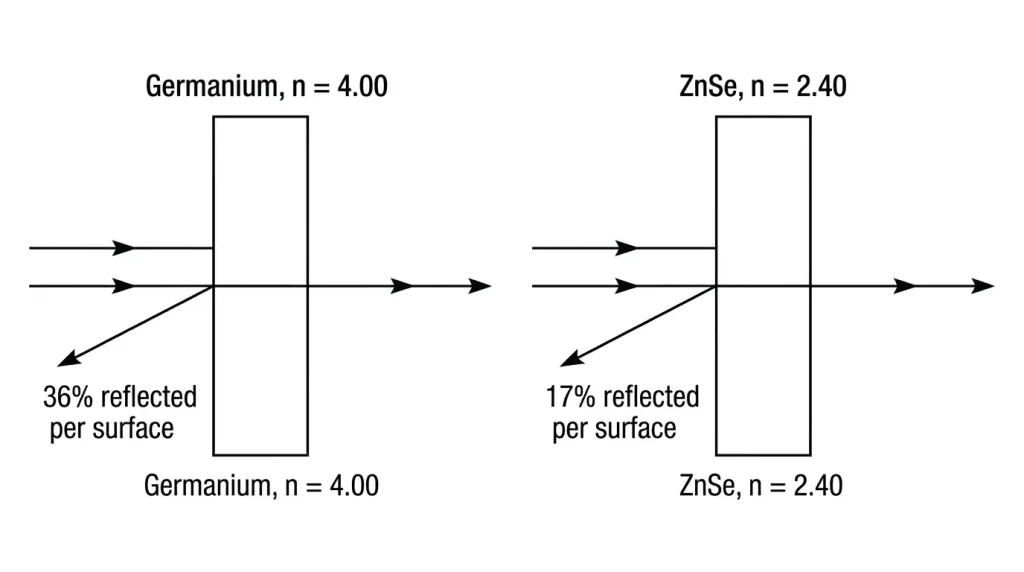
Choose a germanium infrared window when you need a rugged, visible-blocking aperture for an 8 to 14 µm thermal imager that stays below roughly 100 °C. Choose a zinc selenide (ZnSe) window when the aperture has to pass a high-power CO2 laser beam at 10.6 µm, when you want a visible alignment beam through the same aperture, or when the system spans the red end of the visible out to the long-wave infrared. The germanium vs ZnSe infrared window decision comes down to three material facts: refractive index, bulk absorption, and how that absorption behaves as the part heats up.
Everything else, including coating choice, mounting stress, and cost, follows from those three.
The physics that separates the two materials
Refractive index sets your Fresnel loss
At normal incidence, the reflectance at a single air-to-material interface is:
R = ((n − 1) / (n + 1))²
Germanium sits near n = 4.00 across most of its usable band. That gives R = 36% per surface. For an uncoated plane-parallel window with incoherent multiple reflections, transmission is:
T = 2n / (n² + 1)
which works out to 47% for germanium. ZnSe, at n = 2.4028 at 10.6 µm, gives 17% per surface and 71% through two surfaces.
The practical consequence: a bare germanium window is not a usable optic. It loses over half the signal and dumps most of that loss back into the system as ghost reflections and stray light. Germanium windows are effectively always anti-reflection (AR) coated. ZnSe is also normally coated, but an uncoated ZnSe window is at least a functional part for low-stakes work.
Band edges determine what else gets through
Germanium is opaque from the visible out to about 1.8 µm because of its 0.66 eV indirect bandgap. That makes it a built-in longpass filter. If your detector is an uncooled microbolometer and you want solar and visible light rejected at the aperture, germanium does that for free.
ZnSe transmits from about 0.6 µm to 21 µm. Parts look orange or amber in room light. That visible transmission is the single most useful practical property in CO2 laser work: a red HeNe or 650 nm diode alignment beam travels the same path as the invisible 10.6 µm processing beam. It also means your ZnSe window will happily pass ambient visible and near-infrared light into whatever sits behind it, so a separate blocking filter is often required.
Bulk absorption is where the two materials genuinely diverge
Transmission through a coated window follows Beer-Lambert:
T = (1 − R)² · e^(−αd)
with α the bulk absorption coefficient and d the physical thickness.
Germanium is specified at α < 0.027 cm⁻¹ at 10.6 µm. ZnSe is around 0.0005 cm⁻¹, roughly fifty times lower. For a 5 mm thick window, that is about 1.3% bulk loss in germanium versus about 0.03% in ZnSe.
For a passive imaging window collecting microwatts of scene flux, 1.3% is irrelevant. For a 2 kW CO2 laser, it is 26 W deposited in the germanium versus 0.5 W in the ZnSe, and that difference decides whether the part survives.
Germanium vs ZnSe infrared window: property comparison
| Property | Germanium (Ge) | Zinc selenide (CVD ZnSe) |
|---|---|---|
| Transmission range | 1.8 to 23 µm (useful band typically 2 to 14 µm) | 0.6 to 21 µm |
| Refractive index | 4.0026 at 11 µm | 2.4028 at 10.6 µm |
| Reflection loss, 2 surfaces, uncoated | 53% | 29.1% |
| Bulk absorption at 10.6 µm | <0.027 cm⁻¹ | 0.0005 cm⁻¹ |
| dn/dT | 396 × 10⁻⁶ K⁻¹ | +61 × 10⁻⁶ K⁻¹ |
| Knoop hardness | 780 | 120 (50 g indenter) |
| Density | 5.33 g/cm³ | 5.27 g/cm³ |
| Thermal conductivity at 298 K | 58.6 W·m⁻¹·K⁻¹ | 18 W·m⁻¹·K⁻¹ |
| Thermal expansion | 6.1 × 10⁻⁶ K⁻¹ | 7.1 × 10⁻⁶ K⁻¹ |
| Young’s modulus | 102.7 GPa | 67.2 GPa |
| Visible appearance | Opaque, metallic gray | Translucent orange |
| Maximum operating temperature | Below about 100 °C | Limited by coating and oxidation, not by runaway |
Values are representative material data from published supplier datasheets. Specific lots vary, and coated performance depends entirely on the coating design.
Why germanium fails in hot environments
Germanium exhibits thermal runaway. Free-carrier absorption in the 8 to 14 µm band increases with carrier concentration, carrier concentration rises with temperature as the narrow bandgap is thermally excited, absorbed energy raises the temperature further, and the loop closes on itself. Suppliers consistently advise keeping germanium optics below 100 °C. By 100 °C transmission has already degraded badly, and by 200 °C the material passes essentially nothing.
There is a second, subtler penalty. A warm germanium window radiates in the same band your detector is watching. In a sensitive thermal imager, a window that has drifted 20 K above ambient adds a background pedestal and degrades noise equivalent temperature difference (NETD), even before transmission loss shows up. This is why engine-bay, furnace-viewing, and downhole thermal cameras usually get a sapphire, ZnS, or silicon window instead, or an actively cooled germanium assembly.
ZnSe has no equivalent runaway mechanism. Its limits are mechanical and chemical: it is soft, it oxidizes in air at elevated temperature, and its low thermal conductivity of 18 W·m⁻¹·K⁻¹ means absorbed heat leaves slowly, which is why the extremely low absorption coefficient matters so much in high-power use.
Thermo-optic behavior and wavefront error
Germanium’s dn/dT of 396 × 10⁻⁶ K⁻¹ is the largest among common infrared materials, over six times ZnSe’s value. For a plane-parallel window the effect is not focus shift so much as gradient-induced wavefront error.
Take a 3 mm thick germanium window with a 5 K radial temperature gradient from center to edge, which is easy to produce with a warm housing and a cool ambient. Ignoring expansion and stress-optic terms, the optical path difference is:
ΔOPD ≈ d · (dn/dT) · ΔT = 3000 µm × 396 × 10⁻⁶ × 5 = 5.9 µm
That is about 0.56 waves at 10.6 µm from a flat window that measured λ/10 on the bench. The same gradient in ZnSe produces about 0.9 µm, under a tenth of a wave.
If you are building a diffraction-limited long-wave infrared (LWIR) system, model the window thermally, not just optically. Athermalization work that stops at the lens group and treats the window as a non-optic is a recurring source of unexplained field performance loss.
Mechanical durability, coatings, and handling
Germanium at Knoop 780 is genuinely hard, close to hardened steel. That is why it is the default choice for external, exposed apertures on gimbals and vehicle sights. Add a diamond-like carbon (DLC) coating and you get a front surface that survives sand, rain, and field cleaning. DLC costs some transmission compared to a soft broadband AR (BBAR) stack, typically a few percent, so specify it only where the exposure justifies it.
ZnSe at Knoop 120 is soft enough to scratch during a careless wipe. It is chemically stable and non-hygroscopic, with solubility around 0.001 g per 100 g of water, so humidity is not the threat. Abrasion is. ZnSe used at an external aperture needs a hard protective overcoat, and even then it belongs behind a sacrificial cover where practical.
Both materials carry handling requirements. Germanium dust is hazardous to inhale. ZnSe contains selenium, and grinding, polishing, or laser-damaging the material can release toxic compounds, so machining requires local exhaust and the safety data sheet governs disposal. Note that selenium is not among the substances restricted under the RoHS directive, so ZnSe optics are normally RoHS compliant. The health controls are a workplace and waste-handling matter, not a compliance blocker.
For window optics, the relevant drawing standards are MIL-PRF-13830B for surface quality expressed as scratch-dig, or ISO 10110 if you are working to a European drawing convention. Both are widely used; pick one and stay consistent across the print.
Suppliers of precision infrared components, including GIAI Photonics, will generally quote both germanium and ZnSe blanks with a range of coating options, but coating designs and achievable tolerances differ significantly between vendors, so confirm the specific stack against your waveband and angle of incidence.
Datasheet parameters worth specifying
| Parameter | Commonly available commercial | Commonly available precision | Why it matters |
|---|---|---|---|
| Diameter tolerance | +0 / −0.1 mm | +0 / −0.025 mm | Mount fit and stress |
| Thickness tolerance | ±0.1 mm | ±0.025 mm | Optical path, mechanical stack-up |
| Parallelism (wedge) | ≤3 arcmin | ≤10 arcsec | Beam deviation, boresight error |
| Surface quality (scratch-dig) | 60-40 | 40-20 or 20-10 | Scatter, laser damage initiation |
| Surface figure, P-V | λ/2 | λ/10 | Transmitted wavefront |
| Clear aperture | 85% of diameter | 90% of diameter | Usable beam footprint |
| Coating reflectance | R_avg <1% per surface | Application specific | Throughput, ghosting |
These ranges reflect what is broadly offered across the industry. Achievable values, especially on ZnSe where polishing is limited by softness, vary by supplier and by part geometry. Confirm against a specific quotation rather than assuming.
Two material-specific parameters are easy to omit and expensive to omit:
- Germanium resistivity. Optical-grade germanium is specified within a resistivity band because free-carrier absorption scales inversely with it. A window cut from unspecified material can show measurably higher LWIR loss than the datasheet implies.
- Angle of incidence (AOI). Fresnel reflectance and AR coating performance are both AOI-dependent, and at non-normal incidence s and p polarization diverge. A coating designed for 0 degrees will not hold its specification at 30 degrees.
Common specification mistakes
Specifying λ/10 at 633 nm transmitted wavefront on germanium. Germanium is opaque at 633 nm. You can measure surface figure in reflection with a visible interferometer, because the polished surface reflects, but transmitted wavefront error requires a 10.6 µm interferometer. Germanium’s index of 4.0 also amplifies the wavefront contribution of any bulk index inhomogeneity, so surface figure and transmitted wavefront are not interchangeable here. Say which one you mean, and at what wavelength.
Assuming an uncoated germanium window is a valid fallback. At 47% transmission it is not. Any design that has to work with the coating removed needs a different material.
Putting germanium in a hot aperture. The 100 °C figure is a hard practical ceiling, and degradation is well underway before it. Furnace monitoring, engine test cells, and enclosed high-power laser heads all warrant checking the window’s steady-state temperature, not the ambient.
Using germanium for CO2 laser transmission at real power. Germanium does transmit 10.6 µm and works in low-power or alignment paths, but its absorption is high enough that the runaway loop is exactly the failure mode. ZnSe is the correct material above modest power levels.
Over-tightening a ZnSe window in its mount. With Young’s modulus of 67.2 GPa and low hardness, a metal retaining ring bearing directly on ZnSe deforms it and prints stress birefringence into the transmitted wavefront. Use a compliant seat.
How to choose
Pick germanium when the system is a passive LWIR imager in the 8 to 14 µm band, operating below 100 °C, and the aperture is exposed enough that Knoop 780 plus DLC earns its cost. Its natural visible and short-wave blocking is a real design simplification.
Pick ZnSe when 10.6 µm laser power passes through the window, when a visible alignment beam must share the aperture, when the band extends below 2 µm, or when the part will run warm. Accept that it is soft, that it needs protection, and that the polishing tolerances are looser.
Consider a third material when neither fits cleanly. Multispectral zinc sulfide (ZnS) covers roughly 0.37 to 13.5 µm and is harder than ZnSe at Knoop 160, making it a reasonable compromise for exposed broadband apertures. Silicon suits mid-wave infrared (MWIR) work at 3 to 5 µm and is much cheaper and lighter than germanium. Sapphire handles high temperature and pressure but stops transmitting around 5 µm.
One commercial factor now sits alongside the physics. China implemented export licensing on germanium metal and germanium compounds in August 2023, and refined germanium prices outside China have risen substantially since, with Western warehouse material trading at a large premium to Chinese domestic benchmarks. Germanium supply and pricing have become volatile in a way ZnSe supply has not. If you are designing a product with a multi-year production run and germanium is not strictly required, it is worth carrying a qualified alternative through the design phase.
FAQ
Can I use a germanium window with a CO2 laser?
For alignment paths, beam sampling, or low average power, yes. For process-level power, no. Germanium’s bulk absorption at 10.6 µm is roughly fifty times that of ZnSe, and absorbed heat raises absorption further in a self-reinforcing loop. ZnSe is the standard material for CO2 transmissive optics for exactly this reason.
Why does my uncoated germanium window only transmit about half the light?
Because of its refractive index of about 4.0, each air-to-germanium interface reflects 36%. Across two surfaces, uncoated transmission is 2n/(n²+1), or roughly 47%. This is Fresnel reflection, not absorption or a defective part. An AR or BBAR coating matched to your waveband recovers most of it.
Is ZnSe hygroscopic?
No. Its water solubility is around 0.001 g per 100 g, so ambient humidity does not attack it. The vulnerability is mechanical. At Knoop 120 it scratches easily during cleaning and handling, so it needs a hard overcoat or a protected mounting position rather than a moisture barrier.
What is the highest temperature a germanium window tolerates?
Keep it below roughly 100 °C. Transmission degrades progressively as temperature rises through thermal runaway, the material is nearly opaque at 100 °C, and it transmits essentially nothing by 200 °C. A hot window also self-emits into the detector band, which hurts sensitivity before transmission loss becomes obvious.
Which material has better thermal stability for imaging?
ZnSe, by a wide margin on thermo-optic behavior. Its dn/dT of +61 × 10⁻⁶ K⁻¹ is roughly one sixth of germanium’s 396 × 10⁻⁶ K⁻¹, so temperature gradients across the part produce far less wavefront error. Germanium wins on thermal conductivity, 58.6 versus 18 W·m⁻¹·K⁻¹, which helps it flatten gradients in the first place.
Do I still need a bandpass filter behind a germanium window?
Often not for visible and short-wave rejection, since germanium is opaque below about 1.8 µm and acts as a natural longpass. You will still need a filter to define the band edges within the infrared, for example restricting an uncooled detector to 8 to 14 µm. Behind ZnSe, which passes visible light, blocking is almost always required.