
Technical Resources
1064nm vs 532nm F-Theta Scan Lens
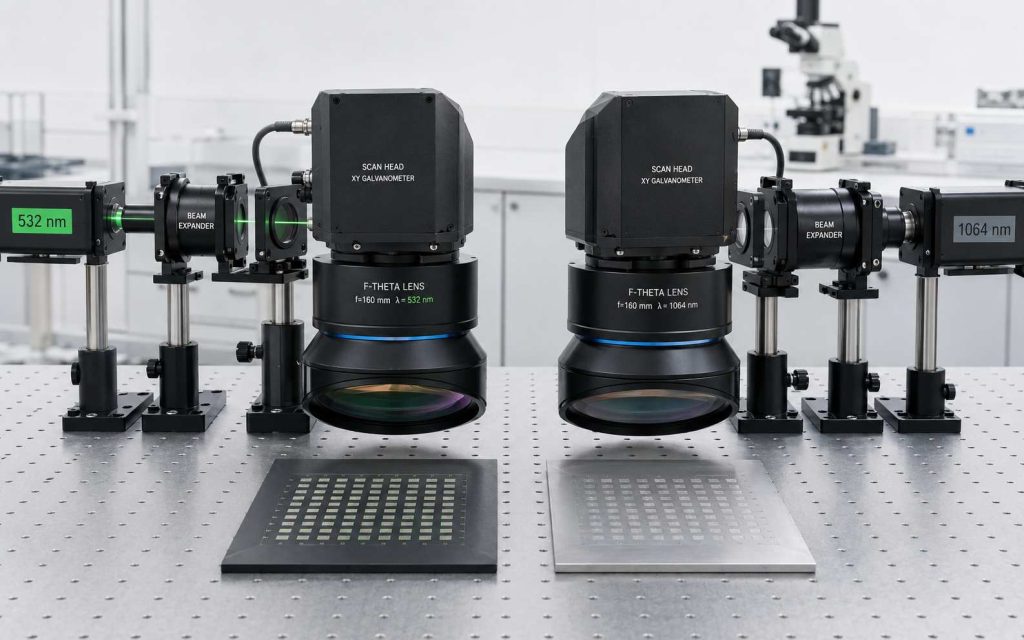
A 1064nm vs 532nm F-theta scan lens comparison starts with a simple rule: the scan lens must be designed for the laser wavelength used by the system. A 532 nm lens is not simply a higher-resolution version of a 1064 nm lens, and a 1064 nm lens should not normally be used at 532 nm unless the optical design and coatings are explicitly specified for both wavelengths.
The wavelength affects diffraction, refractive index, aberration correction, anti-reflection coating performance and interaction with the workpiece. At the same time, wavelength alone does not determine scan field, working distance, process accuracy or laser damage resistance. Those characteristics must be evaluated together with focal length, beam diameter, scanner geometry, laser power and pulse conditions.
What Changes Between a 532nm and 1064nm F-Theta Lens?
Both lenses perform the same basic optical function. Installed after a galvanometer scanner, an F-theta lens converts changing beam angle into a focused position across a substantially flat working field.
For an ideal one-dimensional system, the approximate mapping is:
where y is the focused beam position, f is the effective focal length and θ is the optical scan angle in radians.
The distinction between a 532 nm and 1064 nm version is that the optical prescription and coating system are optimized for different wavelengths. Refractive index changes with wavelength, so element curvature, spacing and glass selection may need to be adjusted to control focus, field curvature, astigmatism, distortion and other aberrations across the required scan field.
For this reason, two scan lenses with the same nominal focal length and mechanical thread can still have different working distances, focal positions, transmission characteristics and field performance.
1064nm vs 532nm F-Theta Scan Lens: Engineering Comparison
| Factor | 532 nm F-Theta Lens | 1064 nm F-Theta Lens |
|---|---|---|
| Spectral region | Visible green | Near infrared; invisible to the human eye |
| Typical laser source | Frequency-doubled solid-state or fiber-based laser system | Fundamental output of many Nd-doped solid-state and ytterbium-based laser systems |
| Theoretical focused spot | Smaller when focal length, input beam diameter, M² and other conditions are equivalent | Larger under otherwise equivalent diffraction-limited conditions |
| AR coating | Must provide suitable performance around 532 nm | Must provide suitable performance around 1064 nm |
| Optical design | Optimized using refractive-index data at or around 532 nm | Optimized using refractive-index data at or around 1064 nm |
| Material processing | Useful where the material couples more effectively to green light or where a shorter wavelength supports the required feature scale | Widely used for industrial marking, engraving, welding, cleaning and other processing when the material and laser architecture are suitable |
| Scan field | Determined by focal length, scan angle and optical design—not wavelength alone | Determined by focal length, scan angle and optical design—not wavelength alone |
| Working distance | Depends on the particular lens prescription | Depends on the particular lens prescription |
| Telecentricity | Available in telecentric or non-telecentric designs | Available in telecentric or non-telecentric designs |
| Laser damage capability | Must be evaluated using actual wavelength, pulse and coating conditions | Must be evaluated using actual wavelength, pulse and coating conditions |
Why 532nm Can Produce a Smaller Focused Spot
For a Gaussian-like laser beam, a useful first-order relationship for focused spot diameter is:
where:
- d = focused spot diameter
- M² = laser beam-quality factor
- λ = wavelength
- f = effective focal length
- D = input beam diameter
If focal length, beam diameter, beam quality and aperture conditions remain identical, reducing the wavelength from 1064 nm to 532 nm reduces the theoretical diffraction-related spot diameter by approximately a factor of two.
That does not mean a real 532 nm laser machine will automatically produce features half the size of a comparable 1064 nm machine.
Actual focus depends on additional factors including:
- field-dependent lens aberrations;
- beam quality and beam profile;
- beam-expander setting;
- galvanometer aperture;
- aperture truncation and vignetting;
- scanner-to-lens spacing;
- focus position;
- thermal effects;
- material response;
- pulse duration and fluence;
- the definition used for “spot diameter.”
Processing line width is therefore not identical to the calculated optical spot diameter.
Wavelength Matching Is More Than an AR Coating
A common mistake is to assume that changing the anti-reflection coating converts a 1064 nm F-theta lens into a 532 nm lens.
The coating is important, but the refractive optical design is also wavelength-dependent.
Refractive index and aberration correction
Optical glass has dispersion: its refractive index changes with wavelength. A multi-element scan lens designed to control off-axis aberrations at 1064 nm may therefore behave differently at 532 nm.
Using a lens far from its design wavelength can change effective focal length, focus position, field curvature and residual aberration. F-theta distortion and edge-field spot quality may also move outside the values expected at the specified design wavelength.
Anti-reflection coatings
Each air-to-glass surface reflects part of the incident beam. Because an F-theta objective contains multiple optical surfaces, these losses can accumulate if the coating is poorly matched to the laser wavelength.
The coating must be specified using the actual wavelength or wavelength range, together with relevant incidence angles, polarization and power conditions.
A coating advertised simply as “visible” or “near-IR” does not automatically establish its suitability for a high-power scanning system.
Can One F-Theta Lens Work at Both 532nm and 1064nm?
Yes, but only when it is deliberately designed and specified as a dual-wavelength scan lens.
A dual-wavelength system may require broader or multi-band AR coatings and an optical prescription that controls focal position and scan performance at both wavelengths. Chromatic focal shift is especially important because the system may otherwise focus 532 nm and 1064 nm at different axial positions.
Engineers should therefore verify at both wavelengths:
- effective focal length;
- working distance or focal-plane position;
- transmission;
- focused spot size;
- F-theta distortion;
- field curvature;
- telecentricity, where relevant;
- ghost reflections;
- power or pulse compatibility.
Matching the mechanical thread alone is insufficient.
Material Interaction: When Does Wavelength Matter?
The laser wavelength should normally be selected according to the processing mechanism and material response before the F-theta lens is selected.
Materials do not absorb 532 nm and 1064 nm equally. Their optical constants, surface condition, coatings, temperature and microstructure can all change how efficiently laser energy is coupled into the workpiece.
Typical reasons for using 1064 nm
Near-infrared laser systems around 1064 nm are widely used for industrial processing. Depending on the laser source and process parameters, applications can include metal marking, engraving, surface treatment, welding, cleaning and general material processing.
One practical advantage is the broad availability of industrial laser architectures operating near this wavelength. However, application suitability still depends on the target material and process window.
Typical reasons for considering 532 nm
Green laser processing may be attractive when the target material absorbs green light more effectively than near-infrared light, or when the shorter wavelength supports the desired focused spot.
Examples can include selected copper processing, semiconductor applications, electronics, polymers and fine material processing. These are application-dependent tendencies rather than universal rules.
A shorter wavelength does not automatically mean lower thermal damage, higher accuracy or better surface quality. Pulse duration, absorption, fluence, repetition rate, scanning strategy and heat flow can be at least as important as wavelength.
Scan Field Is Not Determined by 532nm or 1064nm
It is incorrect to assume that 1064 nm automatically provides a larger scan field or that 532 nm necessarily requires a small field.
For a given scanner geometry, scan field is strongly related to effective focal length and usable optical scan angle. A longer focal length generally supports a larger field and longer working distance, while also tending to increase the diffraction-related focused spot if other variables remain unchanged.
This creates the familiar scan-lens trade-off:
- larger field versus smaller spot;
- longer working distance versus higher numerical aperture;
- larger beam diameter versus scanner-aperture requirements;
- wide scan angle versus edge-field aberration control.
These trade-offs exist at both 532 nm and 1064 nm.
Do the Galvanometer and Beam Expander Also Need Wavelength Matching?
Yes. The F-theta lens is only one part of the laser scanning optical path.
A typical arrangement is:
Laser source → beam conditioning / beam expander → X galvo mirror → Y galvo mirror → F-theta scan lens → workpiece
Changing from 1064 nm to 532 nm can require review of all wavelength-sensitive optical components.
For example, galvanometer mirror coatings must provide suitable reflectivity and power handling at the selected wavelength. Beam expanders, protective windows and other transmissive optics must also be checked for spectral transmission, reflection, absorption and laser damage behavior.
The scanner aperture matters as well. Increasing the expanded beam diameter can reduce the theoretical focused spot, but an oversized beam may clip at the galvo mirrors or scan-lens aperture, particularly toward the edge of the field.
What Specifications Should Be Compared?
When evaluating a 1064nm vs 532nm F-theta scan lens, comparing wavelength and focal length alone is not enough. Use a system-level specification.
| Specification | Engineering Question |
|---|---|
| Design wavelength | Is the optical prescription and coating optimized for the actual laser wavelength? |
| Effective focal length | Does it provide the required balance of scan field, spot size and system size? |
| Input beam diameter | What beam diameter was used when calculating or measuring spot performance? |
| M² | Does the quoted spot assume an ideal beam or the actual laser beam quality? |
| Scan field | Is performance specified at the center, edge and corners of the required field? |
| Working distance | From which mechanical reference is the distance measured? |
| F-theta distortion | What residual mapping error remains before system calibration? |
| Telecentricity | Does the process require the focused beam to remain nearly normal to the work surface? |
| Transmission | Under what wavelength, polarization and incidence conditions was it specified? |
| Laser operating conditions | Are average power, pulse energy, pulse duration, repetition rate and beam size compatible with the optics? |
Which Should You Choose: 532nm or 1064nm?
Choose the wavelength from the laser process first, then select the corresponding F-theta lens.
A 1064 nm F-theta lens is normally appropriate when:
- the laser source operates around 1064 nm;
- the material and process have been validated at near-infrared wavelength;
- the required field, power level and processing objective suit a 1064 nm system.
A 532 nm F-theta lens is normally appropriate when:
- the laser operates at 532 nm;
- green wavelength provides more useful absorption in the target material;
- a shorter wavelength is beneficial to the optical spot requirement;
- the complete beam-delivery system is compatible with 532 nm.
A dual-wavelength lens should be considered when:
- both wavelengths must pass through the same scanning objective;
- switching lenses is mechanically impractical;
- focus, scan field and coating performance can be controlled adequately at both wavelengths.
In every case, wavelength is only the beginning of the specification. The final design should also account for beam diameter, M², focal length, galvo aperture, mirror separation, working distance, scan field, distortion, telecentricity and laser operating conditions.
Conclusion
The main difference in a 1064nm vs 532nm F-theta scan lens comparison is not simply infrared versus green light. Changing wavelength changes the diffraction limit, coating requirement, glass behavior and potentially the way the laser interacts with the workpiece.
At equivalent focal length and input-beam conditions, 532 nm offers a smaller theoretical diffraction-related focused spot. That advantage does not automatically translate into twice the processing resolution, because real performance also depends on beam quality, aberrations, scan geometry and material response.
Likewise, 1064 nm should not be selected simply because it is common in industrial laser systems. The correct engineering sequence is to define the material process and laser source first, then match the F-theta objective, scanner, beam expander and other optics to that wavelength and the required scan field.
Frequently Asked Questions
Can I use a 1064nm F-theta lens with a 532nm laser?
Normally, no. A scan lens designed only for 1064 nm may have inappropriate AR-coating performance, a shifted focal position and degraded aberration correction when operated at 532 nm. The mechanical dimensions may still fit the scanner, but mechanical compatibility does not establish optical compatibility. Use the lens at 532 nm only if the manufacturer provides performance specifications for that wavelength or the lens was intentionally designed as a dual-wavelength 532/1064 nm objective.
Does a 532nm F-theta lens always give a smaller laser spot?
Not necessarily. With equal focal length, beam diameter and beam quality, the shorter 532 nm wavelength provides a smaller theoretical diffraction-related spot than 1064 nm. In a real scanning system, however, lens aberrations, beam M², aperture clipping, scanner geometry, focus setting and field position also affect spot size. Two catalog lenses with different apertures or optical prescriptions therefore cannot be compared using wavelength alone.
Is 532nm always better for precision laser processing?
No. Shorter wavelength can support a smaller optical focus and can couple more efficiently into certain materials, but precision is a system-level result. Material absorption, pulse duration, beam quality, motion control, thermal behavior, scanner calibration and process stability are also important. A well-optimized 1064 nm process can be more suitable than a 532 nm process when the material and production requirements favor near-infrared operation.
Do 532nm and 1064nm lenses with the same focal length have the same working distance?
No. Effective focal length and working distance are different parameters, and working distance depends on the detailed multi-element lens design. Different glass combinations, element spacing and wavelength optimization can produce different mechanical working distances even when two F-theta lenses have the same nominal effective focal length. Mechanical drawings should therefore be checked rather than assuming interchangeability.
Does changing from 1064nm to 532nm require changing other scanner optics?
Potentially, yes. Galvanometer mirrors, beam expanders, protective windows and other optical elements should be checked for transmission or reflectivity, coating absorption and laser damage behavior at the new wavelength. The beam diameter and divergence may also change with the laser architecture. A wavelength conversion should therefore be treated as a review of the complete beam-delivery system rather than a simple F-theta lens replacement.