
Technical Resources
GIAI Photonics Meets You at CIOE 2026
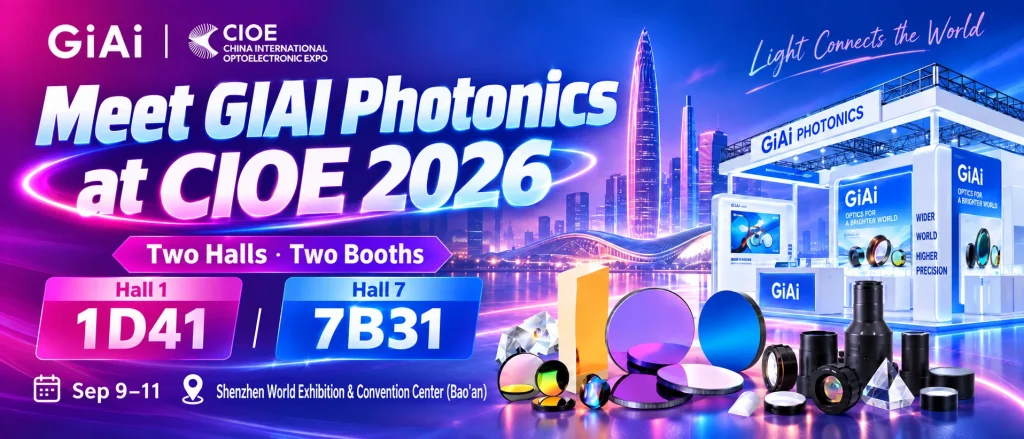
From September 9–11, 2026, the 27th China International Optoelectronic Exposition, CIOE 2026, will take place at the Shenzhen World Exhibition & Convention Center, Bao’an.
This year, GIAI Photonics will be exhibiting in two professional halls, each focusing on a different area of optical technology.
📍 Hall 1 · Booth 1D41
Camera Technology & Applications
📍 Hall 7 · Booth 7B31
Optical Vacuum Coating Hall
🚪 Recommended Entrance: South Lobby
If your work involves optical imaging, machine vision, lenses, cameras, sensing or optical system integration, Booth 1D41 is a good place to start.
If your project focuses more on optical filters, thin-film coatings, spectral performance, coating design or vacuum coating, visit us at Booth 7B31.
Our technical and sales teams will be available throughout the three-day exhibition.
[Insert CIOE exhibition poster here]
About CIOE 2026
CIOE 2026 is expected to cover approximately 260,000 m² and bring together more than 4,000 exhibitors, spanning information and communications, precision optics, camera technologies, laser manufacturing, infrared and ultraviolet technologies, intelligent sensing, displays, AR/VR and other optoelectronic fields.
For engineers working in optical design, R&D, manufacturing and system integration, one of the real advantages of a large exhibition is being able to discuss multiple parts of the optical system in one place.
Many projects eventually come down to very practical engineering questions.
Which wavelength should the filter target?
How should the center wavelength and bandwidth be defined?
Is OD3 or OD4 blocking sufficient, or is higher blocking required?
How much spectral shift will occur when the angle of incidence changes?
How should substrate material, surface quality, dimensional tolerance and coating design be matched?
And after the lenses, windows, mirrors, beamsplitters and filters are integrated into the final system, will the complete optical path still meet both imaging and spectral requirements?
These are exactly the kinds of questions we hope to discuss at our two CIOE booths.
Hall 1 · Booth 1D41
Camera Technology & Applications
If your project involves optical imaging, machine vision, camera systems, sensor-based inspection, medical imaging, consumer electronics or related optical applications, we welcome you to:
📍 Hall 1 · Booth 1D41
Hall 1 is part of the precision optics and camera technology exhibition area, covering optical lenses, image sensors, camera modules, camera systems and related supporting technologies.
In an imaging system, the lens and image sensor are only part of the optical chain.
Ambient light suppression, wavelength selection, infrared blocking, spectral enhancement, stray-light control and transmission matching can all directly affect final image quality.
In a typical machine vision project, engineers may need to consider:
What wavelength does the illumination source emit?
How does the target object reflect or absorb that wavelength?
How sensitive is the CMOS or CCD sensor in that spectral region?
Will ambient light introduce unwanted background noise?
How much will the filter spectrum shift at different angles of incidence?
And where should the filter be positioned—before the lens, inside the optical assembly, or closer to the sensor?
There is no single answer that works for every system.
The correct solution depends on the complete optical path, mechanical structure and real operating conditions.
If you already have a project in development, bring your application requirements, spectral specifications, drawings or existing samples to Booth 1D41. Discussing the actual system usually makes the evaluation much more efficient.
[Insert Hall 1 floor plan here]
📍 GIAI Photonics
Hall 1 · Booth 1D41
Hall 7 · Booth 7B31
Optical Vacuum Coating Hall
If your project is more focused on optical filters, thin-film coatings, coating design, spectral performance or vacuum coating, visit us at:
📍 Hall 7 · Booth 7B31
Hall 7 includes the Optical Vacuum Coating Hall, featuring optical coating materials, coated optical components, vacuum coating technologies and related manufacturing equipment.
For optical coating projects, a spectral curve usually represents a much larger set of engineering requirements, including:
- Center Wavelength, CWL
- Full Width at Half Maximum, FWHM
- Peak Transmission
- Blocking Range
- Optical Density, OD
- Angle of Incidence, AOI
- Substrate and Refractive Index
- Operating Temperature and Environment
- Surface Quality
- Clear Aperture
For interference-based components such as narrow bandpass filters, bandpass filters, longpass filters, shortpass filters, dichroic filters and beamsplitters, AOI, substrate properties and coating structure are closely coupled.
A common example is spectral shift.
As the angle of incidence increases, the spectrum of an interference filter typically shifts toward shorter wavelengths.
This means a filter that meets specification under standard measurement conditions may still behave differently after being installed in the real optical system if the actual working angle was not considered during the design stage.
So the key question is usually not simply:
“Can you make a filter at this wavelength?”
More useful questions include:
What system will the filter be used in?
What is the actual AOI?
Which wavelengths must have high transmission?
Which spectral regions require strong blocking?
What OD level is required?
And under what measurement conditions should the finished component be accepted?
These are the kinds of topics we can discuss at Booth 7B31.
[Insert Hall 7 floor plan here]
📍 GIAI Photonics
Hall 7 · Booth 7B31
What We Work On
GIAI Photonics provides optical components and coating solutions including:
Optical coatings, narrow bandpass filters, bandpass filters, infrared filters, longpass filters, shortpass filters, notch filters and neutral density filters, as well as optical prisms, lenses, windows, mirrors, beamsplitters and dichroic optics.
In real optical systems, these components rarely work independently.
Substrate material, thin-film coating, AOI, spectral response, mechanical structure and inspection conditions often need to be considered together.
For many applications, selecting an optical component is therefore part of the overall system engineering process.
Bring Your Drawings, Spectra or Samples
Your project does not need to be completely finalized before we talk.
A mechanical drawing, a target spectrum, an existing sample or even a specific optical problem can be enough to start a useful technical discussion.
If available, bringing the following information can make the conversation more productive:
- Product drawings, dimensions and tolerances
- Spectral curves, center wavelength and bandwidth
- Transmission requirements
- Blocking range and OD requirements
- Angle of incidence
- Substrate requirements
- Operating environment
- Estimated quantity
- Application details
Typical questions we often encounter include:
How can ambient light be suppressed in a 940 nm ToF system?
What bandwidth should be selected for a machine vision bandpass filter?
Why does the center wavelength of a narrow bandpass filter shift toward shorter wavelengths when the filter is tilted?
Is OD4 sufficient, or does the system require OD6 blocking?
Which substrate is suitable for an optical window?
What can be done when transmission meets the target but blocking performance is insufficient?
Why does the imaging result change after the same filter is used with a different lens?
Questions like these are often easier to solve when the real optical system, operating conditions and spectral requirements are discussed together.
Exhibition Information
📅 Event
The 27th China International Optoelectronic Exposition
CIOE 2026
⏰ Date
September 9–11, 2026
🏛 Venue
Shenzhen World Exhibition & Convention Center, Bao’an
📍 Booth 1
Hall 1 · 1D41
Camera Technology & Applications
📍 Booth 2
Hall 7 · 7B31
Optical Vacuum Coating Hall
🚪 Recommended Entrance
South Lobby
1D41 + 7B31 — See You in Shenzhen
From September 9 to 11, GIAI Photonics will be waiting for you at two locations:
Hall 1 · Booth 1D41
Hall 7 · Booth 7B31
If you are selecting optical filters, precision optical components or optical coating solutions, or if you are currently working through an imaging, spectral, material, AOI or coating-related problem, feel free to bring the details with you.
Bring your drawing.
Bring your spectral curve.
Bring your sample.
Let’s discuss the actual application.
September 9–11, Shenzhen.
GIAI Photonics looks forward to meeting you at CIOE 2026.