
Technical Resources
Hard Coated vs Soft Coated Optical Filters: Engineering Comparison
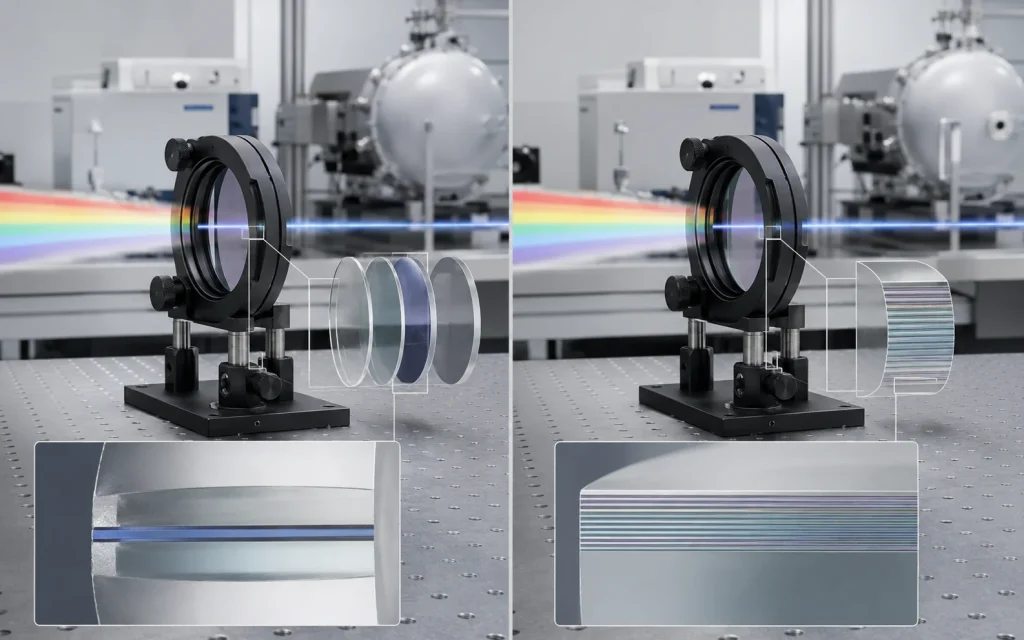
When engineers compare hard coated vs soft coated optical filters, the most important difference is not simply whether one coating feels physically harder than another. The terms describe two broad approaches to thin-film filter construction that differ in coating materials, deposition conditions, film density, environmental stability and, often, mechanical design.
Modern hard-coated filters generally provide better resistance to humidity, cleaning, handling and long-term environmental exposure. Traditional soft-coated filters can still provide useful spectral performance and remain relevant in some legacy systems, specialized wavelength regions and cost-sensitive designs. The correct choice therefore depends on the complete optical and environmental specification rather than the coating label alone.
What Is a Soft-Coated Optical Filter?
A soft-coated optical filter is generally an interference filter made from multilayer thin films deposited using traditional vacuum evaporation processes. Historically, some designs used combinations of relatively high- and low-index materials that produced strong refractive-index contrast and allowed complex spectral filtering.
The deposited films may be comparatively porous and mechanically delicate. Some coating materials can also respond to moisture in the environment. For these reasons, conventional soft coatings are often protected between glass plates rather than left directly exposed.
A typical soft-coated filter assembly may therefore contain:
- an optical substrate;
- one or more interference coating stacks;
- protective cover glass;
- cement or another bonding layer;
- and, in some designs, an absorptive glass component for additional out-of-band blocking.
The exact construction varies substantially. The term “soft coated” should therefore not be interpreted as one universal coating recipe.
What Is a Hard-Coated Optical Filter?
A hard-coated optical filter generally uses dense dielectric thin films deposited onto an optical substrate using processes designed to produce compact and mechanically durable layers. Common approaches can include ion-beam sputtering, magnetron sputtering, ion-assisted deposition and related energetic deposition technologies.
Modern hard coatings frequently use metal-oxide dielectric materials. High-energy deposition can produce films with substantially lower porosity than many traditional evaporated soft coatings, which improves resistance to environmental moisture and makes the exposed coating more suitable for normal optical handling and cleaning.
Some hard-coated filters use a single-substrate construction in which complex spectral filtering is achieved directly on one or both surfaces without placing the coating between protective glass plates. This can reduce the number of internal optical interfaces and eliminate some failure mechanisms associated with laminated assemblies.
However, not every hard-coated filter uses the same materials or deposition technology, and not every hard coating has identical mechanical or optical properties.
Hard Coated vs Soft Coated Optical Filters: Direct Comparison
| Engineering Factor | Hard-Coated Filter | Traditional Soft-Coated Filter |
|---|---|---|
| Coating structure | Usually dense dielectric multilayers | Typically evaporated multilayer films |
| Mechanical durability | Generally higher | Generally more delicate |
| Humidity resistance | Usually strong with dense coating systems | Can be more sensitive depending on film materials and protection |
| Cleaning | Often easier to clean when the coating is designed for exposed use | May require greater care, especially with exposed or older assemblies |
| Construction | May use single-substrate designs | Often protected or laminated between glass elements |
| Spectral capability | Can support narrow bands, steep transitions and deep blocking | Can also provide sophisticated spectral filtering |
| AOI sensitivity | Present because the filter still relies on thin-film interference | Present for the same fundamental reason |
| Long-term stability | Typically better in demanding environments | More dependent on coating protection and environmental conditions |
| Laser use | Potentially suitable, but LIDT must be specified separately | Requires application-specific evaluation |
| Typical selection driver | Reliability, stability, cleanability and precision systems | Legacy compatibility, particular spectral designs or other project constraints |
Does Hard Coating Provide Better Optical Performance?
Not automatically. This is one of the most important distinctions when comparing hard coating vs soft coating optical filters.
The coating category primarily describes aspects of the materials and manufacturing approach. Spectral performance is determined by the complete thin-film design and its manufacturing tolerances.
Relevant optical specifications include:
- center wavelength, or CWL;
- full width at half maximum, or FWHM;
- peak or average passband transmission;
- blocking wavelength range;
- optical density;
- edge steepness;
- passband ripple;
- angle of incidence;
- polarization;
- and temperature conditions.
Modern hard-coating processes can manufacture highly complex multilayer interference structures with high transmission, narrow bandwidths and deep blocking. Nevertheless, an engineer should never assume that a hard-coated filter automatically has higher transmission or stronger blocking than a particular soft-coated design.
The correct comparison is between measured spectral specifications under equivalent conditions.
Environmental Stability and Spectral Drift
Environmental stability is one of the major practical differences between the two coating approaches.
Porous thin films can interact with water vapor. Changes in the effective refractive index of the layers can alter the optical thickness of the coating and consequently move spectral features such as the passband or transition edge.
Dense modern dielectric coatings greatly reduce this mechanism and therefore tend to provide more stable optical behavior under changing humidity conditions.
Traditional protected filter assemblies can also experience other long-term effects related to adhesives, protective layers or interfaces. These issues are separate from the interference mechanism itself and depend on the exact construction.
For equipment expected to operate across temperature and humidity cycles, environmental durability should be specified and tested rather than inferred only from a product description.
Mechanical Durability and Cleaning
A hard coating is normally more resistant to routine handling and cleaning than a traditional exposed soft coating. This matters in laboratory instruments, machine vision systems, field sensors and production equipment where contamination may require periodic maintenance.
That does not mean a hard coating is immune to damage. Particles trapped beneath a cleaning wipe can still scratch an optical surface, aggressive chemicals may be incompatible with some materials, and incorrect handling can damage edges or substrates.
Cleaning procedures should therefore consider both the coating and substrate rather than relying solely on the word “hard.”
For applications where cleanability is a formal requirement, coating durability may be evaluated using defined abrasion, adhesion and moisture-resistance methods rather than subjective descriptions.
Angle of Incidence Still Matters
Hard coating does not eliminate the angular sensitivity of interference filters.
Interference-filter spectral behavior depends on the optical thickness of the multilayer stack as seen by the propagating light. When angle of incidence increases, the effective spectral response generally shifts toward shorter wavelengths. The magnitude of the shift depends on the filter design, materials and incidence geometry.
At larger angles, s- and p-polarized light can also experience different spectral responses. This polarization splitting becomes increasingly important in dichroic filters, edge filters and other components operated well away from normal incidence.
For this reason, a specification measured at 0° AOI should not automatically be applied to a system operating at 30°, 45° or within a converging beam.
When defining an interference filter, engineers should specify the nominal AOI, allowable angular range, cone angle and polarization state where relevant.
Substrate and Filter Construction Matter Too
The coating is only one part of a finished optical filter.
Substrate material affects wavelength range, absorption, thermal behavior, mechanical properties and potentially wavefront performance. A coating designed for visible wavelengths, for example, cannot make an otherwise absorbing substrate transparent in the ultraviolet or infrared.
Likewise, a laminated filter may introduce more optical interfaces than a single-substrate filter. Additional surfaces can influence reflection losses, ghost reflections and mechanical construction unless appropriate optical design measures are used.
For imaging applications, also consider substrate flatness, parallelism, surface quality and transmitted wavefront error. These specifications describe different properties and should not be treated interchangeably.
Hard Coatings and Laser Damage Threshold
Dense dielectric coatings are widely used in laser optics, and some hard-coated filters can withstand substantial optical irradiance. However, hard coating does not by itself specify laser-induced damage threshold.
LIDT depends on multiple factors including:
- wavelength;
- continuous-wave or pulsed operation;
- pulse duration;
- pulse repetition rate;
- beam diameter;
- spatial beam profile;
- incident angle;
- coating defects and contamination;
- substrate properties;
- and the actual coating design.
Reflectivity is also not a substitute for LIDT. A highly reflective coating can still have an unsuitable damage threshold for a particular laser.
Laser-system engineers should request an LIDT specification or test condition appropriate to the actual laser rather than selecting a filter only because it is described as hard coated.
When Hard-Coated Filters Are Usually Preferred
Hard-coated filters are particularly useful where long-term spectral stability and physical durability are important.
Fluorescence and Analytical Instruments
Fluorescence systems may require high transmission in relatively weak emission bands while strongly blocking much brighter excitation wavelengths. Stable spectral edges and blocking performance are therefore important over the operating life of the instrument. Durable coatings are also useful where intense illumination and regular maintenance are expected.
Machine Vision and Optical Sensors
Industrial imaging systems may operate continuously and may be exposed to dust, cleaning cycles or varying temperature and humidity. A mechanically robust coating can reduce maintenance risk, while the optical design must still be matched to the illumination wavelength, camera response and AOI.
Spectroscopy and Raman Systems
Spectroscopic systems often depend on narrow spectral transitions or strong rejection of unwanted wavelengths. Hard-coated filters can be well suited to these requirements, but the critical specification remains the actual spectral curve, especially around the signal and rejection bands.
Laser-Based Optical Systems
Hard dielectric coatings are commonly considered for laser-line filtering and beam separation. Selection must include wavelength, blocking, polarization, AOI and application-specific LIDT rather than coating hardness alone.
When a Soft-Coated Filter May Still Be Appropriate
Soft-coated filters should not be dismissed purely because a newer coating process exists.
A soft-coated or protected multilayer filter may remain reasonable when:
- an existing instrument was designed around a particular legacy filter;
- a required spectral characteristic is already validated with a specific construction;
- environmental exposure and handling are tightly controlled;
- replacement compatibility is more important than changing filter architecture;
- or the project has spectral, material or manufacturing constraints that favor another coating approach.
The important question is whether the finished filter meets the required spectral, mechanical and environmental specifications throughout its intended service conditions.
How to Specify the Coating for a New Optical Filter
For a new design, specifying only “hard coated filter” is usually insufficient. A useful engineering specification should begin with system performance.
Provide, where applicable:
- filter function: bandpass, longpass, shortpass, notch or dichroic;
- operating wavelength range;
- CWL and wavelength tolerance;
- required bandwidth or transition wavelengths;
- minimum passband transmission;
- blocking range and required optical density;
- AOI and angular tolerance;
- polarization state;
- beam cone angle;
- operating temperature and humidity;
- substrate requirements;
- dimensions and clear aperture;
- surface quality and flatness where relevant;
- cleaning or environmental durability requirements;
- and laser parameters if LIDT is important.
Hard Coated vs Soft Coated Optical Filters: Which Should You Choose?
For most modern instruments that require stable performance, frequent handling, environmental resistance and long service life, hard-coated optical filters offer important practical advantages. Dense coatings can reduce moisture sensitivity, withstand routine handling more effectively and support compact single-substrate filter designs.
That conclusion should not be extended into a claim that every hard-coated filter is optically superior to every soft-coated filter. Transmission, OD, bandwidth, spectral slope, AOI sensitivity, polarization behavior, wavefront quality and LIDT are separate engineering specifications.
The most reliable selection process is therefore to compare the complete filter specification under the wavelength, AOI, polarization, temperature and environmental conditions of the actual optical system.
Frequently Asked Questions
Are hard-coated optical filters always better than soft-coated filters?
No. Hard-coated filters generally provide better mechanical durability, environmental resistance and long-term stability, but the coating category alone does not determine spectral performance. A specific soft-coated filter may still satisfy an optical requirement or legacy-system constraint. Compare transmission, bandwidth, blocking, optical density, AOI, polarization, substrate, environmental requirements and other system-level specifications before selecting a filter.
What makes an optical filter coating “hard”?
A hard coating generally consists of dense dielectric layers produced using deposition processes capable of forming mechanically durable and environmentally stable films. Modern designs often use oxide materials deposited by sputtering or other energetic processes. “Hard” is an industry description of the coating technology and durability characteristics rather than a universal numerical hardness grade, so actual abrasion, adhesion and environmental performance should still be specified when they are important.
Do hard-coated filters have higher transmission?
Not necessarily. High transmission depends on the thin-film design, materials, layer control, substrate, wavelength range and manufacturing tolerances. Modern hard coatings can achieve very high transmission, but coating hardness itself does not establish a transmission value. Engineers should distinguish peak transmission from average passband transmission and compare spectral data measured under the intended angle of incidence and polarization conditions.
Are hard-coated optical filters less sensitive to angle of incidence?
No. Hard-coated interference filters still depend on multilayer interference and therefore remain sensitive to angle of incidence. Increasing AOI generally shifts spectral features toward shorter wavelengths, and at larger angles the responses for s- and p-polarized light can separate. Filters used at 45° or in converging beams should therefore be designed and evaluated for that geometry rather than specified only from normal-incidence spectral data.
Does a hard coating mean the filter has a high laser damage threshold?
No. Hard coatings are often mechanically and environmentally robust, but laser-induced damage threshold is a separate performance parameter. LIDT depends on wavelength, pulse duration, repetition rate, beam size, beam profile, coating design, substrate, AOI, defects and contamination. A laser filter should be evaluated using damage-threshold data or test conditions relevant to the actual laser rather than inferred from the coating type or reflectivity.
What information should be provided when specifying a hard-coated interference filter?
Start with the required optical function rather than the coating process. Specify the passband or edge wavelengths, transmission, blocking range, optical density, bandwidth, AOI, polarization and operating environment. Also include substrate, dimensions, clear aperture and mechanical requirements where relevant. For imaging systems, flatness and transmitted wavefront may matter; for laser systems, wavelength, power or pulse conditions and required LIDT should also be defined.