
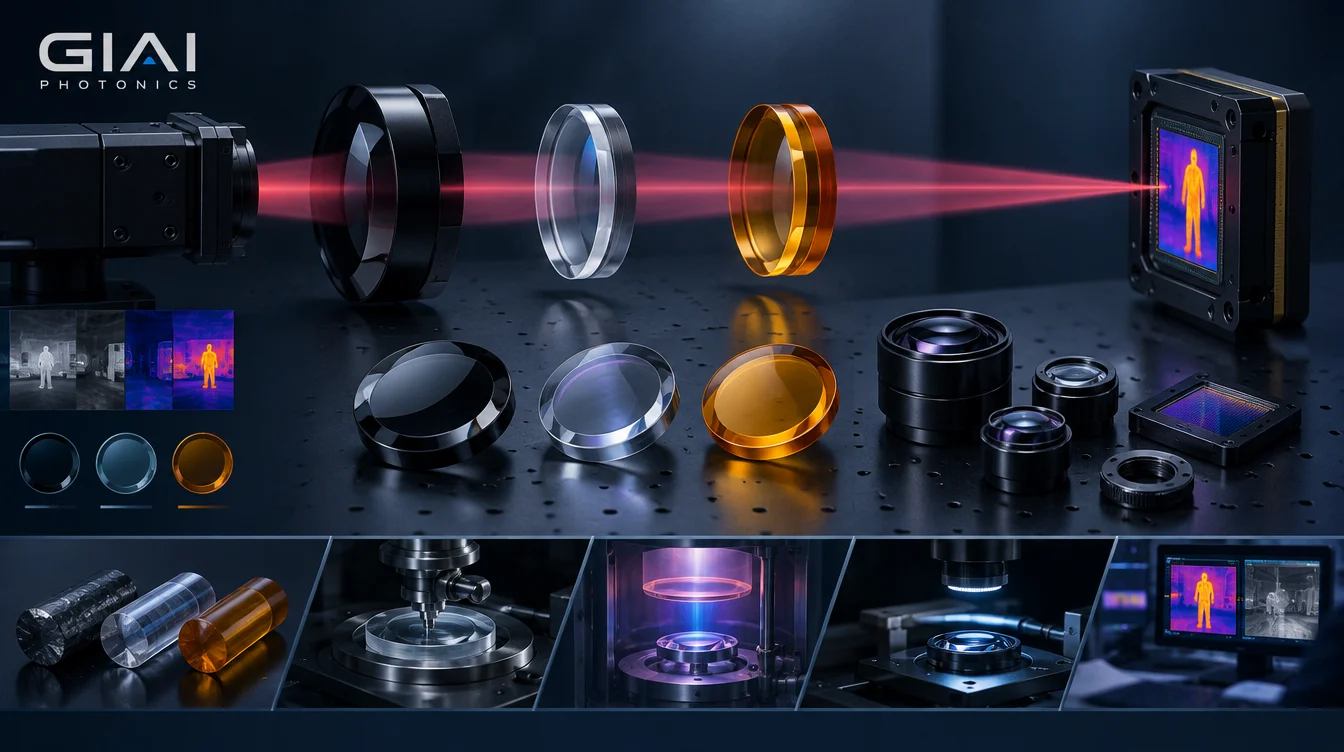
An infrared lens manufacturer should do more than machine a lens from an infrared-transparent material. The manufacturer must translate the complete system requirement—including wavelength band, detector, focal geometry, substrate, coating, operating environment and inspection criteria—into a manufacturable optical component.
For custom IR projects, specifying only “germanium lens,” “silicon lens,” or “infrared lens” is rarely enough. Material, lens geometry and coating must be evaluated together because a choice that works in one infrared system may be unsuitable in another.
What Should an Infrared Lens Manufacturer Actually Control?
Infrared lens manufacturing begins with the optical system, not with the blank material.
The first question should normally be:
What wavelength range must the finished lens transmit and what must it do in the system?
That answer affects nearly every later decision.
An imaging lens may need to focus radiation onto a specific detector format. A sensing optic may prioritize collection efficiency rather than image resolution. A laser focusing lens may place greater emphasis on absorption, coating behavior and beam geometry. A thermal imaging optic may have to maintain usable focus across a defined temperature range.
For that reason, an effective infrared lens specification normally connects several groups of requirements:
- operating wavelength or spectral band;
- optical function and detector or source;
- focal length, aperture and lens geometry;
- infrared material;
- AR or other optical coating;
- clear aperture and mechanical interface;
- surface and dimensional requirements;
- environmental conditions;
- inspection and acceptance criteria.
Infrared optics are particularly material-dependent because many glasses used in visible systems do not remain useful across longer infrared wavelengths. Materials such as germanium, silicon and ZnSe are therefore common in infrared engineering, but they have very different refractive indices, spectral behavior, thermal properties and mechanical characteristics.
Infrared Lens Material Selection Comes Before Manufacturing
There is no universally “best” infrared lens material. The correct choice depends first on the operating spectral region and then on the optical, thermal, mechanical and cost constraints of the system.
| Material | Why engineers consider it | Important design consideration |
|---|---|---|
| Germanium (Ge) | High refractive index and established use in infrared imaging systems | Thermal behavior, surface reflection and coating design require attention |
| Silicon (Si) | Useful for selected infrared bands and offers a high refractive index | The required band must be checked against actual material transmission |
| ZnSe | Broad infrared usefulness and common use in infrared laser optics | Material handling, surface durability and coating requirements matter |
| Sapphire | High mechanical durability with useful transmission in selected spectral regions | It is not a direct replacement for Ge or ZnSe across every IR band |
| MgF₂ | Useful over a broad optical range in suitable applications | Geometry, wavelength and coating requirements must be evaluated together |
The important point is not the material name by itself. Transmission range, refractive index, dispersion, thermo-optic behavior, absorption, mechanical properties and coating compatibility all influence the finished optical system. RP Photonics likewise notes that infrared material choice must account for transmission bands, refractive index, dispersion, thermal effects and mechanical properties rather than spectral transparency alone.
GIAI’s controlled project references currently identify infrared lenses, windows, filters and related IR components as supported product directions, with materials including silicon, germanium, ZnSe, sapphire and MgF₂ among the disclosed optical-material range. The material still has to be matched to wavelength, geometry, coating and operating environment for the individual project.
The Lens Prescription Must Be Manufacturable
Once the material and wavelength region are established, the lens itself has to be defined.
For a simple custom singlet, the drawing may specify parameters such as diameter, center thickness, radii, clear aperture, edge geometry and mechanical tolerances. Depending on the application, focal length, back focal length or other optical requirements may also need to be controlled.
A multi-element infrared imaging lens introduces another level of system interaction. Focal length, f-number, field of view, detector format, distortion, aberration control, element spacing and image-performance requirements cannot be treated as isolated specifications.
This is why the drawing or optical prescription should remain the primary technical reference whenever one is available.
If a complete drawing is not yet available, the manufacturer still needs enough system information to determine which parameters must be defined before production.
GIAI’s current custom-optics workflow allows projects to begin from drawings, specifications or samples, with the manufacturing route reviewed against the optical and mechanical requirements rather than applying one standard process to every component.
AR Coating Is Part of the Infrared Lens Specification
Coating should not be treated as an optional finishing detail.
Many infrared materials have substantially higher refractive indices than conventional visible optical glasses. That can create significant Fresnel reflection at an uncoated air-to-lens interface.
For a simple illustrative case at normal incidence:
If the refractive index were , the theoretical reflection from one uncoated interface would be approximately 36%, before considering material absorption, the second surface or multiple internal reflections.
This does not mean that every infrared lens loses 36% at every surface. Refractive index varies with material and wavelength, and actual system transmission also depends on geometry, absorption and coating. The example simply shows why coating design can be critical for high-index infrared optics.
An IR anti-reflection specification should therefore define the wavelength range rather than merely state “AR coated.” Depending on the system, angle of incidence, polarization, environmental exposure and acceptable transmission or reflection may also matter. The importance of AR treatment for high-index germanium and silicon optics has long been established in optical-coating literature.
Infrared Lens Manufacturing Is a Process Chain
A finished IR lens is the result of several connected manufacturing steps rather than one polishing operation.
The exact route depends on material, geometry and specification. GIAI’s currently verified public manufacturing scope includes material preparation, initial shaping, milling and grinding, precision grinding, optical polishing, cleaning, edging or geometry processing, optical coating, inspection and—where applicable—assembly. Not every part passes through every one of these operations.
That distinction is important when evaluating an infrared lens manufacturer.
The process should follow the component rather than forcing every optic into the same manufacturing flow. For example, changing the substrate, surface geometry, coating specification or clear aperture may change both fabrication and inspection requirements.
Inspection Criteria Should Be Defined Before Production
A finished infrared lens cannot be evaluated from appearance alone.
The acceptance plan should follow the optical drawing and the characteristics that affect the actual system.
Depending on the component, relevant checks may include dimensions, thickness, edge geometry, clear aperture, surface condition, coating coverage and other drawing-controlled characteristics. Optical verification should then address whichever properties have actually been specified for the part.
For a coated infrared optic, that may include wavelength-dependent transmission or reflection. For an imaging component, geometric and optical-performance requirements may require different inspection methods.
GIAI’s current quality framework follows this project-specific approach: requirement review is performed before manufacturing, relevant characteristics are checked during processing, and final verification is tied to the agreed optical, dimensional and appearance requirements.
The practical implication is simple:
Do not ask only whether a manufacturer “tests infrared lenses.” Ask whether the inspection method and acceptance criteria correspond to the requirements that matter in your system.
How to Evaluate an Infrared Lens Manufacturer
For engineering procurement, a manufacturer can be evaluated by the questions it asks before quotation.
| Evaluation area | What should be clarified |
|---|---|
| Wavelength | Operating band rather than only “IR” |
| Optical function | Imaging, focusing, collimation, collection or sensing |
| Detector / source | Relevant detector band, source spectrum or laser wavelength |
| Material | Grade and material suitability for the target spectrum |
| Geometry | Drawing, radii, thickness, diameter and mechanical interfaces |
| Coating | Spectral range, AOI and required transmission/reflection |
| Environment | Temperature and other relevant operating conditions |
| Inspection | Acceptance criteria and required reports |
| Production stage | Prototype, validation or repeat production |
A supplier that immediately quotes an “infrared lens” without clarifying the wavelength, material and optical function may still be able to manufacture the physical shape, but those inputs are insufficient to establish whether the component will work correctly in the final system.
GIAI Photonics as an Infrared Lens Manufacturer
GIAI Photonics supports precision optical components and custom optics projects, including optical lenses and infrared optics. Current disclosed infrared product directions include infrared lenses, infrared windows, infrared filters and related IR optical components.
The currently published material scope includes silicon, germanium, ZnSe, sapphire, MgF₂ and other optical materials. This should not be interpreted to mean that every material can be produced to identical dimensions, tolerances or optical specifications. Feasibility is evaluated at project level.
For a custom infrared lens project, GIAI reviews the available drawing, sample or specification together with the wavelength, material, component geometry, coating conditions and inspection criteria before defining the manufacturing route. This same engineering-first workflow is also reflected on GIAI’s current Manufacturing Capabilities page.
What to Send With an Infrared Lens RFQ
For a more useful technical review, send as much of the following information as is available:
- Required wavelength or spectral band.
- Lens drawing, optical prescription or existing sample.
- Preferred infrared material or allowable alternatives.
- Diameter, thickness, radii and other critical geometry.
- Optical function, focal requirement or system information.
- Coating requirement and operating AOI where relevant.
- Clear aperture, surface and mechanical requirements.
- Operating temperature or other environmental conditions that affect performance.
- Inspection and documentation requirements.
- Prototype quantity and expected production quantity.
These inputs are consistent with GIAI’s controlled project-review logic, which treats optical function, material, geometry, coating, inspection and order stage as connected requirements rather than separate purchasing fields.
If the project is still at an early stage, the starting information does not have to be perfect. A drawing, existing lens sample, target wavelength, detector information or preliminary system specification can be used to identify what still needs to be defined before manufacturing.
FAQ
What materials are commonly used for infrared lenses?
Common infrared optical materials include germanium, silicon, ZnSe, sapphire and various other crystals or specialty infrared glasses. The appropriate choice depends on wavelength, optical design, temperature, mechanical requirements and coating strategy. A material that works well in one infrared band may not be appropriate for another.
Is germanium always the best material for an infrared lens?
No. Germanium is important in infrared imaging, but material selection should not be based on popularity alone. Silicon, ZnSe and other infrared materials can offer different spectral, thermal, mechanical and system-level trade-offs. The detector band and operating environment should be defined before selecting the substrate.
Why do infrared lenses often need AR coatings?
Many IR materials have relatively high refractive indices, which can create substantial surface reflection. A suitable AR coating can reduce reflection over the intended wavelength region, but its performance depends on coating design, substrate, wavelength and operating conditions.
Can an infrared lens be manufactured from an existing sample?
A physical sample can be useful as an engineering reference, especially when the original drawing is unavailable. However, a sample does not automatically reveal all material, coating or optical-performance requirements. GIAI’s current custom project process allows sample-based review together with available application and specification information.
What is the most important information to give an infrared lens manufacturer?
Start with the operating wavelength, optical function, material preference, drawing or geometry, coating requirements and intended system. Inspection requirements and production quantity should then be added so that manufacturing feasibility and acceptance criteria can be reviewed together.