
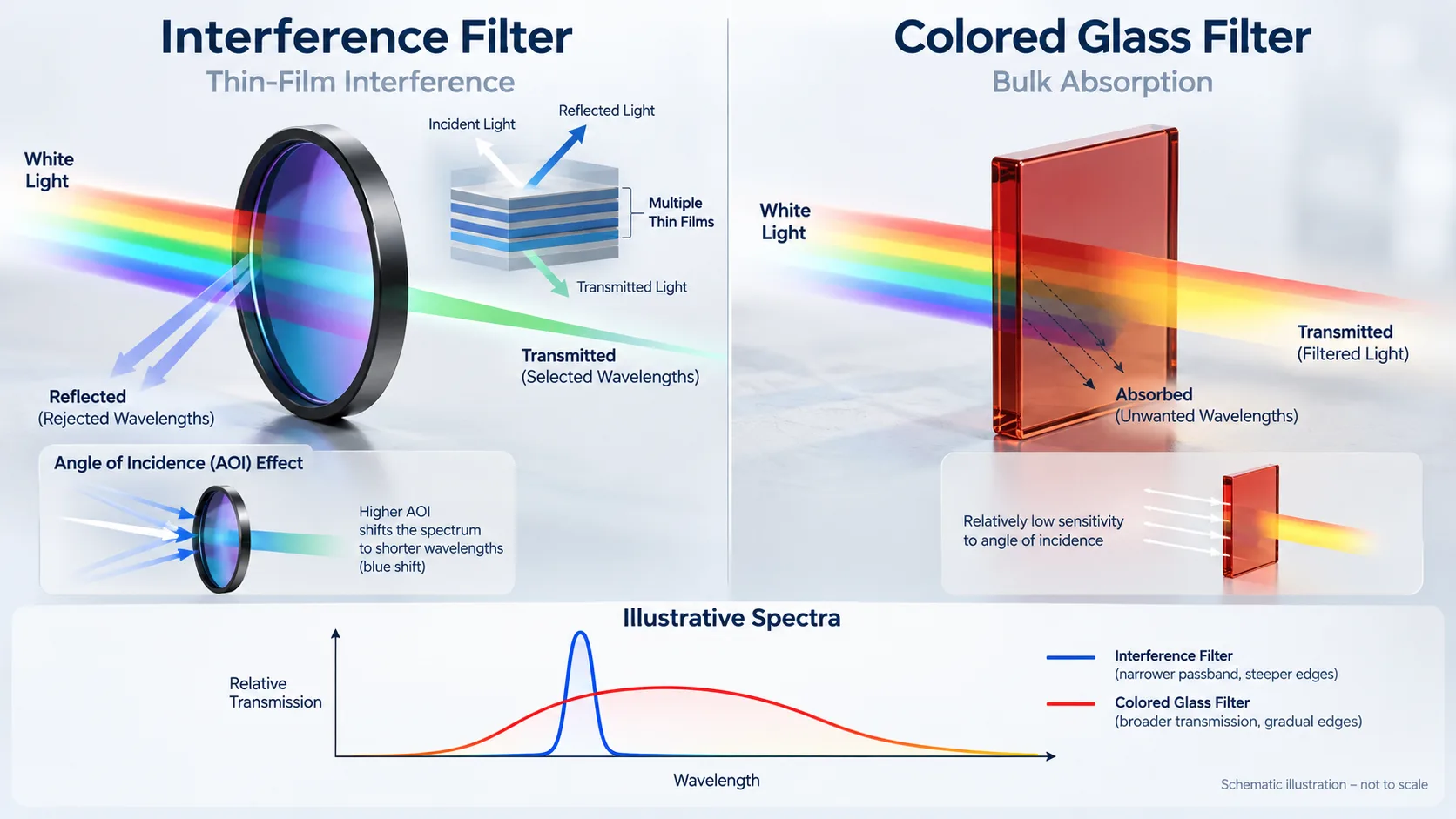
When an optical system needs to transmit one wavelength range and suppress another, both interference filters and colored glass filters may appear to solve the same problem. They do not, however, control light in the same way.
A colored glass filter primarily relies on wavelength-dependent absorption inside the glass, while an interference filter uses multiple thin-film layers and optical interference to create the required transmission and blocking spectrum.
That difference affects almost every engineering decision that follows: spectral edge steepness, bandwidth, blocking range, angle-of-incidence sensitivity, filter thickness, thermal behavior, cost, and manufacturability.
For a broad illumination or imaging requirement, colored glass may be sufficient. When the system needs a defined center wavelength, narrow FWHM, steep spectral edges, or controlled out-of-band blocking, a thin-film interference filter is often the more appropriate architecture.
Quick Comparison: Interference Filter vs Colored Glass Filter
| Parameter | Interference Filter | Colored Glass Filter |
|---|---|---|
| Filtering mechanism | Thin-film optical interference | Bulk material absorption |
| Spectral selectivity | Can be very high | Usually broader |
| Narrow bandpass capability | Well suited | Limited |
| Edge steepness | Can be relatively steep | Usually more gradual |
| AOI sensitivity | Significant | Much lower |
| Spectral shift with tilt | Yes, typically toward shorter wavelengths | Generally small |
| Thickness effect | Mainly mechanical/substrate-related; coating defines spectrum | Thickness directly affects transmission and blocking |
| Blocking mechanism | Primarily reflection plus some absorption depending on design | Absorption |
| Thermal loading | Rejected light may be largely reflected | Absorbed radiation can become heat |
| Design flexibility | High | Determined strongly by available glass composition |
| Typical cost | Usually higher for complex specifications | Often economical for broad spectral filtering |
| Typical applications | Sensing, fluorescence, machine vision, laser systems, spectroscopy | Imaging, color correction, broad longpass/shortpass filtering, detector protection |
These are general engineering tendencies rather than universal performance guarantees. Actual behavior depends on the specific coating design, glass type, thickness, wavelength range, AOI, polarization, and operating environment.
How Does a Colored Glass Filter Work?
A colored glass filter is an absorptive optical filter. Its glass composition contains constituents that absorb selected regions of the spectrum while transmitting others.
SCHOTT describes optical filter glass as glass specifically engineered for selective spectral absorption. Its published technical information also shows that changing glass thickness changes spectral blocking behavior.
Conceptually:
incident light → wavelength-dependent absorption in the glass → transmitted spectrum
This makes thickness an important design variable.
If the glass thickness increases, absorption at wavelengths where the material has a non-zero absorption coefficient generally increases. The result may be stronger blocking, but transmission within other parts of the spectrum can also change.
Therefore, specifying only a glass type is often insufficient. An engineering drawing or RFQ should normally define the required glass type, thickness, dimensions, transmission range, and blocking requirement.
Where colored glass performs well
Colored glass is particularly useful when the system needs:
- broad longpass or shortpass behavior,
- broad color correction,
- relatively low sensitivity to AOI,
- simple spectral shaping,
- economical filtering over comparatively broad wavelength ranges.
One major practical advantage is angular behavior. Because the spectral function is primarily generated through absorption rather than a multilayer interference cavity, colored glass does not exhibit the same pronounced AOI-induced spectral shift seen in interference filters. This can be useful with wide-angle imaging systems or divergent light.
Its limitation is spectral precision. Absorptive glass generally cannot reproduce the narrow passbands and very steep transitions achievable with a purpose-designed multilayer interference coating.
How Does an Interference Filter Work?
An interference filter uses alternating thin-film layers with controlled refractive indices and optical thicknesses.
Each interface reflects part of the incident optical field. The coating is designed so that these reflected and transmitted waves undergo constructive or destructive interference at selected wavelengths.
The result can be engineered to produce functions such as:
- narrow bandpass,
- broadband bandpass,
- shortpass,
- longpass,
- notch,
- dichroic separation,
- multi-band transmission.
The spectrum is therefore determined largely by the thin-film stack, rather than by absorption in the bulk substrate.
Interference filters offer much greater freedom to define center wavelength, bandwidth and spectral transitions than ordinary absorptive glass. RP Photonics notes that multilayer interference filters can provide a wide range of spectral characteristics because many coating parameters can be adjusted during design.
This is why interference filters are common in applications where the optical system must isolate a relatively specific spectral signal from a stronger background.
Spectral Selectivity: The Most Important Difference
Suppose a detector needs to measure radiation near one wavelength while rejecting broadband ambient light.
A colored glass filter may reduce a large portion of unwanted radiation, but its transition region may remain relatively broad.
An interference filter can instead be designed around specifications such as:
- Center Wavelength — CWL
- Full Width at Half Maximum — FWHM
- minimum or average passband transmission
- cut-on / cut-off wavelength
- blocking wavelength range
- Optical Density — OD
- AOI
- polarization
For narrowband sensing, fluorescence, laser detection or spectral measurement, this additional control can be decisive.
For example, a filter requirement such as:
transmit a narrow signal band while maintaining specified blocking across a much wider detector-sensitive range
is fundamentally different from:
remove most wavelengths below a broad spectral edge.
The first usually points toward an interference design. The second may be achievable with colored glass.
Angle of Incidence: A Major Interference-Filter Constraint
AOI is one of the most important differences between the two filter families.
When the AOI of a multilayer interference filter increases, its spectral features generally shift toward shorter wavelengths, commonly called a blue shift. At larger angles, the passband shape can also change, and s- and p-polarized light may behave differently.
Hard-coated bandpass filter documentation similarly shows that non-normal incidence can change both center wavelength and passband shape, with narrow filters being particularly sensitive.
This means an interference filter should not be specified only as:
“850 nm filter”
A useful specification needs to state how the filter is actually illuminated.
Important inputs include:
- nominal AOI,
- AOI tolerance,
- collimated or converging/diverging beam,
- cone half-angle or system NA where relevant,
- polarization state if relevant.
This issue becomes especially important with wide-angle machine-vision lenses. Rays from different field positions can reach a filter at different incidence angles, producing different spectral responses across the image field.
Colored glass is considerably less sensitive to this effect and may therefore be preferable where spectral precision is moderate but the angular distribution is large.
Thickness Matters Differently
Thickness has a different engineering meaning for the two technologies.
Colored glass
The filter material itself produces the absorption.
Changing thickness can therefore directly change:
- transmission,
- blocking,
- apparent spectral edge,
- optical density.
Published filter-glass data are consequently associated with defined sample thicknesses. SCHOTT’s filter-glass technical information explicitly treats thickness as a parameter affecting blocking performance.
Interference filter
For an interference filter, the wavelength-selective function is primarily established by the thin-film coating design.
The substrate thickness still matters mechanically and optically—for mounting, flatness, transmitted wavefront, weight, and integration—but simply making the substrate thicker does not tune the passband in the same way that increasing absorptive-glass thickness changes its blocking.
What Happens to Rejected Light?
This distinction can matter in systems with substantial optical power.
A colored glass filter removes unwanted wavelengths largely through absorption. Part of that absorbed optical energy becomes heat in the glass.
An interference filter commonly rejects a significant portion of unwanted wavelengths by reflection.
That difference can affect:
- filter temperature,
- thermal gradients,
- nearby detector heating,
- illumination-system architecture.
However, it should not be assumed that every interference filter is automatically suitable for high-power operation. Coating absorption, substrate material, wavelength, beam size, CW or pulsed operation and laser-induced damage requirements all need separate evaluation.
For laser applications, LIDT should therefore be treated as an explicit project specification, not inferred solely from the filter type.
Which Filter Gives Better Blocking?
There is no useful universal answer without defining the wavelength range.
Colored glass can produce substantial attenuation where the material strongly absorbs, and greater thickness can increase attenuation.
Interference coatings provide greater freedom to engineer specific blocking regions and transition slopes.
For demanding systems, the relevant question is not simply:
“What is the OD?”
It is:
“What blocking level is required, over which wavelength range, at what AOI, and under what measurement conditions?”
This distinction is particularly important because a detector may remain sensitive far outside the nominal passband.
A narrow passband with excellent nearby rejection can still produce poor system-level signal-to-noise ratio if an unblocked spectral leak overlaps a strong light source or a sensitive detector region.
Can Colored Glass and Interference Coatings Be Used Together?
Yes.
The technologies are not mutually exclusive.
An absorptive glass can serve as the substrate or an additional blocking element in a coated optical filter. This allows the designer to combine bulk absorption with thin-film interference.
Possible reasons include:
- extending out-of-band blocking,
- suppressing secondary transmission regions,
- reducing unwanted spectral leakage,
- combining broad absorption with a precise interference edge.
The final architecture should be evaluated as a complete optical system rather than assuming either technology has to operate alone.
Typical Application Choices
Machine Vision
If the requirement is broad color enhancement or suppression and the lens has a large angular field, colored glass may be adequate.
If illumination is centered around a specific LED or laser wavelength and ambient-light rejection is critical, an interference bandpass filter may provide substantially better spectral discrimination.
Fluorescence Detection
Fluorescence systems often need to separate relatively weak emission from much stronger excitation light.
Defined passbands, steep spectral transitions and deep blocking therefore commonly make interference filters the preferred architecture.
Laser Sensing
When detecting a narrow laser wavelength against solar or broadband background radiation, a narrowband interference filter can improve spectral discrimination.
AOI, FWHM, CWL, polarization and blocking range should all be defined as part of the receiver design.
General Imaging
Where broad color control is sufficient and rays reach the filter across a relatively wide angular range, colored glass can offer a simple and robust solution.
High Optical Flux
The choice requires thermal analysis. An absorptive filter may convert substantial rejected radiation into heat, while an interference design may reflect much of that radiation elsewhere in the system.
Neither approach should be selected solely from the transmission curve.
How to Choose Between an Interference Filter and Colored Glass
A useful selection sequence is to begin with the optical requirement rather than the filter technology.
Choose colored glass when:
- broad spectral filtering is sufficient;
- the spectral edge does not need to be extremely steep;
- the optical system contains a wide range of incidence angles;
- filter thickness can be used as part of the spectral design;
- cost and simplicity are important.
Consider an interference filter when:
- a defined CWL is required;
- the passband must be narrow;
- FWHM is an important specification;
- steep cut-on or cut-off behavior is required;
- out-of-band blocking must be engineered over a specified range;
- signal-to-background ratio is critical.
For interference designs, the system geometry must also be included in the specification.
What Should Be Included in an RFQ?
For either filter type, avoid sending only a nominal wavelength such as “650 nm filter” or “850 nm filter.”
A more useful filter specification includes:
- optical function: bandpass, longpass, shortpass, notch, etc.;
- center wavelength or spectral range;
- FWHM where applicable;
- passband transmission;
- blocking range;
- required OD;
- substrate or acceptable material;
- dimensions and thickness;
- clear aperture;
- AOI;
- cone angle or NA if relevant;
- polarization if relevant;
- operating environment;
- inspection and acceptance requirements;
- prototype and expected production quantity.
GIAI’s current engineering workflow supports custom optical projects based on drawings, specifications or samples, with manufacturing routes reviewed against material, geometry, coating and inspection requirements. Project-level review should include wavelength, transmission, blocking, substrate, geometry, AOI and acceptance criteria rather than assuming one standard filter configuration fits every system.
Interference Filter vs Colored Glass Filter: The Engineering Decision
The fundamental difference is straightforward:
Colored glass controls the spectrum mainly through absorption in the material. Interference filters control it primarily through wavelength-selective thin-film interference.
That difference determines their practical strengths.
Colored glass is useful when broad spectral filtering, angular tolerance, simplicity and cost are priorities. Interference filters provide much greater spectral design freedom when an application requires narrow bandwidth, steep transitions or controlled blocking.
Neither technology is inherently the correct choice for every optical system.
The correct filter is the one whose measured spectral behavior matches the actual source, detector, wavelength range, AOI, beam geometry, environment and acceptance criteria of the application.