
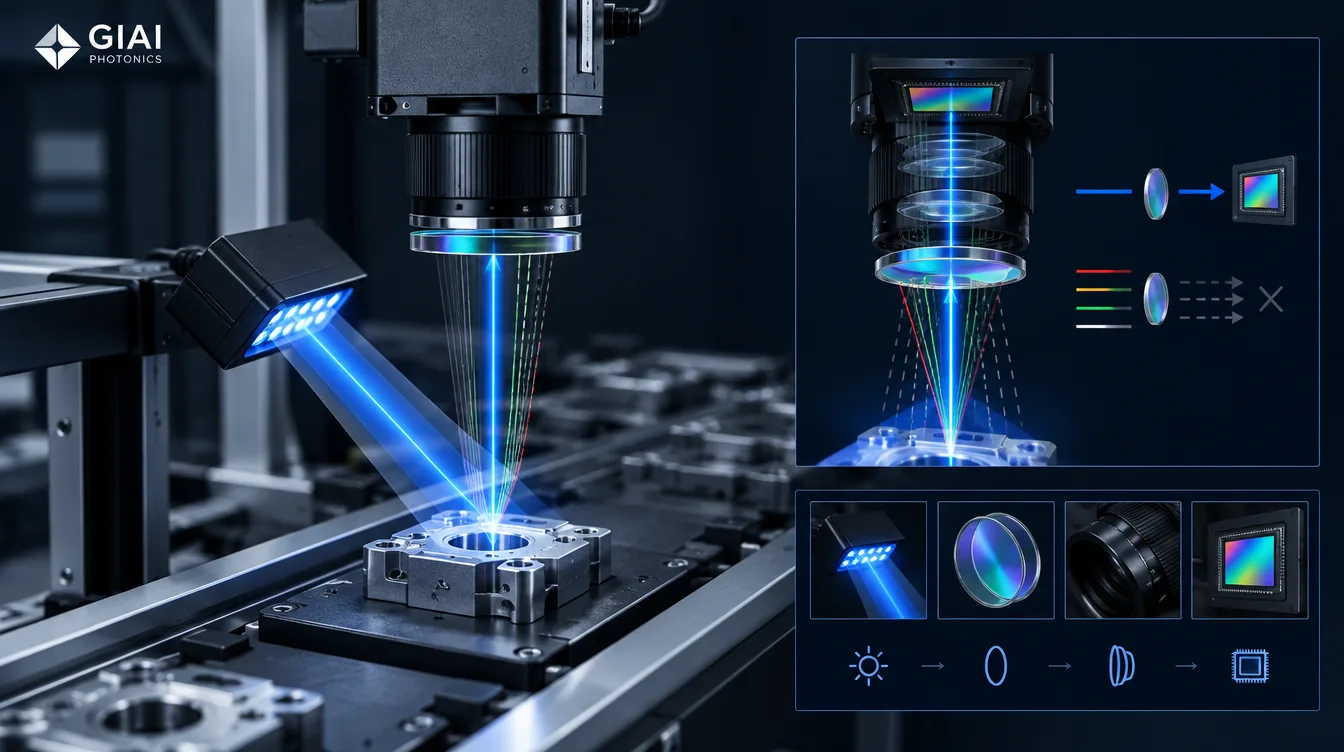
A machine vision filter manufacturer should do more than manufacture a filter around a nominal wavelength. The filter must be evaluated together with the illumination spectrum, camera sensor response, lens geometry, angle of incidence, required blocking range, mechanical integration, and inspection conditions.
GIAI Photonics supports precision optical components and custom optical projects, including optical filters and optical coatings, with project review based on drawings, specifications, samples, materials, geometry, coating conditions, and inspection requirements. Machine vision and industrial inspection are among the application areas identified in GIAI’s current project references.
What Should a Machine Vision Filter Actually Do?
In a machine vision system, the optical filter is normally used to improve the spectral separation between the information the camera needs and the light that does not contribute to the inspection.
A typical example is a camera illuminated by a defined LED wavelength. A properly selected bandpass filter can transmit the useful wavelength region while reducing unrelated ambient light reaching the sensor. Longpass and shortpass filters can instead separate broader spectral regions, while IR-cut filters are useful where unwanted near-infrared response interferes with visible imaging.
The engineering objective is therefore not simply:
“block as much light as possible.”
It is:
maximize useful image information while controlling unwanted spectral energy without unnecessarily reducing the signal.
This distinction matters because the filter, illumination, detector, lens, and inspected object form one optical system.
Machine Vision Filter Types and Where They Fit
Different inspection problems require different spectral strategies.
| Filter Type | Typical Engineering Function | Machine Vision Consideration |
|---|---|---|
| Bandpass filter | Pass a defined wavelength region while rejecting wavelengths outside it | Common when illumination is based on a selected LED, laser, fluorescence signal, or NIR source |
| Narrow bandpass filter | Increase spectral selectivity around a narrower signal | Useful when unwanted broadband illumination must be suppressed, but AOI and source wavelength variation become more important |
| Longpass filter | Pass wavelengths above a cut-on region | Useful for separating longer-wavelength signals from visible or shorter-wavelength illumination |
| Shortpass filter | Pass wavelengths below a cut-off region | Can suppress red or NIR energy when shorter wavelengths are required |
| IR-cut filter | Reduce unwanted NIR reaching a visible imaging sensor | Common where sensor NIR sensitivity affects visible imaging or color response |
| Neutral density filter | Reduce optical power over a defined spectral region | Useful when exposure or signal level must be controlled without relying only on camera settings |
| Color / absorptive filter | Enhance spectral or color contrast | Can be useful for monochrome inspection and applications where wide angular acceptance is important |
| Polarization filter | Manage reflection and glare rather than wavelength alone | Often combined with polarized illumination for inspecting reflective surfaces |
Optical filtering can improve machine vision contrast by suppressing illumination that does not contribute to the feature being inspected. Polarization is a related but different approach: crossed polarization can reduce reflections from many glass, plastic, and painted surfaces, although the effect depends strongly on the material and geometry.
Match the Filter to the Illumination and Sensor
One of the most common machine vision specification errors is treating the filter wavelength as an isolated parameter.
Suppose the system uses an LED nominally centered around a particular wavelength. The filter passband has to account for the actual LED spectrum, wavelength tolerance, operating temperature, camera sensitivity, optical geometry, and the required signal margin.
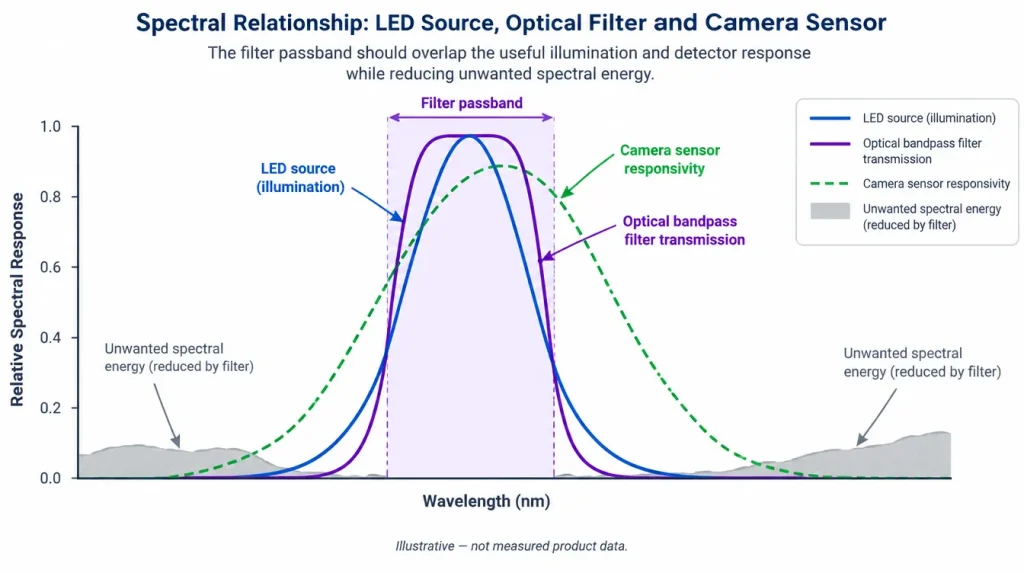
Making the passband narrower does not automatically improve the system.
A very narrow filter may reduce broadband background more effectively, but it can also reduce useful signal if the source spectrum and filter passband do not overlap sufficiently under real operating conditions.
For this reason, filter selection should consider three spectral functions together:
illumination spectrum → filter transmission → detector response
The detector response matters because blocking wavelengths where the detector has little or no useful sensitivity may provide limited system benefit, while insufficient blocking inside a highly sensitive detector region may significantly affect image contrast.
The same principle applies to the blocking specification. “OD4” or another optical-density value is incomplete unless the wavelength range over which that blocking must apply is also defined.
Why AOI Matters in Machine Vision Filters
Angle of incidence is especially important for interference filters.
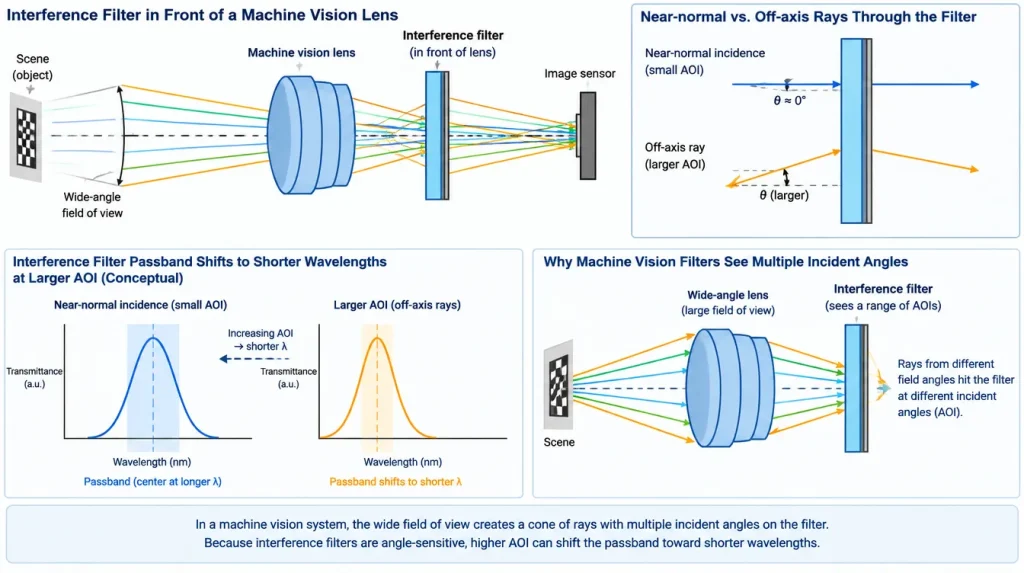
An interference filter is normally designed and characterized at a defined AOI. As AOI increases, its spectral response can shift toward shorter wavelengths. The passband shape can also change. This effect becomes increasingly important when the filter has a narrow spectral band.
Machine vision systems make this more complicated because the filter may not receive a single collimated ray.
If the filter is mounted in front of a wide-angle lens, rays from different field positions can arrive at different angles. The effective angular distribution therefore depends on factors such as lens field of view, aperture, filter position, and optical geometry.
A custom machine vision filter specification should therefore identify, when relevant:
nominal AOI, expected angular range, lens geometry, and filter mounting position.
Ignoring these conditions can produce a filter that performs correctly during a normal-incidence spectral measurement but behaves differently after installation.
Blocking Should Be Defined as a Range, Not Just an OD Number
Blocking is another area where incomplete RFQs create unnecessary redesign cycles.
Instead of specifying only:
OD4 blocking
a useful specification should define:
required blocking level + wavelength interval + measurement conditions.
The required range depends on the light source, ambient spectrum, camera response, optical path, and inspection objective.
More blocking is also not automatically better if the additional blocking does not solve a real system problem. Higher blocking requirements may increase coating complexity or constrain the achievable combination of transmission, bandwidth, angular performance, and cost.
The manufacturer therefore needs to understand what light must be rejected and why.
There is also a physical limitation worth recognizing: a spectral filter cannot distinguish wanted and unwanted light at exactly the same wavelength. If glare, stray reflection, or background illumination overlaps the useful signal spectrally, the solution may also require lighting geometry, polarization, baffling, exposure control, or other optical changes.
What to Evaluate in a Machine Vision Filter Manufacturer
For an OEM or machine vision integrator, manufacturer evaluation should focus on whether the optical requirements can be translated into a controlled, measurable component rather than on a generic list of filter types.
Optical requirement review
The manufacturer should understand CWL, FWHM, cut-on or cut-off wavelength, transmission, blocking range, optical density, AOI, polarization when applicable, substrate, clear aperture, and operating environment.
More importantly, those parameters should be reviewed as a system rather than independently.
Coating and optical fabrication
A filter project may involve substrate preparation, optical fabrication, geometry processing, cleaning, coating, and inspection. The exact route depends on the component.
GIAI’s currently documented manufacturing scope includes optical filters and custom coated optics. Publicly documented processes include material preparation, shaping, grinding, precision grinding, optical polishing, cleaning, edging and geometry processing, optical coating, inspection, and selected assembly operations where applicable. Not every component necessarily passes through every process.
Mechanical integration
A spectrally correct filter can still fail as a component if the mechanical definition is incomplete.
Important inputs may include diameter or rectangular dimensions, thickness, clear aperture, edge geometry, coated area, mounting orientation, and other drawing requirements.
If the filter is installed directly in front of a machine vision lens, the available space and filter location should be defined early.
Inspection under relevant conditions
Visual inspection alone cannot verify the spectral function of a machine vision filter.
Depending on the specification, optical verification may involve transmission, reflection, blocking, operating wavelength, CWL, FWHM, cut-on/cut-off behavior, OD, AOI, or other project-defined characteristics. Measurement conditions should correspond to the agreed specification and intended application.
For custom optical projects, GIAI’s quality workflow is based on requirement review, appropriate process inspection, optical verification, final inspection, and handling or packaging according to the specific part requirements.
Information to Send With a Machine Vision Filter RFQ
A useful RFQ does not have to begin with a complete optical drawing. However, providing the system conditions greatly reduces ambiguity.
| RFQ Input | What to Provide |
|---|---|
| Inspection objective | Feature to detect, measure, classify, or suppress |
| Illumination | LED, laser, broadband or other source; wavelength and spectral width if known |
| Camera | Monochrome or color; sensor model or spectral response if available |
| Lens | Lens type, focal length, field of view and filter position when relevant |
| Filter function | Bandpass, longpass, shortpass, IR-cut, ND or other spectral requirement |
| Passband | CWL/FWHM or required transmission wavelength range |
| Transmission | Required transmission target and applicable wavelength range |
| Blocking | Required OD or rejection target together with the blocking wavelength range |
| AOI | Nominal incidence angle and expected angular range |
| Polarization | State whether polarization sensitivity is relevant |
| Substrate | Required material, or allow the manufacturer to evaluate options |
| Geometry | Diameter/length/width, thickness, shape, clear aperture and edge requirements |
| Environment | Temperature, humidity, cleaning, mechanical or other operating conditions if relevant |
| Inspection | Required measurement method, report, sampling rule or acceptance criteria |
| Quantity | Prototype, validation batch, or production quantity |
GIAI evaluates custom optical projects against the drawing or sample, optical requirements, material, geometry, coating conditions, inspection criteria, quantity, and other project inputs before defining the manufacturing route.
Common Machine Vision Filter Specification Mistakes
Several recurring specification problems can be avoided before requesting a quote:
- Specifying only a center wavelength.
CWL alone does not define bandwidth, transmission, blocking, AOI, or usable spectral performance. - Requesting the narrowest possible FWHM without system analysis.
A narrower passband may suppress more broadband background, but it also reduces tolerance to source wavelength variation and AOI-dependent spectral shift. - Writing only an OD value without a blocking wavelength range.
Blocking is meaningful only over a defined spectral region. - Ignoring the camera response.
Filter performance should be evaluated against the detector’s useful spectral sensitivity. - Ignoring AOI and ray angles.
This can be particularly problematic with interference filters and wide-field imaging systems. - Treating a spectral curve measured under one condition as universal.
AOI, polarization and measurement setup can affect the result. - Defining optical performance but not mechanical integration.
Diameter, thickness, clear aperture, mounting location and edge geometry can be just as important to successful system integration.
GIAI Photonics as a Machine Vision Filter Manufacturer
GIAI Photonics manufactures precision optical components and supports custom optics projects based on drawings, specifications, or samples. Its current product scope includes optical filters, optical coatings, lenses, prisms, windows, mirrors, beamsplitters, infrared optics, and related custom components.
For a machine vision filter project, the engineering review can include the required wavelength region, transmission and blocking targets, substrate, component geometry, AOI, coating requirements, clear aperture, operating conditions, and inspection criteria.
The goal is not to select a generic “machine vision filter” label. It is to define an optical component whose spectral and mechanical behavior matches the actual imaging system.
If you already have a drawing, target spectrum, existing filter sample, illumination specification, or camera/lens configuration, these can be used as inputs for project-level technical review.
4. FAQ
What filter is commonly used for machine vision?
Bandpass filters are frequently used when a system has a defined LED, laser, or other narrow spectral signal because they can transmit the required region while suppressing unrelated wavelengths. Longpass, shortpass, IR-cut, color, ND, and polarization filters may be more appropriate for other inspection problems. The correct choice depends on the illumination, object response, camera sensor, and optical geometry.
Is a narrower machine vision bandpass filter always better?
No. A narrower FWHM can improve rejection of broadband background, but it also reduces spectral margin. Source wavelength tolerance, temperature, AOI, lens angular distribution, and filter manufacturing tolerance can all affect system performance. The passband should therefore be designed around the complete source–filter–detector combination.
Can a machine vision filter remove ambient light?
It can suppress ambient wavelengths outside the desired transmission band and may substantially improve contrast when the useful illumination occupies a distinct spectral region. It cannot spectrally remove unwanted light that overlaps the useful signal at the same wavelength. Lighting geometry, shielding or polarization may also be required.
Does filter angle matter in front of a machine vision lens?
Yes, particularly for interference filters. Increasing AOI generally shifts their spectral response toward shorter wavelengths. A wide-angle lens can also present a range of ray angles to the filter, so both the nominal AOI and the angular distribution should be considered during filter design.
Can GIAI review an existing filter sample instead of a complete drawing?
Yes. GIAI’s documented custom-project workflow includes drawing-based, specification-based, and sample-based review. The manufacturing route and inspection requirements are then evaluated according to the actual project.