
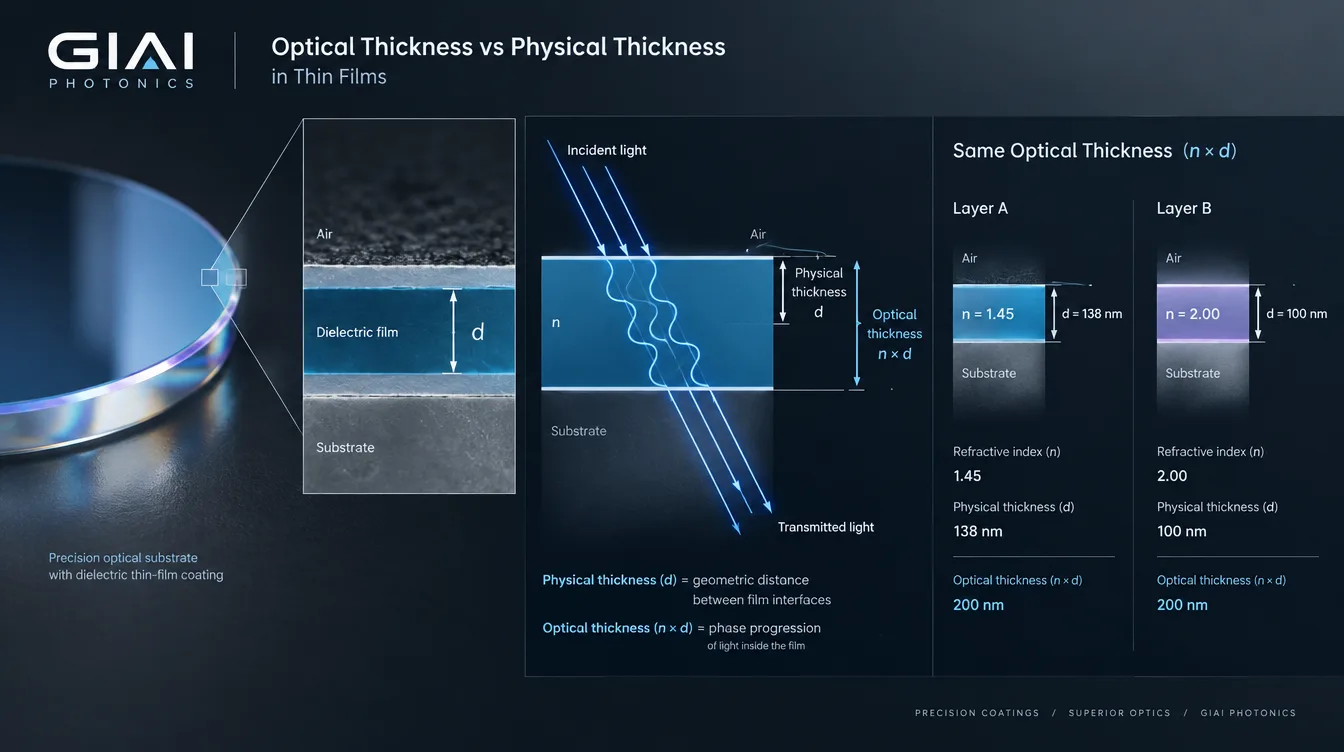
Physical thickness is the actual geometric thickness of a thin-film layer, while optical thickness describes how that layer affects the phase of light. At normal incidence, optical thickness is commonly written as ndn d, where nn is refractive index and dd is physical thickness. Two films can therefore have the same optical thickness but very different physical thicknesses.
This distinction is fundamental in optical coatings. A coating engineer may design a layer in terms of quarter-wave optical thickness, while deposition equipment ultimately produces a layer with a real physical thickness measured in nanometers. Confusing the two can shift the spectral response of an antireflection coating, bandpass filter, mirror, or other interference coating.
What Is the Difference Between Optical Thickness and Physical Thickness?
Physical thickness, usually represented by , is simply the geometric distance between the two boundaries of a film. For a uniform coating, it is the thickness you would describe in nanometers or micrometers.
Optical thickness includes the refractive index of the material:
for normal incidence.
Because the refractive index generally depends on wavelength, the physical layer does not change thickness as wavelength changes, but its optical thickness can.
| Parameter | Physical Thickness | Optical Thickness |
|---|---|---|
| Basic meaning | Geometric film thickness | Optical phase-related thickness |
| Common symbol | ||
| Typical units | nm, µm | nm, µm, waves, QWOT |
| Depends on refractive index | No | Yes |
| Depends on wavelength | Normally no | Yes, because is dispersive |
| Main engineering role | Deposition geometry, mechanical structure | Thin-film interference and phase |
| Same for two different materials at equal ? | Yes | Not necessarily |
Optical thickness is therefore not simply another unit for physical thickness. It combines material properties with geometry.
Why Does Refractive Index Change the Effective Thickness of a Film?
Light accumulates phase as it propagates through a medium. A higher-index material produces more phase delay than a lower-index material of the same physical thickness.
For a homogeneous transparent film at normal incidence, this relationship is captured by:
Suppose two coating materials are used at a design wavelength of 550 nm.
A quarter-wave optical thickness is:
For an illustrative material with :
For another material with :
Both layers have the same 137.5 nm optical thickness, but their physical thicknesses differ by almost 30 nm.
This is why an instruction such as “deposit a quarter-wave layer” is not equivalent to specifying one universal nanometer thickness.
What Is Quarter-Wave Optical Thickness?
Quarter-wave optical thickness, commonly abbreviated QWOT, is widely used in thin-film coating design.
At normal incidence:
where is the design wavelength.
The required physical thickness is therefore:
Quarter-wave layers are important because the phase relationship between reflections at successive interfaces can create constructive or destructive interference. Multilayer mirrors and many classical antireflection structures use this principle, although practical modern coatings are not necessarily restricted to quarter-wave layers.
A critical point is that QWOT specifies an optical condition, not a fixed physical thickness.
Why Matching Optical Thickness Is Not the Whole Coating Design
Two layers with equal at one wavelength do not automatically behave identically.
Thin-film performance also depends on:
- refractive-index contrast between adjacent layers;
- refractive-index dispersion;
- absorption or extinction coefficient;
- substrate index;
- layer sequence;
- wavelength;
- angle of incidence;
- polarization;
- the number and thickness distribution of layers.
This matters especially for broadband coatings. Refractive index is dispersive, so a layer that has the desired at one wavelength may not maintain the same relationship elsewhere in the spectrum. Published optical research has specifically shown that dispersion can shift transmission or reflection extrema away from predictions based on a simplified quarter-wave assumption.
Therefore, “same optical thickness” should normally be understood as same optical thickness under defined wavelength and material-index conditions, not as proof that two films are optically interchangeable.
Optical Thickness at Oblique Incidence
The simple equation is most straightforward at normal incidence.
For a layer in a thin-film stack at oblique incidence, the phase thickness used in characteristic-matrix calculations becomes:
where:
- is the refractive index of layer ;
- is its physical thickness;
- is the propagation angle inside that layer;
- is the free-space wavelength.
The corresponding interference path difference contains the familiar dependence.
At normal incidence, and , so the expression reduces to the familiar normal-incidence form.
This distinction becomes important in filters and coatings operated at non-zero AOI. Changing incidence angle alters the phase condition of the multilayer system and can shift spectral features. At larger angles, s- and p-polarized light must also be treated separately because their optical admittances differ.
For that reason, an interference coating should not normally be specified using wavelength and thickness alone when its operating angle is important.
Does Physical Thickness Change When the Wavelength Changes?
No—assuming temperature, stress, swelling, or other physical effects are unchanged, the geometric thickness of a deposited layer remains the same.
Optical thickness is different because:
If refractive index changes with wavelength, so does .
This is one reason thin-film calculations use wavelength-dependent optical constants rather than a single refractive-index value when accurate broadband performance is required.
The distinction becomes even more important for absorbing materials. Their optical response is described by a complex refractive index containing both and an extinction term . In those systems, physical thickness, phase behavior, and absorption must be modeled together; a simple value alone does not describe the complete spectral response.
Why Thickness Errors Can Shift a Thin-Film Spectrum
Interference coatings rely on controlled phase relationships between light reflected at multiple interfaces.
If the physical thickness changes while refractive index remains approximately constant:
so the optical thickness changes.
Likewise, if the deposited material has a different refractive index from the value assumed in the design:
the optical thickness changes even when the physical thickness is exactly on target.
This is why coating fabrication cannot always be reduced to “deposit exactly X nm.” The deposited material’s optical constants and the required optical response must agree with the design model.
For a multilayer coating, errors can also accumulate differently depending on which layers deviate and how sensitive the particular design is to those deviations.
How Are Physical and Optical Thickness Measured?
The two quantities should not automatically be treated as the same measurement.
Physical thickness can be determined using methods such as step-height or surface-profile measurements, cross-sectional techniques, or model-based optical measurements when the material structure is sufficiently characterized.
Optical measurements observe how a film affects reflected or transmitted light. Interference methods can be strongly sensitive to combinations of refractive index and thickness rather than independently revealing both quantities.
Ellipsometry addresses this by measuring changes in polarization and fitting an optical model. Depending on the film, substrate, wavelength range, and model quality, ellipsometry can determine film thickness together with refractive index and extinction coefficient. Universities and metrology literature describe its use for separating film thickness from optical constants rather than assuming one from the other.
The important engineering point is that an optically derived physical thickness is usually model-dependent. The assumed substrate, optical constants, roughness, layer structure, and dispersion model can affect the fitted result.
What Should Be Specified for a Thin-Film Coating?
A statement such as “100 nm coating” may be mechanically clear but optically incomplete. Similarly, “one quarter-wave” is incomplete without the reference wavelength and refractive-index definition.
For an engineering coating specification, relevant inputs normally include the design wavelength or spectral range, substrate, coating function, transmission or reflection targets, blocking requirements where applicable, AOI, polarization conditions, clear aperture, and inspection criteria.
When thickness itself is part of the specification, make clear whether the value means:
physical thickness, optical thickness ndnd, QWOT, or another normalized optical-thickness definition.
The refractive-index model or reference wavelength should also be defined when it materially affects interpretation.
Optical Thickness vs Physical Thickness in Custom Coating Projects
For a finished optical component, neither coating thickness nor a theoretical value should be considered in isolation from the required spectral performance.
GIAI Photonics supports custom coated optical components including filters, lenses, mirrors, windows, prisms and related optics. Project review is based on the actual optical requirement, substrate, geometry, coating specification, AOI and inspection conditions rather than assuming one universal coating construction.
This is particularly important when converting an existing coating design, spectral requirement or reference sample into a manufacturing specification. The physical film stack must ultimately produce the required optical behavior under the intended operating and measurement conditions.
For a custom thin-film project, provide the available spectral target, wavelength range, substrate, dimensions, AOI, polarization conditions where relevant, coating surfaces, acceptance criteria and expected quantity. GIAI can then review the coating requirement together with the component and manufacturing route.
FAQ
Is optical thickness the same as physical thickness?
No. Physical thickness is the actual geometric film thickness. At normal incidence, optical thickness is commonly . They would only have the same numerical value when the relevant refractive index is approximately 1.
Can two thin films have the same optical thickness but different physical thicknesses?
Yes. If , the two films have the same optical thickness at the specified wavelength even when and are different. Their complete spectral behavior can still differ because refractive index, dispersion and interfaces are different.
Is quarter-wave optical thickness a physical thickness?
No. QWOT means:
at normal incidence. The corresponding physical thickness is , so it depends on the film’s refractive index.
Does optical thickness change with wavelength?
Generally yes. Physical thickness remains fixed, but refractive index is normally wavelength-dependent. Therefore changes with wavelength.
What happens to optical thickness at an angle?
For thin-film interference calculations, phase thickness at oblique incidence contains the factor , where is the angle inside the layer. At larger AOI, polarization effects also become increasingly important.