
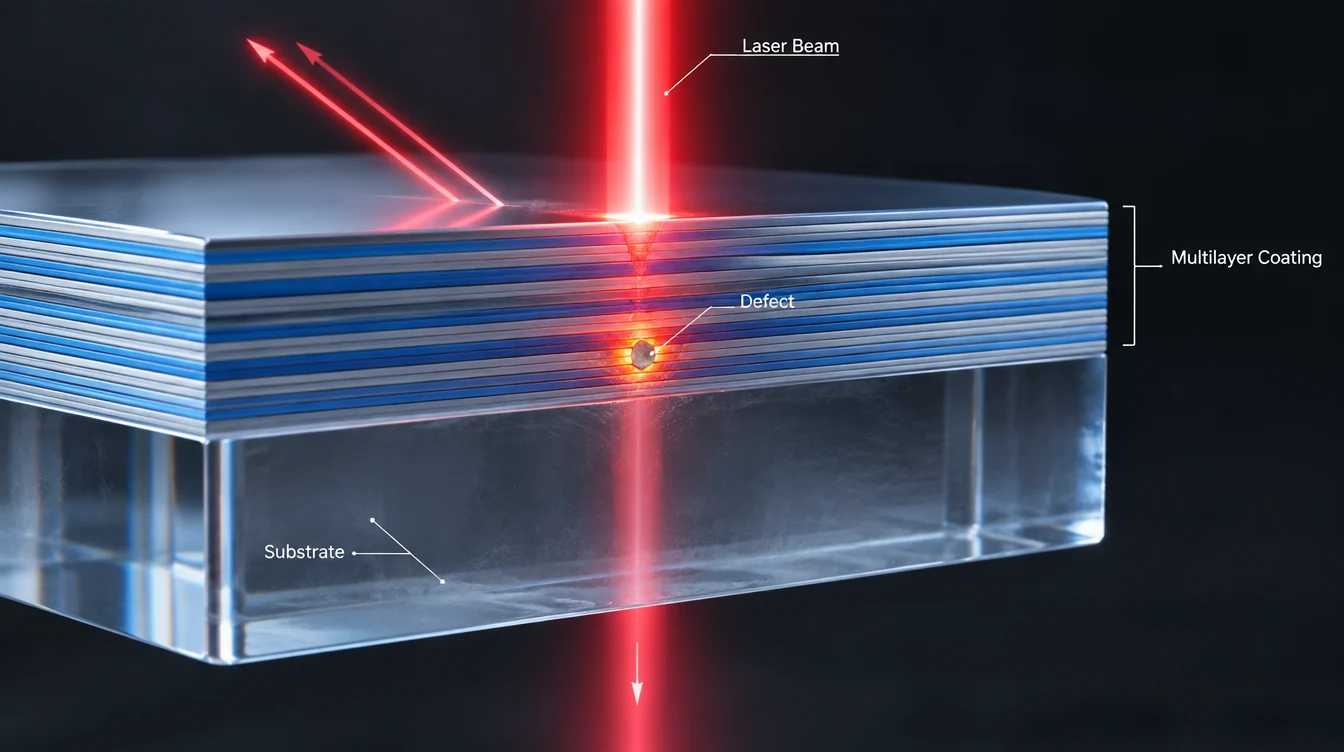
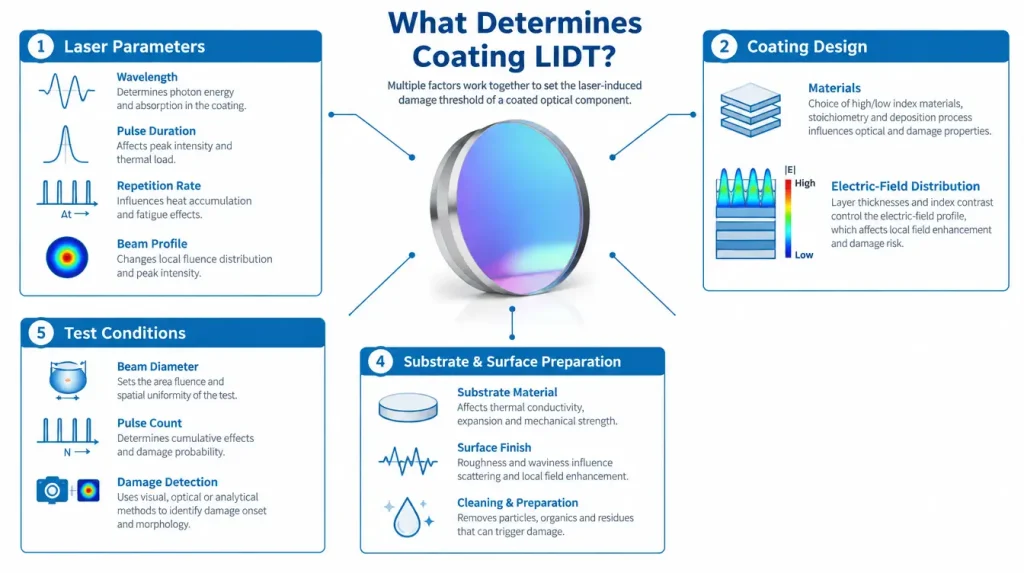
The laser damage threshold of an optical coating, usually referred to as the laser-induced damage threshold or LIDT, is not determined by the coating material alone. It depends on the laser wavelength and temporal regime, beam characteristics, multilayer design, coating defects and absorption, substrate preparation, contamination, environmental conditions, and the method used to test for damage.
This is why an LIDT value is meaningful only when its test conditions are defined. ISO 21254 treats laser damage as a condition-dependent property and identifies laser parameters, optical preparation, defects, contamination, handling, and environment as relevant factors in damage performance.
LIDT Is Not a Single Material Constant
A statement such as:
“This coating has a damage threshold of 5 J/cm²”
is incomplete unless the accompanying conditions are known.
For a pulsed laser, an engineer normally needs to know at least the wavelength, pulse duration, repetition rate, beam diameter and profile, number of pulses applied to each site, and the damage-detection criterion. For continuous-wave or long-duration exposure, thermal loading and absorption become especially important, and the appropriate power-density definition must also be specified.
Consequently, two published LIDT numbers should not be compared directly simply because they use the same units. A coating tested with nanosecond pulses at one wavelength is not automatically equivalent to the same coating used with picosecond, femtosecond, or CW radiation.
What Determines the Laser Damage Threshold of a Coating?
The main variables fall into several interacting groups.
| Factor | Why It Affects Coating LIDT |
|---|---|
| Laser wavelength | Changes absorption, photon energy, coating behavior, and the electric-field distribution within the multilayer |
| Pulse duration | Changes the dominant damage mechanism and the time available for energy to diffuse thermally |
| Repetition rate / pulse count | Can introduce cumulative heating, fatigue, or conditioning effects |
| Beam diameter and profile | Determines local irradiance or fluence; hot spots can damage an optic before the average beam level suggests a problem |
| Coating materials | Absorption, band structure, thermal properties, and mechanical properties affect resistance to laser exposure |
| Multilayer design | Layer thickness and field distribution determine where optical energy is concentrated inside the coating |
| Coating defects | Nodules, inclusions, pores, cracks, and other localized defects may become damage-initiation sites |
| Substrate and polishing | Surface roughness, scratches, subsurface damage, contamination, and interface quality affect the finished coating |
| AOI and polarization | Can modify field distribution and optical behavior of multilayer coatings |
| Cleanliness and handling | Particles and contamination can absorb energy locally and lower practical damage resistance |
| Test method | Damage criterion, pulse count, test sites, inspection method, and statistical treatment affect the reported result |
These variables are coupled rather than independent. ISO 21254 specifically notes that laser damage measurements reflect a combination of laser exposure parameters, material and surface preparation, handling, environment, and imperfections rather than one isolated coating property.
1. Wavelength Changes the Damage Mechanism
The same optical coating can have different damage behavior at different wavelengths.
Material absorption can change substantially with wavelength, particularly as the operating wavelength approaches an absorption band or material limitation. Photon energy also increases toward shorter wavelengths, and the relationship between coating material, optical field, defects, and laser interaction changes.
Historical damage measurements on optical coatings at different UV and visible wavelengths demonstrate that threshold values can differ substantially between wavelengths and coating structures.
For this reason, a coating tested at 1064 nm should not automatically be assigned the same threshold at 532 nm, 355 nm, or another wavelength.
2. Pulse Duration Can Completely Change the Comparison
Pulse duration is one of the most important parameters in any LIDT specification.
With longer pulses and CW exposure, absorbed energy has more time to produce thermal effects. Heating, thermal expansion, thermal stress, melting, and coating/substrate absorption can therefore become important.
As pulses become shorter, particularly in the picosecond and femtosecond regimes, the interaction increasingly involves very high peak electric fields and electronic excitation processes before conventional thermal diffusion can dominate.
Experimental work has shown that damage behavior and pulse-duration scaling can vary substantially between coating materials and pulse regimes.
Therefore, a “high LIDT coating” for a nanosecond laser is not automatically a high-LIDT coating for an ultrafast system.
3. Repetition Rate and Number of Pulses Matter
A single pulse does not necessarily tell you how an optic will behave after thousands or millions of pulses.
Repeated exposure can produce cumulative effects. ISO 21254 discusses both fatigue, where repeated irradiation can contribute to delayed damage, and conditioning, where prior exposure under some conditions can alter subsequent damage behavior.
This makes the distinction between single-pulse and multiple-pulse testing important.
A threshold obtained using one pulse per test location should not be interpreted as equivalent to a threshold obtained after repeated exposure at the same location.
4. Beam Diameter and Beam Profile Affect Local Loading
Real laser beams are rarely perfectly uniform.
A Gaussian beam contains a higher intensity at its center than its average over the nominal beam area. Other lasers may contain hot spots or spatial nonuniformity caused by the source, focusing optics, contamination, or upstream beam-shaping components.
This means that average laser power alone is not sufficient for evaluating coating risk.
Beam diameter and the definition used to calculate effective beam area also matter. In fact, incorrect treatment of Gaussian beam area can introduce significant errors when converting pulse energy into fluence or optical power into intensity.
When reviewing an LIDT report, always check how the beam size and beam profile were defined.
5. Coating Materials Matter—but They Do Not Determine LIDT Alone
Material selection is important because coating materials differ in optical absorption, refractive index, thermal behavior, mechanical stress, and electronic properties.
However, it is misleading to assign a universal LIDT to a coating material.
The same nominal high-index or low-index material can behave differently depending on deposition process, stoichiometry, film density, contamination, layer interfaces, defects, and the complete multilayer design.
Earlier optical-coating studies have shown that laser damage is strongly influenced by both the coating material system and the way the coating is processed.
The correct question is therefore not simply:
“Which coating material has the highest LIDT?”
It is:
“Which complete coating design and manufacturing process is suitable for this laser under these operating conditions?”
6. Multilayer Design Controls the Internal Electric Field
A dielectric laser coating is an optical structure, not just a stack of protective material.
Interference between forward- and backward-propagating waves produces an electric-field distribution within the multilayer. Depending on layer thicknesses, refractive indices, wavelength, AOI, polarization, and coating function, some locations can experience significantly stronger fields than others.
If a field maximum coincides with an absorbing layer, interface, or defect, the local damage risk can increase.
Modern high-LIDT coating engineering therefore considers not only spectral transmission or reflection but also the distribution of electric-field intensity through the stack. Studies of dielectric multilayers have shown that localized field enhancement around defects can contribute directly to laser-damage initiation.
This is also why high reflectivity does not automatically mean high LIDT.
7. Microscopic Defects Can Become the Weakest Point
Real coatings are not perfectly homogeneous.
Potential damage precursors include nodular defects, particles, pores, microcracks, absorbing inclusions, interface defects, and other local irregularities.
Even when they occupy only a very small fraction of the coated area, these defects can locally enhance absorption, temperature, mechanical stress, or electric-field intensity.
Research on dielectric multilayer coatings has repeatedly identified coating defects—particularly nodular defects—as important laser-damage initiation sites in relevant nanosecond high-power applications.
This explains an important practical point: LIDT is strongly affected by manufacturing consistency, not just theoretical coating design.
8. Substrate Preparation Matters Before Coating Begins
The coating cannot be separated from the optical surface underneath it.
Polishing scratches, subsurface damage, roughness, residual polishing material, particles, and cleaning residues can all influence what happens after the multilayer is deposited.
ISO 21254 explicitly identifies polishing scratches, subsurface damage, bulk inclusions, coating defects, and other technological imperfections as factors that can affect laser damage performance.
For high-power laser optics, surface preparation therefore forms part of the LIDT problem.
A sophisticated coating design deposited onto a poorly prepared optical surface may not deliver the intended laser resistance.
9. Cleanliness and Contamination Can Lower Practical Damage Resistance
A coating may perform well during controlled testing but fail earlier in a real optical system if its surface becomes contaminated.
Dust, deposited particles, residues, volatile contaminants, fingerprints, and other absorbing material can create highly localized heating.
Environmental contamination is specifically identified in ISO’s laser-damage framework as one of the factors affecting the performance of laser optical components.
For this reason, storage, assembly, cleaning, packaging, and operating environment should be considered whenever LIDT is critical.
Why You Cannot Compare Two LIDT Numbers Without the Test Conditions
Suppose two coating suppliers provide an LIDT value.
Even if both report their result in J/cm², the numbers are not directly comparable unless the test conditions are sufficiently similar.
At minimum, compare the wavelength, pulse duration, repetition rate, pulse count, beam diameter, beam profile, test geometry, damage criterion, test protocol, and sample condition.
The ISO 21254 series exists specifically to improve the definition and comparability of laser-induced damage testing. Part 1 defines terminology and general principles, while Part 2 addresses threshold determination and Part 3 addresses verification of laser power or energy handling capability.
An LIDT number without these conditions is therefore of limited engineering value.
What Should You Specify When Requesting a Laser Coating?
For a coating intended for a laser system, provide enough information to reproduce the actual optical loading rather than asking only for a generic “high-damage-threshold coating.”
Useful project inputs include:
- Laser wavelength or wavelength range
- CW or pulsed operation
- Pulse duration, if pulsed
- Pulse energy and/or optical power
- Repetition rate
- Beam diameter and beam profile
- Angle of incidence
- Polarization, when relevant
- Coating function: AR, HR, beamsplitter, filter, etc.
- Substrate material and geometry
- Required spectral performance
- Required LIDT or operating margin
- Expected environment and cleanliness conditions
- Required damage-test method or acceptance criteria, if applicable
This allows the coating requirement to be reviewed as a complete optical-system requirement rather than as an isolated reflectance or transmission target.
GIAI Approach to Laser Coating Requirements
GIAI supports optical coating work for filters, lenses, mirrors, windows, prisms, and related custom optical components. Coating projects are reviewed against wavelength or spectral range, transmission or reflection targets, substrate, AOI, polarization where relevant, geometry, and inspection requirements.
For laser applications, however, LIDT should not be inferred from the coating name, reflectivity, hardness, or another product’s published result. GIAI’s controlled project guidance specifically requires LIDT and other special coating requirements to be confirmed for the individual project rather than treated as a universal manufacturing number.
If LIDT is a critical requirement, include the laser operating conditions and required test or acceptance conditions with the drawing or coating specification so the project can be evaluated on that basis.
GIAI’s current manufacturing workflow covers fabrication, surface preparation, coating, and project-specific inspection for applicable custom optics.
FAQ
Does a high-reflectivity coating automatically have a high laser damage threshold?
No. Reflectivity describes spectral performance, while LIDT describes resistance to laser-induced damage under defined exposure conditions. A coating can have very high reflectivity but still contain absorption, field concentrations, or defects that limit its damage resistance.
Does a hard coating always have a higher LIDT?
No. Mechanical or environmental durability and laser-damage resistance are different properties. Wavelength, pulse duration, beam parameters, coating materials, multilayer design, defects, substrate, contamination, and the test method must still be considered. GIAI’s existing engineering guidance likewise treats coating hardness and LIDT as separate parameters.
Why can the same coating survive one laser but fail with another?
Changing wavelength, pulse duration, repetition rate, beam diameter, beam profile, or operating geometry changes how optical energy interacts with the coating. The damage mechanism can therefore change even when the physical optic is identical.
Should LIDT be specified at the actual operating wavelength?
Yes. Whenever laser damage is critical, the threshold or qualification conditions should represent the intended laser as closely as practical. Extrapolating from a substantially different wavelength or pulse regime introduces additional uncertainty.
Can LIDT be calculated from the coating design alone?
Modeling can identify electric-field concentrations, thermal loading, material absorption, and potentially vulnerable layers, but real coatings also contain process-dependent defects and variations. Experimental damage testing therefore remains important when a verified LIDT is required.