
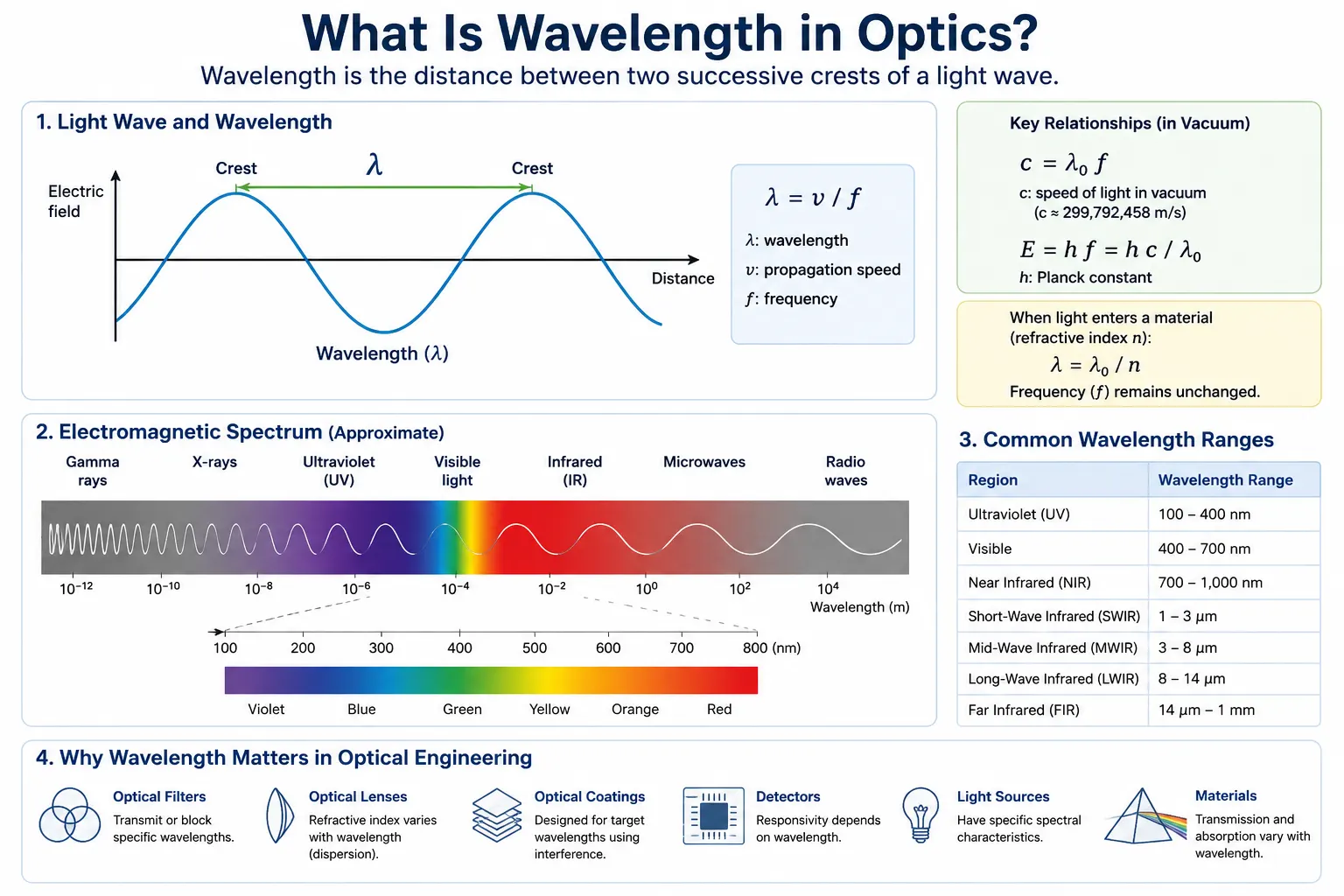
Wavelength in optics is the spatial distance over which a light wave repeats, commonly measured from one wave crest to the next. It is represented by the Greek letter λ (lambda) and is normally expressed in nanometers (nm) for visible and near-infrared optics or micrometers (µm) for longer infrared wavelengths. Wavelength is one of the fundamental ways engineers describe electromagnetic radiation because the interaction of light with optical filters, lenses, detectors, coatings, and materials often depends strongly on wavelength.
A wavelength value, however, is not just a number attached to a color. Its physical meaning depends on wave frequency and propagation speed, and the wavelength inside an optical material can differ from the wavelength of the same radiation in vacuum.
What Does Wavelength Mean Physically?
Light can be described as an electromagnetic wave consisting of oscillating electric and magnetic fields. For a simple periodic wave, wavelength is the distance between two equivalent points in successive cycles—for example, from one crest to the next.
A useful simplified representation is:
λ = v / f
where:
- λ = wavelength
- v = propagation speed of the wave in the medium
- f = frequency
For light propagating in vacuum:
λ₀ = c / f
where c = 299,792,458 m/s, the defined speed of light in vacuum.
This equation shows that wavelength and frequency are inversely related when propagation speed is fixed. A higher optical frequency corresponds to a shorter vacuum wavelength, while a lower frequency corresponds to a longer wavelength.
For example, visible violet light has a shorter wavelength and higher frequency than visible red light. Outside the visible region, the same principle continues through ultraviolet, infrared, and the broader electromagnetic spectrum.
How Is Optical Wavelength Measured?
The SI unit of wavelength is the meter, but a meter is far too large for most optical wavelengths. Engineers therefore normally work with smaller units.
| Unit | Symbol | Equivalent |
|---|---|---|
| Meter | m | 1 m |
| Micrometer | µm | 10⁻⁶ m |
| Nanometer | nm | 10⁻⁹ m |
| Picometer | pm | 10⁻¹² m |
Visible and many near-infrared specifications are commonly expressed in nanometers. Mid- and long-wave infrared specifications are often easier to express in micrometers.
For example:
1000 nm = 1 µm
The unit does not change the physical wavelength; it only changes how the numerical value is written.
Is Wavelength the Same as Color?
Not exactly.
For radiation that falls within the visible response of the human eye, wavelength is related to perceived color. Shorter visible wavelengths are generally associated with violet and blue, while longer visible wavelengths are associated with orange and red.
But wavelength is a physical quantity, whereas color is a visual perception.
This distinction matters for several reasons.
First, much of the electromagnetic radiation used in optical engineering is invisible. Ultraviolet and infrared radiation still have precisely defined wavelengths even though humans cannot see them directly.
Second, a perceived color does not necessarily represent a single wavelength. Broadband sources can contain many wavelengths at the same time.
Third, optical detectors, coatings, and materials respond according to their spectral properties rather than according to human color perception.
For engineering work, it is therefore better to think in terms of spectral wavelength than simply in terms of color.
What Happens to Wavelength When Light Enters Glass?
When light moves from one optical medium to another, its frequency remains unchanged at the interface, while its propagation speed and wavelength can change.
The refractive index of a material is commonly expressed as:
n = c / v
where:
- n = refractive index
- c = speed of light in vacuum
- v = phase velocity in the material
For a given frequency, the wavelength in a medium can therefore be written conceptually as:
λ = λ₀ / n
for a refractive index evaluated at the relevant wavelength. Real optical materials are dispersive, so refractive index itself generally varies with wavelength. University optics material likewise notes that when light enters a slower optical medium, the frequency stays constant while the wavelength becomes shorter.
This is an important reason engineers distinguish vacuum wavelength from wavelength inside a material.
In most optical component specifications, a quoted operating wavelength normally refers to the wavelength of the radiation before accounting for shortening inside the optical material, unless the specification explicitly states otherwise.
Why Does Wavelength Matter in Optical Engineering?
Wavelength affects nearly every stage of an optical system because materials, coatings, sources, and detectors generally do not behave identically across the entire electromagnetic spectrum.
Optical filters
Optical filters are intentionally wavelength-selective. A bandpass filter may transmit a defined spectral region while reducing radiation outside that region, while longpass and shortpass filters separate spectral regions around specified transitions.
Important specifications may include:
- center wavelength
- passband
- FWHM
- cut-on or cut-off wavelength
- blocking range
- transmission
- optical density
- angle of incidence
- polarization
A statement such as “high transmission” is incomplete unless the relevant wavelength range and measurement conditions are also defined. GIAI Photonics’ current technical material similarly treats transmission, reflection, and absorption as wavelength-dependent quantities whose interpretation requires the measurement conditions to be known.
Optical lenses
Wavelength also matters for optical lenses because refractive index varies with wavelength. This phenomenon, known as dispersion, causes different wavelengths to refract differently.
In imaging systems, dispersion can contribute to chromatic aberration when different spectral components do not focus at exactly the same position.
Lens material, anti-reflection coating, focal design, detector response, and operating spectrum therefore need to be considered together rather than treating focal length as completely independent of wavelength.
Infrared optics
The operating wavelength becomes especially important when choosing infrared filters, lenses, or windows.
A material suitable for one spectral region may absorb strongly in another. Likewise, a coating designed for one infrared band cannot automatically be assumed to provide the same performance elsewhere.
The engineering specification should therefore identify the actual operating spectral range instead of describing a component only as “infrared.”
Optical coatings
Thin-film optical coatings rely on interference effects that depend on optical thickness and wavelength.
As a result, an anti-reflection coating, mirror coating, bandpass filter, or dichroic coating is normally designed around a particular wavelength or spectral range.
Its behavior can also change with angle of incidence and polarization, so a coating specification should not be interpreted independently of the optical geometry.
Wavelength, Frequency, and Photon Energy: What Is the Difference?
Wavelength and frequency describe the same electromagnetic radiation from different perspectives.
For light in vacuum:
c = λ₀f
A shorter wavelength corresponds to a higher frequency, while a longer wavelength corresponds to a lower frequency.
Photon energy is also related to frequency:
E = hf
and therefore, in vacuum:
E = hc / λ₀
where h is Planck’s constant.
This means that shorter-wavelength photons have higher photon energy than longer-wavelength photons.
It is important, however, not to confuse these quantities:
- Wavelength describes spatial periodicity.
- Frequency describes oscillations per unit time.
- Photon energy describes the energy associated with a photon.
- Optical power describes energy transferred per unit time and is not determined by wavelength alone.
A high-frequency beam is therefore not automatically a high-power beam.
What Is a Spectrum?
Real optical sources often emit more than one wavelength.
A spectrum describes how optical energy, power, intensity, radiance, or another spectral quantity is distributed as a function of wavelength or frequency.
A laser may have a relatively narrow emission spectrum, while an LED, lamp, thermal source, or broadband illumination system may emit over a much wider range.
This distinction matters because a nominal wavelength does not necessarily describe the complete source.
For example, specifying only that an illumination source is “850 nm” does not reveal:
- spectral bandwidth
- wavelength tolerance
- wavelength shift with temperature
- secondary emission
- source-to-source variation
The complete spectral distribution may be important when matching a source with a filter and detector.
What Is Center Wavelength?
Center wavelength is a specification used particularly often for bandpass filters and other wavelength-selective components.
It is not another name for wavelength.
Wavelength is the general physical quantity. Center wavelength describes a defined central position of a spectral feature or passband according to the applicable specification or measurement convention.
Likewise, wavelength should not be confused with:
- FWHM, which describes spectral width;
- cut-on wavelength, associated with the transition into a transmitting region;
- cut-off wavelength, associated with a defined spectral transition;
- blocking range, where unwanted wavelengths are attenuated;
- peak wavelength, the position of a maximum in a spectrum.
These parameters answer different engineering questions.
Does One Wavelength Completely Describe an Optical System?
Usually not.
A wavelength may be the starting point, but practical optical systems normally contain a source spectrum, optical components with wavelength-dependent properties, and a detector with its own spectral responsivity.
For a simple source-filter-detector path, engineers may need to compare:
Source spectrum → filter spectral response → optical transmission → detector response
The useful signal depends on how these spectral functions overlap.
Geometry matters as well. Interference filters, for example, can change spectral behavior when angle of incidence changes. Polarization can also become important in certain optical configurations.
For this reason, a nominal wavelength measured or specified under one condition should not automatically be treated as sufficient for every installation geometry.
A Simplified Engineering Example
Consider a hypothetical optical sensor using a narrow emission feature near 850 nm.
The value 850 nm identifies the approximate operating spectral region, but it does not by itself define the complete system.
An engineer selecting the associated optics may still need to determine:
- the actual source spectrum;
- source wavelength tolerance;
- detector responsivity around 850 nm;
- desired filter passband;
- required out-of-band blocking;
- angle of incidence;
- cone angle;
- polarization conditions;
- operating temperature;
- substrate transmission;
- coating performance.
This is why wavelength is fundamental, but rarely sufficient as a standalone optical specification.
The 850 nm value in this example is illustrative and does not represent a GIAI Photonics product specification.
Common Misunderstandings About Wavelength
“Wavelength and frequency both change when light enters glass.”
Normally, frequency remains continuous across the interface. The propagation velocity and wavelength change.
“A component designed for one wavelength works the same at every wavelength.”
Not necessarily. Material transmission, refractive index, coatings, detector response, and many other optical properties are wavelength dependent. GIAI Photonics’ current guidance similarly emphasizes that optical transmission and reflection must be considered over the actual operating wavelength range.
“Wavelength only matters for optical filters.”
No. It affects filters, lenses, mirrors, windows, prisms, coatings, detectors, sources, and optical materials.
“A wavelength value tells me how much optical power is present.”
No. Wavelength describes the electromagnetic wave or photon spectral position; it does not by itself specify optical power.
“Visible color and wavelength are identical concepts.”
No. Wavelength is a physical quantity. Color is a perceptual response to visible radiation and may result from a spectrum containing multiple wavelengths.
What Should Engineers Specify About Wavelength?
For simple educational discussion, a single wavelength may be enough. For component selection or optical-system integration, a more complete specification is usually required.
Depending on the application, engineers may need to define:
- operating wavelength or wavelength range;
- source spectral bandwidth;
- wavelength tolerance;
- transmission or reflection requirements;
- blocking range;
- detector spectral response;
- angle of incidence;
- cone angle;
- polarization;
- substrate;
- coating;
- temperature range;
- dimensions and clear aperture;
- relevant inspection conditions.
The goal is not to specify every possible parameter. It is to define the conditions that can materially affect the optical function of the component.
Conclusion
Wavelength is one of the fundamental coordinates used to describe light. It represents the spatial period of an electromagnetic wave and is related to frequency through the propagation velocity of light.
For optical engineering, its importance extends far beyond visible color. Wavelength affects refractive index, dispersion, material transmission, detector response, optical coatings, spectral filtering, and many other system behaviors.
The most important practical distinction is that a wavelength value must be interpreted in context. Engineers should know whether they are discussing vacuum wavelength, an operating spectral range, a source peak, a filter center wavelength, or another wavelength-related specification—and should evaluate that value together with the conditions under which the optical system actually operates.
D. FAQ
What is the simplest definition of wavelength in optics?
Wavelength is the distance over which a light wave repeats, such as the distance from one wave crest to the next. It is represented by λ and is commonly expressed in nanometers or micrometers in optical engineering. Wavelength is related to wave frequency and propagation speed by λ = v/f. In vacuum, the relationship becomes λ₀ = c/f.
What is wavelength measured in?
The SI unit of wavelength is the meter, but optical wavelengths are usually expressed in nanometers (nm) or micrometers (µm). One nanometer equals 10⁻⁹ meter, while one micrometer equals 10⁻⁶ meter. Visible and many near-infrared specifications commonly use nanometers, while longer infrared wavelengths are frequently expressed in micrometers.
Does wavelength change when light enters glass?
Yes. When light enters a material with a different refractive index, its propagation speed changes and its wavelength changes, while the frequency remains continuous across the interface. For a given frequency, a higher refractive index generally corresponds to a shorter wavelength inside the material.
Is a shorter wavelength always more energetic?
For individual photons in vacuum, shorter wavelength corresponds to higher frequency and therefore higher photon energy according to E = hf = hc/λ₀. This does not mean that a shorter-wavelength light beam necessarily has greater optical power, because beam power also depends on the number and rate of photons carrying energy.
Why is wavelength important when selecting optical components?
Optical materials, coatings, filters, lenses, and detectors commonly have wavelength-dependent behavior. An optical filter may transmit one spectral region and reject another, while refractive index, material absorption, coating reflectance, and detector response can also vary with wavelength. A component therefore needs to be evaluated over the actual operating spectrum and relevant optical conditions.
What is the difference between wavelength and center wavelength?
Wavelength is a general physical quantity describing the spatial period of electromagnetic radiation. Center wavelength is a specification associated with the central location of a particular spectral feature or passband. It should not be confused with bandwidth, FWHM, peak wavelength, cut-on wavelength, or cut-off wavelength.