
Technical Resources
What Makes a Narrowband Filter Expensive? Key Cost Drivers
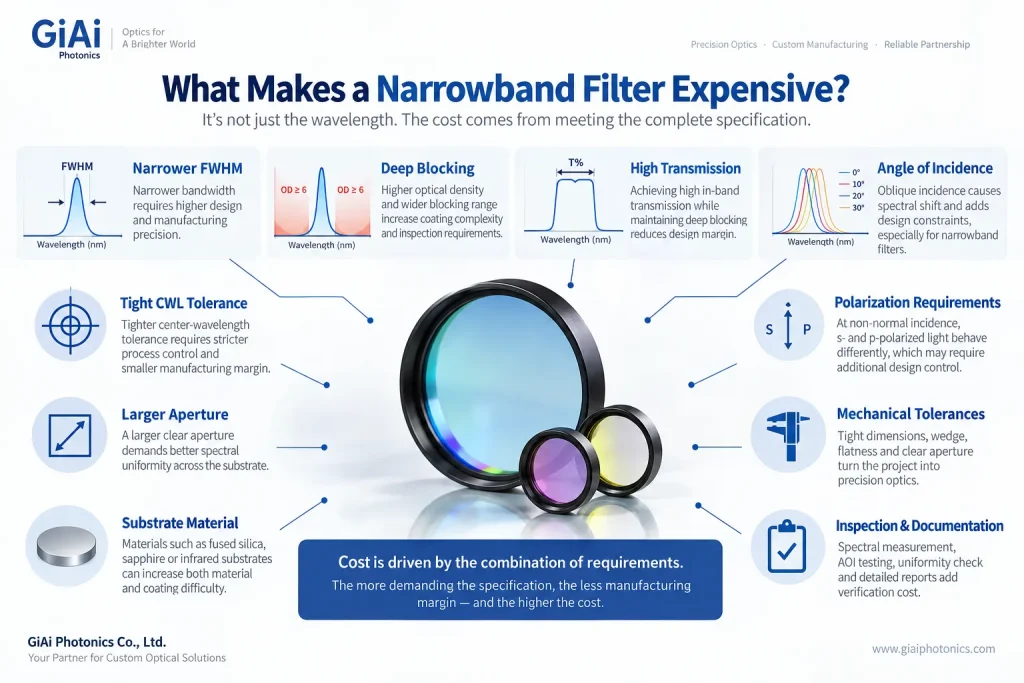
Two narrowband filters may both be described as “850 nm bandpass filters” or “1064 nm narrowband filters,” yet their manufacturing cost can differ substantially.
The reason is that center wavelength alone does not define the difficulty of a narrowband filter.
A filter becomes more demanding when the specification combines a narrow FWHM, high in-band transmission, deep out-of-band blocking, wide blocking range, tight wavelength tolerance, non-zero angle of incidence, large clear aperture, environmental requirements, or stringent inspection criteria.
The cost is therefore better understood as the cost of meeting the complete spectral and mechanical specification with acceptable manufacturing repeatability, not simply the cost of depositing a coating onto a piece of glass.
For engineers preparing a custom filter specification, the important question is not only:
“How narrow is the filter?”
It is:
“How difficult is this complete spectral requirement to manufacture and verify?”
1. A narrower FWHM generally increases design and manufacturing difficulty
For a narrowband bandpass filter, one of the first specifications engineers look at is FWHM — full width at half maximum.
A filter with a relatively broad passband allows more spectral margin around the center wavelength. As the required passband becomes narrower, the coating design becomes increasingly sensitive to optical thickness errors.
In an interference filter, the passband is generated by controlled interference within a multilayer dielectric coating structure. Small deviations in deposited layer thickness or refractive index can change the final spectral response.
As FWHM becomes narrower, those deviations may have a larger effect on:
- center wavelength
- passband shape
- peak transmission
- edge position
- lot-to-lot repeatability
This is one reason a 10 nm, 3 nm and 1 nm class filter at the same nominal wavelength should not be assumed to have similar manufacturing difficulty.
However, FWHM should never be considered alone. A moderately narrow filter with extremely demanding blocking can be more difficult than a narrower filter with relaxed out-of-band requirements.
2. Deep blocking can cost more than the passband itself
A common purchasing mistake is to focus almost entirely on peak transmission and FWHM.
In many real optical systems, the more difficult requirement is actually the blocking region.
Blocking is commonly expressed using optical density:
where is transmitted intensity expressed as a fraction.
For example, increasing required optical density means reducing the amount of unwanted light that can pass through the filter.
This becomes especially important in systems such as:
- fluorescence detection
- Raman-related optical systems
- laser sensing
- LiDAR
- machine vision
- spectral instrumentation
- photodetector systems exposed to strong background light
The coating must not only create the desired passband. It must also suppress unwanted wavelengths over the specified blocking range.
A specification such as:
Pass 850 nm ± a narrow band
is very different from:
Pass 850 nm with deep blocking from the visible region through a broad near-infrared range.
The second requirement places much greater demands on coating design, deposition control and spectral verification.
GIAI’s project documentation also treats blocking range, OD, CWL and FWHM as separate project-defined spectral characteristics rather than assuming one automatically determines another.
3. High transmission and deep blocking create a trade-off
Customers often want all three of the following:
- very narrow bandwidth
- very high transmission
- very deep blocking
Each requirement may be reasonable individually, but demanding all of them simultaneously reduces the available design margin.
The coating must create strong spectral selectivity while minimizing losses inside the passband.
This is why a filter specification should not simply state:
“Highest possible transmission, narrowest possible bandwidth and maximum OD.”
A better engineering approach is to define what the optical system actually needs.
For example:
- How much signal reaches the detector?
- What background wavelengths create noise?
- What signal-to-background ratio is required?
- Does an additional optical component already provide part of the blocking?
- Is the entire blocking range important, or only several critical wavelength regions?
Removing unnecessary requirements can sometimes reduce coating complexity without compromising system performance.
4. Tight center-wavelength tolerance increases process sensitivity
A nominal center wavelength is not enough for a production specification.
An optical designer may need to define:
CWL = target wavelength ± allowable tolerance
The tighter that tolerance becomes, the smaller the acceptable manufacturing variation.
This matters because interference filter performance depends on the optical thickness of the deposited layers.
If the allowable center-wavelength deviation is relatively wide, the manufacturing process has more usable margin. A much tighter spectral tolerance may require more demanding process control and tighter acceptance criteria.
The effect becomes even more important when the passband itself is narrow.
For example, a small center-wavelength error represents a much larger fraction of a very narrow passband than of a broad bandpass filter.
The practical specification should therefore consider FWHM and CWL tolerance together, rather than defining them independently.
5. Angle of incidence can make a narrowband filter more difficult
Interference filters are sensitive to angle of incidence (AOI).
As the incidence angle changes from the design condition, the transmitted spectral band generally shifts toward shorter wavelengths. The magnitude of the shift depends on the optical design, materials, polarization and angular conditions.
This is especially important in narrowband systems because even a modest spectral shift may become significant relative to the filter bandwidth.
A filter designed for approximately normal incidence should therefore not automatically be assumed to provide the same spectral response at:
- 10°
- 20°
- 30°
- or inside a strongly converging optical beam
Project material available to GIAI includes measured examples showing the same nominal 1064 nm bandpass concept at several incidence angles, illustrating the expected spectral displacement with increasing AOI.
For procurement, AOI should be stated explicitly:
AOI: 0°
or, where applicable:
AOI: specified operating angle
If the filter is used over an angular cone rather than a single ray angle, that optical geometry should also be communicated during technical review.
6. Polarization requirements can add another design constraint
At normal or near-normal incidence, polarization may have limited practical effect in many filter applications.
At larger angles, however, s- and p-polarized light no longer behave identically in the multilayer coating.
This can produce differences in:
- spectral edge location
- passband shape
- transmission
- effective bandwidth
If a system uses a defined polarization state, or if polarization splitting at oblique incidence would affect measurement accuracy, the specification should include it.
A filter that only needs acceptable performance for unpolarized light at near-normal incidence may be easier to realize than one requiring tightly controlled spectral performance for both polarization states at a significant AOI.
7. Large diameter and clear aperture affect uniformity requirements
Filter diameter is not merely a mechanical purchasing parameter.
As the coated area becomes larger, spectral uniformity across the useful aperture becomes increasingly important.
If optical thickness varies spatially across the substrate, different regions of the filter can exhibit slightly different spectral responses.
This may affect:
- CWL uniformity
- FWHM uniformity
- transmission
- edge position
The more demanding the spectral specification, the more important spatial coating uniformity becomes.
Therefore, a large narrowband filter with a wide clear aperture and tight CWL uniformity requirement can be substantially more challenging than a small filter with otherwise similar spectral targets.
When requesting a quotation, engineers should distinguish between:
- overall part diameter
- coated area
- clear aperture
- active optical area
These dimensions are not necessarily interchangeable.
8. Substrate material and substrate quality also affect cost
The coating cannot be evaluated independently from the substrate.
A filter specification may involve materials such as:
- BK7
- fused silica
- B270
- sapphire
- other optical glasses or infrared materials
Material selection can affect:
- wavelength transmission
- thermal behavior
- mechanical properties
- polishing requirements
- coating compatibility
- environmental stability
- total component cost
GIAI’s current manufacturing reference publicly lists materials including BK7, fused silica, B270, sapphire, silicon, germanium, ZnSe and MgF2, while correctly treating actual material suitability and manufacturability as project-specific rather than universal.
For narrowband filters, the substrate specification may also include requirements for thickness, wedge, flatness, surface condition or other drawing-defined characteristics.
A high-performance coating deposited on a tightly specified precision substrate is a different manufacturing task from coating a basic optical window.
9. Mechanical tolerances can turn a coating project into a precision-optics project
Sometimes the spectral filter itself is not the dominant cost driver.
The mechanical drawing may require:
- tight outside dimensions
- controlled thickness
- small wedge
- specific edge geometry
- a defined clear aperture
- special coated or uncoated regions
- mounting-related geometry
- surface requirements
These features introduce additional fabrication and inspection steps before and after coating.
This is why custom filter pricing should be based on both the optical specification and the mechanical drawing.
A technically complete RFQ therefore needs more than a spectrum screenshot.
10. Inspection requirements affect the real manufacturing cost
A narrowband filter cannot be qualified by visual inspection alone.
For wavelength-selective optical components, spectral verification may need to confirm parameters such as:
- CWL
- FWHM
- peak or average transmission
- blocking
- optical density
- cut-on or cut-off position
- specified spectral range
- AOI-dependent performance
GIAI’s current quality framework explicitly ties inspection to the drawing, optical specification and agreed acceptance criteria rather than applying one identical inspection scheme to every optical component.
Additional requirements may include:
- individual inspection rather than lot sampling
- multiple spectral measurement points
- measurements at a specified AOI
- spatial uniformity measurements
- serialized records
- inspection reports
- special documentation
These requirements require additional metrology time and therefore form part of the actual component cost.
11. Prototype quantity and production repeatability change the economics
A custom filter design often includes engineering effort that does not scale linearly with part count.
A prototype quantity may need:
- spectral requirement review
- coating design
- deposition setup
- test runs
- process adjustment
- spectral measurement
- acceptance review
Once a process is established, larger production quantities can distribute some of those fixed engineering and setup costs across more parts.
But production introduces another requirement: repeatability.
A filter that can be produced once is not automatically equivalent to a filter specification that must be maintained across repeated production lots.
For a production program, the engineering discussion should therefore include not only nominal spectral performance but also the tolerances that define acceptable production variation.
Which Specifications Usually Increase Narrowband Filter Cost?
The following table summarizes the main cost drivers.
| Requirement | Why It Can Increase Difficulty |
|---|---|
| Narrower FWHM | Smaller optical-thickness error margin |
| Tighter CWL tolerance | Requires tighter spectral control |
| Higher in-band transmission | Reduces allowable optical loss |
| Higher OD | More demanding unwanted-light suppression |
| Wider blocking range | More spectral territory must meet blocking requirements |
| Oblique AOI | Introduces spectral shift and additional design constraints |
| Polarization control | s/p behavior may need separate consideration |
| Larger clear aperture | Greater coating-uniformity requirement |
| Tight mechanical tolerances | Adds precision fabrication and inspection |
| Special substrate | Changes material, fabrication and coating requirements |
| Tight spectral uniformity | Requires consistent performance across the aperture |
| Detailed inspection/documentation | Adds measurement and verification effort |
| Small prototype quantity | Fixed engineering/setup cost is spread over fewer units |
The key point is that cost is driven by the combination of requirements.
There is no single specification such as FWHM or OD that can predict filter price by itself.
How to Reduce Narrowband Filter Cost Without Compromising the Optical System
The most effective way to control cost is not necessarily to choose a lower-grade filter. It is to avoid specifying performance the system does not need.
Before issuing an RFQ, review the following questions:
- What FWHM is actually required by the detector and signal spectrum?
- Which wavelength regions genuinely require deep blocking?
- What OD is necessary to reach the required signal-to-background ratio?
- What is the real operating AOI?
- Is the beam collimated or converging?
- Does polarization matter?
- What CWL tolerance can the system accept?
- How large does the clear aperture actually need to be?
- Which dimensions are functionally critical?
- What inspection documentation is genuinely required?
An optical specification with justified tolerances is usually more manufacturable than one in which every parameter has simply been pushed toward an extreme value.
What Should You Send for a Custom Narrowband Filter RFQ?
For an engineering review, provide as much of the following information as possible:
Spectral requirements
- center wavelength
- FWHM or passband
- minimum or target transmission
- blocking range
- optical density requirement
- AOI
- polarization, if relevant
Mechanical requirements
- substrate or preferred material
- diameter or length × width
- thickness
- clear aperture
- drawing and tolerances
Application information
- light source
- detector or sensor
- approximate optical geometry
- operating environment
Commercial and quality requirements
- prototype or production quantity
- inspection criteria
- required reports or documentation
This approach is consistent with GIAI’s current custom-optics workflow: custom projects are reviewed against the drawing or sample, optical requirements, substrate, geometry, coating conditions and inspection criteria before the manufacturing route is defined.
So, What Really Makes a Narrowband Filter Expensive?
A narrowband filter becomes expensive when the design has little manufacturing margin.
The cost usually increases when several demanding requirements occur simultaneously:
narrow passband + tight wavelength tolerance + high transmission + deep and broad blocking + difficult AOI conditions + large aperture + tight mechanical tolerances + extensive inspection.
That combination increases coating-design complexity, deposition sensitivity, manufacturing control requirements and verification effort.
For this reason, comparing narrowband filters only by wavelength and FWHM can be misleading.
A more useful comparison is based on the complete optical specification and the conditions under which that specification must be achieved.
GIAI Custom Narrowband Filter Review
GIAI Photonics supports custom optical filters and other coated optical components based on project-specific requirements. Current public manufacturing information includes optical fabrication, precision grinding, polishing, cleaning, geometry processing, optical coating and inspection, while actual manufacturability is evaluated against the individual project rather than assumed for every specification.
For a technical review, send your drawing, target spectrum or existing sample, together with the CWL, FWHM, transmission, blocking range, OD, AOI, substrate, dimensions, clear aperture, inspection criteria and expected quantity.