
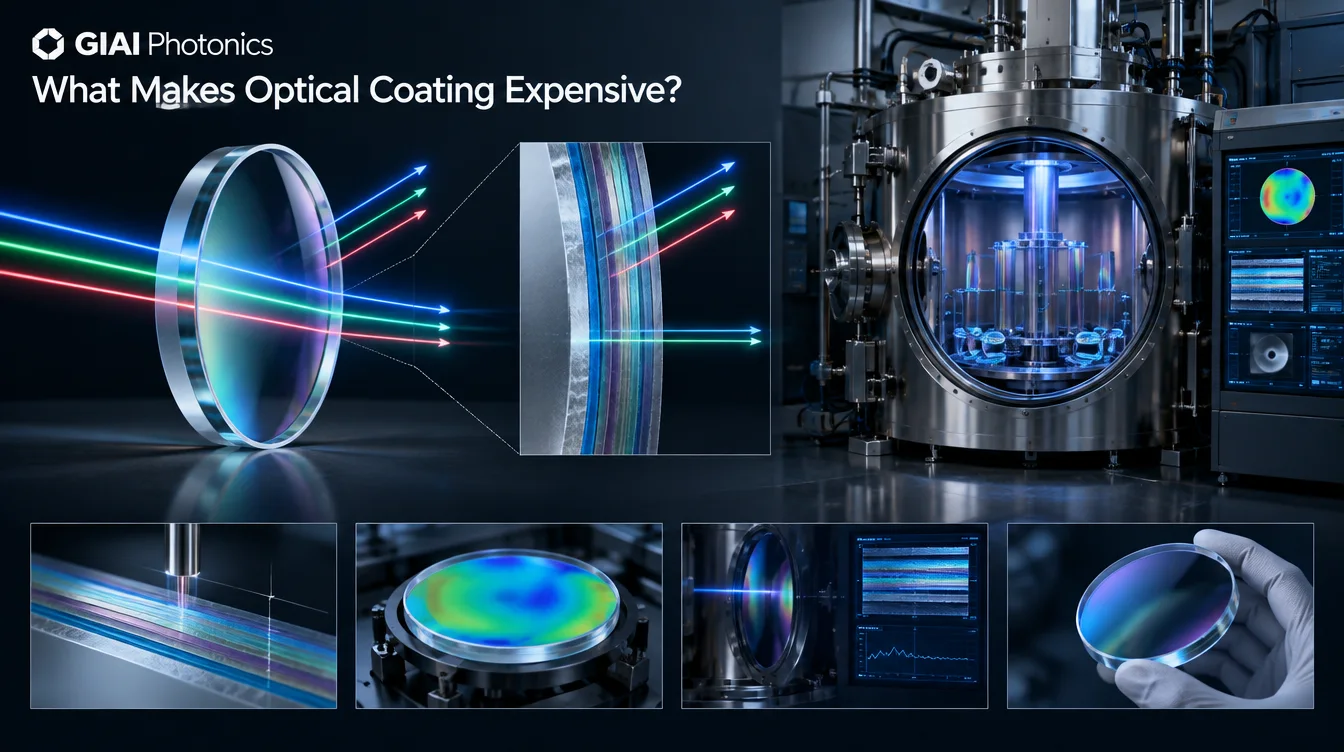
Two optical components can look almost identical, use the same substrate material, and have similar dimensions—yet their coating costs may be very different.
The reason is that optical coating cost is driven less by the visible amount of coating material and more by the difficulty of achieving the required optical performance repeatedly. Spectral bandwidth, blocking, angle of incidence, polarization, substrate geometry, coating uniformity, deposition control, environmental requirements, inspection and production quantity can all change the manufacturing burden.
For precision optical coatings, a more useful question is therefore not simply “How many coating layers are required?” but “How difficult is this specification to manufacture, verify and reproduce?”
The Main Factors That Determine Optical Coating Cost
| Cost Driver | Why It Can Increase Cost | What to Define Clearly |
|---|---|---|
| Spectral performance | More demanding transmission, reflection or blocking targets can require more complex designs and tighter process control | Wavelength range, T/R targets, blocking range |
| Bandwidth and edge steepness | Narrow bands or steep transitions may be more sensitive to layer errors | FWHM, cut-on/cut-off, transition region |
| Layer structure | More complex or thicker multilayers increase deposition time and cumulative process sensitivity | Functional requirement rather than an arbitrary layer count |
| AOI and polarization | Coating response can change with incidence angle and polarization | AOI range, s/p/unpolarized condition |
| Substrate geometry | Large, curved or difficult-to-fixture parts complicate uniformity and handling | Size, curvature, clear aperture, coated area |
| Uniformity | Tight spectral consistency across the aperture requires tighter deposition distribution control | Allowed spatial variation |
| Durability | Environmental or laser-use requirements can add process and qualification requirements | Operating environment and applicable test criteria |
| Inspection | More wavelengths, angles or acceptance conditions mean more metrology | Measurement method and acceptance criteria |
| Quantity and yield | Setup and chamber overhead are significant for small batches; demanding specifications can also increase rejection risk | Prototype and production quantity |
These factors interact. A specification that is straightforward at normal incidence on a small flat substrate may become substantially more difficult when the same spectral response must be maintained over a large curved optic or over a wide AOI range.
1. Spectral Requirements Usually Matter More Than the Coating Color
A coating described only as “AR coating,” “high-reflection coating” or “bandpass coating” is not yet a complete manufacturing specification.
Consider an antireflection coating. Reducing reflection around one wavelength and one incidence angle is generally a different engineering problem from maintaining low reflection across a broad wavelength range, multiple incidence angles and different polarization states.
Similarly, a bandpass coating becomes more demanding when the specification combines a narrow passband, high in-band transmission, steep transitions and strong out-of-band suppression.
Multilayer optical coatings depend on carefully controlled optical thickness and refractive index. Deposition monitoring is therefore a core manufacturing issue: errors in layer thickness or optical constants can shift the final spectral response away from the intended design. Optical coating literature treats thickness monitoring and control as fundamental to producing complex multilayer coatings.
The important point is that tight spectral specifications usually increase manufacturing sensitivity, even when the physical component itself remains unchanged.
2. More Layers Can Increase Cost—but Layer Count Alone Is Misleading
It is tempting to estimate coating price by asking how many layers are in the design.
There is some logic behind this. Additional layers can mean longer deposition cycles, more cumulative thickness-control requirements and more opportunities for process errors. Some demanding interference coatings may indeed require substantially more complex multilayer structures.
However, layer count is not a reliable pricing metric by itself.
Two coatings with a similar number of layers can differ significantly in total optical thickness, deposition rate, materials, monitoring strategy and sensitivity to errors. Conversely, an optimized design with more layers may sometimes be easier to manufacture robustly than a theoretically shorter but highly sensitive design.
For engineering procurement, it is usually better to specify the required optical function and let the coating manufacturer determine an appropriate design and process route.
3. Narrow Bandwidth, Steep Edges and Deep Blocking Increase Sensitivity
A coating does not become difficult simply because one parameter has a demanding value. Difficulty often comes from trying to satisfy several demanding requirements simultaneously.
For example, a narrowband filter may require a defined center wavelength and FWHM while also maintaining transmission within the passband and sufficient rejection across a broad blocking range.
As tolerances tighten, small variations in deposited thickness or refractive index become more significant. Modern research on multilayer structures continues to show that thickness deviations can be a major source of performance degradation.
This is why specifying only the desired center wavelength is insufficient for pricing a precision filter coating. The required passband, blocking range, OD or rejection level, AOI and measurement conditions also matter.
4. AOI and Polarization Can Make the Same Coating Much Harder
For interference coatings, spectral behavior depends on the angle of incidence.
As AOI changes, the optical path through the multilayer structure changes, which can shift spectral features. At oblique incidence, s- and p-polarized light can also behave differently.
That means a coating optimized at approximately normal incidence cannot automatically be assumed to provide the same performance at 30°, 45° or over a converging beam.
A specification such as:
High transmission from 450–650 nm
is therefore much less complete than:
High transmission from 450–650 nm at the specified AOI and polarization condition.
Coating design tools explicitly treat wavelength range, AOI and polarization as independent design inputs because they affect the calculated optical response.
When performance must remain within tolerance over multiple angles or polarization states, design and verification requirements generally become more demanding.
5. Substrate Size, Shape and Curvature Affect Coating Uniformity
Optical coating is deposited onto a physical substrate, so the substrate cannot be separated from the coating problem.
A small flat window is relatively straightforward to fixture and expose uniformly inside a coating chamber. A larger substrate, steeply curved lens, prism or unusual geometry may require different tooling, orientation or masking.
Uniformity becomes particularly important when spectral performance must remain consistent across the usable aperture.
Research on optical thin-film deposition has shown that coating thickness uniformity depends on deposition geometry and process conditions, and specialized substrate motion can be used to improve uniformity over larger areas.
This creates an important distinction:
A coating that works at the center of a sample is not necessarily sufficient if the customer requires the same spectral response across the entire clear aperture.
The larger or more geometrically difficult the coated area, the more attention may be required for fixturing, masking and uniformity control.
6. Deposition Technology and Process Control Affect Manufacturing Cost
Different optical coating requirements may call for different deposition approaches and monitoring strategies.
The manufacturing burden can include vacuum preparation, substrate cleaning, deposition, material switching, thickness monitoring, optical monitoring, process stabilization and post-deposition inspection.
For high-precision multilayer coatings, controlling deposited thickness is especially important. More sophisticated monitoring methods can improve control but also add process complexity. Optica literature describes quartz monitoring, single-wavelength optical monitoring and broadband optical monitoring as different approaches to multilayer coating control.
This is another reason coating price cannot be estimated reliably from raw material cost alone. In many precision coatings, process time, equipment utilization and process-control requirements are more important than the physical amount of deposited material.
7. Environmental and Laser Requirements Add Another Specification Layer
An optical coating may perform correctly on a spectrophotometer but still need to survive its operating environment.
Depending on the application, engineers may need to consider adhesion, abrasion, moisture exposure or other mechanical, chemical and climatic conditions. ISO 9211-3 addresses environmental durability categories for optical coatings, while ISO 9211-4 defines specific methods including abrasion, adhesion and resistance to water.
Laser optics create another set of requirements. ISO 9211-8 specifically addresses coatings used for laser optics, including optical function, laser power handling and environmental resistance.
These requirements should not be added automatically to every coating specification. But when they are genuinely required by the application, they can increase manufacturing, process-control and qualification effort.
8. Inspection Can Be a Significant Part of the Cost
A coating specification is incomplete if there is no practical way to decide whether the finished component passes or fails.
For wavelength-selective coatings, inspection may involve transmission, reflection, blocking, CWL, FWHM, cut-on/cut-off wavelength or other project-defined spectral characteristics. Measurement conditions such as AOI and polarization may also be critical.
GIAI’s project documentation specifically treats inspection method, acceptance criteria, measurement conditions and documentation requirements as part of the engineering review rather than assuming one fixed test method for every component.
The more measurement conditions required—for example several AOIs, different polarization states or an extended blocking range—the greater the metrology workload can become.
This is one reason two coatings with similar nominal spectral curves may still receive different quotations.
9. Prototype Quantity and Production Yield Matter
Optical coating is fundamentally a batch process.
A coating run may require tooling preparation, substrate cleaning, loading, vacuum cycling, deposition setup, monitoring and inspection whether the batch contains a small prototype quantity or a larger production lot.
As a result, low-volume prototype orders can carry relatively high setup cost per component.
At the same time, specifications that operate very close to the process tolerance can increase manufacturing risk. A design that technically meets the target in simulation is not necessarily economical if small process variations create a high rejection rate.
For production projects, manufacturability and tolerance robustness can therefore be as important as nominal optical performance.
How to Reduce Optical Coating Cost Without Sacrificing the System
The most effective cost reduction usually comes from removing requirements that the optical system does not actually need.
For example, engineers can review whether the coating truly needs an extremely broad blocking range, whether the minimum transmission target can be relaxed slightly, whether performance is required over the full physical diameter or only the clear aperture, and whether a wide AOI range is really present in the system.
It can also help to avoid specifying parameters independently. A demanding FWHM, high peak transmission, steep edge, deep blocking and wide AOI tolerance may each be reasonable individually, but satisfying all of them simultaneously can create a much more difficult coating problem.
The goal should therefore be to define system-relevant specifications rather than maximized specifications.
What Should You Send for an Optical Coating Quote?
A useful coating RFQ should define the optical function rather than simply requesting “the best coating.”
For a typical project, provide the substrate material, part geometry and dimensions, wavelength or spectral range, transmission and/or reflection requirements, blocking range where applicable, AOI, polarization condition, clear aperture or coated area, operating environment, quantity and acceptance criteria.
If the coating is part of a filter, additional parameters such as CWL, FWHM, OD and cut-on/cut-off wavelengths may be relevant.
GIAI Photonics supports optical coating and custom coated optics projects and reviews requirements at the project level against the substrate, geometry, spectral targets, AOI, polarization where relevant, inspection criteria and other application requirements before defining the manufacturing route. GIAI’s documented manufacturing workflow also includes optical coating and inspection/metrology as part of its available manufacturing route, depending on the individual component.
The result is a more useful quotation because the coating can be evaluated against the conditions in which it actually has to work.
FAQ
Is a coating with more layers always more expensive?
Not necessarily. More layers can increase deposition time and process-control burden, but layer count alone does not determine manufacturing difficulty. Total coating thickness, materials, deposition rate, monitoring requirements, spectral sensitivity, substrate geometry and expected yield can be equally important.
Why are narrowband optical filters often more expensive to coat?
Narrow spectral features can be more sensitive to small layer-thickness and refractive-index deviations. When a narrow passband is combined with high transmission, steep edges and demanding out-of-band blocking, both design and manufacturing tolerances can become more challenging.
Does a larger optical component always cost more to coat?
Not simply because it uses more material. Larger components can become more expensive when they require tighter coating uniformity across the aperture, specialized fixtures or a larger portion of the available coating chamber capacity.
Does AOI affect optical coating cost?
It can. If performance is specified only at one controlled AOI, the design problem may be simpler than maintaining the required spectrum over a broad angular range. At oblique angles, polarization behavior may also need to be considered.
Why does inspection affect the quotation?
The manufacturer needs a defined method to verify whether the finished coating meets the specification. Testing multiple spectral ranges, angles, polarization states or durability conditions requires additional measurement and documentation effort.