
Technical Resources
ZnSe vs ZnS Infrared Optics
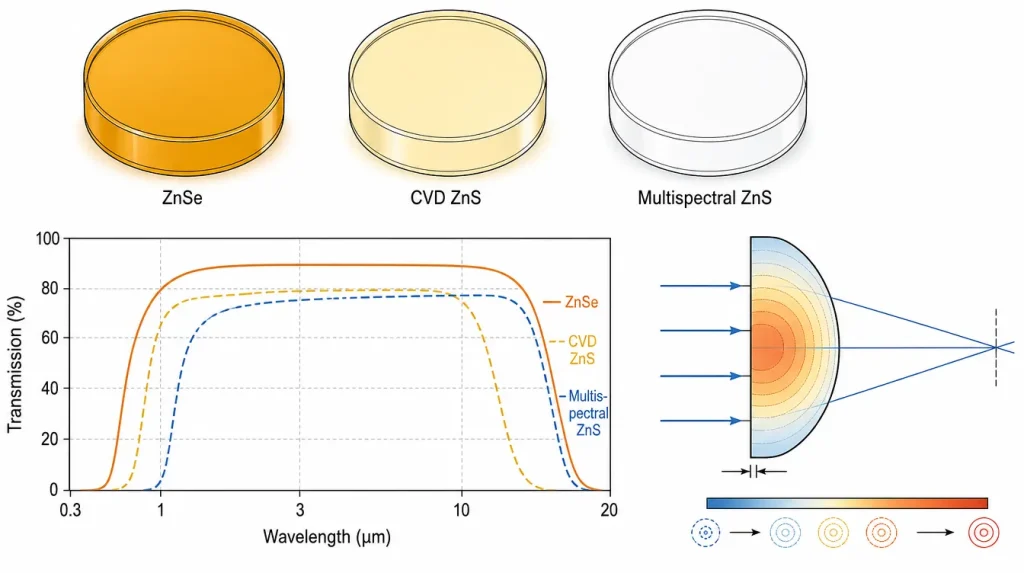
Choose zinc selenide (ZnSe) when the optic sits in a CO2 laser beam or has to transmit past about 14 µm. Choose zinc sulfide (ZnS) when the optic faces weather, sand, or rain, or when visible light and thermal infrared have to share one aperture. In practice the ZnSe vs ZnS infrared optics decision reduces to three numbers on the datasheet: bulk absorption at the working wavelength, Knoop hardness, and the long-wavelength cutoff.
Both materials are grown by chemical vapor deposition (CVD) from zinc vapor and a hydride gas, and both are polycrystalline. They look similar on a purchase order and behave very differently in a system.
What the two materials actually are
CVD ZnSe is grown from zinc vapor and hydrogen selenide, forming polycrystalline sheets on a graphite substrate. It is yellow-orange and transparent enough in the red that you can see a visible alignment beam through it. It is also soft, with a Knoop hardness around 120 (50 g indenter), which drives most of its handling and mounting problems.
ZnS comes in two commercial grades that are often confused:
- Standard CVD ZnS, usually sold as FLIR grade after the forward-looking infrared systems it was developed for. It is pale yellow and translucent in the visible, used as deposited. This is the harder, stronger grade.
- Multispectral ZnS (MS ZnS), made by taking standard CVD material and applying hot isostatic pressing (HIP). HIP removes zinc hydride inclusions and normalizes the crystal structure, producing water-clear material that transmits from the visible through the long-wave infrared (LWIR, 8 to 14 µm). The trade-off is grain growth, which lowers hardness and flexural strength.
If a drawing just says “ZnS,” it is underspecified. The two grades differ in transmission below 3 µm, in hardness, and in price.
Why the transmission windows differ
The short-wavelength edge is set by the electronic bandgap. Using λ(µm) ≈ 1.24 / E_g(eV), ZnSe’s bandgap near 2.7 eV puts its intrinsic absorption edge around 0.46 µm, which is why the material is colored. ZnS has a much wider gap near 3.7 eV, giving an edge near 0.34 µm. That is the physical reason multispectral ZnS can be water-clear and ZnSe cannot.
The long-wavelength edge is set by multiphonon lattice absorption, and it scales with the mass of the anion. Selenium is heavier than sulfur, so ZnSe’s optical phonon frequencies are lower and its Reststrahlen band sits near 45.7 µm, against roughly 30.5 µm for ZnS. That single fact is why ZnSe keeps working out to 16 µm and beyond in thin windows while ZnS is finished by about 13 to 14 µm.
For anything past the LWIR band, including far-infrared spectroscopy and attenuated total reflectance (ATR) prisms, ZnS is not a candidate.
ZnSe vs ZnS infrared optics: specification comparison
| Parameter | CVD ZnSe | Standard CVD ZnS (FLIR grade) | Multispectral ZnS |
|---|---|---|---|
| Quoted transmission range | 0.6 to 21 µm | 1.0 to 13 µm | 0.37 to 13.5 µm |
| Appearance | Yellow-orange, transparent | Pale yellow, translucent | Water-clear |
| Refractive index | 2.4028 at 10.6 µm | 2.192 at 10.6 µm | 2.2008 at 10 µm |
| Uncoated two-surface Fresnel loss | 29.1% at 10.6 µm | 24.6% at 10.6 µm | 24.7% at 10 µm |
| Bulk absorption | 0.0005 cm⁻¹ at 10.6 µm | 0.02 cm⁻¹ at 3.8 µm | 0.0006 cm⁻¹ at 3.8 µm |
| dn/dT | +61 × 10⁻⁶ K⁻¹ at 10.6 µm | +43 × 10⁻⁶ K⁻¹ at 3.39 µm | +38.7 × 10⁻⁶ K⁻¹ at 3.39 µm |
| Knoop hardness (50 g) | 120 | 200 to 235 | ~160 |
| Flexural strength / apparent elastic limit | ~55 MPa | ~103 MPa | ~69 to 75 MPa |
| Thermal conductivity | 18 W m⁻¹ K⁻¹ | 16.7 W m⁻¹ K⁻¹ | 27.2 W m⁻¹ K⁻¹ |
| Coefficient of thermal expansion (CTE) | 7.1 × 10⁻⁶ K⁻¹ | 6.6 × 10⁻⁶ K⁻¹ | 6.5 × 10⁻⁶ K⁻¹ |
| Density | 5.27 g/cm³ | 4.08 g/cm³ | 4.09 g/cm³ |
| Reststrahlen peak | 45.7 µm | 30.5 µm | 30.5 µm |
| Max service temperature in air | 250 °C | 250 °C | 250 °C |
Values are compiled from published supplier material datasheets. Two cautions. First, the dn/dT figures are quoted at different wavelengths, so they are not directly comparable; if thermal defocus matters to your design, ask for dn/dT at your actual band. Second, ZnS hardness numbers vary between published datasheets, and at least one widely circulated source lists the Knoop values for the two grades in the opposite order from everyone else. The consistent finding across sources, and the one supported by the metallurgy, is that HIP causes grain growth and therefore the multispectral grade is softer and weaker than the as-deposited grade.
Absorption at 10.6 µm decides CO2 laser optics
This is the parameter that ends most arguments. ZnSe’s bulk absorption of 0.0005 cm⁻¹ at 10.6 µm is roughly three orders of magnitude below that of ZnS and germanium. Notice that ZnS datasheets do not usually quote an absorption coefficient at 10.6 µm at all. They quote it at 3.8 µm. That omission tells you what the material is for.
Absorbed power follows Beer-Lambert, and for a thin optic the absorbed fraction is approximately αt:
I = I₀ e^(−αt) ≈ I₀(1 − αt) for αt ≪ 1The absorbed heat produces a radial temperature gradient, which produces an optical path difference through dn/dT and through bulge of the surfaces. The result is thermal lensing: focus walks during the cut, spot size grows, and process stability degrades. In a real system the bulk absorption is not the whole story. Published work on CO2 laser output couplers notes that once you include coating absorption, material variation, and surface contamination, a 5 mm coated ZnSe optic typically shows around 0.25% total absorption, giving an effective coefficient near 0.005 cm⁻¹, ten times the ideal bulk figure.
The practical conclusion: for CO2 laser windows, lenses, output couplers, and beam expanders above a few tens of watts, ZnSe is the material. ZnS substitution to save cost is a false economy that shows up as focus drift and, eventually, coating failure.
Dispersion and thermal defocus
For LWIR lens design, the more interesting difference is dispersion. Taking published index values at 8, 10, and 12 µm and forming an Abbe-style number V = (n₁₀ − 1) / (n₈ − n₁₂):
- ZnSe: V ≈ 58
- ZnS, both grades: V ≈ 23
Germanium sits far above both. That makes ZnS the strong flint of the common LWIR trio, and it is why Ge/ZnS doublets are so common in thermal imaging objectives. In many designs ZnS is chosen for color correction, not for durability, and a designer who swaps in ZnSe for its better transmission will find the chromatic correction has collapsed.
Thermal defocus is the other design-level difference. For a thin lens in a fixed mount, ignoring housing expansion:
Δf / f ≈ −[ (dn/dT)/(n − 1) − α_CTE ] ΔTFor ZnSe at 10.6 µm this gives about 36 ppm per kelvin. A 100 mm focal length ZnSe singlet over a 40 K swing shifts focus by roughly 145 µm. The diffraction depth of focus for an f/2 system at 10 µm is about ±2λ(F/#)² = ±80 µm. The shift is nearly twice the depth of focus, so it is a real image quality problem, not a rounding error. Aluminum housings partly compensate through their own expansion, but only partly, and only if someone did the calculation.
Mechanical durability and environmental exposure
ZnSe is soft. Knoop 120 means it scratches during routine cleaning if the technique is careless, and it means an exposed front window collects sleet and sand damage quickly. Handling rules that feel excessive for BK7 are appropriate here: no metal tweezers, generous chamfers on the drawing, lens tissue with isopropanol rather than dry wiping.
Standard CVD ZnS has roughly double the flexural strength of ZnSe and nearly twice the hardness, which is why it dominates external windows and domes on airborne and vehicle-mounted thermal systems. Where erosion resistance still is not enough, a diamond-like carbon (DLC) or hard carbon coating is applied to the exposed face. DLC buys durability at the cost of some transmission and a narrower usable band, so it belongs on the outer surface only.
Neither material tolerates heat well. Both oxidize significantly around 300 °C and should be kept below 250 °C in normal atmosphere. Engineers designing furnace or combustion viewports regularly miss this and specify sapphire or fused silica behind the zinc chalcogenide window as a sacrificial thermal barrier, which is the right instinct.
For infrared windows and lenses in either material, suppliers such as GIAI Photonics list the substrate grade separately from the coating band, and it is worth reading both lines on the quote rather than assuming a default.
What to put on the drawing
For a ZnSe or ZnS window or lens, the specification an optical shop actually needs:
- Material and grade. Not “ZnS,” but “multispectral ZnS, HIP” or “CVD ZnS, FLIR grade.”
- Clear aperture as a diameter or percentage of the outer diameter, plus outer diameter and thickness with tolerances.
- Surface figure. Peak-to-valley power and irregularity, with the test wavelength stated. A window specified as λ/2 P-V is meaningless unless you say whether λ is 632.8 nm or 10.6 µm. λ/2 at 632.8 nm is roughly λ/34 at 10.6 µm.
- Surface quality. Scratch-dig per MIL-PRF-13830B, or surface imperfection per ISO 10110-7 if you are working to the ISO system. Do not mix conventions on one drawing.
- Wedge or parallelism in arcminutes, which matters more for windows in imaging paths than most people expect.
- Transmitted wavefront error (TWE) if the part is in an imaging or laser beam path.
- Coating. AR band, average or minimum transmission, and the angle of incidence (AOI) the specification applies at. A coating optimized at 0° AOI does not hold its performance at 45°.
- Absorption for CO2 laser parts, specified as a calorimetric measurement at 10.6 µm rather than inferred from transmission.
- Chamfers, especially on ZnSe.
Common specification mistakes
Substituting ZnS for ZnSe in a CO2 beam path. The transmission curves look similar in the LWIR, so the substitution looks harmless. The absorption difference is three orders of magnitude, and it appears as thermal lensing and focus drift under power.
Ordering FLIR-grade ZnS for a multiband system. Standard CVD ZnS scatters and absorbs below about 3 µm. If the system carries a visible boresight laser, a short-wave infrared (SWIR) channel, or any daylight imaging path, you need multispectral grade. This failure is discovered at integration, after the parts are coated.
Reading a transmission number without checking whether it includes the coating. Uncoated ZnSe loses 29.1% at 10.6 µm to Fresnel reflection alone, from R = ((n−1)/(n+1))² at each surface. A single-line 10.6 µm antireflection (AR) coating can push two-surface transmission above 99%; a broadband 8 to 12 µm design gives up some peak performance in exchange for bandwidth. The substrate number and the coated number are not close.
Over-specifying scratch-dig on LWIR windows. At 10 µm, surface defects far smaller than the wavelength scatter weakly, so 60-40 is usually adequate for imaging windows and 40-20 adds cost for little benefit. The exception is high-power CO2 optics, where digs act as absorption sites and damage initiators. There the tighter spec earns its price.
Ignoring the 250 °C limit. Both materials oxidize above roughly 300 °C and deform plastically near 500 °C. Process monitoring viewports fail this way.
How to choose
- CO2 laser optics at 9.3 or 10.6 µm, any meaningful power: ZnSe.
- Transmission required beyond 14 µm, including far-infrared spectroscopy and ATR prisms: ZnSe.
- Exposed external window or dome in a harsh environment: standard CVD ZnS, with DLC if erosion is severe.
- One aperture shared by visible, SWIR, mid-wave infrared (MWIR), and LWIR channels: multispectral ZnS.
- Internal LWIR lens element needing flint-like dispersion to correct a germanium element: ZnS.
- Low-power MWIR or LWIR internal elements where transmission matters more than durability: ZnSe.
On handling and disposal, both materials are stable solids in normal use. ZnSe contains selenium and ZnS contains sulfur, and both can release toxic hydrides on contact with strong acids, so broken or scrap parts should go through hazardous waste channels per local regulations rather than into general waste. Neither selenium nor sulfur appears on the RoHS (Restriction of Hazardous Substances) restricted list, so RoHS compliance is normally a question about the coating and the mount, not the substrate.
FAQ
Can I use ZnS instead of ZnSe for a CO2 laser focusing lens to reduce cost? No, not above trivial power levels. ZnS absorption at 10.6 µm is roughly three orders of magnitude higher than ZnSe’s 0.0005 cm⁻¹. The absorbed power creates a radial thermal gradient that acts as a lens, so your focal position drifts during operation and spot quality degrades. Coating damage typically follows. The material cost saving is small relative to the process loss.
My ZnS window is yellow and I cannot see through it. Is it defective? Almost certainly not. Standard CVD ZnS, or FLIR grade, is pale yellow and translucent in the visible by design, because it retains zinc hydride inclusions and fine grain structure that scatter short wavelengths. It still performs normally from 8 to 14 µm. If you need visible clarity, you need the hot isostatically pressed multispectral grade instead.
Which material should I use for the front window of an 8 to 14 µm thermal camera? Standard CVD ZnS in most cases. It has roughly twice the flexural strength and hardness of ZnSe, which matters for an exposed surface subject to cleaning, sand, and rain. Use multispectral ZnS if the same aperture carries a visible or SWIR channel, and add a diamond-like carbon coating on the outer face for severe erosion environments.
How much focus shift should I expect from temperature in a ZnSe lens? For a ZnSe singlet at 10.6 µm the thermo-optic term works out near 36 ppm of focal length per kelvin, ignoring housing expansion. A 100 mm lens over a 40 K swing moves about 145 µm, against roughly ±80 µm of diffraction depth of focus at f/2. Athermalization through housing material choice or a passive compensator is usually necessary.
What surface figure and scratch-dig make sense for an LWIR window? Specify surface figure with the test wavelength stated, since λ/2 at 632.8 nm is about λ/34 at 10.6 µm and the two readings differ by more than an order of magnitude. For scratch-dig, 60-40 per MIL-PRF-13830B is generally adequate for LWIR imaging windows. Tighten to 40-20 only for high-power laser optics, where digs seed absorption and damage.
Whether the application calls for a ZnSe CO2 laser lens or a hardened ZnS thermal imaging window, the substrate grade and the coating band belong on the drawing together, and GIAI Photonics can quote both as part of its infrared lenses and optical windows range.