
- A beam expander is an afocal telescope that scales a collimated beam diameter by M.
- Far-field divergence scales by 1/M; the diameter-angle product stays fixed at one wavelength.
- Galilean layouts avoid an internal focus; Keplerian layouts allow pinhole spatial filtering.
- Focused spot diameter shrinks by M, but depth of focus shrinks by M squared.
- Expansion does not change M squared; a poor input beam stays a poor beam.
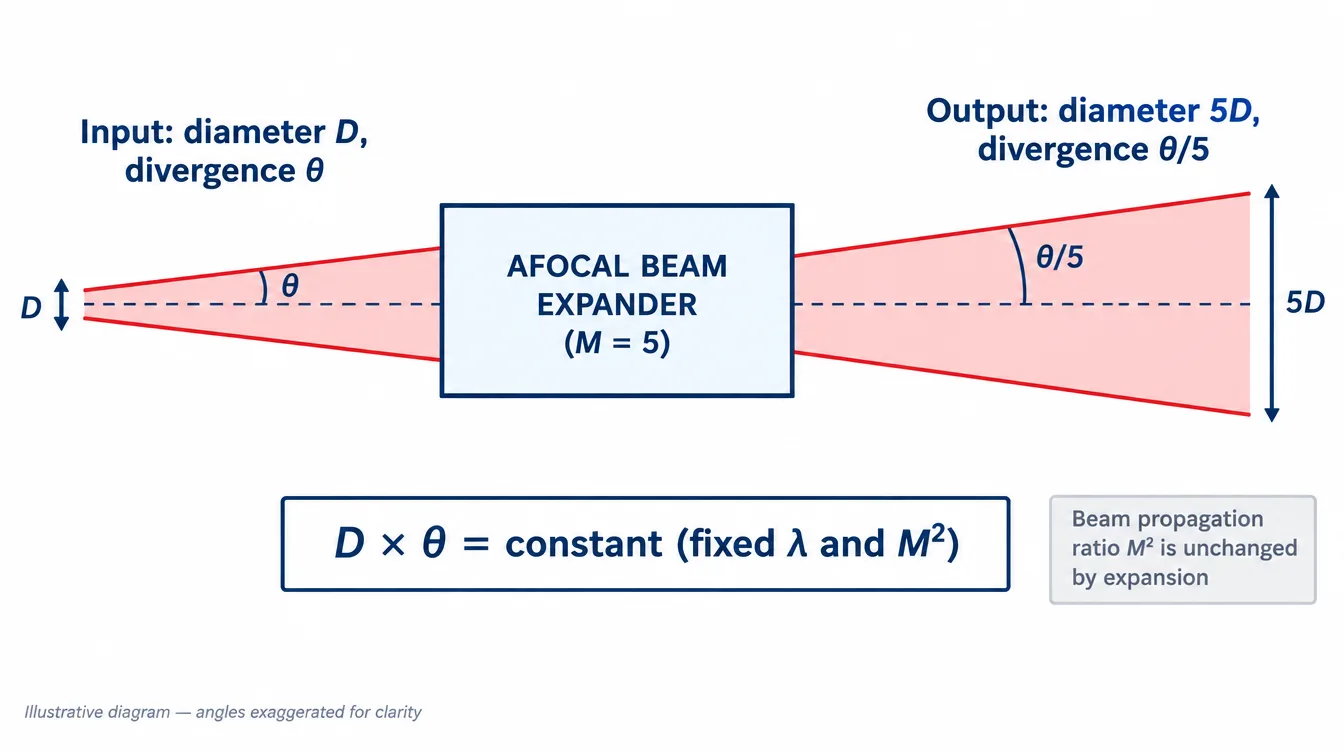
A beam expander is an afocal optical system, usually a two-group lens telescope, that changes the diameter of a collimated laser beam. Expanding the diameter by a factor M reduces the far-field divergence by 1/M, because an afocal system conserves the product of beam size and angle. Used in reverse, the same assembly reduces diameter and increases divergence.
That single relationship explains almost everything a beam expander is used for: filling the aperture of a scan lens, holding a beam collimated over a long working distance, reaching a smaller focused spot, or lowering the power density on a sensitive downstream component. It also explains what a beam expander cannot do, which is where most integration problems start.
How expanding the diameter reduces divergence
An afocal system has no net optical power: a collimated beam enters and a collimated beam leaves. In the paraxial limit, such a system scales transverse dimensions by M and angles by 1/M. Enlarging the beam therefore forces the divergence down by exactly the same factor.
For an ideal single-mode Gaussian beam, the far-field half-angle divergence is θ = λ / (π w₀), where w₀ is the beam waist radius measured at the 1/e² intensity level and λ is the wavelength in the propagation medium. For a real beam, the relation becomes θ = M² λ / (π w₀), where M² is the beam propagation ratio defined in ISO 11146-1. Both forms show the same thing: waist radius and divergence are inversely linked, and their product is fixed for a given wavelength and a given M².
Note the notation collision that causes real confusion in specifications. M is the geometric expansion ratio of the telescope. M² is the beam propagation ratio of the laser. They are unrelated quantities, and an expander changes the first while leaving the second untouched.
Galilean and Keplerian layouts
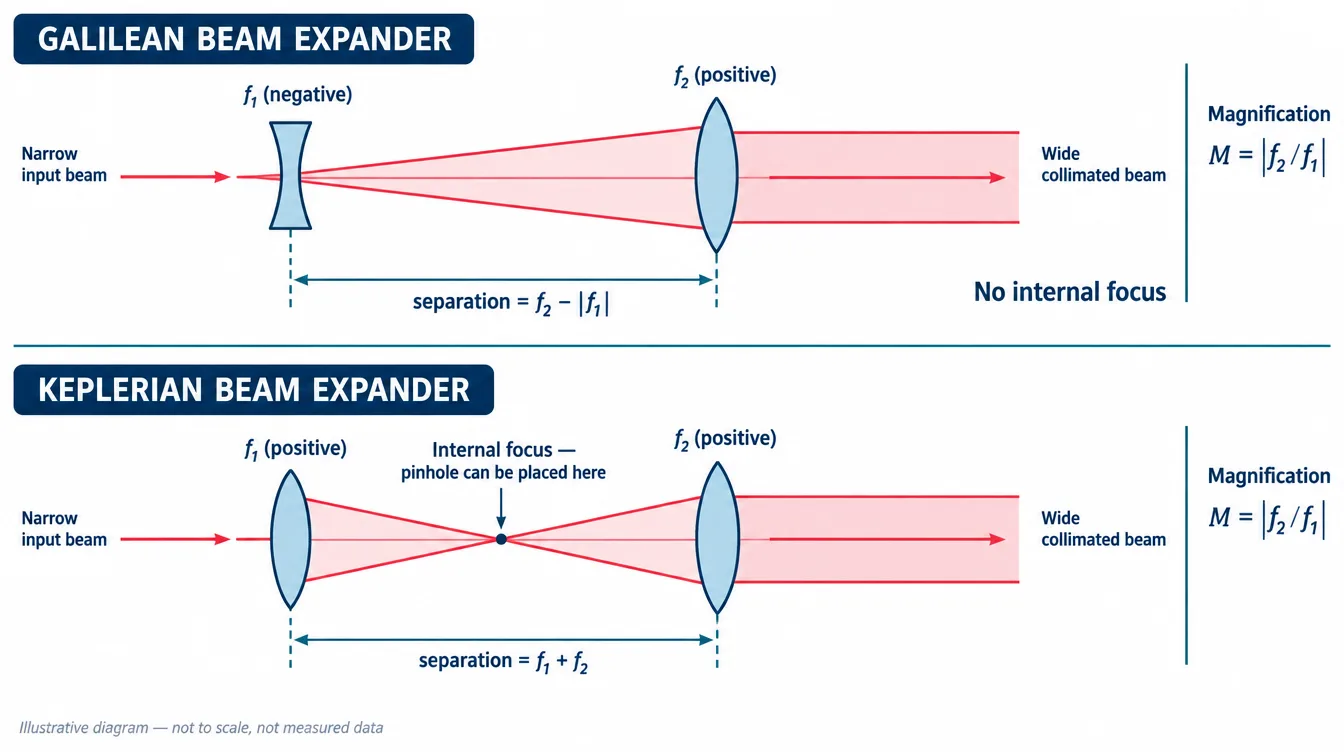
Two refractive layouts dominate. A Keplerian expander uses two positive lenses and brings the beam to a real focus between them. A Galilean expander uses a negative input lens and a positive output lens, and has no internal focus. Both are afocal, and both give the same magnification for the same focal-length ratio.
| Layout | Lens types | Internal focus | Relative length | Spatial filtering | Beam orientation |
|---|---|---|---|---|---|
| Galilean | Negative, then positive | None | Shorter | Not possible | Preserved |
| Keplerian | Positive, then positive | Real focus in air | Longer | Pinhole can be placed at focus | Rotated 180° |
The internal focus is the deciding factor for pulsed sources. Concentrating a high peak power into a small volume of air can ionise it, and the resulting plasma disturbs the transmitted beam. Galilean designs avoid that volume entirely, which is why they are common in material-processing beam delivery. The same focus is an advantage in metrology: a pinhole placed there acts as a spatial filter and removes high-spatial-frequency structure from the wavefront.
Two non-refractive alternatives exist for cases where lenses are awkward. Off-axis reflective pairs remove chromatic effects and handle broadband or deep-UV beams. Anamorphic prism pairs and cylindrical lens elements expand in one transverse direction only, which suits the elliptical output of edge-emitting laser diodes.
How magnification and lens spacing are set
Magnification is the ratio of the output-group focal length to the input-group focal length, M = |f₂ / f₁|. A 25 mm input lens paired with a 125 mm output lens gives M = 5, regardless of layout. The afocal condition sets the spacing: the separation equals the algebraic sum f₁ + f₂. For a Keplerian pair both focal lengths are positive, so the separation is f₁ + f₂. For a Galilean pair f₁ is negative, so the separation reduces to f₂ − |f₁|, which is why the Galilean assembly is physically shorter for the same M.
These relations assume thin lenses, a paraxial treatment, and an input beam collimated well enough that its Rayleigh range is long compared with the expander length. Real assemblies use finite thicknesses and principal-plane positions, and many commercial expanders deliberately allow the spacing to be adjusted by a few tenths of a millimetre. That adjustment breaks the afocal condition on purpose, adding a small amount of positive or negative power so the operator can compensate for the residual divergence of the source and reach true collimation at the working distance.
What expansion does to the focused spot
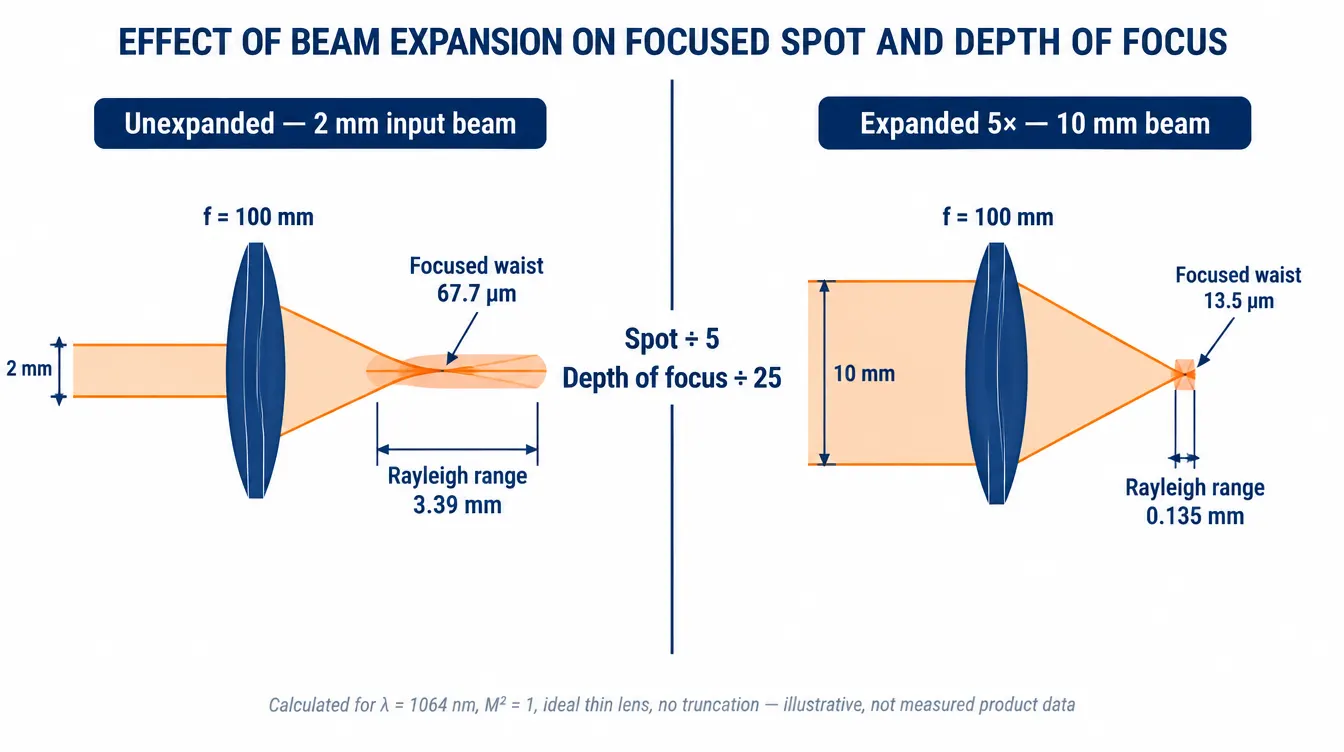
Most beam expanders are installed in front of a focusing element, so the question that matters is what happens at the work plane. For an ideal Gaussian beam of 1/e² diameter D focused by a thin lens of focal length f, the focused waist diameter is 2w₀ = 4λf M² / (πD). Diameter at the lens and diameter at the focus are inversely related, so expanding the beam by M shrinks the focused spot by M.
The cost appears in the axial direction. The Rayleigh range z_R = π w₀² / λ, the distance over which the beam radius grows by √2, scales with the square of the waist radius. Shrinking the spot by M shortens the usable depth of focus by M².
A worked example makes the size of that penalty concrete. Take λ = 1064 nm, a focusing lens of f = 100 mm, an ideal beam with M² = 1, and no truncation or aberration. A 2 mm input beam focuses to a waist diameter of 67.7 µm with a Rayleigh range of 3.39 mm. Expanding the same beam to 10 mm gives a waist of 13.5 µm with a Rayleigh range of 0.135 mm. The spot is five times smaller and the depth of focus is twenty-five times shorter. These are calculated values from the ideal Gaussian thin-lens relations, not measured product data.
| Quantity | Scaling with M | Practical consequence |
|---|---|---|
| Beam diameter | × M | Clear apertures downstream must grow |
| Far-field divergence | × 1/M | Collimation holds over longer distance |
| Focused spot diameter | × 1/M | Higher irradiance at the work plane |
| Depth of focus | × 1/M² | Tighter tolerance on working distance |
| Fluence on optics | × 1/M² | Lower damage risk after the expander |
| Input pointing error | × 1/M | Angular jitter from the source is suppressed |
| Input lateral offset | × M | Decentre at the input walks the output beam |
What a beam expander cannot fix
Expansion rescales a beam. It does not clean it. The beam propagation ratio M² is invariant through an ideal afocal telescope, so a multimode or astigmatic source stays multimode or astigmatic after expansion, and the focused spot remains M² times larger than the diffraction-limited value. Selecting a larger expansion ratio to compensate for a poor source is a common and unproductive substitution.
Three further limits are worth stating explicitly, because they are assumptions rather than specifications:
- Collimated input only. The afocal geometry is defined for a collimated input. A strongly divergent input produces a divergent output and may overfill the internal apertures.
- Design wavelength only. Refractive index and therefore focal length vary with wavelength. Operating a singlet-based expander away from its design wavelength changes the focal-length ratio, breaks the afocal spacing, and leaves the output slightly convergent or divergent. Anti-reflection coatings are also wavelength-specific, and the transmission loss compounds across four or more surfaces.
- Bounded beam-size range. Each design has an input aperture and an internal aperture. Below the intended input size the wavefront curvature assumptions fail; above it, the beam clips.
Trade-offs in choosing the expansion ratio
No single ratio is correct, because M pulls several requirements in opposite directions.
Aperture fill against truncation. Overfilling a downstream aperture produces diffraction rings and power loss; underfilling wastes the available numerical aperture and leaves the spot larger than necessary. For an ideal TEM₀₀ beam passing a centred circular hard aperture, the calculated transmitted power fraction is 86.5 % when the aperture diameter equals the 1/e² beam diameter, 98.9 % at 1.5 times that diameter, and 99.97 % at twice that diameter. These are computed from the Gaussian intensity integral, ignoring aberration and edge scattering.
Spot size against working tolerance. The M² penalty on depth of focus means that a very small spot demands a correspondingly precise working distance, a flat part, and a stable thermal environment. Many processes fail on Z-axis tolerance rather than on spot size.
Compactness against alignment tolerance. Galilean assemblies are shorter for the same ratio, which shortens the lever arm available to the mount and makes tilt of the negative element relatively more significant. Keplerian assemblies are longer and place a real focus in air.
Fluence distribution inside the assembly. In a Galilean expander used for expansion, the smallest beam and therefore the highest fluence occurs at the negative input element. In a Keplerian expander, the highest fluence is at the internal focus. Damage-threshold specification should refer to the element that actually sees the peak, and testing should follow a defined method such as ISO 21254-1 rather than an unqualified number.
Specifying and integrating one without surprises
Several recurring integration problems have nothing to do with the expander itself.
- Assuming the laser output is collimated. Many sources emit a slowly diverging beam. Measure the beam width at two separations and fit, following the approach of ISO 11146-1, before choosing a ratio.
- Specifying beam diameter without a definition. A 1/e² diameter, a FWHM diameter and a D4σ diameter are different numbers for the same beam. State which one applies.
- Ignoring clear aperture versus mechanical aperture. The usable optical aperture is smaller than the housing bore, and clear aperture and surface-quality requirements belong on the element drawing.
- Treating the AR coating as generic. Coating band, angle of incidence and damage requirements must match the source. Coating specification for a narrow laser line differs substantially from a broadband requirement.
- Overlooking thermal drift. Absorption in substrates and coatings shifts focal lengths, and an assembly that is afocal cold may not be afocal after thermal equilibrium at high average power.
- Forgetting the reverse case. Running an expander backwards as a reducer increases divergence by M and raises fluence on every surface after the assembly, which is a frequent cause of downstream damage.
When the expander is a custom build rather than a catalogue part, the element-level requirements are what drive feasibility: substrate material, radii and thickness, centration, surface figure and surface quality, clear aperture, coating band and angle of incidence, and the inspection method that will be used at acceptance. Those follow the same drawing conventions as any other precision laser beam delivery component, and the acceptance criteria should be agreed before fabrication rather than after.
FAQ
Does a beam expander reduce beam divergence?
Yes. An afocal beam expander scales transverse dimensions by the magnification M and angles by 1/M, so expanding a collimated beam by five times reduces its far-field divergence to one fifth. The product of beam diameter and divergence stays constant for a fixed wavelength and a fixed beam propagation ratio M².
Can a beam expander be used in reverse as a beam reducer?
An afocal expander works in both directions. Running it backwards reduces the beam diameter by 1/M and increases divergence by M. Two cautions apply: fluence on every surface downstream of the assembly rises by roughly M², and the input aperture of the reversed path is the element originally intended as the output, which limits the acceptable input size.
What is the difference between a Galilean and a Keplerian beam expander?
A Keplerian expander uses two positive lenses and forms a real focus between them, which permits pinhole spatial filtering but concentrates peak power in air. A Galilean expander uses a negative input lens and a positive output lens with no internal focus, is shorter for the same magnification, and preserves beam orientation rather than rotating it by 180 degrees.
Does a beam expander improve beam quality?
No. The beam propagation ratio M² is invariant through an ideal afocal telescope. Expansion changes diameter and divergence together but leaves the fundamental beam quality of the source unchanged, so the focused spot stays M² times larger than the diffraction-limited value. Improving beam quality requires spatial filtering, mode selection at the source, or a different source.
Why does a beam expander have to match the laser wavelength?
Focal length depends on refractive index, which varies with wavelength. Away from the design wavelength the focal-length ratio changes, the afocal lens spacing is no longer correct, and the output beam becomes slightly convergent or divergent instead of collimated. Anti-reflection coatings are also band-specific, so transmission loss and back-reflection both increase outside the design band.
What is a variable or zoom beam expander?
A variable beam expander contains at least three optical groups whose separations can be changed, allowing the magnification to be tuned continuously over a range while the output stays collimated. It trades mechanical complexity, cost and alignment stability for flexibility, and is used where one optical train must serve several spot sizes or working distances.
References
- ISO 11146-1, Lasers and laser-related equipment — Test methods for laser beam widths, divergence angles and beam propagation ratios — Part 1: Stigmatic and simple astigmatic beams
- ISO 11145, Optics and photonics — Lasers and laser-related equipment — Vocabulary and symbols
- ISO 21254-1, Lasers and laser-related equipment — Test methods for laser-induced damage threshold — Part 1: Definitions and general principles
- ISO 10110 series, Optics and photonics — Preparation of drawings for optical elements and systems
- A. E. Siegman, Lasers, University Science Books
- S. A. Self, “Focusing of spherical Gaussian beams,” Applied Optics, Optica Publishing Group
Discussing a custom beam expander element set
For a project-level technical review, send the drawing, optical specification or sample together with the laser wavelength, input beam diameter and its definition, measured divergence or M², required expansion ratio, clear aperture, substrate preference, coating band and angle of incidence, damage-threshold requirement, mechanical envelope, inspection criteria and expected quantity. GIAI Photonics evaluates custom optics from drawings, specifications or existing samples, and acceptance methods are defined against the part drawing and the project requirements.