
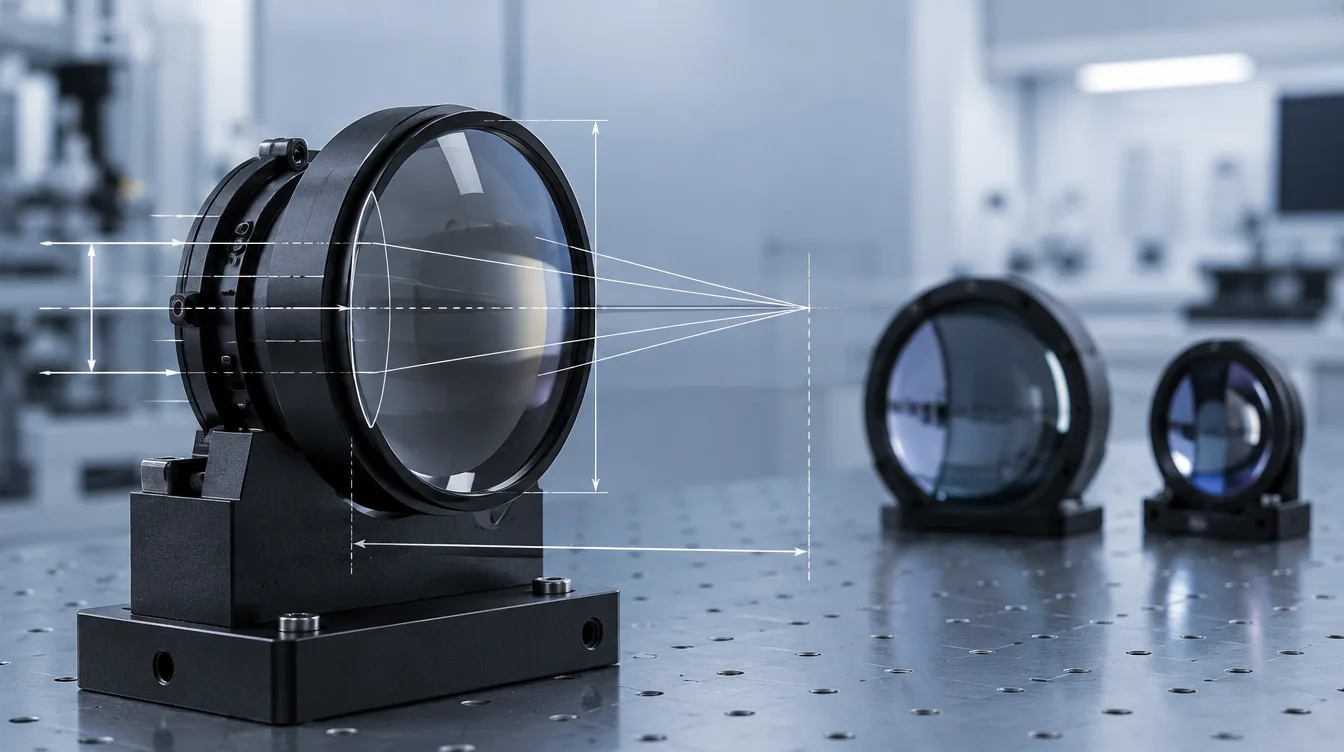
Choosing a germanium lens starts with the infrared system requirements, not the diameter or lens shape. The most important factors are the detector wavelength range, effective focal length, f-number, field of view, coating performance, operating temperature, and optical inspection criteria.
Germanium (Ge) is widely used in infrared imaging because it transmits important portions of the mid-wave infrared (MWIR) and long-wave infrared (LWIR) spectrum. Its high refractive index also makes it useful for compact optical designs.
However, germanium is not automatically the correct material for every infrared application. A lens that performs well at room temperature may suffer focus drift or reduced transmission at elevated temperatures. Similarly, selecting an appropriate substrate without specifying the coating can lead to unnecessary optical losses.
This guide explains how to choose a germanium lens for thermal cameras, infrared sensors, and custom imaging systems.
1. Start with the Operating Wavelength
Before choosing the lens geometry, confirm the spectral range of the detector and the complete optical system.
Germanium has a commonly cited infrared transmission region of approximately 2–14 µm under appropriate conditions. Its practical performance depends on material grade, thickness, temperature, and the coatings applied to the finished component.
| Operating band | Germanium lens consideration |
|---|---|
| 3–5 µm MWIR | Germanium can be used, but silicon and other IR materials should also be evaluated |
| 8–12 µm LWIR | A common operating region for germanium thermal-imaging lenses |
| 8–14 µm LWIR | Potentially suitable, but verify performance at the long-wavelength end |
| Broadband MWIR/LWIR | Requires careful evaluation of material absorption and coating bandwidth |
| Visible and near-IR | Germanium is generally unsuitable when visible transmission is required |
The quoted material transmission range is not a guarantee of high transmission from a finished lens throughout that entire interval.
For example, an infrared camera designed for 8–12 µm operation requires a lens whose substrate, coating, and geometry support adequate throughput across the detector’s actual response band.
A specification such as “germanium lens for infrared” is therefore incomplete. It should identify the wavelength band and optical performance requirements.
2. Choose the Focal Length Based on Field of View
The effective focal length (EFL) determines how a lens maps object angles onto the detector.
For an imaging system focused at infinity, a longer focal length generally produces a narrower field of view and a larger image of distant objects. A shorter focal length provides wider coverage but reduces the number of detector pixels allocated to a distant target.
For an approximately rectilinear optical system, the horizontal field of view can be estimated from:
Horizontal FOV ≈ 2 × arctan(sensor width / 2EFL)
This relationship is useful for preliminary selection. Actual field of view can differ because of distortion, focus position, and the complete lens prescription.
Match the lens to the detector
Focal length should be evaluated together with detector dimensions and pixel pitch.
An engineer designing an infrared camera should consider the target distance, required field of view, smallest feature that must be resolved, detector format, and expected spatial resolution.
A wider field of view may be appropriate for monitoring a large industrial area. A narrower field may be necessary when measuring or observing a relatively small target from a greater distance.
The goal is not simply to obtain a sharp image. For quantitative thermal imaging, the target must also occupy sufficient detector pixels to meet the intended measurement requirement.
See FLIR’s technical discussion of choosing the correct thermal camera lens for the relationship between field of view, target size, and spatial resolution.
3. Evaluate the F-Number and Clear Aperture
The f-number describes the relationship between focal length and the effective entrance pupil diameter.
F/# = Effective Focal Length / Entrance Pupil Diameter
For comparable optical systems, a lower f-number permits a larger entrance pupil relative to focal length. This can improve the amount of infrared radiation reaching the detector, an important consideration for thermal imaging sensitivity.
However, selecting the lowest possible f-number is not always the best engineering decision.
Fast infrared lenses can place greater demands on aberration correction, optical alignment, manufacturing tolerances, and mechanical packaging.
The clear aperture must also be distinguished from the physical outer diameter of the lens.
A lens may fit the mounting space while still having insufficient usable aperture for the required beam cone or field angles.
When specifying a germanium lens, evaluate the aperture requirements at both the center and edge of the field. Mechanical housings, retaining rings, and nearby optical components must not introduce unacceptable vignetting.
4. Select the Appropriate Lens Geometry
Germanium lenses can be designed with spherical or aspheric surfaces. The correct geometry depends on the optical function and imaging requirements.
Spherical germanium lenses
Spherical designs may be appropriate for relatively simple focusing or beam-control tasks.
A plano-convex germanium lens, for example, can be considered for focusing a collimated infrared beam where the relevant aberrations remain within the system’s tolerances.
Spherical geometry can be simpler to specify and manufacture, but it does not automatically provide acceptable image quality over a wide field or at a low f-number.
Aspheric germanium lenses
Aspheric surfaces provide additional design freedom for controlling spherical aberration and other imaging errors.
They can be useful in compact thermal imaging systems where the lens must achieve a demanding combination of aperture, field of view, and optical performance.
However, the presence of an aspheric surface does not guarantee improved system performance.
The complete prescription, surface accuracy, centration, wavelength band, and operating conditions still determine the resulting image quality.
For a custom lens, engineers should provide the optical prescription or relevant performance targets rather than selecting an aspheric shape solely because it appears more sophisticated.
5. Specify the Correct Anti-Reflection Coating
Germanium has a refractive index of approximately 4.0 in commonly used thermal infrared regions.
This high refractive index is beneficial for optical design, but it also creates substantial Fresnel reflection at an uncoated air–germanium interface.
At normal incidence, the theoretical reflection from one uncoated surface is approximately 36%, neglecting absorption and other losses.
Consequently, anti-reflection (AR) coatings are particularly important for germanium lenses.
Common infrared coating design regions include 3–5 µm for MWIR applications and 8–12 µm for LWIR thermal imaging. Broader designs are possible, but their performance must be evaluated against the required bandwidth.
What should the coating specification include?
Rather than requesting only “AR-coated germanium,” define the operating wavelength range, required transmission or reflectance, relevant incidence angles, and environmental conditions.
The coating must be evaluated over the actual range of ray angles encountered in the optical system. Its performance at normal incidence may not fully represent performance in a fast or wide-angle lens.
For infrared imaging, overall transmission is especially important because losses reduce the useful optical signal reaching the detector.
When is a protective coating necessary?
Germanium lenses used behind a sealed protective window face different environmental conditions from lenses directly exposed to the outside environment.
External optics may encounter dust, abrasion, humidity, cleaning, and mechanical contact.
Diamond-like carbon (DLC) coatings are used on some infrared optical components to improve surface durability.
However, a protective coating and an anti-reflection coating do not necessarily serve the same function. Their combination must be selected according to the required infrared transmission and environmental resistance.
The coating design, layer arrangement, and durability requirements should be reviewed as part of the complete component specification.
6. Consider Temperature Before Finalizing Germanium
Temperature sensitivity is one of the most important limitations of germanium optics.
Germanium has a relatively large thermo-optic coefficient, meaning that its refractive index changes significantly with temperature.
Material data commonly report a value near 396 × 10⁻⁶ K⁻¹ at 10 µm, although the actual coefficient depends on wavelength and temperature.
This behavior can produce two different engineering problems.
Thermal defocus
As the temperature changes, the refractive index changes, affecting optical power and potentially shifting the focal plane.
Mechanical expansion of the lens and its housing can introduce additional focus changes.
For an infrared camera operating across a wide environmental temperature range, image sharpness should therefore be evaluated at more than one temperature.
Depending on the system, passive athermalization, mechanical compensation, or active refocusing may be necessary.
Reduced infrared transmission at elevated temperatures
Germanium absorption can also increase significantly with temperature.
This effect is sometimes described as thermal runaway, particularly where increasing absorption and component heating reinforce one another.
Published research has reported meaningful transmission degradation at elevated temperatures, including conditions relevant to infrared imaging equipment.
There is no single temperature threshold that guarantees acceptable performance for every germanium lens. Material grade, thickness, wavelength, coating, thermal loading, and the required transmission all matter.
For systems exposed to substantial heat, germanium should be compared with other infrared materials before the optical architecture is finalized.
Engineering recommendation: Specify the component’s expected temperature range and assess both focus stability and spectral transmission across that range.
7. Review Weight and Mechanical Integration
Germanium has a density of approximately 5.3 g/cm³, making it considerably heavier than silicon.
This may have little impact on a small stationary infrared sensor. For larger optics, moving assemblies, or weight-constrained instruments, it can become a significant design consideration.
Lens thickness, edge geometry, mounting surfaces, and mechanical support should therefore be considered together.
Germanium is also a brittle crystalline material. Surface hardness alone does not eliminate the risk of chipping, fracture, or damage caused by inappropriate mounting loads.
Mechanical specifications should address the relevant dimensions, edge treatment, retaining method, clear aperture, and expected thermal or vibration loads.
These requirements are especially important when the lens will be integrated into a compact infrared camera module with limited mechanical clearance.
8. Define Optical Tolerances and Inspection Requirements
A germanium lens should not be accepted solely because its diameter, appearance, and coating color match the drawing.
The inspection plan should reflect the function of the component.
For an imaging lens, relevant characteristics may include surface figure, surface quality, centration, focal length, clear aperture, and coating performance.
At the system level, modulation transfer function (MTF), distortion, and focus behavior may also require verification.
Recommended specification checklist
| Parameter | What to specify |
|---|---|
| Material | Germanium grade and material requirements |
| Wavelength | Operating band and detector response |
| Optical function | Imaging, focusing, or collimation |
| Effective focal length | Nominal EFL and required tolerance |
| Aperture | F-number, entrance pupil, and clear aperture |
| Optical geometry | Spherical or aspheric prescription |
| Dimensions | Diameter, center thickness, and edge requirements |
| Surface requirements | Surface quality, figure, and centration where applicable |
| Coating | Spectral band, transmission or reflectance, and AOI conditions |
| Environment | Operating temperature, contamination, and mechanical exposure |
| Verification | Optical, dimensional, and coating inspection criteria |
Not every project requires equally tight tolerances.
Unnecessarily demanding specifications can increase manufacturing complexity and cost without improving system performance.
Conversely, omitting a critical optical tolerance can result in a lens that meets its mechanical drawing but does not perform adequately in the assembled instrument.
The correct acceptance criteria should be derived from the optical design and the intended use.
9. Common Mistakes When Choosing a Germanium Lens
Several problems occur when the lens is selected from a limited catalog description rather than the full system requirements.
Selecting by diameter alone. A matching outer diameter does not establish the correct focal length, image circle, working distance, or aperture.
Ignoring coating bandwidth. A lens coated for MWIR operation should not automatically be expected to deliver the required transmission throughout an LWIR band.
Assuming room-temperature performance is sufficient. Temperature-dependent refractive index and absorption can affect field performance even when the lens works correctly during initial laboratory inspection.
Treating germanium as interchangeable with other infrared materials. Different refractive indices, dispersion characteristics, thermal properties, and absorption behavior can require a different optical prescription.
Overlooking assembly-level verification. Individual surface specifications do not fully establish the image quality of a multi-element infrared objective.
These mistakes can be reduced by reviewing the optical, thermal, coating, and mechanical requirements before selecting or manufacturing the component.
10. How to Specify a Custom Germanium Lens
For a custom infrared system, the most useful starting point is an existing optical drawing, prescription, sample, or clearly defined set of optical requirements.
The project should identify the detector band, intended optical function, focal or imaging geometry, material requirements, operating temperature, coating targets, and relevant inspection criteria.
Quantity and project stage should also be stated, particularly when distinguishing prototype evaluation from an intended production order.
GIAI Photonics includes germanium within its published infrared optical material and component scope.
For custom optical projects, GIAI reviews drawings, samples, material requirements, geometry, coating conditions, and inspection criteria before determining an appropriate manufacturing route.
Engineers can review the company’s infrared optical components, manufacturing capabilities, and custom optics process when preparing a project.
A specific germanium lens design, tolerance, or coating requirement remains subject to project-level feasibility review.
Conclusion
Choosing a germanium lens requires more than confirming infrared transmission.
The operating wavelength determines whether the material is appropriate. Focal length and f-number influence field of view and light collection. Lens geometry affects aberration control, while coatings govern reflection losses and environmental suitability.
Temperature is equally important because germanium’s refractive index and absorption can change substantially under thermal loading.
A reliable selection process therefore begins with the detector and application requirements, proceeds through optical and mechanical design, and ends with inspection criteria tied to the intended operating conditions.
For custom infrared components, contact GIAI Photonics with the drawing, wavelength range, dimensions, coating requirements, and operating conditions for an engineering review.
Frequently Asked Questions
What wavelength range is suitable for a germanium lens?
Germanium is commonly used across important infrared regions within approximately 2–14 µm, particularly MWIR and LWIR. Actual suitability depends on material grade, lens thickness, temperature, coatings, and the detector’s operating band.
Does a germanium lens need an AR coating?
For most transmissive infrared imaging applications, an AR coating is strongly recommended. Germanium’s high refractive index produces substantial reflection at uncoated surfaces. The coating must be designed for the required wavelength band.
Is a germanium aspheric lens better than a spherical lens?
Not necessarily. Aspheric surfaces provide additional flexibility for correcting aberrations, especially in compact or fast imaging systems. A spherical lens may be sufficient for simpler applications. The optical requirements determine the appropriate choice.
Can a germanium lens be used in high-temperature environments?
Germanium transmission and refractive index are temperature-sensitive. At elevated temperatures, absorption and thermal defocus may become limiting factors. Suitability must be evaluated against the actual lens temperature, wavelength, and performance requirements.
What information is needed to order a custom germanium lens?
Provide the operating wavelength, optical function, EFL or prescription, aperture, dimensions, material requirements, coating specifications, operating conditions, quantity, and inspection criteria. An existing drawing or sample is particularly helpful.
Technical References
- Burnett, J. H., et al. (2020). Index of Refraction of Germanium. Applied Optics, 59(13). NIST.
- Umicore — Infrared Optical Materials and GASIR. Material property and thermo-optic comparisons.
- FLIR — Choosing the Right Lens. Thermal imaging field of view and spatial resolution.
- Edmund Optics — Germanium Optical Properties and AR Coatings. General material and coating principles.
- Optical Degradation of Germanium with Elevated Temperature: Consequences for Infrared Imaging Systems. Published research.