
A dichroic filter may appear to be a simple coated glass plate, but its performance can determine whether an optical system separates wavelengths correctly or introduces unwanted signal loss and crosstalk.
In fluorescence imaging, laser instrumentation, multispectral cameras, and optical sensing systems, the filter must direct selected wavelengths into the intended optical paths. A small difference in the cut-on wavelength, angle of incidence, or polarization response can affect the performance of the entire system.
GIAI Photonics is a dichroic filter manufacturer in China, supporting custom dichroic mirrors, wavelength-selective optical coatings, and precision optical components based on application requirements, drawings, and specifications.
Rather than selecting a filter solely by its nominal wavelength, engineers should consider its transmission and reflection bands, operating angle, polarization behavior, substrate, and inspection criteria.
Custom Dichroic Filters and Mirrors: How They Work
A dichroic filter is a wavelength-selective optical component designed to transmit certain wavelengths while reflecting others.
Unlike an absorptive color filter, a typical dielectric dichroic filter uses interference within a multilayer optical coating to produce its spectral characteristics.
The coating consists of thin layers with different refractive indices. Their optical thicknesses and arrangement determine how incident light is transmitted or reflected across the specified wavelength range.
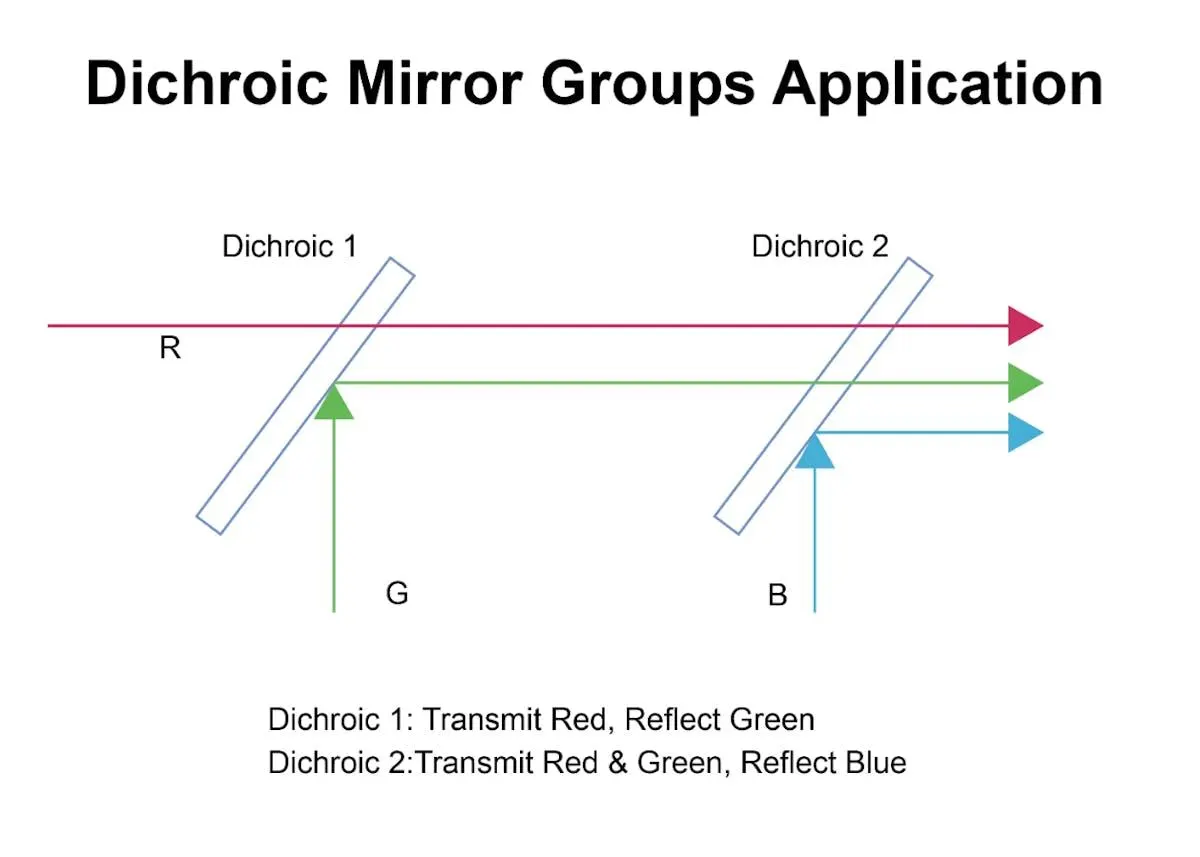
A dichroic component can therefore separate two wavelength bands into different optical paths, or combine beams of different wavelengths along a shared path.
For example, in a fluorescence imaging system, a dichroic mirror may reflect excitation light toward the sample while transmitting longer-wavelength fluorescence toward the detector.
The required spectral response depends on the excitation source, fluorophore emission, detector sensitivity, and optical geometry.
A dichroic filter is not interchangeable with every conventional bandpass filter. While both can use dielectric interference coatings, a dichroic beamsplitter is generally specified for useful performance in both its transmitted and reflected paths.
Dichroic Filter Manufacturer: Custom Manufacturing at GIAI Photonics
GIAI Photonics manufactures precision optical components and supports drawing-based and specification-based custom optical projects.
Its publicly documented manufacturing scope includes optical fabrication, grinding, polishing, edging, cleaning, optical coating, and inspection. The manufacturing route is determined by the particular component and the requirements agreed for the project.
For custom dichroic filters, relevant engineering considerations include the coating’s spectral function, substrate properties, component geometry, and operating conditions.
GIAI’s existing optical component range includes wavelength-selective filters, dichroic mirrors, and beamsplitters. One published dichroic mirror example reflects green light while transmitting specified red and blue wavelength regions.
This is a product-specific example rather than a performance specification for all GIAI dichroic coatings.
For non-standard designs, material suitability, coating performance, dimensional tolerances, inspection methods, and manufacturing feasibility must be evaluated against the actual requirements.
Learn more about GIAI’s optical manufacturing capabilities.
What Types of Dichroic Filters Can Be Specified?
The appropriate dichroic design depends on which wavelengths must pass through the optic and which must be reflected.
Longpass Dichroic Filters
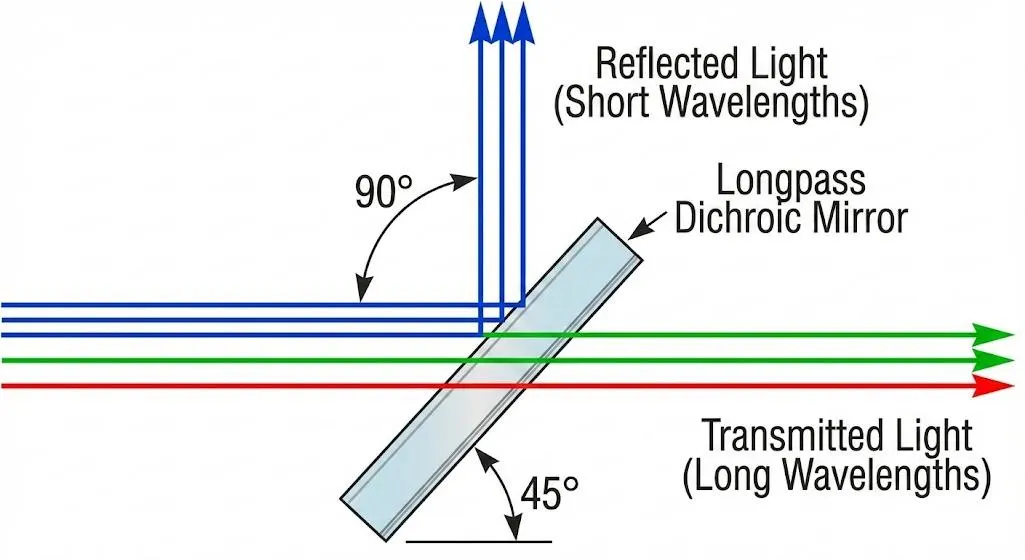
A longpass dichroic filter transmits wavelengths above a specified transition region while reflecting shorter wavelengths within its designed reflection band.
These filters are commonly used in fluorescence systems where shorter-wavelength excitation light must be separated from longer-wavelength emission light.
The required transition edge should be selected with sufficient margin between the source spectrum and the useful emission spectrum.
Shortpass Dichroic Filters
A shortpass dichroic filter transmits shorter wavelengths and reflects longer wavelengths within its specified operating range.
This arrangement may be useful in spectral imaging, beam-combining systems, and instruments requiring a particular wavelength routing configuration.
The coating should be evaluated at its actual operating angle rather than assuming that specifications measured at normal incidence will apply.
Multiband and Color-Separation Dichroic Mirrors
Some systems require more complex spectral routing than a single longpass or shortpass transition.
A multiband or color-separation dichroic coating may be designed to transmit selected spectral regions while reflecting others.
Such requirements are relevant to RGB color separation, projection systems, and multi-channel optical instruments.
The achievable combination of bands, edge transitions, polarization behavior, and tolerances depends on coating-design feasibility and should be reviewed individually.
Key Specifications for Custom Dichroic Filters
The most useful specification is one that describes what the filter must accomplish inside the optical system.
| Parameter | What Engineers Should Define |
|---|---|
| Transmission band | Wavelength range and minimum required transmission |
| Reflection band | Wavelength range and minimum required reflectance |
| Transition edge | Required cut-on or cut-off behavior and allowable transition region |
| Angle of incidence (AOI) | Nominal operating angle and angular range |
| Polarization | Unpolarized, s-polarized, p-polarized, or polarization-specific requirements |
| Substrate | Material, thickness, optical quality, and relevant thermal properties |
| Dimensions | Diameter or length and width, thickness, and mechanical tolerances |
| Clear aperture | Usable coated area under the actual beam geometry |
| Optical quality | Surface condition, flatness, and wavefront requirements where relevant |
| Inspection | Spectral test conditions, acceptance limits, and documentation |
A drawing or datasheet that states only a nominal cut-on wavelength is rarely sufficient for evaluating a custom dichroic filter.
The wavelength ranges, acceptable losses, operating angle, and measurement conditions should also be defined.
Why Angle of Incidence Matters
Dichroic filters are frequently installed at an angle to the incident beam, with 45° being common in beam-separation systems.
However, 45° is not a universal operating condition.
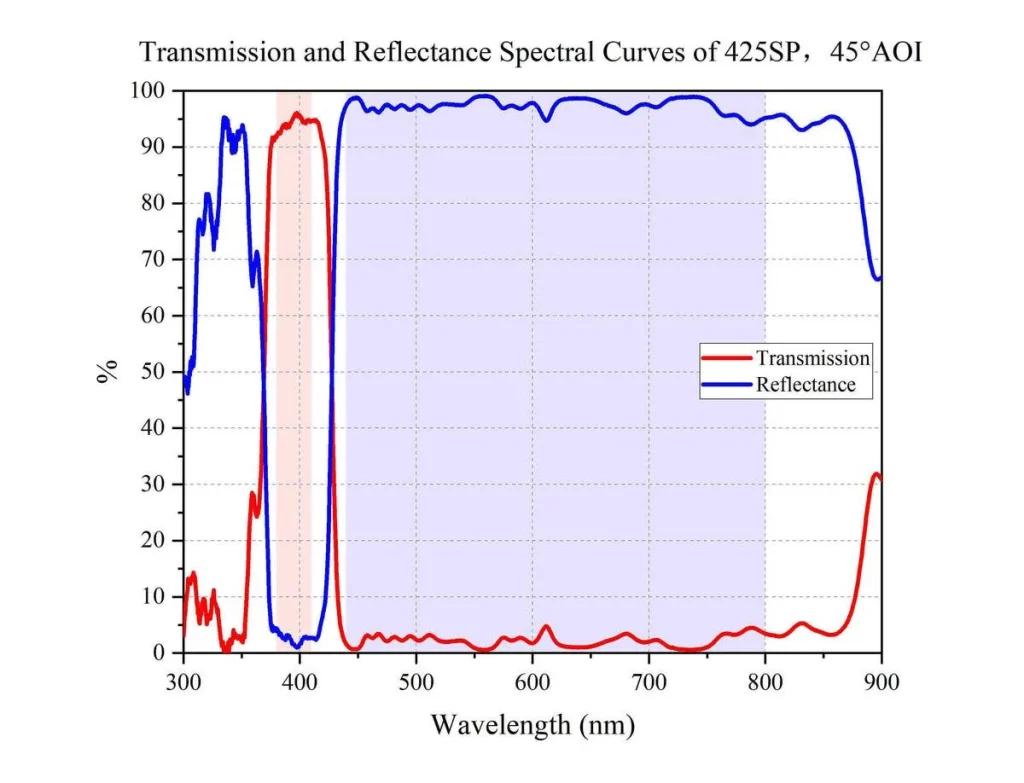
The spectral response of a dielectric interference coating changes with angle of incidence. Increasing the angle generally shifts spectral features toward shorter wavelengths.
For a filter designed around a particular operating angle, even a relatively small angular deviation can become important when the transition edge is close to a wavelength that the optical system needs to transmit or reflect.
The angular distribution also matters. A filter positioned in a converging or diverging beam receives light over a range of incidence angles rather than at one exact angle.
This can broaden or otherwise modify the effective spectral transition seen by the system.
Polarization Dependence at Non-Normal Incidence
At non-normal incidence, s-polarized and p-polarized light can experience different transmission and reflection characteristics.
This difference is particularly relevant for dichroic filters with steep spectral edges.
A coating that satisfies a requirement for unpolarized light may not provide the same result for a strongly polarized laser beam.
For polarization-sensitive applications, engineers should define separate spectral acceptance requirements for s- and p-polarized light where necessary.
A useful coating specification should therefore connect the wavelength requirement with both AOI and polarization conditions.
Substrate, Coating, and Mechanical Integration
Spectral performance is only part of the component design.
The substrate influences optical transmission, mechanical stability, and manufacturability. Common optical substrate candidates include BK7-type optical glass and fused silica, although the appropriate material depends on wavelength range, geometry, environmental requirements, and the coating design.
Thickness and geometry also matter.
A dichroic plate installed at an angle occupies a different beam footprint than one placed at normal incidence. The clear aperture must accommodate the actual beam footprint and alignment allowance without clipping.
For imaging systems, surface figure and transmitted or reflected wavefront quality may need to be specified separately from the coating’s spectral response.
Coating orientation should also be considered during mechanical integration. Depending on the optical configuration, reflections from substrate surfaces may introduce unwanted ghost beams or beam displacement.
For custom components, the drawing should identify any required coated surface, incident direction, and mounting orientation.
Where Are Dichroic Filters Used?
Fluorescence Microscopy and Life Sciences
Fluorescence instruments often use a combination of excitation filters, dichroic mirrors, and emission filters.
The dichroic mirror directs excitation light toward the sample and separates the returning fluorescence from the illumination path.
The overall signal-to-background performance depends on the complete filter arrangement, including spectral leakage, source intensity, and detector response.
Machine Vision and Multispectral Imaging
Dichroic mirrors can divide incoming light into wavelength-specific channels for different cameras or detectors.
This allows an optical system to collect information from several spectral regions without relying exclusively on sequential measurements.
The coating’s spectral edges, beam geometry, and imaging wavefront requirements should be matched to the intended channels.
Laser Beam Combining and Separation
Laser systems may use dichroic optics to combine beams of different wavelengths or route selected wavelengths into separate paths.
Relevant requirements include reflectance, transmission, polarization, incidence angle, beam geometry, and optical power.
For high-power applications, laser-induced damage threshold and related operating conditions require specific technical validation. They should not be inferred from ordinary transmission and reflection specifications.
Projection and Color-Separation Systems
Dichroic mirrors are also used to combine or separate red, green, and blue light paths.
Coating performance affects the spectral distribution and relative optical throughput of the different color channels.
The design should consider the actual light-source spectra, optical arrangement, and acceptable channel leakage.
How Does GIAI Verify Dichroic Filter Quality?
A dichroic filter cannot be adequately evaluated by its visible coating color alone.
The finished component must be assessed against the optical and mechanical characteristics specified for its intended application.
GIAI’s quality assurance process is based on component-specific requirements, including the drawing, coating specifications, and agreed acceptance criteria.
For a custom dichroic filter, relevant verification may include transmission and reflection characteristics across the specified wavelength ranges, performance at the agreed angle of incidence, and dimensional or surface requirements.
Where polarization is critical, the inspection requirements should identify the relevant polarization states and testing conditions.
Spectral curves should also be interpreted carefully. A transmission curve does not, by itself, establish that the reflected beam satisfies a separately specified reflectance or wavefront requirement.
The inspection scope, test conditions, and required documentation should be agreed before manufacturing.
From Optical Specification to Custom Manufacturing
A successful custom project usually begins with an engineering requirement rather than a generic filter description.
At GIAI Photonics, custom optical projects can be reviewed using customer drawings, specifications, or existing samples.
The project review considers the optical function, wavelength bands, material, geometry, coating requirements, and inspection criteria.
Once the requirements are understood, the manufacturing and verification approach can be evaluated.
For engineers developing a new system, it is useful to distinguish between essential performance requirements and preferred design targets.
For example, a minimum transmission requirement at the detector wavelength may be essential, while a more ambitious transition-edge target may be negotiable if it introduces unnecessary design complexity.
Communicating these priorities can make the feasibility review more effective.
See the GIAI custom optics process for additional information about project evaluation and manufacturing.
What Information Should You Send to a Dichroic Filter Manufacturer?
When requesting a custom dichroic filter quotation, provide the following information where available:
- Optical function: Which wavelength bands must be transmitted or reflected, and in which directions?
- Spectral requirements: Transmission, reflectance, transition-edge requirements, and any relevant blocking limits.
- Operating conditions: Nominal AOI, angular range, polarization, light source, and optical power where relevant.
- Mechanical details: Substrate preference, dimensions, thickness, clear aperture, and mounting requirements.
- Quality requirements: Surface specifications, inspection conditions, and required measurement documentation.
- Project information: Prototype quantity, anticipated production quantity, and available drawings or reference samples.
Not every parameter needs to be finalized before an initial inquiry. However, clearly identifying the critical requirements helps establish whether a proposed coating and component configuration is suitable.
Frequently Asked Questions
What is the difference between a dichroic filter and a conventional beamsplitter?
A dichroic filter separates light primarily according to wavelength, using different transmission and reflection characteristics across selected spectral regions.
A conventional non-polarizing beamsplitter is generally intended to divide optical power according to a specified ratio over its operating band.
The correct choice depends on whether the system requires wavelength separation or power division.
Can a dichroic filter be designed for an angle other than 45°?
Yes. Dichroic coatings can be designed for different operating angles, subject to optical and manufacturing feasibility.
The target AOI, angular tolerance, wavelength bands, and polarization requirements should be specified together.
A filter designed for 45° should not be assumed to provide identical spectral performance at another angle.
What affects the cost of a custom dichroic filter?
Cost depends on the coating requirements and the complete component specification.
Relevant factors include spectral complexity, transition-edge steepness, transmission and reflection targets, polarization sensitivity, substrate selection, component size, tolerances, inspection requirements, and production quantity.
A demanding combination of requirements may increase design and verification complexity. Cost evaluation should therefore be based on the actual specification.
Can GIAI manufacture dichroic filters from an existing drawing or sample?
GIAI accepts drawings, specifications, and samples as starting points for custom optical project review.
The available information is evaluated together with the optical function, coating requirements, material, geometry, and inspection criteria before manufacturing feasibility is confirmed.
Request a Custom Dichroic Filter Quotation
Selecting a dichroic filter manufacturer involves more than finding a nominal wavelength match. The component must deliver the intended transmission and reflection characteristics under the actual operating conditions of the optical system.
GIAI Photonics supports custom optical component projects involving wavelength-selective coatings, optical fabrication, and specification-based quality verification.
If you are developing a fluorescence instrument, multispectral imaging system, laser assembly, or other wavelength-separation application, share your optical requirements, drawing, or reference sample for an engineering review.
Contact GIAI Photonics to Discuss Your Custom Dichroic Filter Project