
- A medical optical filter is a passive component — typically bandpass, dichroic, edge, or notch — selected by spectral function, not by a device-level regulatory label.
- Fluorescence and flow cytometry paths usually need matched excitation, dichroic, and emission filters working together, not a single filter substituting for all three.
- Filter substrate size, angle-of-incidence tolerance, and blocking depth trade off against cost, miniaturization, and manufacturing complexity.
- A supplier’s quality-system certificate covers the component’s quality management system; it does not by itself confer regulatory clearance on the finished medical device.
- An RFQ should specify wavelength, substrate, dimensions, coating, AOI, blocking target, and inspection criteria — not simply “medical grade.”
- A medical optical filter is a passive component — typically bandpass, dichroic, edge, or notch — selected by spectral function, not by a device-level regulatory label.
- Fluorescence and flow cytometry paths usually need matched excitation, dichroic, and emission filters working together, not a single filter substituting for all three.
- Filter substrate size, angle-of-incidence tolerance, and blocking depth trade off against cost, miniaturization, and manufacturing complexity.
- A supplier’s quality-system certificate covers the component’s quality management system; it does not by itself confer regulatory clearance on the finished medical device.
- An RFQ should specify wavelength, substrate, dimensions, coating, AOI, blocking target, and inspection criteria — not simply “medical grade.”
A medical optical filter is a wavelength-selective component — usually a bandpass, dichroic, edge, or notch filter — that separates excitation light from a weaker signal inside instruments such as fluorescence imagers, flow cytometers, and OCT systems. Sourcing one means matching filter type and spectral specification to the optical path, then verifying supplier quality documentation separately from device-level regulatory clearance.
Filter selection differs by application. Fluorescence microscopy and flow cytometry need matched excitation, dichroic, and emission filters. Endoscopy and pulse oximetry typically use one or two bandpass or edge filters ahead of a detector. Point-of-care instruments add a size constraint that narrows the usable substrate diameter and mounting options.
What Counts as a Medical Optical Filter
A medical optical filter is defined by its optical function inside a device’s beam path, not by a regulatory label. It selects, blocks, or redirects a wavelength band between a light source and a detector — separating a fluorescence emission from its excitation line, isolating a diagnostic wavelength from ambient light, or splitting a beam toward two detection channels. The filter itself is a passive optical component; the finished instrument, not the filter, carries any medical device classification.
Instrument categories that commonly use these filters include:
- Fluorescence microscopes and imaging systems
- Flow cytometers and cell sorters
- Optical coherence tomography (OCT) systems
- Endoscopes and fiber-coupled imaging probes
- Pulse oximeters and other photoplethysmography sensors
- Microplate readers and qPCR instruments
- Point-of-care and handheld diagnostic devices
Filter Types Used in Medical and Life-Science Optical Paths
Most medical and life-science optical paths use a small set of filter types, each performing a distinct spectral function. Bandpass filters pass a narrow band and block the rest of the spectrum; notch filters do the opposite, rejecting one narrow band while passing everything else. Edge filters — longpass or shortpass — define a single cut-on or cut-off wavelength rather than a band. Dichroic filters split light into a transmitted and a reflected path, commonly used near 45° angle of incidence (AOI) rather than at normal incidence.
| Filter Type | Optical Function | Typical Medical/Life-Science Use |
|---|---|---|
| Narrow bandpass | Passes a narrow spectral band, blocks the rest | Isolating a specific fluorophore excitation or emission line |
| Notch | Rejects one narrow band, passes the rest | Removing a laser line while passing the surrounding signal in bioanalytical instrumentation |
| Longpass / shortpass (edge) | Defines a single cut-on or cut-off wavelength | Blocking excitation light ahead of a detector in fluorescence or endoscopy paths |
| Dichroic beamsplitter | Splits light into transmitted and reflected bands at an angle | Directing excitation and emission light along separate paths in fluorescence microscopy or flow cytometry |
| Neutral density (ND) | Attenuates broadband intensity without changing spectral shape | Protecting a detector from saturation in imaging or photoplethysmography channels |
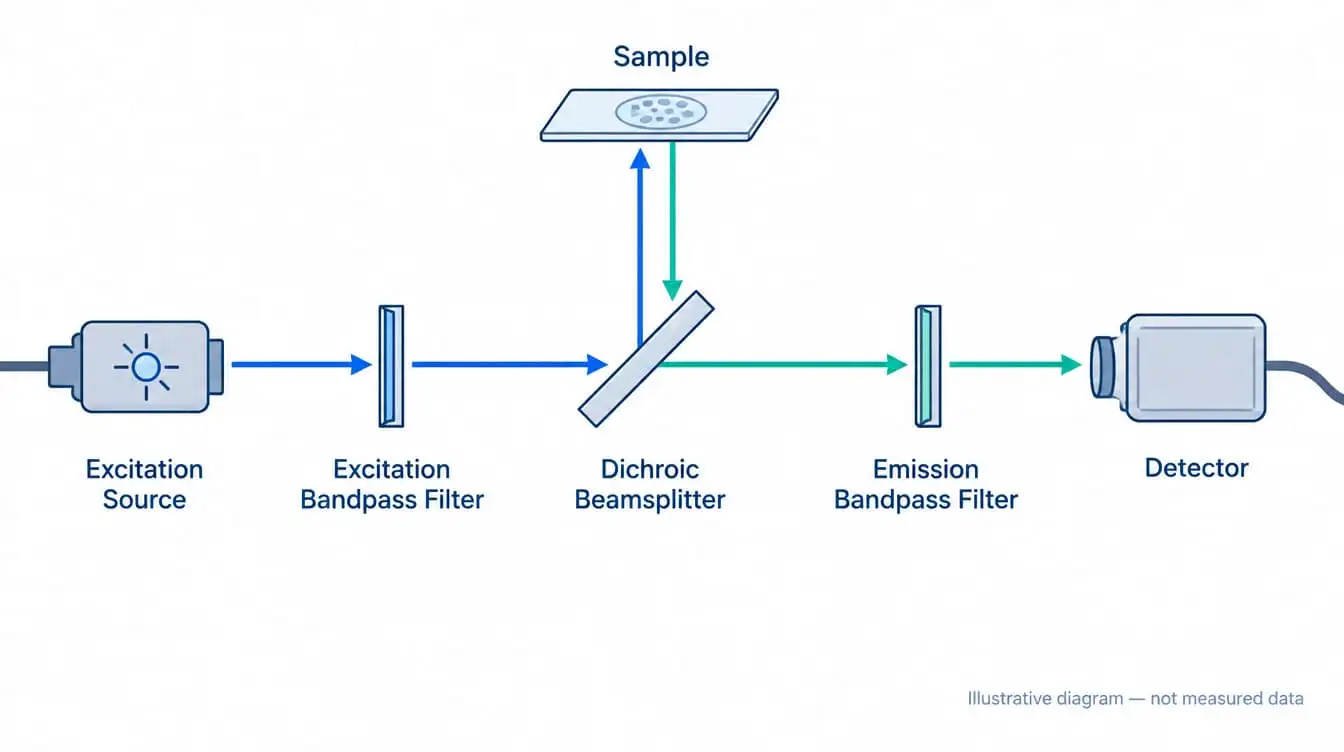
A fluorescence measurement typically needs all three core filter types working together: an excitation bandpass filter shapes the illumination, a dichroic beamsplitter separates excitation from emission along the optical path, and an emission bandpass or longpass filter blocks residual excitation light before the detector reaches it. Substituting one filter type for another changes the signal-to-background ratio rather than simply shifting a wavelength.
Key Specifications That Drive Filter Manufacturing
A filter manufacturer needs several parameters before quoting a medical or life-science filter, and each one interacts with the others rather than standing alone.
Center wavelength (CWL) and passband fix what signal the filter accepts and what it rejects; both must be defined at the angle of incidence the filter will actually see in the instrument, not just at normal incidence.
FWHM sets spectral selectivity. A narrower passband improves rejection of adjacent wavelengths but typically reduces peak transmission and tightens manufacturing tolerance — it is a trade-off, not a value to minimize by default.
Blocking depth, usually expressed as optical density (OD), describes how completely out-of-band light is rejected. Deeper blocking matters more where the excitation source is much stronger than the signal being measured, as in fluorescence detection, but deeper blocking generally requires more coating layers and adds cost and lead time.
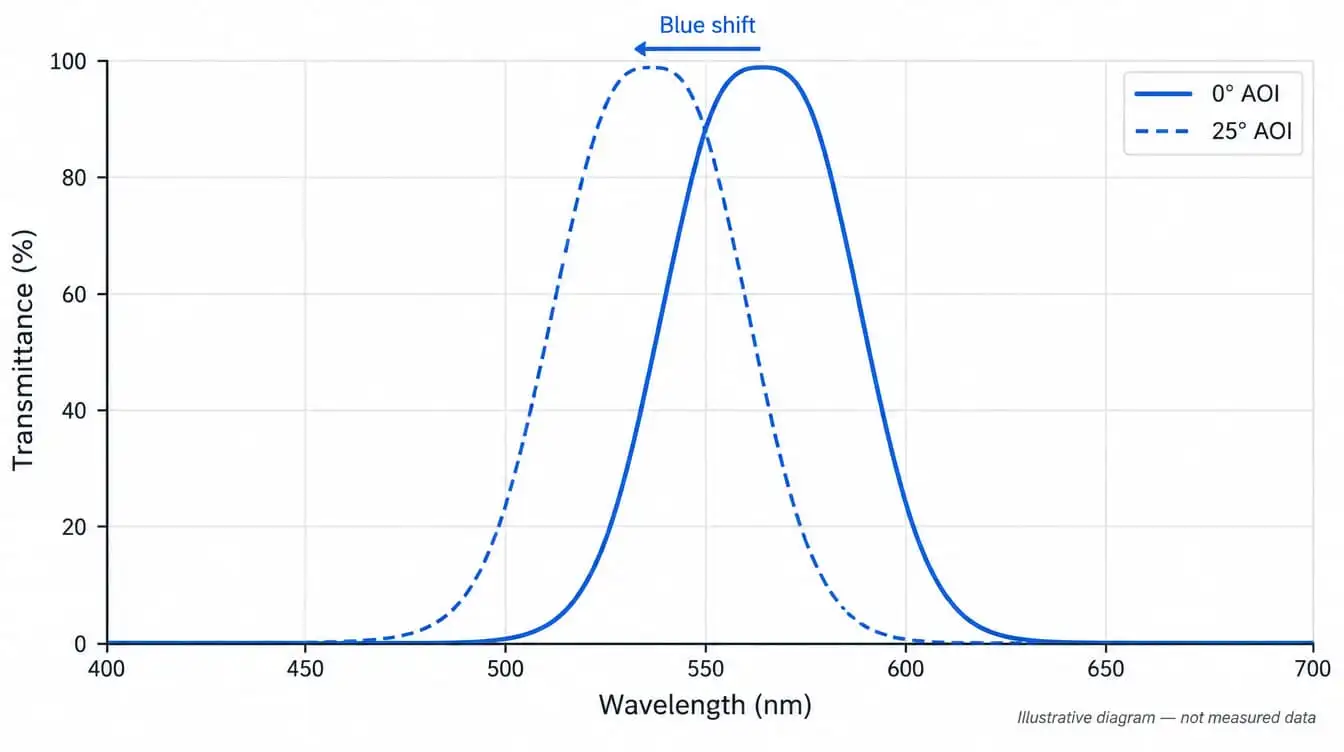
Angle of incidence (AOI) matters because interference-coated filters shift toward shorter wavelengths as the incidence angle increases from normal. A filter specified and verified at 0° AOI will not reproduce the same spectral position at 45°, which is relevant both for dichroic beamsplitters used off-normal by design and for any beam convergence or divergence in a miniaturized point-of-care path that broadens the effective angle range striking the filter.
Substrate selection depends on the transmission range needed and the mechanical or thermal environment; common substrates for visible-range medical optics include BK7 and fused silica, with other materials required for infrared paths.
Dimensions and clear aperture matter more in point-of-care and handheld devices, where the push toward small filter formats constrains mounting options and can make coating uniformity across the full clear aperture harder to hold.
Durability under handling and cleaning depends on coating type. Interference coatings deposited with ion-assisted or sputtering processes are generally denser and more resistant to humidity and abrasion than older, uncoated evaporated films, which is relevant for filters exposed to repeated cleaning or handling in clinical settings.
Trade-offs in Selecting a Medical Optical Filter
Optical filter selection for medical and life-science instruments involves trade-offs rather than a single “best” specification.
- Narrow FWHM vs. transmitted signal — a tighter passband rejects more background but passes less signal, which matters when the measured emission is already weak relative to noise.
- Custom vs. catalog filters — a catalog filter at a standard wavelength is faster to source, while a custom design matches the exact optical path but adds coating design and tooling lead time.
- Miniaturization vs. coating uniformity — shrinking the filter substrate for a point-of-care or handheld device reduces the usable clear aperture and can make consistent spectral performance across the part harder to maintain.
- Coating durability vs. cost — a more durable, ion-assisted or sputtered coating typically costs more to produce than a conventional evaporated coating, so the choice should follow the device’s actual cleaning and handling conditions rather than a default assumption.
Common Mistakes When Sourcing Optical Filters for Medical Devices
- Treating “medical grade” as a specification. A filter does not carry a clinical rating; the requirement should be stated as explicit optical, mechanical, and environmental parameters instead.
- Assuming a catalog filter validated at 0° AOI will perform the same at its working angle without re-checking the spectral shift, particularly for dichroic beamsplitters used off-normal.
- Confusing a filter supplier’s own quality-system certificate with the finished device’s regulatory clearance — these describe different scopes and are issued by different parties.
- Leaving inspection and documentation requirements out of the RFQ and discovering the gap only during a device-level supplier audit.
- Assuming one filter design covers every wavelength variant of a product line without separately verifying CWL, FWHM, and blocking for each configuration.
Quality Systems and Regulatory Scope When Sourcing
A quality management system certificate held by an optical filter supplier and the regulatory clearance of a finished medical device are related but distinct. The certificate describes how the supplier controls its own manufacturing and inspection processes; it does not by itself mean the finished instrument built with that filter has clinical or regulatory approval.
ISO 9001 is a general quality management system standard used across manufacturing industries. ISO 13485 is a quality management system standard written specifically for medical device organizations. In the United States, the FDA’s Quality System Regulation (21 CFR Part 820) now incorporates ISO 13485:2016 as its core quality management system requirement for medical device manufacturers. That requirement applies to the legal manufacturer of the finished device; component suppliers are not automatically brought under it, though many device manufacturers still evaluate a component supplier’s quality system — including whether it holds ISO 13485 — as part of their own supplier qualification process.
Buyers sourcing filters for a regulated instrument should confirm a supplier’s specific certificate scope, site, and validity directly, using a controlled copy of the certificate rather than a logo or a historical brochure. GIAI’s English website certifications and compliance page currently lists an ISO 9001 quality management system certification; buyers evaluating a supplier for a medical or life-science project should confirm the exact certificate scope that applies to their project directly with the supplier before relying on it in a device-level submission.
What to Include in a Filter Manufacturing RFQ
A filter manufacturer can only quote and design to a project that defines both the optical function and the physical constraints of the part. A complete RFQ for a medical or life-science optical filter typically includes:
- Drawing, specification, or sample for reference
- Optical function (bandpass, notch, edge, dichroic, ND)
- Center wavelength or cut-on/cut-off wavelength and passband
- FWHM and blocking (OD) target, where relevant
- Transmission target across the passband
- Angle of incidence the filter will see in the actual optical path
- Substrate or material preference
- Dimensions, thickness, and clear aperture
- Coating requirement and polarization sensitivity, if relevant
- Operating environment (temperature, cleaning, sterilization exposure)
- Inspection criteria and documentation requirements
- Quantity — prototype, sample, or production volume
GIAI reviews custom optical filter projects against the drawing, sample, optical requirement, substrate, geometry, coating condition, and inspection criteria before defining a manufacturing route. Engineers working from the optical filter product family or the filters and coatings resource hub can review current manufacturing capabilities and the quality verification process before submitting a drawing.
Frequently Asked Questions
What types of optical filters are used in medical devices?
Medical and life-science instruments most often use bandpass, notch, longpass/shortpass edge, dichroic, and neutral density filters. Fluorescence and flow cytometry systems typically combine several of these — an excitation bandpass filter, a dichroic beamsplitter, and an emission filter — rather than relying on a single filter type.
Does an optical filter need FDA approval or CE marking?
Regulatory clearance such as FDA 510(k) or CE marking applies to the finished medical device, not to an individual optical filter component. A filter supplier’s own certifications describe its quality management system; buyers still need to confirm how that fits into the device manufacturer’s own regulatory submission.
What is the difference between ISO 9001 and ISO 13485 for an optical filter supplier?
ISO 9001 is a general-purpose quality management system standard. ISO 13485 is written specifically for medical device organizations and is now incorporated into the U.S. FDA’s Quality System Regulation. Which one a supplier holds affects how easily a device manufacturer can qualify it as a supplier, not whether the filter itself is inherently “medical grade.”
Can a standard catalog filter be used in a medical instrument, or does it need to be custom?
A catalog filter can work if its CWL, FWHM, blocking, AOI, and dimensions match the optical path exactly, including the actual angle of incidence in use. When the wavelength, size, or angle falls outside standard catalog options, a custom design is generally needed.
What specifications should be included in an RFQ for a medical optical filter?
A complete RFQ typically includes the drawing or sample, optical function, wavelength and passband, FWHM and blocking target, transmission target, angle of incidence, substrate, dimensions, coating requirement, operating environment, inspection criteria, and quantity.
Why do fluorescence imaging systems need matched excitation, dichroic, and emission filters?
Each filter serves a different role: the excitation filter shapes the illumination wavelength, the dichroic beamsplitter separates excitation from emission along the optical path, and the emission filter blocks residual excitation light before it reaches the detector. Mismatching any one of the three reduces signal-to-background ratio.
References
- International Organization for Standardization — ISO 13485:2016 — Medical devices — Quality management systems — Requirements for regulatory purposes
- International Organization for Standardization — ISO 9001:2015 — Quality management systems — Requirements
- International Organization for Standardization — ISO 10110 (series) — Optics and photonics — Preparation of drawings for optical elements and systems
- International Organization for Standardization — ISO 9211 (series) — Optics and photonics — Optical coatings
- U.S. Food and Drug Administration — Quality System Regulation, 21 CFR Part 820 (incorporates ISO 13485:2016)
- H. A. Macleod — Thin-Film Optical Filters — SPIE Press / CRC Press
Send the drawing, optical specification, or sample together with the wavelength range, substrate, dimensions, coating requirements, AOI, inspection criteria, and expected quantity for technical review through GIAI’s custom optics process or by submitting a project for technical review.