
Technical Resources
Aspheric Lens vs Achromatic Lens: How to Choose
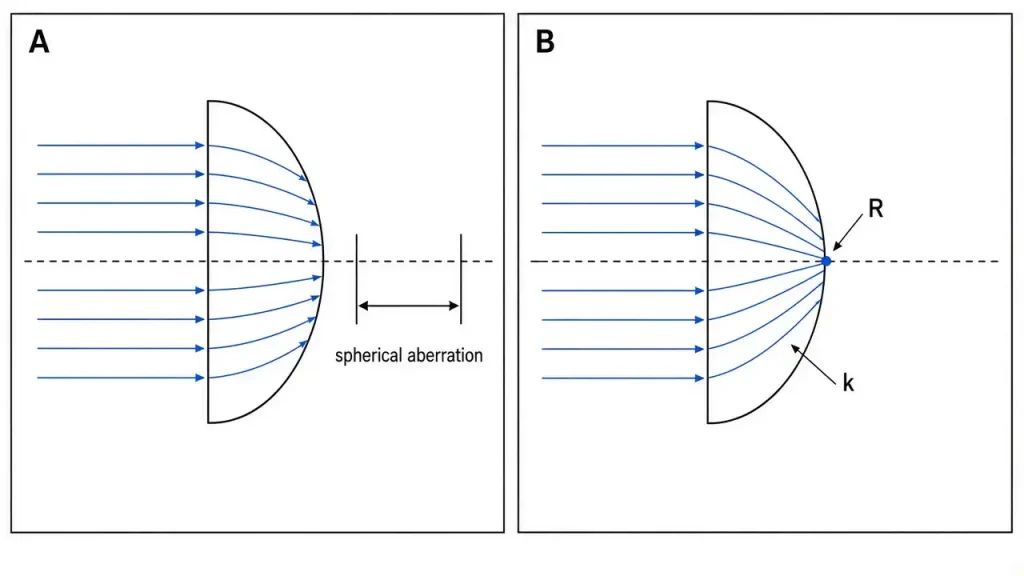
An aspheric lens corrects spherical aberration in a single element. An achromatic lens corrects chromatic aberration by combining two glasses with opposing dispersion. The aspheric lens vs achromatic lens decision therefore reduces to one question: is your dominant error source geometry or wavelength? A monochromatic source at low f-number points to an asphere. Broadband light at moderate f-number points to an achromat. A system that has both problems needs a hybrid or a multi-element design, not a single catalog part.
The two aberrations these lenses solve
Spherical aberration is a geometry problem
A spherical surface is easy to generate and easy to test, but it is the wrong shape for focusing. Rays that strike the outer zone of a spherical lens cross the axis closer to the lens than paraxial rays do. That longitudinal spread is spherical aberration, and it exists in perfectly monochromatic light with a perfectly manufactured lens.
Third-order spherical wavefront error scales roughly with the inverse cube of the f-number, so it grows quickly as you open the aperture. Above roughly f/7 a well-made spherical element can in principle reach the diffraction limit, at which point the aspheric premium buys very little. At f/2 the same singlet can sit many waves away from that limit.
An aspheric surface fixes this by varying curvature across the clear aperture. Every design code describes the rotationally symmetric case with the same even-asphere sag equation:
z(r) = (r² / R) / (1 + √(1 − (1 + k) r² / R²)) + A₄r⁴ + A₆r⁶ + A₈r⁸ + …Here z is the surface sag at radial height r, R is the vertex radius of curvature, k is the conic constant, and A₄, A₆, A₈ are higher-order aspheric coefficients. A conic constant of 0 gives a sphere, −1 a parabola, and values below −1 a hyperbola.
The clean textbook case is a plano-convex singlet with the flat face toward a collimated beam. The exit surface then refracts collimated light from glass into air, and a hyperboloid with conic constant k = −n² gives a geometrically perfect on-axis focus at the design wavelength. For n = 1.517 that is roughly k = −2.30. Catalog aspheres depart from this ideal because they must account for finite center thickness, a working distance in air, and often a different conjugate, which is why they carry higher-order coefficients as well as a conic term.
Nothing in that correction depends on wavelength, but the refractive index does. As the index shifts across the spectrum, the surface is no longer exactly right, and the residual is called spherochromatism. This is the reason an asphere is not a color-corrected element.
Chromatic aberration is a material problem
Refractive index varies with wavelength, focal length varies with index, and blue light therefore focuses shorter than red. The standard measure of that dispersion is the Abbe number:
V_d = (n_d − 1) / (n_F − n_C)evaluated at the d line (587.6 nm, helium), the F line (486.1 nm, hydrogen), and the C line (656.3 nm, hydrogen). Low Abbe number means high dispersion.
An achromatic doublet cancels first-order chromatic focal shift by pairing a positive crown element of high Abbe number with a negative flint element of low Abbe number. For thin lenses in contact, the achromatic condition and the power constraint are:
φ₁ / V₁ + φ₂ / V₂ = 0 and φ₁ + φ₂ = φA common visible pairing is N-BK7 (n_d 1.5168, V_d 64.2) with N-SF5 (n_d 1.6727, V_d 32.3). Faster or better-corrected designs move to lanthanum crowns such as N-LAK22 against dense flints such as N-SF6HT.
The doublet brings two wavelengths to a common focus. Everything between them lands slightly short, and that residual is secondary spectrum. For a classical crown and flint achromat in the visible it is on the order of f/2000, though the exact value depends on the glass pair. Reducing it further requires apochromatic designs using special short-flint or anomalous-dispersion glasses such as N-PK52A or calcium fluoride, and usually a third element.
There is a second benefit that is easy to overlook. A cemented doublet has four surfaces and therefore enough degrees of freedom for the designer to cancel third-order spherical aberration and coma at the design conjugate as well. That is why an achromat usually outperforms a plano-convex singlet even in monochromatic light. The correction is third order only, so higher-order spherical aberration reappears as the f-number drops.
Aspheric lens vs achromatic lens: direct comparison
| Attribute | Aspheric singlet | Achromatic doublet |
|---|---|---|
| Primary correction | Spherical aberration | Longitudinal chromatic aberration |
| Secondary benefit | Fewer surfaces, fewer reflection losses, shorter package | Third-order spherical and coma correction at design conjugate |
| Dominant residual | Spherochromatism plus full chromatic focal shift | Secondary spectrum plus higher-order spherical at low f/# |
| Element count | 1 | 2, usually cemented |
| Best fit | Single-wavelength or narrowband light at low f-number | Broadband or multi-line light at moderate f-number |
| Weak point | Broadband sources | Fast apertures and high NA |
| Metrology burden | Profilometry or interferometry with a computer-generated hologram | Standard spherical interferometry |
| Cost driver | Aspheric surface generation and form verification | Two elements, centering, cementing |
This is not a ranking. An asphere used with a white-light source produces a color-blurred spot no matter how good its form error is, and an achromat used at f/1.5 produces a spherically aberrated spot no matter how good its glass pair is.
Matching the lens to the light source
- Single-wavelength laser at low f-number. Aspheric singlet. Laser diode and fiber collimation, focusing heads, optical pickup.
- Broadband imaging at moderate f-number. Achromatic doublet. Machine vision relays, spectrometer input optics, illumination condensers.
- Several discrete laser lines, as in 405 / 488 / 561 / 640 nm fluorescence. An asphere will place each line at a different focus. Several discrete laser lines, such as 405 / 488 / 561 / 640 nm. A singlet asphere will generally show wavelength-dependent focus. A standard achromat may still leave significant secondary spectrum across this span; verify chromatic focal shift, and use an apochromat or multi-element design when the focus tolerance is tight.
- Broadband light at low f-number. Neither single part is enough. Use an aspherized achromat, a molded aspheric doublet, or a proper multi-element design.
- Thermal infrared. Germanium has very low dispersion across 8 to 12 µm, so LWIR designs are usually limited by spherical aberration and thermal defocus rather than by color. This is one reason diamond-turned aspheres dominate that band, and why suppliers such as GIAI Photonics list infrared lenses as a separate category from visible optical lenses.
The specification parameters that actually decide the part
| Parameter | Applies to | What to watch |
|---|---|---|
| Effective focal length and tolerance | Both | Commercial catalog tolerance is commonly ±1%; tighter grades cost more |
| Design wavelength and conjugate | Both | Catalog parts are typically optimized for infinite conjugate; performance at 1:1 is not the datasheet performance |
| Clear aperture | Both | Frequently smaller than the outer diameter; check before assuming full-aperture illumination |
| Numerical aperture or f/# | Both | Determines whether spherical or chromatic error dominates |
| Surface quality (scratch-dig) | Both | Per MIL-PRF-13830B; 60-40 and 40-20 are common commercial grades, 20-10 or 10-5 for laser use |
| Surface figure or form error | Both | Spheres are quoted in waves P-V; aspheres are quoted as irregularity against the aspheric equation |
| Conic constant and aspheric coefficients | Asphere | Must be transmitted exactly, with the sign convention and the equation form stated |
| Waviness / mid-spatial-frequency error | Asphere | Ripple-like error repeating roughly 5 to 100 times across the aperture, introduced by small-tool polishing and rarely seen in whole-aperture spherical polishing |
| Surface roughness | Asphere | Matters for scatter in laser and low-stray-light systems |
| Aspheric axis decenter and tilt | Asphere | The aspheric axis must agree with the mechanical axis; this is a separate tolerance from centration |
| Centration / beam deviation | Achromat | Quoted in arcminutes; the two elements must be co-aligned before cementing |
| Cement and its temperature range | Achromat | Sets the upper environmental limit and the damage threshold |
| AR coating spectral range | Both | A doublet corrected 450 to 650 nm behind a coating optimized for 550 nm is a mismatch |
For drawings, ISO 10110 gives the compact notation: 3/ for surface form, 4/ for centring, 5/ for surface imperfections, and 7/ for surface texture, with ISO 10110-12 covering aspheric surfaces specifically. Many suppliers still accept scratch-dig per MIL-PRF-13830B, so state which convention governs rather than mixing them on one drawing.
Manufacturing route sets tolerance and price
Achromats are made by full-aperture spherical polishing, then centered and cemented. The process is mature and inexpensive, which is why a cemented doublet often costs less than a comparable asphere. Aspheres have four practical routes, each constraining material, volume, and achievable form error:
- Precision glass molding. Low transition temperature glasses pressed in a figured mold. Low unit cost at volume, significant tooling cost, limited glass selection.
- Deterministic CNC polishing. Small contact-area tools are driven across the part to generate the aspheric profile, with magnetorheological finishing added when higher figure quality is required. Works with any polishable glass and gives the best form accuracy, at per-part cost and with mid-spatial-frequency error to watch.
- Single-point diamond turning. The cutting tool is far smaller than a polishing tool, which gives good surface finish and form accuracy, but glass cannot be diamond turned. The technique applies to polymers, metals, and crystals such as germanium, silicon, and zinc selenide. It is also used to cut the molds for the molding routes above.
- Polymer on glass. A thin aspheric photopolymer layer is molded onto a finished spherical surface, most often onto an achromat. This is the aspherized achromat, and it corrects both aberration types in one component. The trade-off is real: the polymer layer blocks deep-UV transmission and is not scratch resistant, and its temperature and damage-threshold limits are set by the polymer, not the glass.
Common specification mistakes
Choosing an asphere for a broadband source. The most frequent error. The spot looks tight in the design software at the single design wavelength and blurs in the lab under white light. Model the actual source spectrum, not a center wavelength.
Installing an achromat backward. A visible achromat optimized for infinite conjugate expects the crown element to face the collimated side. Reversed, the spherical aberration correction is no longer valid and the spot grows visibly at fast apertures. This is invisible in the assembly drawing unless orientation is called out explicitly.
Using a catalog part at the wrong conjugate. Both achromats and aspheres are optimized for a stated conjugate. Dropping an infinite-conjugate doublet into a 1:1 relay throws away most of the correction. The standard fix is two identical elements mounted back to back so each works near infinite conjugate.
Specifying P-V irregularity and nothing else on an asphere. A peak-to-valley number says nothing about spatial frequency. A part can pass a 1-wave P-V spec and still carry small-tool ripple that scatters light into a halo around the focus. Add a slope error or RMS requirement, and state how the surface will be measured, since profilometry and interferometry with a computer-generated hologram do not weight errors the same way.
Mounting on the aspheric surface. Molded aspheres often have a small clear aperture relative to their outer diameter, and clamping into the aspheric zone introduces stress birefringence and local figure error. Confirm the clear aperture and the intended mounting datum before designing the barrel.
How to choose
- Write down the source bandwidth. If it spans more than a few tens of nanometers, color correction is mandatory and an asphere alone will not do it.
- Write down the working f-number. Slower than roughly f/7, a good spherical element may already be diffraction limited and an asphere is hard to justify.
- Check whether you need both corrections at once. If so, price an aspherized achromat and a molded aspheric doublet before assuming a custom multi-element design.
- Confirm the conjugate. Match the catalog part to how you will actually use it, or specify a custom design.
- Decide what you will measure on receipt. If you cannot verify the form error you specified, specify something you can verify.
- Check the environment last. Cement limits, polymer limits, and coating spectral range eliminate parts that otherwise look correct on paper.
FAQ
Can an aspheric lens correct chromatic aberration? No. An aspheric surface changes the geometry of the wavefront, not the dispersion of the material. A single-material asphere still has the full chromatic focal shift of its substrate, plus spherochromatism because the correction is exact only at the design wavelength. Color correction requires two or more materials with different Abbe numbers, or a diffractive surface.
Is an achromat ever the better choice for a single-wavelength laser? Often, yes. A doublet has four surfaces, which lets the designer null third-order spherical aberration and coma at the design conjugate, so it outperforms a spherical singlet in monochromatic light. It loses to an asphere when the f-number gets low enough that higher-order spherical aberration dominates, or when you need to minimize element count and back reflections.
What does an aspherized achromat give up? It corrects both aberration types in one cemented part at a modest cost premium, but the polymer aspheric layer sets the limits. It blocks deep-UV transmission, it is not scratch resistant, and its temperature and laser damage thresholds are below those of the glass underneath. For visible imaging, relays, and condensers it is an efficient choice; for UV or high-power laser work it is not.
How should I specify asphere form error so the vendor and I agree? State three things: the irregularity budget against the aspheric equation, over a named clear aperture, measured by a named method. Add a mid-spatial-frequency or slope error requirement if the part focuses laser light. Provide the sag equation form and sign convention along with the coefficients, since equation variants differ between design codes.
Do I need to specify centration separately on an asphere? Yes. On a spherical element, centration is the relationship between the optical and mechanical axes. On an asphere, the aspheric axis can be decentered or tilted relative to the base sphere by the molding or polishing process, which produces astigmatism and coma that no amount of careful mounting will remove.
If your design has settled on a particular element type, the relevant starting points are the optical lenses and infrared lenses categories at GIAI Photonics, where substrate, coating range, and tolerance grade can be specified together rather than sequentially.