
Technical Resources
IBS vs IAD Optical Coating: How to Choose the Process
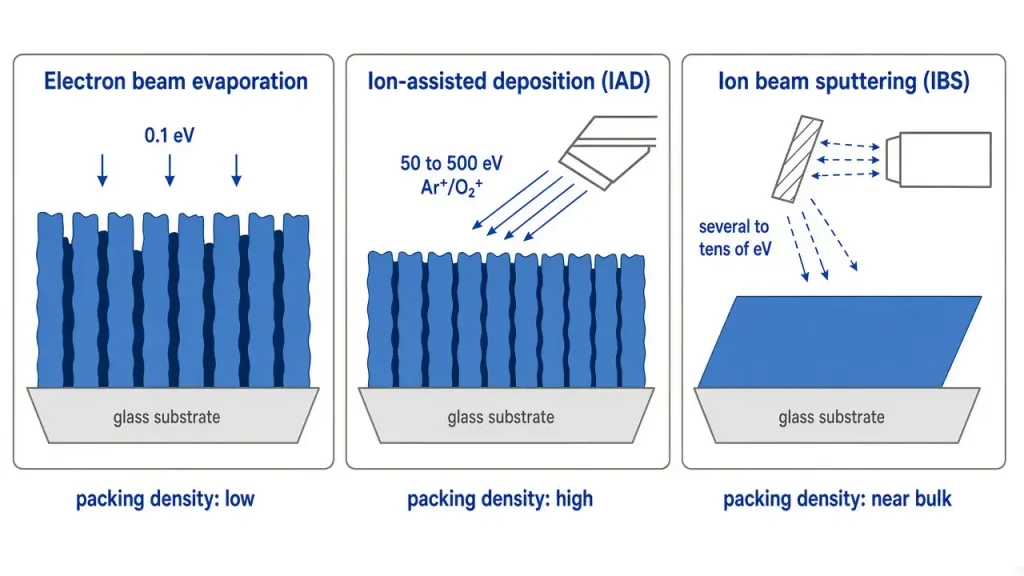
The difference between IBS vs IAD optical coating comes down to how much kinetic energy the film-forming atoms carry when they land, and what that energy buys you. Ion beam sputtering (IBS) delivers sputtered atoms with several to tens of electronvolts, producing amorphous, essentially fully dense layers with very low absorption and scatter. Ion-assisted deposition (IAD) starts from thermal or electron beam evaporation at roughly 0.1 eV per atom and adds a separate ion source to compact the growing film, reaching most of the way to a dense coating at a fraction of the run time.
Neither process wins across the board. IBS leads on spectral stability, optical loss, and layer thickness repeatability. IAD leads on throughput, batch size, stress control, and in some pulsed laser regimes, damage threshold. The right answer depends on which of those your system is actually limited by.
The physics: adatom energy sets the microstructure
In unassisted evaporation, atoms arrive with roughly 0.1 to 0.3 eV and have limited surface mobility. Self-shadowing during growth produces the columnar microstructure described by the Movchan-Demchishin and Thornton structure zone models. Those columns leave voids, and voids fill with atmospheric water.
Packing density p is the fraction of film volume occupied by solid material. To first order, the effective index of the layer is:
n_eff ≈ p · n_solid + (1 − p) · n_void
When water (n ≈ 1.33) displaces air in the voids, n_eff rises and the whole spectrum shifts to longer wavelengths. Pump the same part down to vacuum, the water desorbs, and the spectrum shifts back toward the blue. For porous evaporated coatings this shift is on the order of a few tenths of a percent of the center wavelength, which is enough to move a 10 nm-wide passband off a laser line. The exact figure depends on the design, materials, and layer count.
IAD attacks this directly. A separate ion source, typically argon or oxygen at roughly 50 to 500 eV, bombards the growing film, knocks loosely bound atoms into voids, and improves oxidation of the reactive species. Substrate temperatures in the 150 to 300 °C range are common. The result is a film close to bulk density with far less environmental drift than conventional evaporation.
IBS takes a different route to the same energy. A gridded ion source directs Ar⁺, Kr⁺, or Xe⁺ at several hundred to a few thousand eV onto a target. The sputtered species leave with enough energy to build a dense amorphous film without substrate heating, and ion energy and flux can be set independently of deposition rate. That decoupling is what makes IBS the most repeatable of the common processes.
What actually changes on the datasheet
| Parameter | IBS | IAD (ion-assisted evaporation) |
|---|---|---|
| Particle energy at substrate | Sputtered atoms, several eV to tens of eV | Evaporant ~0.1 eV plus assist ions ~50 to 500 eV |
| Microstructure | Amorphous, near bulk density | Dense, but material and process dependent |
| Typical deposition rate | Around 0.1 nm/s (1 Å/s), higher on optimized systems | Typically several times faster, material dependent |
| Run time, 100+ layer stack | Many hours to multiple days | Hours |
| Vacuum-to-air spectral shift | Negligible | Small; larger than IBS, far smaller than unassisted e-beam |
| Absorption and scatter | Lowest available; ppm-level total loss achievable | Low, generally higher than IBS |
| Residual stress | High compressive, commonly in the hundreds of MPa | Tunable tensile to compressive via ion energy |
| Substrate heating | Not required | Usually required |
| Coated area and batch size | Smaller per run, excellent uniformity achievable | Large planetary chambers, high volume |
| Relative cost and lead time | Highest | Moderate |
Two entries in that table cause most of the real-world arguments, so they are worth expanding.
Optical loss. IBS is the process behind ring laser gyroscope mirrors and other applications where total loss is counted in parts per million. If your error budget is written in ppm rather than percent, the conversation is effectively over.
Stress. IBS oxide stacks are known for high compressive stress. Published work on IBS SiO₂ reports values around 490 MPa reduced to roughly 48 MPa only with dedicated high-energy oxygen assist during deposition. That stress bends the substrate, and the Stoney equation gives the scale of the problem:
σ = E_s · t_s² / [ 6 (1 − ν_s) · R · t_f ]
where t_s is substrate thickness, t_f is coating thickness, and R is the radius of curvature induced. Because the substrate thickness term is squared, halving substrate thickness quadruples the bow for the same coating stress.
Angle of incidence and temperature: what the process does not fix
A common misreading is that a dense sputtered coating shifts less with angle than an evaporated one. It does not, in any meaningful way. Center wavelength shift with angle of incidence (AOI) follows:
λ(θ) ≈ λ₀ · √( 1 − sin²θ / n_eff² )
The governing term is the effective index of the cavity structure, which is a design variable, not a deposition variable. If you need low angular sensitivity, specify a high effective index design. Choosing IBS will not save a filter placed in an f/1.5 cone.
Temperature is different, and here process and materials do matter. Hard-coated dielectric filters made by sputtering or plasma-assisted processes typically show a center wavelength thermal coefficient in the region of 2 to 5 pm/°C over normal instrument temperature ranges, though the value depends on the substrate as much as the film. Published work on IAD narrow bandpass filters found the thermal coefficient varying from about +0.018 nm/°C to −0.005 nm/°C purely by changing the substrate expansion coefficient. Read the substrate line on your quotation before you read the coating line.
Where IBS is the wrong choice
High energy nanosecond lasers. This is the counterintuitive one. Comparative studies of hafnia films under UV nanosecond exposure have found electron beam evaporated layers more damage resistant than IBS layers. Separate work at high-energy laser facilities shows that removing ion assistance and slowing the HfO₂ rate raised the laser-induced damage threshold (LIDT) of a dichroic coating, at the cost of spectral performance. Dense IBS and IAD films do hold their LIDT in vacuum, where porous e-beam films degrade. The lesson is that LIDT is a function of pulse duration, wavelength, defect population, and environment, not of process branding. Require a test to ISO 21254 under your conditions.
Thin or single-side-coated substrates. A thick high-reflector stack in IBS on a 1 mm window will not hold λ/10 peak-to-valley figure without compensation.
Large batches of commodity parts. Machine vision bandpass filters, camera windows, and broadband antireflection coatings on volume optics rarely justify IBS economics when a well-run IAD process meets the spec.
Common specification mistakes
- Treating “hard coated” as a synonym for IBS. Durable, non-hygroscopic coatings come from IBS, magnetron sputtering, and plasma or ion-assisted evaporation alike. Specify the environmental test you need, such as the humidity and abrasion levels in MIL-C-48497 or ISO 9211, rather than a process name.
- Specifying IBS without a surface figure budget. Ask for the post-coating figure, not the substrate figure. Mitigations exist: thicker substrates, back-side stress-compensating layers, post-deposition annealing, and splitting a stack across both faces. All of them cost money or schedule, and all should be agreed before the purchase order.
- Copying an LIDT number across pulse regimes. A value measured at 1064 nm with 10 ns pulses tells you almost nothing about 355 nm picosecond operation. State wavelength, pulse duration, repetition rate, spot size, and test protocol.
- Quoting optical density (OD) without a blocking range or measurement method. OD6 has no meaning until you state the wavelength interval it applies over and how it was measured. Many spectrophotometers cannot resolve past roughly OD5 to OD6 without special techniques, so a supplier may be reporting a design value rather than measured data.
- Ignoring the vacuum shift on space or cryogenic hardware. If the part will operate in vacuum and was coated by conventional evaporation, the passband you accepted in the metrology lab is not the passband you will fly.
How to choose
| If your limiting requirement is… | Specify |
|---|---|
| Total loss in ppm, cavity or gyro mirrors | IBS |
| Narrow bandpass, tight CWL tolerance, multi-cavity | IBS or high-quality plasma-assisted sputtering |
| Vacuum or wide temperature operation | IBS or IAD, never unassisted evaporation |
| Nanosecond high-energy laser optics | IAD or e-beam, with LIDT testing to ISO 21254 |
| Thin substrates, tight post-coating figure | IAD, or IBS with an explicit stress plan |
| High volume, moderate spectral demands | IAD |
| Fluorescence imaging, steep edges, deep blocking | IBS or sputtered hard coating |
For narrow bandpass and custom coating work, the practical question to put to a supplier is not “do you have IBS” but “show me the measured transmission, blocking, thermal coefficient, and post-coating surface figure on a part like mine.” GIAI Photonics quotes custom optical coatings against exactly that kind of measured specification rather than a process label.
FAQ
Is IBS always better than IAD? No. IBS gives the lowest absorption, lowest scatter, and best spectral repeatability, which matters for narrow bandpass filters, laser resonator mirrors, and low-loss reflectors. IAD gives faster runs, larger batches, tunable stress, and in some nanosecond laser applications a higher damage threshold. Match the process to the parameter your system is limited by.
Does an IBS filter shift less with angle of incidence than an IAD filter? Not meaningfully. AOI shift is governed by the effective index of the filter design, which is set by the layer structure and material pair, not by how the layers were deposited. To reduce angular sensitivity, ask for a high effective index design, or reduce the cone angle at the filter.
Why did my IBS-coated window fail its flatness spec after coating? Almost certainly coating stress. IBS oxide stacks carry high compressive stress, and the induced bow scales inversely with the square of substrate thickness. Options are a thicker substrate, a stress-compensating layer on the back face, annealing, or redistributing the design. Agree the post-coating figure requirement before ordering.
Which process should I specify for a 1064 nm nanosecond high-reflector? Do not assume IBS. Published comparisons show evaporated hafnia films can outperform sputtered films under nanosecond exposure, and process changes that lower defect density often matter more than process family. Specify LIDT testing to ISO 21254 at your wavelength, pulse duration, and repetition rate, and require the raw damage data.
Can an IAD coating reach deep blocking on a narrow bandpass filter? Yes, though it is harder. Deep blocking needs many layers with tight thickness control, and error accumulation over 100-plus layers is where IBS repeatability pays off. IAD narrow bandpass filters are routinely produced, but expect looser center wavelength tolerance and be specific about the blocking range and how it was measured.
Does packing density affect anything besides the wet-dry shift? Yes. Lower packing density lowers the effective index, which changes the achievable index contrast and therefore edge steepness and reflector bandwidth. Porous films also adsorb contamination more readily and can lose damage threshold in vacuum as adsorbed water desorbs from the pore structure.
For optical filters, laser mirrors, and custom coating work where the deposition process is part of the specification rather than an afterthought, GIAI Photonics can quote against your measured performance requirements.