
- Crystal orientation is a drawing requirement: C-plane removes birefringence at normal incidence, A-plane and random cuts do not.
- Growth method determines blank size, shape and defect type, so ask where the crystal comes from.
- Uncoated sapphire reflects 7.7% per surface at 589 nm (calculated); an AR coating recovers this but is softer than the crystal.
- Thickness serves pressure and infrared transmission in opposite directions and must be checked against both.
- A usable quotation needs orientation, grade, surface, wavefront, coating and inspection criteria stated with conditions.
A sapphire window manufacturer converts single-crystal aluminum oxide into polished, optionally coated plates with a defined crystal orientation, geometry and surface specification. Evaluating one means checking three things: where the crystal comes from and how its orientation is controlled, how the hard material is ground and polished, and how each requirement on the drawing is verified.
Sapphire is selected for windows that face abrasion, pressure, heat or chemical exposure while transmitting from the ultraviolet through the visible into the mid-wave infrared. The same properties that justify the material make it slow to machine and easy to under-specify. This page covers what to put on the drawing, which trade-offs to settle before the RFQ, and what evidence to ask a supplier for.
What does a sapphire window manufacturer actually do?
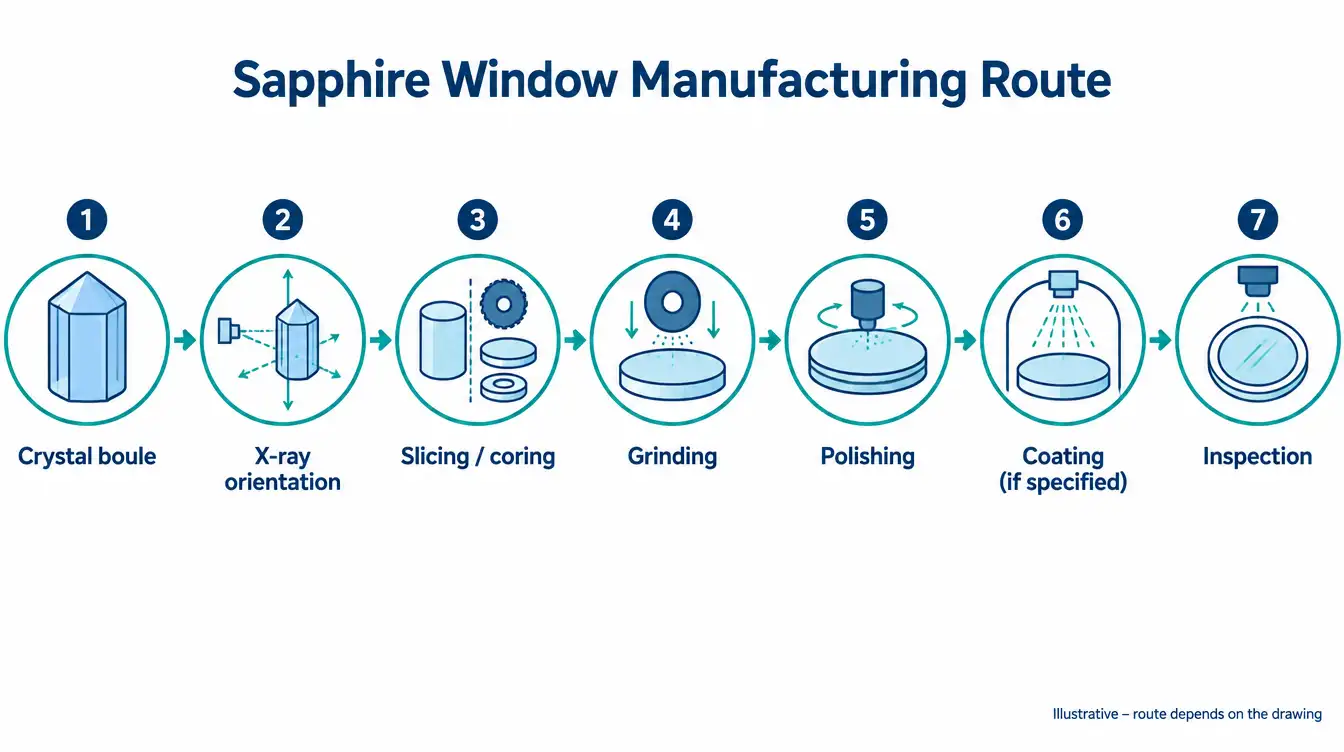
A sapphire window manufacturer takes grown crystal, orients it by X-ray diffraction, cuts blanks, grinds and polishes both faces, finishes the edges, applies any coating and inspects the part against the drawing. Some suppliers grow their own crystal. Many buy oriented blanks or boules and add value in fabrication, coating and metrology.
Both models can produce good windows. What matters to the buyer is traceability: which growth method and material grade the blank came from, how orientation was measured, and which steps are performed in-house or by a subcontractor. Sapphire has a Mohs hardness of 9, so every shaping and polishing step uses diamond abrasives and takes longer than the same step on optical glass. Removal rate also varies with crystal plane, which is one reason the same drawing can be quoted very differently for two orientations.
Which crystal orientation should a sapphire window have?
Specify C-plane when polarization state, interferometric performance or image quality matters, because light at normal incidence then travels along the optic axis and sees a single refractive index. Specify A-plane, R-plane or M-plane only when the application calls for that cut. Accept random orientation only for unpolarized, non-imaging paths where birefringence has no consequence.
Sapphire is a negative uniaxial crystal. At 589 nm the ordinary index is 1.768 and the extraordinary index is 1.760, a birefringence of 0.008. In an A-plane window the c-axis lies in the face, so a normally incident beam is resolved into two polarization components that travel at different speeds. For a 1 mm thick A-plane window at 589 nm the calculated optical path difference is 0.008 × 1 mm = 8.0 µm, which is 13.6 waves of retardation. That is a calculated value for the stated indices and thickness, and it shows why orientation cannot be left open on a polarization-sensitive drawing.
C-plane removes this effect only for rays parallel to the c-axis. Rays at other angles inside the crystal see a birefringence that grows with angle, so a C-plane window in a fast converging beam or at a large angle of incidence still introduces some polarization dependence. When the optic axis is oblique to the faces, as in a random cut, the two components leave a plane-parallel window parallel to each other and laterally displaced.
| Orientation | C-axis vs. surface normal | Birefringence at normal incidence | Where it fits |
|---|---|---|---|
| C-plane (0001) | Parallel (0°) | None | Imaging, laser, polarization-sensitive and interferometric paths |
| A-plane (11-20) | Perpendicular (90°) | Full, 0.008 at 589 nm | Applications that specify this cut for mechanical or substrate reasons |
| M-plane (10-10) | Perpendicular (90°) | Full, 0.008 at 589 nm | Applications that specify this cut |
| R-plane (1-102) | 57.6° | Partial | Applications that specify this cut |
| Random | Uncontrolled | Uncontrolled | Unpolarized viewports, covers and protective windows |
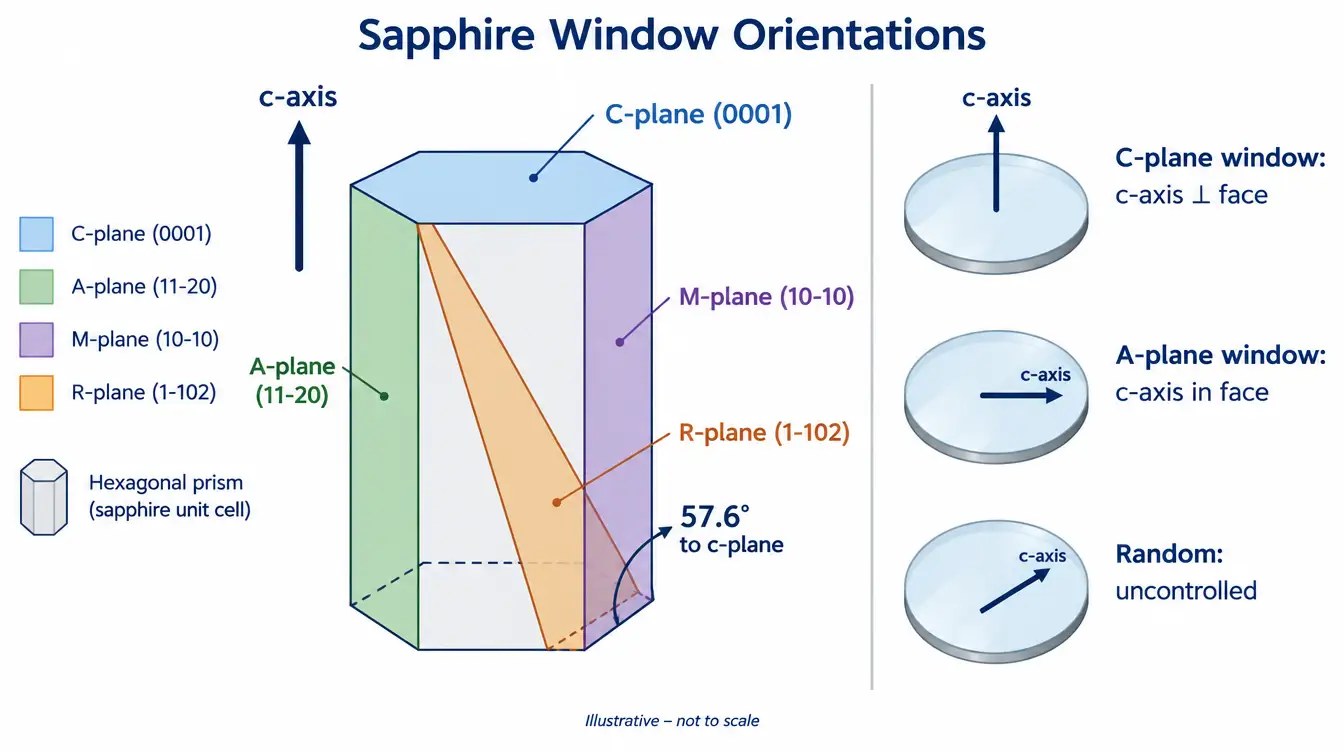
State the orientation tolerance as well as the plane. “C-plane” without an angular tolerance leaves the supplier free to choose one, and the residual birefringence scales with the misorientation.
How does the crystal growth method affect a sapphire window?
The growth method sets the size and shape of the available blank and the kind of defect most likely to appear in it. It does not by itself decide optical quality, which depends on the grade selected from the grown crystal. Ask the supplier which method and grade the quoted blanks come from.
| Growth method | Blank form | What to ask about |
|---|---|---|
| Kyropoulos (KY) | Large boules; windows are cored and sliced | Bubble and inclusion grade, orientation of the cored blank |
| Heat exchanger method (HEM) | Large boules grown in the crucible | Bubble and inclusion grade, orientation of the cored blank |
| Edge-defined film-fed growth (EFG) | Ribbons, sheets and tubes pulled through a shaping die | Voids near the as-grown surface, striations along the pull direction, as-grown orientation |
| Czochralski (CZ) | Boules pulled and rotated from the melt | Inclusion grade, residual stress |
| Verneuil (flame fusion) | Small boules | Residual stress and curved growth striations in the optical path |
Material grade also governs the spectral edges. Deep-ultraviolet transmission below 250 nm depends on crystal purity and point defects, which is why UV-grade sapphire is sold as a separate grade. A window intended for that region needs the grade and a transmission requirement at stated wavelengths and thickness.
What should a sapphire window specification include?
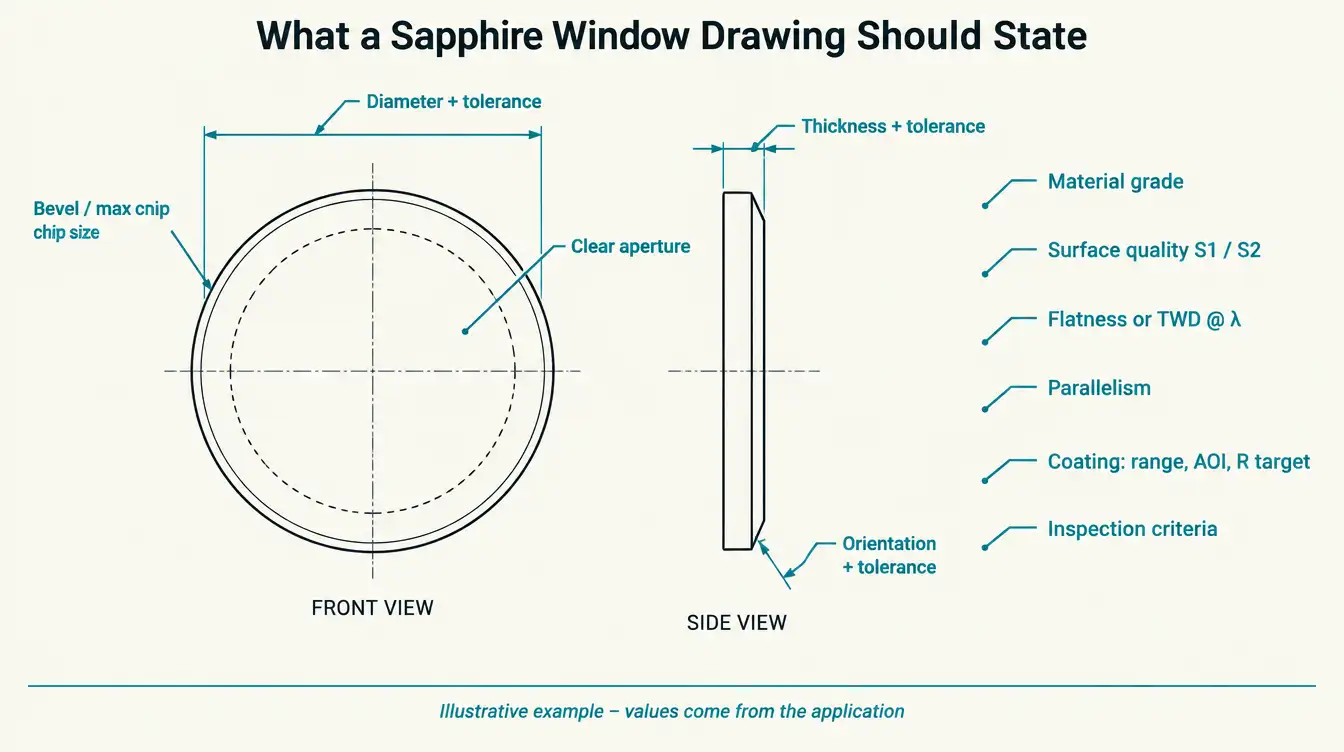
A complete sapphire window specification states material grade, orientation with tolerance, geometry, surface requirements, coating and inspection conditions. Leaving any of these open transfers the decision to the supplier, and two suppliers will fill the gap differently.
- Material: optical or UV grade, limits on bubbles and inclusions inside the clear aperture.
- Orientation: plane and angular tolerance.
- Geometry: diameter or length and width, thickness, tolerances, bevel or chamfer, clear aperture.
- Surface quality: scratch-dig per MIL-PRF-13830B or surface imperfections per ISO 10110-7, plus surface roughness when scatter matters.
- Surface form: flatness per face, or transmitted wavefront at a stated wavelength over the clear aperture.
- Parallelism or wedge: stated in arc minutes or arc seconds.
- Coating: wavelength range, reflectance or transmission target, angle of incidence, polarization where relevant, coated aperture.
- Environment: operating temperature, pressure differential, sealing or mounting method.
- Inspection: measurement method, test conditions, acceptance criteria and report format.
Reflection loss deserves a number early in the design. For an uncoated surface at normal incidence with n = 1.768 (ordinary index at 589 nm), the Fresnel reflectance is ((n − 1)/(n + 1))² = 7.7% per surface. Including multiple reflections between the two faces and assuming no absorption, the calculated transmission of the window is (1 − R)/(1 + R) = 85.7%. A quarter-wave layer of magnesium fluoride with n = 1.38 is close to the ideal single-layer index of √1.768 = 1.33 and gives a calculated residual reflectance of 0.14% at the design wavelength and normal incidence. These are calculated values for ideal, lossless conditions and are not measured product data.
What are the trade-offs when specifying a sapphire window?
Each sapphire window parameter improves one property at the expense of another, so the specification should follow the application and stop there. The four trade-offs below account for most over-specified drawings.
Thickness: pressure margin against infrared transmission
For a circular window under a uniform pressure differential, required thickness scales linearly with the unsupported diameter and with the square root of the pressure multiplied by the safety factor and divided by the design strength. The coefficient depends on whether the edge is clamped or simply supported. Thicker sapphire also moves the multiphonon absorption edge in the mid-wave infrared to shorter wavelengths, and the edge moves further as temperature rises. A transmission requirement near 5 µm therefore has to be stated together with thickness and operating temperature.
Orientation: optical neutrality against blank availability
C-plane gives the cleanest optical behavior at normal incidence. The orientations that a given growth method yields most efficiently differ, so the largest or least costly blank from a supplier may be a different cut. Fix the orientation the optics need first and then confirm the size is available in it.
Surface specification: scatter and wavefront against polishing time
Tight scratch-dig, low roughness and tight flatness are all achievable on sapphire, and each one lengthens a polishing cycle that is already slow because of the hardness. A protective viewport and a laser cavity window do not need the same surface. Apply the tight values only inside the clear aperture.
AR coating: transmission against surface durability
An AR coating recovers most of the 7.7% per-surface reflection loss. The coating materials are softer than sapphire, so the exposed face then has the abrasion resistance of the coating. Windows on abrasive or frequently cleaned outer surfaces are often coated on the inner face only.
Thermal behavior: conductivity against expansion
Sapphire conducts heat more than ten times better than fused silica at room temperature, and its thermal expansion coefficient is also about ten times higher and differs along and across the c-axis. High conductivity helps under thermal load. The expansion and its anisotropy have to be considered when the window is brazed, bonded or clamped into a metal housing.
What mistakes cause sapphire window orders to fail?
Most rejected sapphire windows trace back to a requirement that was never written down. The recurring cases are listed below.
- No orientation on the drawing. The part arrives random-cut and the polarization or imaging performance fails at system level.
- A transmission value without conditions. Wavelength, thickness, coated or uncoated state, angle of incidence and temperature all change the number.
- Copying a glass window tolerance block. Values that are routine on optical glass carry a different cost and yield on sapphire.
- Treating strength as one number. Flexural strength depends on orientation, surface and edge finish, and temperature. The pressure calculation belongs to the system designer, with the design strength and safety factor stated.
- Ignoring the edge. Chips and subsurface damage at the edge are where fractures start in a loaded window. Specify the bevel and the allowed chip size.
- Assuming visual inspection covers coating performance. A coated window needs a spectral measurement at the specified angle of incidence.
How do you verify a sapphire window supplier before ordering?
Verify a sapphire window supplier by asking for evidence that matches each line of the drawing: the source and grade of the crystal, the orientation measurement, the surface and wavefront metrology, the coating measurement and the scope of the quality certificate. Claims that are not tied to a measurement method are not evidence.
- Which growth method and grade do the blanks come from, and is crystal growth in-house or purchased?
- How is orientation measured, and is the result recorded per lot or per part?
- Which instruments measure flatness or transmitted wavefront, and at what wavelength and aperture?
- Which surface standard is used for inspection, and under what viewing conditions?
- Is the coating measured on the part or on a witness sample, and at what angle of incidence?
- Which legal entity, site and scope does the ISO 9001 certificate cover, and what are its validity dates?
- Can a first-article report be supplied before the production lot?
Sapphire appears among the materials that GIAI lists publicly for optical fabrication, alongside grinding, polishing, edging, coating and inspection steps described on its manufacturing capabilities page. Projects for optical windows are reviewed against the drawing, sample, substrate, geometry, coating conditions and inspection criteria before the manufacturing route is defined, as set out in the custom optics process. Achievable size, tolerance and surface grade for a specific sapphire part are confirmed at that review. Inspection and acceptance methods are described under quality assurance, and controlled certificate details are available through the certifications and compliance page. Background on substrate choice is collected in the optical materials and infrared resources.
Frequently asked questions
What is a sapphire window?
A sapphire window is a flat, polished plate of single-crystal aluminum oxide used to pass light while separating an optical system from its environment. Sapphire is chosen when the window must resist abrasion, pressure, heat or chemical attack and still transmit from the ultraviolet through the visible into the mid-wave infrared.
What is the difference between C-plane and A-plane sapphire windows?
A C-plane sapphire window has the crystal c-axis perpendicular to its faces, so light at normal incidence travels along the optic axis and sees no birefringence. An A-plane sapphire window has the c-axis lying in the face, so normally incident light is split into two polarization components with different refractive indices and accumulates retardation with thickness.
Do sapphire windows need an anti-reflection coating?
An uncoated sapphire window reflects 7.7% per surface at 589 nm and normal incidence, a value calculated from a refractive index of 1.768. An anti-reflection coating is needed when that loss or the resulting ghost reflection is unacceptable. The coating is softer than sapphire, so the coated face loses part of the abrasion resistance of the bare crystal.
How thick should a sapphire window be?
Sapphire window thickness is set by the pressure differential, the unsupported diameter, the edge support condition, the design strength and the safety factor. Required thickness scales linearly with unsupported diameter and with the square root of pressure. Added thickness also shifts the infrared transmission edge to shorter wavelengths, so mechanical and spectral requirements must be checked together.
What information does a sapphire window manufacturer need for a quote?
A sapphire window manufacturer needs the drawing or dimensions, crystal orientation and its tolerance, material grade, wavelength range, surface quality, flatness or transmitted wavefront, parallelism, clear aperture, edge treatment, coating requirements with angle of incidence, inspection criteria and quantity. Operating temperature, pressure and mounting method should be included when the window is a structural or sealing element.
References
- I. H. Malitson, “Refraction and Dispersion of Synthetic Sapphire,” Journal of the Optical Society of America, vol. 52, pp. 1377–1379 (1962).
- E. R. Dobrovinskaya, L. A. Lytvynov, V. Pishchik, Sapphire: Material, Manufacturing, Applications, Springer.
- D. C. Harris, Materials for Infrared Windows and Domes: Properties and Performance, SPIE Press.
- ISO 10110-7, Optics and photonics — Preparation of drawings for optical elements and systems — Part 7: Surface imperfections.
- MIL-PRF-13830B, Optical Components for Fire Control Instruments; General Specification Governing the Manufacture, Assembly, and Inspection of.
- ISO 9001, Quality management systems — Requirements.
To have a sapphire window reviewed by GIAI, send the drawing, optical specification or sample together with the wavelength range, crystal orientation and grade, dimensions, coating requirements, AOI, inspection criteria and expected quantity for technical review.