
- Germanium suits 8–12 µm imaging lenses: an index of 4.0 and very low LWIR dispersion keep element count and curvature low.
- ZnSe suits high-power CO2 laser optics: its bulk absorption at 10.6 µm is far lower and it has no thermal runaway.
- Germanium absorption rises with temperature; suppliers commonly rate optical-grade germanium for use below 100 °C.
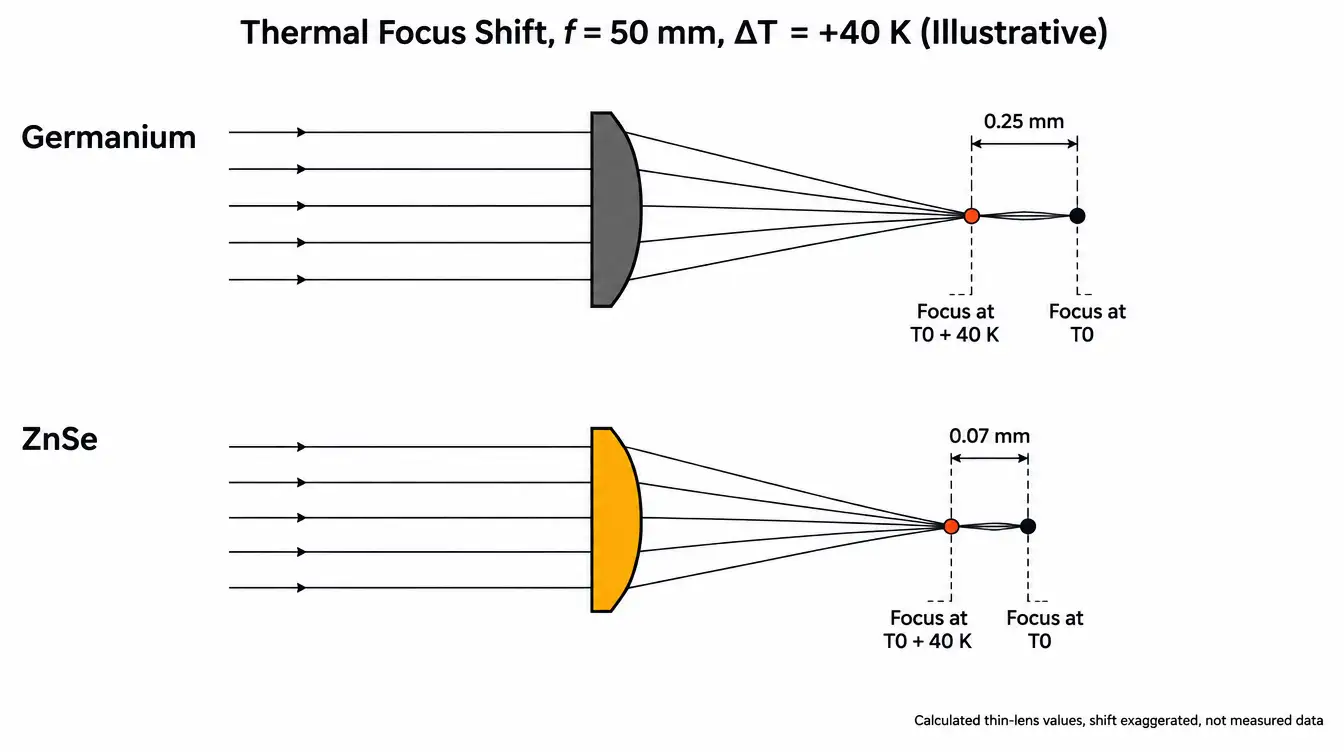
- A thin germanium lens defocuses about 3.5 times more per kelvin than the same ZnSe lens (calculated).
- ZnSe transmits red light, so a visible alignment beam passes through it. Germanium is opaque below 1.8 µm.
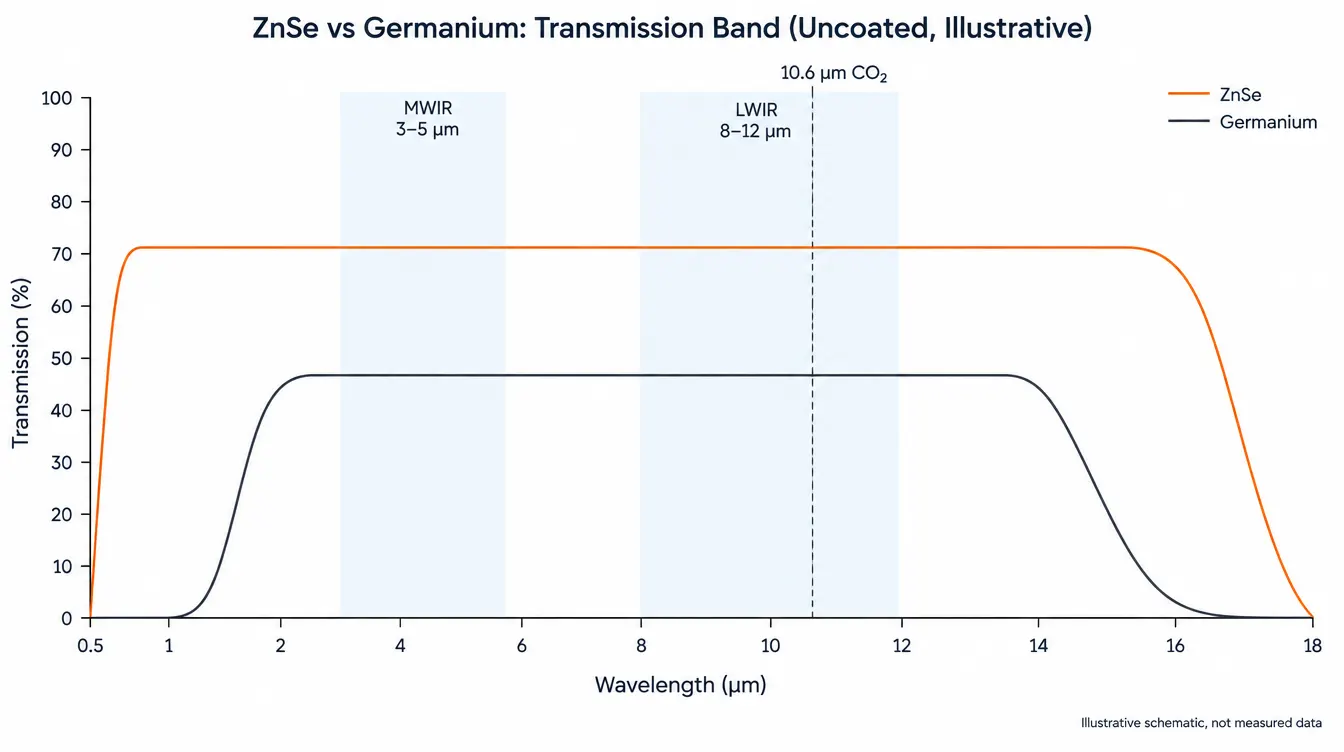
Germanium is the usual first choice for 8–12 µm thermal imaging lenses because its refractive index of 4.0 and very low LWIR dispersion allow compact designs with few elements. ZnSe is the better choice for high-power CO2 laser optics, hot environments and broadband systems, because it absorbs far less and transmits from 0.6 to 16 µm.
Neither material wins on every axis. The ZnSe vs germanium decision for infrared lenses comes down to five questions: which band the system uses, how much optical power passes through the lens, what temperature range the lens sees, whether the surface is exposed, and whether a visible channel or alignment beam must share the path. The sections below take those questions in order. Background on each material is collected in our optical materials and infrared resources.
How do ZnSe and germanium compare on paper?
Germanium has the higher index, lower LWIR dispersion, higher hardness and higher thermal conductivity. ZnSe has the wider transmission band, much lower bulk absorption and a much smaller thermo-optic coefficient. Density is almost identical, so neither material is inherently lighter.
| Material | Transmission range | Index at 10.6 µm | dn/dT | Thermal conductivity | Knoop hardness | Density |
|---|---|---|---|---|---|---|
| Germanium (Ge) | 2–14 µm | 4.003 | 396 × 10−6 /K | 59 W/(m·K) | 780 kg/mm² | 5.33 g/cm³ |
| Zinc selenide (CVD ZnSe) | 0.6–16 µm | 2.403 | 61 × 10−6 /K | 18 W/(m·K) | 120 kg/mm² | 5.27 g/cm³ |
Values are published room-temperature bulk properties from the references listed at the end of this article. They describe the materials, not any specific finished lens. Transmission limits depend on thickness, and the figures above refer to parts a few millimetres thick.
The index difference has a direct consequence for uncoated parts. Using the normal-incidence Fresnel equation R = ((n − 1)/(n + 1))², a single germanium surface in air reflects 36.0% at 10.6 µm and a ZnSe surface reflects 17.0%. For a plane-parallel uncoated plate with no absorption and incoherent multiple reflections, T = (1 − R)/(1 + R), which gives 47.0% for germanium and 70.9% for ZnSe. These are calculated values under the stated assumptions, not measured product data. Both materials therefore need anti-reflection coatings in any practical lens, and the coating design, wavelength band and angle of incidence belong in the specification alongside the substrate.
Why is germanium preferred for 8–12 µm thermal imaging lenses?
Germanium gives an LWIR lens designer the most optical power per unit of surface curvature and the least chromatic error. With an index of 4.0, a germanium surface needs a much longer radius than a ZnSe surface to produce the same focal length, and longer radii mean lower spherical aberration and thinner elements.
The surface power of a lens scales with (n − 1). That term is 3.00 for germanium and 1.40 for ZnSe at 10.6 µm, so a ZnSe element of the same shape has less than half the power. To reach the same focal length in ZnSe the designer must use steeper curves or add elements, and both raise aberrations, centre thickness and material volume. Because the densities are nearly equal, this extra volume is the real source of any weight difference between the two materials.
Dispersion points the same way. Across 8–12 µm the index of germanium changes by a few thousandths, while the index of ZnSe changes by more than 0.02. A fast germanium singlet or doublet can often cover the whole LWIR band without a dedicated colour-correcting element. ZnSe usually cannot. In LWIR designs ZnSe therefore appears more often as the dispersive partner that corrects residual colour in a germanium or chalcogenide group than as the main power element.
This low dispersion is specific to the LWIR band. In the 3–5 µm band germanium sits closer to its absorption edge and is far more dispersive, which is why MWIR designs commonly pair it with silicon rather than rely on it alone.
Hardness matters for the front element. Germanium is hard enough to carry a diamond-like carbon coating on an exposed outer surface, an established approach for lenses that face rain, dust or wiping. ZnSe is soft, scratches easily and is normally kept behind a protective window or inside a sealed housing. Lens types and geometries are listed under optical lenses.
Why is ZnSe preferred for CO2 laser optics?
ZnSe absorbs far less of a 10.6 µm beam than germanium does, and its absorption does not climb with temperature in the operating range of a laser head. Laser-grade CVD ZnSe is specified with bulk absorption at or below 5 × 10⁻⁴ cm−1 at 10.6 µm. Optical-grade germanium at 25 °C is in the 10−2 cm−1 range.
Absorbed power heats the centre of the lens more than the edge. The resulting radial temperature gradient creates a radial index gradient through dn/dT, and the lens acquires extra positive power: thermal lensing. Germanium has higher absorption and a dn/dT about 6.5 times larger than ZnSe, so the focus of a germanium lens moves with beam power far more than that of a ZnSe lens of the same geometry. Germanium does conduct heat about three times better, which flattens the gradient, but that advantage does not offset the other two terms.
ZnSe also transmits red light. A 632.8 nm HeNe or red diode alignment beam passes through a ZnSe focusing lens along the same axis as the CO2 beam, although the two foci do not coincide because the index differs between the two wavelengths. Germanium is opaque below 1.8 µm, so a co-axial visible pointer cannot pass through it.
Germanium still has a place in CO2 systems where the absorbed power is small and the part is well cooled. Related beam-delivery parts are grouped under laser components.
What is germanium thermal runaway, and when does it matter?
Thermal runaway is a positive feedback loop in which a germanium optic absorbs more as it warms, and warms more as it absorbs. It matters whenever the lens runs hot, either from ambient temperature or from absorbed beam power. Material suppliers commonly rate optical-grade germanium for use below 100 °C.
Germanium is a semiconductor with a band gap of 0.67 eV. Raising the temperature excites more electrons across the gap, and the resulting free carriers absorb infrared light. Holes absorb more strongly than electrons in the LWIR band, which is why optical-grade germanium is doped n-type and specified by resistivity, commonly 5–40 Ω·cm. Doping lowers the room-temperature absorption. It does not remove the temperature dependence.
Two situations trigger the problem in practice. One is a high-ambient environment such as an engine bay, furnace viewport or sun-loaded enclosure, where transmission falls even with no laser present. The other is a high-power beam, where absorbed heat raises the local temperature, absorption rises, and the centre of the lens can reach damage temperatures. ZnSe has a band gap wide enough that free-carrier absorption is not a design concern at these temperatures.
How much does focus shift with temperature in each material?
A germanium lens defocuses about 3.5 times more per kelvin than an equivalent ZnSe lens. For a thin lens in air, the fractional change in focal length per kelvin is −γ, where γ = (dn/dT)/(n − 1) − α and α is the linear thermal expansion coefficient.
Using the table values with α = 6.1 × 10⁻⁶ /K for germanium and 7.1 × 10⁻⁶ /K for ZnSe:
- Germanium: γ = 396/3.003 − 6.1 = 125.8 × 10⁻⁶ /K
- ZnSe: γ = 61/1.403 − 7.1 = 36.4 × 10⁻⁶ /K
For a 50 mm focal length lens and a uniform 40 K temperature rise, the focal length shortens by 0.25 mm in germanium and by 0.07 mm in ZnSe. These are calculated thin-lens values that ignore housing expansion. For scale, the quarter-wave depth of focus ±2λ(F/#)² at 10 µm and F/1 is ±0.02 mm. An uncompensated fast germanium lens goes out of focus after a few kelvin of temperature change, which is why LWIR germanium objectives are athermalised mechanically, optically with a second material, or by refocusing.
What does each material cost you in the design?
Every advantage of one material is paid for by a weakness on another axis. Choosing germanium buys compactness and low LWIR colour at the cost of temperature sensitivity. Choosing ZnSe buys thermal stability, low absorption and bandwidth at the cost of optical power per surface and durability.
- Germanium: large thermal focus shift; absorption that rises with temperature; no transmission in the visible or near infrared; a supply chain tied to by-product recovery from other metals, which makes availability less predictable than for synthesised materials.
- ZnSe: steeper curves or more elements for the same focal length; stronger LWIR dispersion; a soft surface that needs careful handling and cleaning; dust and thermal decomposition products that are hazardous, so damaged or burnt optics must be handled according to the supplier safety data sheet.
- Both: high Fresnel loss without coatings, so coating durability and coating absorption become part of the comparison. In a high-power laser lens the coating can absorb more than the ZnSe bulk does.
Which material should you specify for your application?
Start from the band, then check power and temperature, then check exposure. One of those three usually decides the material before secondary factors come into play.
- Uncooled or cooled LWIR imaging at 8–12 µm, moderate ambient range: germanium as the power element, with athermalisation planned from the start.
- CO2 laser focusing, scanning or beam expansion at 10.6 µm: ZnSe, with a laser-grade absorption specification for the bulk and the coating.
- Lens temperature above 100 °C or strong solar loading: ZnSe, or another non-germanium material, regardless of band.
- A visible or near-infrared channel, or an alignment beam, sharing the lens: ZnSe.
- Exposed front element in a field instrument: germanium with a hard outer coating, or ZnSe behind a separate protective window.
- Wide-band spectroscopy from the near infrared through the LWIR: ZnSe.
- Colour-corrected LWIR objective: both, with germanium carrying most of the power and ZnSe correcting colour.
Chalcogenide glasses, zinc sulfide and gallium arsenide cover cases that neither material handles well, such as moulded aspheres in volume or very abrasive environments. They are outside the scope of this comparison.
Common specification mistakes
- Naming the substrate without the grade. “Germanium” without a conductivity type and resistivity range, or “ZnSe” without a laser-grade absorption requirement, leaves the absorption behaviour undefined.
- Quoting transmission without conditions. A transmission value needs the wavelength band, the part thickness, the coating and the temperature at which it applies.
- Substituting ZnSe into a germanium design, or the reverse, with the same radii. The focal length, aberration balance and colour correction all change with the index.
- Buying a CO2 laser focusing lens for imaging. A laser lens is corrected for one wavelength on axis and has no control over field aberrations or LWIR colour.
- Leaving the operating temperature range off the drawing for a germanium lens.
GIAI lists both germanium and ZnSe among the substrates it processes for infrared optics; the achievable geometry, tolerances and coating for a given part are confirmed per drawing, as described on the manufacturing capabilities page.
FAQ
Why not always use ZnSe instead of germanium?
ZnSe cannot always replace germanium because its refractive index is 2.40 against 4.00 and its dispersion across 8–12 µm is much stronger. A ZnSe imaging lens needs steeper surfaces or more elements to reach the same focal length and colour correction, which adds aberration, thickness and material volume. ZnSe is also soft and unsuited to an exposed front element.
Is ZnSe or germanium better for a CO2 laser lens?
ZnSe is the better CO2 laser lens material at high power. Laser-grade ZnSe has bulk absorption at or below 5 × 10⁻⁴ cm−1 at 10.6 µm and a small thermo-optic coefficient, so thermal lensing stays low. Germanium absorbs more and its absorption rises with temperature, which limits it to low absorbed power and well-cooled mounts.
At what temperature does germanium stop transmitting infrared?
Germanium does not cut off at a single temperature. Its free-carrier absorption rises continuously as it warms, so transmission falls progressively. Material suppliers commonly rate optical-grade germanium for use below 100 °C, and above that point the loss increases quickly enough that thick lenses become unusable. The exact behaviour depends on thickness, wavelength and resistivity.
Can you see through a ZnSe lens?
A ZnSe lens is partly transparent to the eye. CVD zinc selenide transmits from about 0.6 µm, so it passes red and orange light and looks yellow-orange. This allows a visible red alignment laser to share the optical path. Germanium looks like polished metal because it is opaque to all wavelengths below 1.8 µm.
Do germanium and ZnSe lenses need anti-reflection coatings?
Germanium and ZnSe lenses both need anti-reflection coatings. An uncoated germanium surface reflects 36% at normal incidence and an uncoated ZnSe surface reflects 17%, calculated from their indices at 10.6 µm. Without coatings a single germanium element would lose more than half the incident light. The coating must be specified for the working band and angle of incidence.
Is ZnSe hazardous to handle?
An intact ZnSe lens is handled like any other coated optic, with gloves and without touching the polished surfaces. ZnSe dust and the fumes released when a lens is burnt by a laser are hazardous. A cracked or thermally damaged ZnSe optic should be removed, bagged and disposed of according to the supplier safety data sheet and local regulations.
References
- H. H. Li, “Refractive index of silicon and germanium and its wavelength and temperature derivatives,” Journal of Physical and Chemical Reference Data, vol. 9, 1980.
- H. H. Li, “Refractive index of ZnS, ZnSe, and ZnTe and its wavelength and temperature derivatives,” Journal of Physical and Chemical Reference Data, vol. 13, 1984.
- P. Klocek (ed.), Handbook of Infrared Optical Materials, Marcel Dekker, 1991.
- D. C. Harris, Materials for Infrared Windows and Domes: Properties and Performance, SPIE Press, 1999.
- M. J. Riedl, Optical Design Fundamentals for Infrared Systems, 2nd ed., SPIE Press, 2001.
For a material review on a specific lens, send the drawing or sample to GIAI through the contact page together with the wavelength range, preferred substrate and grade, dimensions and clear aperture, coating requirements, AOI, optical power and operating temperature range, inspection criteria and expected quantity.