
- An optical coating manufacturer sells either a coating service on parts you supply or a finished coated component; the two split risk differently.
- Coating-only supply leaves substrate identity, surface condition and scrap replacement with the buyer.
- A coating design belongs to one substrate index: the same single MgF2 layer leaves 1.8% on fused silica and 0.1% on sapphire (calculated).
- Fixturing leaves an uncoated margin, so the drawing needs a coated aperture and a handling zone.
- Fix acceptance location, lot overage and rework rules before parts ship.
An optical coating manufacturer applies anti-reflection, mirror, filter or beamsplitter coatings to optical surfaces, either on substrates the customer supplies or on components it fabricates itself. The first choice in sourcing is which of those two you are buying, because it decides who answers for substrate quality, scrapped parts and final spectral acceptance. The specification work comes after that decision.
What does an optical coating manufacturer supply?
A coating manufacturer supplies one of three things: a coating run on customer-supplied parts, a finished component made and coated under one drawing, or a catalog coated optic. The vacuum process can be identical in all three. What changes is the acceptance chain, meaning which company is answerable when a coated part fails inspection.
| Sourcing model | Supplier controls | Buyer carries | Fits when |
|---|---|---|---|
| Coating-only service | Coating design, cleaning before coating, deposition, spectral test | Substrate material and surface condition, transit damage, replacement parts | You already own polished parts, or the coating is the only missing step |
| Coated component supply | Substrate fabrication, coating and final inspection under one drawing | A complete drawing and specification at the start | Drawing-based custom optics and repeat production |
| Catalog coated optic | Everything, to the supplier’s own specification | Fit between a fixed specification and the system | Standard sizes, bench work and early prototypes |
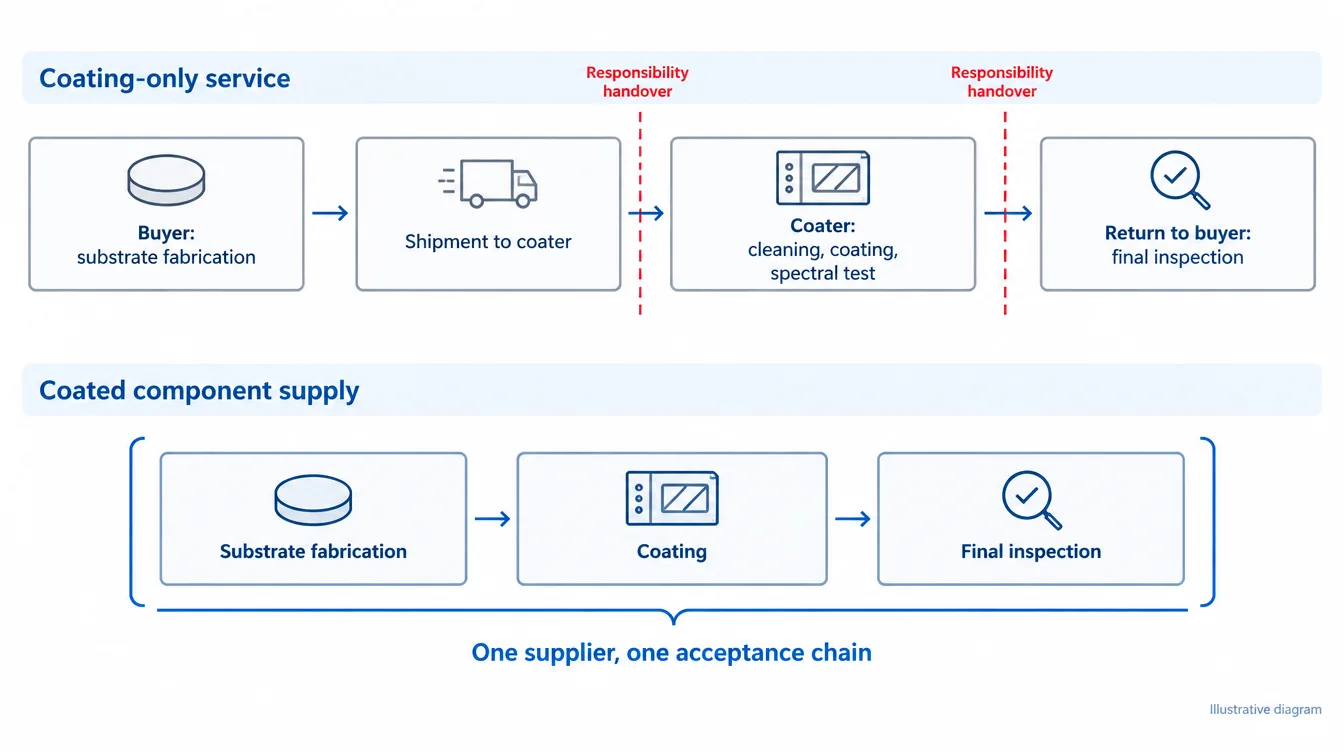
Many suppliers offer more than one of these models, so the RFQ should state which one you want. A quotation that assumes customer-supplied substrates will not include material, polishing or dimensional inspection.
What does coating-only supply leave with the buyer?
Coating-only supply leaves the buyer responsible for everything that happened to the part before it reached the coating chamber. That covers the material, the polish, the cleanliness and the packaging. A coating follows the surface it is deposited on, so a scratch, a stain or a polishing residue is still there after coating and is often easier to see.
Substrate identity
A coating design is calculated for one substrate refractive index. Supplying parts as “optical glass” without a material designation forces the coater to guess or to measure. The single-layer case shows how much the result depends on the substrate.
| Substrate | Index used | Uncoated R | With MgF2 layer |
|---|---|---|---|
| Fused silica | 1.4585 | 3.5% | 1.8% |
| N-BK7 type crown glass | 1.5168 | 4.2% | 1.3% |
| Sapphire (ordinary ray) | 1.768 | 7.7% | 0.1% |
These are calculated Fresnel values per surface at normal incidence and 587.6 nm, in air, for non-absorbing surfaces and one quarter-wave MgF2 layer with n = 1.38. They are not measured product data. The same layer that leaves 1.8% on fused silica leaves 0.1% on sapphire, because a single quarter-wave layer reaches zero reflectance only when its index equals the square root of the substrate index. Multilayer designs reduce this dependence but do not remove it, and a filter or beamsplitter design also needs the substrate’s absorption edge and thickness.
Surface condition on arrival
Parts arrive with a history. Fingerprints, protective lacquer, blocking wax and tape adhesive all have to come off before coating, and some residues leave stains that only show after the coating is applied. Agree an incoming inspection: who inspects, to which surface imperfection notation, and what happens to parts that fail before coating. Without that record, a defect found after coating cannot be assigned to either side.
Temperature limits of the part
Some parts cannot take the substrate temperature a process uses. Cemented doublets, polymer optics, parts with painted edges and optics already bonded into mounts all limit it. State any such limit in the RFQ, since it narrows the processes the coater can use and can change the durability the coating reaches.
How do fixturing and chamber loading affect the part?
Every part in a coating run sits in tooling, and tooling touches or shadows part of the surface. The coated aperture is therefore smaller than the physical part unless the tooling is designed otherwise, and layer thickness varies with position in the chamber. Both effects belong in the drawing and the acceptance plan.
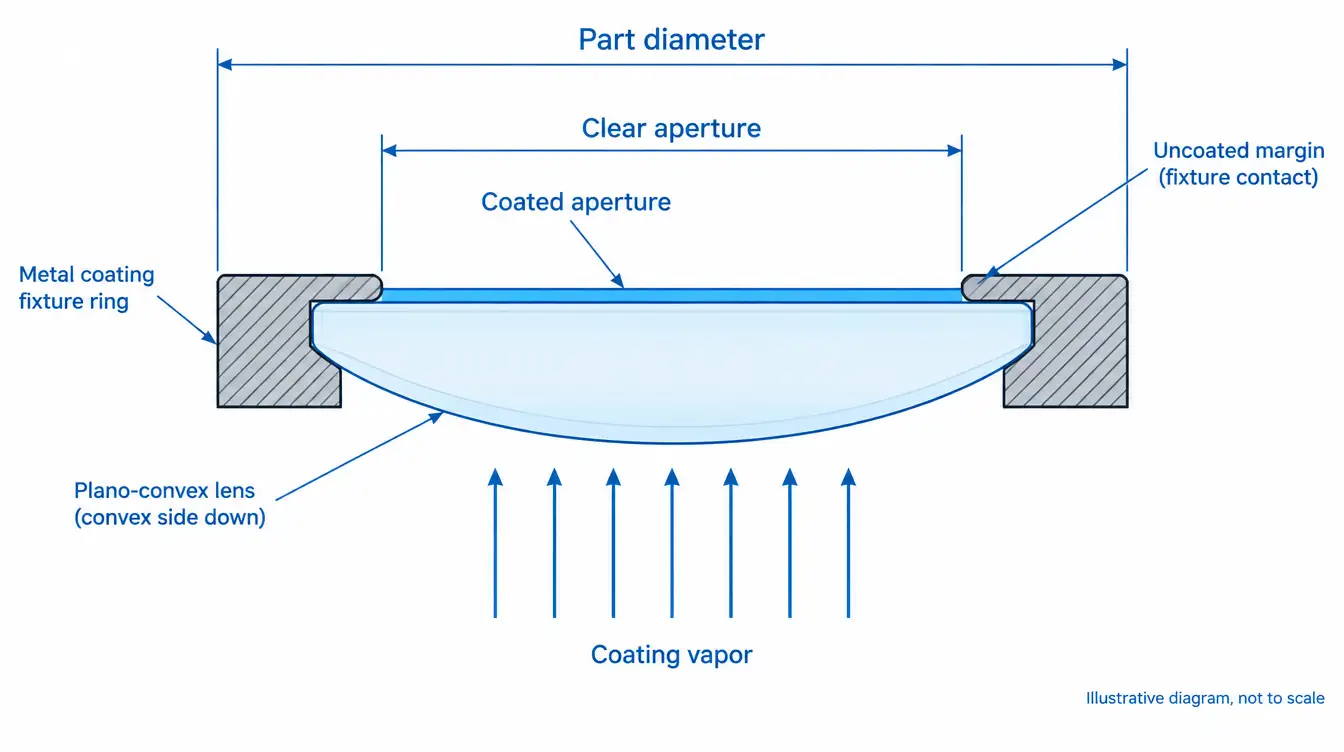
- Uncoated margin. Define the clear aperture, the minimum coated diameter and the zone where tooling contact is allowed. A window that must seal on its coated face needs this more than most parts.
- Two-sided coatings. Each side is coated separately. The first coating is handled, turned and exposed to stray deposition during the second, so say which side is coated first if one is more critical.
- Uniformity across the load. Thickness depends on position relative to the source. Rotating tooling and masks even it out, but a tight spectral tolerance can restrict where parts may sit and how many fit in one run.
- Dedicated tooling. Unusual shapes such as prisms, rectangles with chamfers, steep lenses and mounted parts need their own fixtures before the first run.
What trade-offs separate coating-only from coated component supply?
Coating-only supply gives the buyer control of the substrate and takes away single-point accountability. Coated component supply does the reverse. Neither is better in general, and the right choice depends on which risk is cheaper for the project to carry.
Scrap and lot size
A coating run can fail as a whole. When the parts belong to the buyer, the coater can refund or repeat the coating but cannot replace a polished substrate. Buyers therefore send more parts than they need. An integrated supplier absorbs substrate replacement inside its own process and plans its own overage.
Rework
A coating that misses its specification can sometimes be removed. Chemical stripping depends on the coating materials and can attack some substrates. Repolishing removes substrate material, so thickness, surface figure and, for a lens, radius and centre thickness must be measured again afterwards. Decide before the order whether rework is permitted and what the part must meet after it.
Diagnosis
When a coated part shows a defect, the cause can sit in the substrate, in cleaning or in the coating. With two suppliers, each can point to the other, and the buyer holds the only complete record. With one supplier, the diagnosis is internal, but the buyer sees less of it. Requesting incoming and outgoing inspection records narrows the gap in both models.
Flexibility
Coating-only supply lets a buyer keep a qualified polisher, coat parts made by several sources, or add a coating to stock optics. It also suits recoating of existing parts. Coated component supply fits better when coating and substrate interact, as with a filter whose blocking depends on an absorbing glass, or a thin part that bends under coating stress.
How should you choose between the two models?
Choose coating-only supply when the substrate is already made, already qualified, or special enough that you want to control it yourself. Choose coated component supply when the part is new, when spectral performance depends on the substrate, or when you need one acceptance report covering dimensions, surfaces and spectrum.
- You hold polished parts and the coating is the last step: coating-only.
- The substrate comes from a qualified source you must keep: coating-only, with a written incoming inspection.
- The part is a bandpass, edge or dichroic filter on a new substrate: coated component supply.
- The part is thin relative to its diameter and flatness matters after coating: coated component supply, so thickness and coating stress are designed together.
- You need a few coated parts quickly for bench tests: a catalog optic, if its specification fits.
For drawing-based projects, GIAI reviews custom coated optics against the drawing, sample, optical requirements, substrate, geometry, coating conditions and inspection criteria before defining the manufacturing route. The route itself is described under manufacturing capabilities, and acceptance logic under quality assurance. The factory tour shows the fabrication, coating and inspection areas.
Once the model is chosen, the supplier still has to be evaluated on process and verification. The companion guide on evaluating a thin film coating supplier covers deposition processes, angle-of-incidence shift and durability standards, and the article on AR coatings for lenses covers anti-reflection design choices.
Which sourcing mistakes cause rejected coating lots?
Most rejected lots in coating-only supply trace back to something that was never written down. Each of the following has a simple fix at the RFQ stage.
- Sending substrates without a material designation or melt data when the design is index-sensitive.
- Shipping parts with no incoming inspection agreed, then disputing a scratch after coating.
- Sending the exact quantity needed, with no overage for set-up, witness pieces or handling loss.
- Drawing the coating to the physical edge of a part that has to be held by that edge.
- Leaving out the fact that the part is cemented, mounted or painted.
- Accepting on a witness sample for a steep lens without agreeing how the witness relates to the part.
- Quoting a quality system certificate as evidence of coating performance. Check the holder, scope and site in the supplier’s certification documents; a management system certificate says nothing about a spectrum.
What should a coating RFQ state about supply and acceptance?
Beyond spectral targets, a coating RFQ should state who supplies the substrate, in what condition, and how the coated lot will be accepted. These items decide the quotation as much as the coating design does.
- Sourcing model: customer-supplied substrates or complete coated component.
- Substrate material designation, dimensions, thickness and surface specification, with drawings.
- Condition on arrival: cleaned, lacquered, mounted, cemented, previously coated.
- Coating function per surface, wavelength range, spectral targets, angle of incidence and polarization.
- Clear aperture, minimum coated area and permitted tooling contact zone.
- Maximum temperature the part can tolerate.
- Acceptance: on part or on witness sample, measurement conditions, durability tests and report format.
- Quantity required, quantity supplied, and the rule for rework or replacement.
FAQ
What does an optical coating manufacturer do?
An optical coating manufacturer designs thin-film coatings and deposits them on optical surfaces in a vacuum chamber, then verifies the result by spectral measurement and durability testing. Some coat only parts that customers supply, some fabricate the substrate as well and deliver finished components, and many do both. The supplier’s role in a given order depends on which of those is being bought.
Can optical coatings be applied to customer-supplied substrates?
Optical coatings can be applied to customer-supplied substrates when the coater knows the substrate material, surface condition, dimensions and temperature limit. The buyer normally remains responsible for substrate quality and for replacing parts lost in a failed run. An agreed incoming inspection and a stated overage quantity prevent most disputes in this arrangement.
Can an optical coating be removed and reapplied?
An optical coating can sometimes be removed by chemical stripping or by repolishing the surface, and the part can then be coated again. Chemical stripping depends on the coating materials and may attack certain substrates. Repolishing removes material, so thickness and surface figure change and must be remeasured. Whether rework is allowed should be agreed before the order.
What is a witness sample in optical coating?
A witness sample in optical coating is a flat test piece placed in the chamber and coated in the same run as the parts. Spectral and durability tests are performed on the witness when the parts are too small, curved or valuable to test directly. A witness is a proxy, so its material and its position in the chamber should be agreed in advance.
What information does an optical coating manufacturer need for a quote?
An optical coating manufacturer needs the coating function for each surface, the wavelength range and spectral targets, the angle of incidence and polarization, the substrate material and dimensions, the clear aperture, the acceptance method and the quantity. For customer-supplied parts, it also needs the condition of the parts on arrival and any temperature limit.
References
- H. Angus Macleod, Thin-Film Optical Filters, CRC Press.
- ISO 9211-1, Optics and photonics — Optical coatings — Part 1: Vocabulary.
- ISO 9211-2, Optics and photonics — Optical coatings — Part 2: Optical properties.
- ISO 9211-3, Optics and photonics — Optical coatings — Part 3: Environmental durability.
- ISO 10110-7, Optics and photonics — Preparation of drawings for optical elements and systems — Part 7: Surface imperfections.
- ISO 10110-9, Optics and photonics — Preparation of drawings for optical elements and systems — Part 9: Surface treatment and coating.
To have a coating requirement reviewed, send the drawing, optical specification or sample together with the wavelength range, substrate, dimensions, coating requirements for each surface, AOI, inspection criteria and expected quantity, and state whether you will supply the substrates, to GIAI through the custom project contact page.