
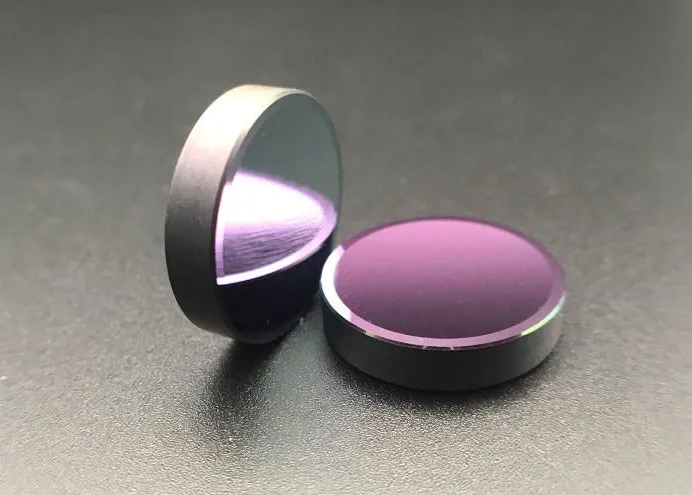
Germanium (Ge) is used in infrared optics primarily to manufacture thermal imaging lenses, infrared windows, protective sensor optics, and components for infrared measurement systems. Its useful transmission range extends approximately from 2 to 14 μm, covering important mid-wave infrared (MWIR) and long-wave infrared (LWIR) regions.
Unlike conventional optical glass, germanium blocks visible light while transmitting selected infrared wavelengths. Its high refractive index makes it particularly useful for compact infrared lens designs. However, surface reflection, temperature sensitivity, material density, and coating requirements must be considered before selecting it for an optical system.
What Is Germanium Used for in Infrared Optics?
Germanium is a crystalline semiconductor material that also functions as an infrared-transmitting optical substrate. It is commonly fabricated into lenses, windows, and other optical components that must transmit infrared radiation to a detector or measurement instrument.
Its primary applications include:
| Application | Function of Germanium | Important Design Consideration |
|---|---|---|
| Thermal imaging cameras | Focuses infrared radiation onto a detector | LWIR transmission, image quality, AR coating |
| Infrared protective windows | Provides an optical barrier while transmitting IR radiation | Transmission, thickness, surface durability |
| Infrared temperature measurement | Transmits radiation from a target to the sensing system | Detector wavelength, calibration, thermal conditions |
| Gas detection and spectroscopy | Transmits selected infrared wavelengths through optical instruments | Absorption bands, spectral losses, material grade |
| Infrared laser systems | Transmits or shapes suitable infrared beams | Absorption, power density, thermal lensing |
Although these applications share the need for infrared transmission, their requirements differ substantially. A germanium lens designed for passive thermal imaging is not automatically suitable for a high-power infrared laser.
Why Is Germanium Used in Infrared Optical Systems?
1. Transmission Across Important Infrared Wavelengths
The main reason germanium is used in infrared optics is its ability to transmit radiation in spectral regions where many conventional optical glasses are strongly absorbing.
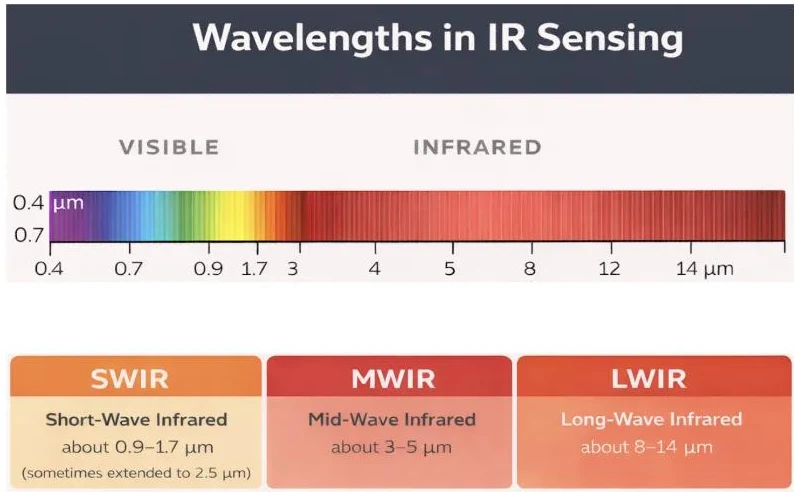
Optical-grade germanium is commonly associated with a useful wavelength range of approximately 2–14 μm. Some material specifications extend the nominal range toward 16 μm, but practical transmission depends on material grade, thickness, wavelength, temperature, and other factors.
Two particularly important regions are:
Mid-wave infrared (MWIR): 3–5 μm
This region is used in certain thermal imaging systems, infrared spectroscopy instruments, and gas detection applications.
Germanium can transmit radiation within this band, although silicon and other infrared materials may offer advantages depending on the optical design.
Long-wave infrared (LWIR): 8–14 μm
This region is especially important for thermal imaging of objects near ordinary environmental temperatures.
Germanium is frequently selected for LWIR lenses and windows because it provides useful transmission across much of this spectral region.
The quoted material transmission range should not be confused with the guaranteed transmission of a finished optical component. Actual performance must be evaluated for the required wavelength range, thickness, coatings, and operating conditions.
2. High Refractive Index for Compact Lens Designs
Germanium has a refractive index of approximately 4.0 in much of its commonly used infrared range.
This is significantly higher than that of conventional visible-light optical glasses.
A high refractive index allows an optical designer to achieve substantial refractive power with relatively shallow surface curvatures. Depending on the design constraints, this can support compact infrared objectives or reduce the number of elements required.
However, high refractive index also introduces a substantial reflection penalty.
For an uncoated air–germanium interface at normal incidence, Fresnel reflectance can be approximated by:
R = [(n − 1) / (n + 1)]²
Where:
- R = Reflectance at a single optical interface
- n = Refractive index of germanium, relative to air
Using n = 4.0:
R = [(4 − 1) / (4 + 1)]² = 0.36 = 36%
The calculated reflection is approximately 36% per uncoated interface.
A finished germanium lens or window typically has two optical surfaces, so reflection losses can significantly reduce system throughput. Multiple internal reflections and material absorption must also be considered when calculating total transmission.
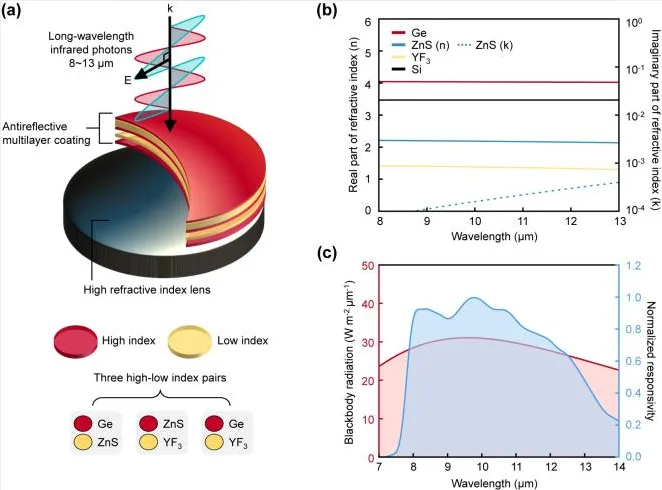
This is why anti-reflection coatings are important for many germanium infrared components.
3. Low Dispersion Over Selected Infrared Bands
Germanium exhibits relatively low refractive-index dispersion across certain infrared wavelength regions.
Lower dispersion can reduce wavelength-dependent focal shifts and simplify optical correction in some broadband infrared systems.
Nevertheless, low dispersion does not mean that germanium is completely free of chromatic aberration. Refractive-index variation must still be included in the lens design, particularly when the system operates over a broad spectral range.
For precision imaging applications, wavelength-dependent focal performance should be evaluated using appropriate material dispersion data.
How Is Germanium Used in Thermal Imaging Cameras?
Thermal imaging is one of the most recognizable applications of germanium optics.
A conventional visible-light camera records reflected visible light. A thermal camera measures infrared radiation emitted by a scene and, depending on the instrument, also receives reflected infrared radiation.
In a typical LWIR thermal camera, infrared radiation passes through an objective lens assembly before reaching a detector sensitive to the appropriate wavelength region.
Germanium can serve as a refractive element within that objective.
The lens assembly collects and focuses radiation onto the detector, allowing the camera to form a spatial image from the measured infrared signal.
Germanium does not convert infrared radiation into visible light. The detector and subsequent electronics convert the received infrared information into an image that can be displayed.
Why Can’t Ordinary Glass Replace Germanium?
Most conventional optical glasses transmit visible light effectively but strongly absorb radiation in the 8–14 μm region.
Consequently, a visible-light camera lens cannot normally be substituted directly into an LWIR thermal imaging system.
Germanium has the opposite behavior over these regions: it is opaque to visible light but can transmit useful long-wave infrared radiation.
This explains why a germanium lens may appear dark or metallic when viewed by eye while functioning as a transmissive optical element for an infrared detector.
Germanium Windows for Infrared Sensors and Instruments
Germanium is also used to manufacture flat infrared windows.
Unlike a focusing lens, an optical window is generally intended to transmit radiation while providing protection or physical separation.
A germanium window may be installed in front of an infrared detector, inside a measurement instrument, or as part of a sealed optical enclosure.
Its functions can include:
- Protecting sensitive optical components from direct environmental exposure.
- Separating an infrared optical path from the surrounding environment.
- Transmitting the required infrared wavelength range.
- Providing a defined optical interface for a measurement system.
Window design involves more than choosing an infrared-transparent material.
Thickness, clear aperture, surface flatness, parallelism, mounting stress, and coating performance can all influence the optical result.
For imaging instruments, transmitted wavefront distortion may be especially important. A protective window with inadequate flatness or inappropriate mounting can degrade image quality even when its spectral transmission is acceptable.
Does Germanium Also Work as an Infrared Filter?
Germanium naturally blocks much of the visible spectrum while transmitting selected infrared wavelengths, giving it a useful intrinsic longpass-like spectral behavior.
However, a germanium substrate is not automatically equivalent to a precisely specified infrared bandpass filter.
Applications requiring a narrow spectral passband, defined cutoff wavelength, or high out-of-band rejection generally need additional wavelength-selective optical design.
The required optical function must therefore be distinguished from the material’s inherent transmission characteristics.
What Are the Limitations of Germanium Infrared Optics?
Germanium offers useful infrared optical properties, but it is not the best material for every system.
Temperature Sensitivity
Temperature behavior is one of the most important limitations.
Germanium has a relatively large thermo-optic coefficient, meaning that its refractive index changes appreciably with temperature.
As the temperature of a germanium lens changes, its optical power and focal position may change as well.
This can introduce thermal defocus and affect the image quality of infrared cameras operating across changing ambient temperatures.
Germanium absorption can also increase at elevated temperatures. Under sufficiently demanding thermal and optical loading conditions, this can contribute to thermal lensing or positive-feedback heating, sometimes described as thermal runaway.
These effects are not interchangeable.
Uniform temperature changes primarily affect refractive index and system focus, whereas nonuniform heating can introduce additional refractive-index gradients and wavefront distortion.
The severity of the effect depends on wavelength, material grade, absorbed optical power, component geometry, and heat dissipation.
High Material Density
Germanium has a density of approximately 5.33 g/cm³.
Its relatively high mass can be a disadvantage in portable infrared systems, moving optical assemblies, and applications with strict weight limitations.
Engineers must consider not only the mass of the optical element but also its effect on mechanical support, mounting, vibration response, and overall system packaging.
Surface Reflection
The high refractive index that benefits optical design also causes significant Fresnel reflection at uncoated surfaces.
This makes the coating specification a central part of component selection rather than a minor finishing detail.
Material and Manufacturing Considerations
Germanium is a brittle crystalline material and requires suitable optical fabrication and handling methods.
Optical surface quality, edge geometry, mounting conditions, and mechanical loading should be controlled according to the requirements of the finished component.
For exposed infrared windows, environmental protection may also be required.
Certain designs use diamond-like carbon (DLC) coatings or other protective coating structures, but their suitability depends on the intended environment and coating specification.
Why Are Anti-Reflection Coatings Important for Germanium?
Germanium’s high surface reflectance makes anti-reflection (AR) coatings particularly valuable.
A properly designed coating reduces reflection within its specified wavelength range and helps improve the infrared energy reaching the detector.
Common coating design regions include the 3–5 μm MWIR band and the 8–12 μm LWIR band, although broader or application-specific coating designs are also possible.
An AR coating must be evaluated according to:
- Operating wavelength range
- Angle of incidence and polarization, where relevant
- Substrate material and surface geometry
- Required transmission or reflectance
- Operating temperature and environmental exposure
- Durability and inspection requirements
For wide-angle infrared imaging systems, rays may encounter the lens surfaces over a range of incidence angles. Coating performance should therefore be considered across the actual optical geometry rather than at normal incidence alone.
The measured transmission of a coated germanium component should be evaluated over the specified wavelength range and under defined measurement conditions.
Germanium vs Other Infrared Optical Materials
Germanium is only one option among several infrared-transmitting materials.
The best material depends on the detector band, environmental requirements, imaging geometry, and acceptable system trade-offs.
| Material | Typical Optical Strength | Main Consideration |
|---|---|---|
| Germanium (Ge) | Useful LWIR transmission and high refractive index | Reflection, temperature sensitivity, weight |
| Silicon (Si) | Useful in many NIR and MWIR designs | Standard optical grades are not generally direct LWIR substitutes |
| Zinc Selenide (ZnSe) | Broad infrared transmission, including 10.6 μm | Mechanical durability and handling requirements |
| Chalcogenide IR Glass | Infrared transmission with some moldable optical grades | Properties vary significantly by composition |
For a conventional 8–14 μm thermal imaging objective, germanium is a well-established candidate.
For a 3–5 μm system, silicon may also deserve consideration.
For systems involving transmission of significant CO₂ laser power at 10.6 μm, absorption and thermal loading may favor other materials, such as suitable optical-grade ZnSe.
For a more detailed comparison, see Germanium vs Silicon Infrared Optics.
Material selection should be based on complete system requirements, not a single transmission-range specification.
How to Select Germanium for an Infrared Optical System
An infrared system should be specified from its optical function and operating conditions before selecting a germanium component.
Define the detector wavelength range. Determine whether the system operates in MWIR, LWIR, or another infrared region. Confirm that the required material grade provides suitable transmission across the complete operating band.
Identify the component function. A focusing lens has different optical requirements from a protective window or filter substrate.
Determine the optical geometry. Specify focal length, numerical aperture or f-number, field of view, clear aperture, and the relevant mechanical dimensions.
Evaluate temperature and environmental conditions. Consider ambient temperature variation, possible component heating, humidity, contamination, and mounting stresses.
Specify the coating. Define the required spectral performance, operating angles, and environmental durability rather than requesting an unspecified infrared AR coating.
Establish verification requirements. Inspection may include dimensional measurement, surface characteristics, spectral transmission, reflected performance, and other drawing-defined criteria.
For imaging systems, wavefront performance and image-quality requirements may also need to be evaluated at the assembly level.
The objective is to select an optical component that satisfies the complete system requirement, rather than choosing germanium simply because it transmits infrared radiation.
Germanium Infrared Optics at GIAI Photonics
GIAI Photonics supports custom optical components and infrared optics projects, including infrared lenses, windows, filters, and related optical components.
Germanium is among the infrared materials identified within GIAI’s published material scope.
Custom optical projects can be reviewed against drawings, samples, material requirements, optical specifications, component geometry, coating conditions, and inspection criteria.
For a germanium infrared component, useful project information includes the operating wavelength range, lens or window function, dimensions, surface requirements, coating specifications, application environment, and expected quantity.
GIAI evaluates project-specific requirements before defining an appropriate manufacturing and inspection route.
Engineers developing infrared imaging or sensing equipment can review the company’s germanium lenses or custom optics process for further information.
For project inquiries, submit available drawings or specifications through the GIAI Photonics contact page.
Frequently Asked Questions
Is germanium mainly used for infrared cameras?
Thermal imaging is a major application of germanium, particularly for LWIR camera lenses and protective windows. However, germanium is also used in infrared sensing, measurement instruments, spectroscopy, and selected infrared laser systems. The actual suitability depends on wavelength, temperature, coating, and optical geometry.
Can germanium transmit visible light?
Optical-grade germanium is generally opaque in the visible spectrum while transmitting useful infrared wavelengths. This is why a germanium lens often appears dark to the human eye. Its visible opacity should not be interpreted as proof of a particular infrared transmission specification.
What wavelengths can germanium optics transmit?
Germanium is commonly specified for useful transmission from approximately 2 to 14 μm, with some material references extending toward 16 μm. The actual performance depends on material grade, thickness, temperature, coating, and wavelength. A finished optical component should be evaluated against its specified operating band.
Does germanium need an anti-reflection coating?
Many transmissive germanium components benefit substantially from AR coatings because uncoated germanium surfaces have high Fresnel reflectance. The coating should be selected according to the required wavelength band, angle of incidence, and environmental conditions. Uncoated germanium may still be appropriate for applications where reflection losses are acceptable.
Is germanium suitable for high-temperature infrared applications?
Germanium requires caution in high-temperature environments because its refractive index and infrared absorption can change significantly with temperature. Elevated temperatures can cause focus drift and transmission degradation. Suitability must be assessed for the expected thermal conditions rather than assuming that germanium remains optically stable at all temperatures.
Can germanium be used for CO₂ laser optics?
Germanium transmits at the 10.6 μm wavelength of a CO₂ laser, so it can be used in certain infrared laser optical configurations. However, material absorption and thermal lensing become important under optical loading. High-power applications require evaluation of the specific material, coating, beam parameters, and thermal design; transmission at 10.6 μm alone is not sufficient qualification.
Germanium is used in infrared optics because it combines useful mid- and long-wave infrared transmission with a high refractive index and optical properties suited to thermal imaging and infrared sensing.
Its most established applications include thermal imaging lenses and infrared windows. However, its advantages must be balanced against substantial surface reflection, temperature sensitivity, and relatively high density.
Successful germanium component selection depends on the complete optical system: wavelength, detector, geometry, coating, environmental conditions, and verification requirements.