
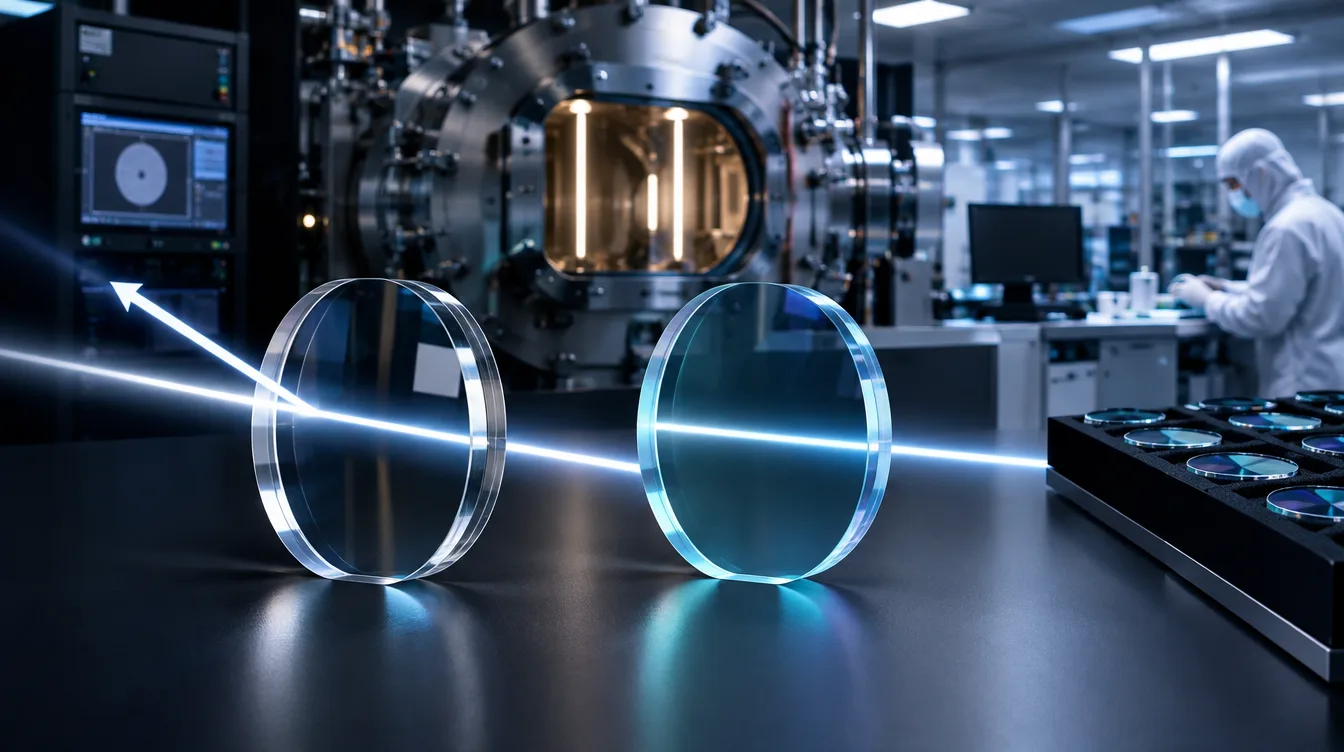
AR Coating for Optical Lenses: What Engineers Need to Specify
For a simple flat window, the incoming beam may encounter a relatively narrow range of incidence angles. A lens is more complicated. Its curved surfaces refract the beam, and different rays can strike different areas of the coating at different local angles.
This means that selecting an AR coating for optical lenses is not only a thin-film question. The coating has to be evaluated as part of the complete lens and optical system.
Why Do Optical Lenses Need AR Coating?
Whenever light crosses an interface between materials with different refractive indices, part of the optical power is reflected. An optical lens normally contains at least two external surfaces, and a multi-element lens assembly may contain many more optical interfaces.
Even when the reflection from one surface appears small, reflections can accumulate across a multi-element system. Depending on the application, unwanted surface reflections can contribute to:
- reduced optical throughput;
- flare and ghost images in imaging systems;
- lower image contrast;
- unwanted return light in laser systems;
- reduced source-to-detector efficiency;
- additional stray light inside an optical assembly.
An anti-reflection coating uses thin-film interference to reduce reflection over defined optical conditions. The important phrase is defined optical conditions. A coating optimized for one wavelength and one angle should not automatically be assumed to provide the same performance over a broad spectral range or a large cone of incident angles.
A Lens Coating Is Different From Coating a Flat Window
The curvature of a lens introduces an additional engineering variable: the angle at which light reaches the coating can vary across the optical surface.
For a collimated beam passing through a relatively weak lens, the angular range may be modest. For a strongly curved lens, high numerical-aperture system, aspheric lens or wide-field imaging system, the range of local incidence angles can become much larger.
The chief ray entering the lens at one angle does not necessarily describe the AOI experienced by every ray across the full clear aperture.
This is one reason coating requirements should be reviewed together with the optical prescription or at least with enough system information to understand the real operating geometry.
Choose the AR Coating Around the Spectral Requirement
The first coating question should normally be: What wavelength or wavelength range must the finished lens transmit efficiently?
Different optical systems can require very different AR strategies.
| Coating Approach | Typical Engineering Use | Main Specification Concern |
|---|---|---|
| Single-wavelength / V-coat | Defined laser wavelength or narrow source band | Design wavelength, AOI and polarization |
| Broadband AR / BBAR | Imaging, illumination or instruments using a wider spectrum | Full wavelength range and allowable reflectance across the band |
| Dual-band / multi-band AR | Systems using separated source or detection wavelengths | Performance in each required band rather than unnecessary continuous bandwidth |
| Infrared AR | IR imaging, sensing and infrared optical systems | Substrate, IR band, environment and temperature conditions |
A wider coating range is not automatically better. Increasing bandwidth can create trade-offs in residual reflectance and design complexity. Engineers should specify the spectral range the optical system actually needs rather than requesting the widest possible coating band by default.
For a more detailed comparison between narrow and broadband designs, see V-Coat vs Broadband AR Coating: Specs and Trade-Offs.
Specify Reflectance Correctly
A statement such as “low reflection” is not sufficiently measurable for a production drawing.
A useful specification should clarify whether the requirement refers to:
- reflectance at one wavelength;
- average reflectance across a wavelength band;
- maximum reflectance anywhere inside that band;
- one optical surface;
- both external surfaces;
- one defined AOI;
- a complete angular range;
- unpolarized, S-polarized or P-polarized light.
Average and maximum reflectance should not be confused. A coating may have a satisfactory average across a broad band while still containing a localized region of higher reflection. If that region overlaps an important laser line, illumination band or detector sensitivity peak, the system can still be affected.
Reflectance and Lens Transmission Are Related but Not Identical
Reducing surface reflection usually increases the amount of useful light transmitted by the lens when other losses are small. However, a transmission requirement and a reflection requirement are not interchangeable.
Finished-lens transmission can also depend on:
- absorption inside the substrate;
- coating absorption;
- surface scatter;
- lens thickness;
- other coated or uncoated surfaces;
- cemented interfaces in multi-element optics;
- additional filters or optical components in the system.
If the engineering problem is back-reflection or ghost control, reflectance may be the more direct acceptance parameter. If total optical throughput matters, the finished-lens transmission requirement may also need to be defined.
AOI Is Especially Important for Curved Lenses
The spectral response of an interference coating depends on incidence angle. As the ray angle changes, the optical path through the coating layers changes as well.
For flat components, the AOI may be easy to define. On a curved lens, the local surface normal changes continuously across the aperture. The actual AOI is therefore determined by both ray direction and surface curvature.
Important system information may include:
- nominal beam direction;
- minimum and maximum ray angle;
- numerical aperture or cone angle;
- field angle;
- surface curvature;
- whether the beam is collimated, converging or diverging;
- whether the optical element scans or rotates during operation.
For demanding wide-angle or high-NA systems, coating performance should be evaluated over the relevant angular distribution rather than only at normal incidence.
When Does Polarization Matter?
Near normal incidence, polarization may have limited practical influence in many lens applications. At larger incidence angles, however, S- and P-polarized light can exhibit increasingly different reflectance behavior.
Polarization deserves particular attention in:
- laser optical systems;
- beam scanning;
- systems containing polarization-sensitive components;
- large-AOI lens surfaces;
- optical paths where polarization state is controlled deliberately.
If polarization is important to the final system, it should be stated explicitly rather than left for the coating supplier to assume.
The Lens Substrate Changes the Coating Problem
The optical substrate is part of the coating design because its refractive index, spectral transmission and material behavior influence the interface on which the film stack operates.
A coating developed for one glass should not automatically be treated as equivalent on another optical glass, crystal or infrared material.
The lens specification should therefore identify the exact optical material or material grade where possible rather than using a generic description such as “optical glass.”
Material selection must also remain consistent with the operating wavelength. For infrared lenses, for example, substrate transmission and surface reflection need to be considered together.
Should Both Lens Surfaces Use the Same AR Coating?
Not necessarily.
For a simple lens in air, applying an appropriate AR coating to both external surfaces can reduce reflection losses from both interfaces. But the two surfaces may not always experience identical ray angles, surrounding media or system conditions.
In a complex optical assembly, one surface may face air while another is cemented, bonded or positioned next to another optical component. The coating requirement should therefore identify exactly which surfaces are coated rather than relying only on the phrase “AR coated lens.”
On an engineering drawing, surface identification is preferable to an ambiguous general coating note.
AR Coating Can Reduce Ghosts, but It Does Not Correct Lens Aberrations
Surface reflections inside a lens system can create secondary optical paths. In imaging systems, these reflections may contribute to ghost images and flare. In laser systems, unwanted reflections can send optical power back toward an upstream component or source.
AR coating can reduce these reflection-related effects, but it should not be confused with optical prescription correction.
An AR coating does not by itself correct:
- spherical aberration;
- chromatic aberration;
- coma;
- astigmatism;
- field curvature;
- incorrect focal length;
- decentration or mechanical alignment errors.
Coating design and lens design solve different engineering problems, even though they interact in the final optical system.
AR Coating for Different Lens Applications
| Lens Application | Main AR Coating Concern | Important Inputs |
|---|---|---|
| Machine vision / imaging | Transmission, contrast and ghost suppression | Illumination spectrum, sensor response, field angle, lens geometry |
| Laser focusing or collimation | Low surface reflection and return-light control | Laser wavelength, AOI, polarization, beam size and operating conditions |
| Fiber collimation | Efficient transmission through compact optical surfaces | Operating wavelength, lens geometry, fiber output cone and surface angle |
| Infrared lens | Surface reflection combined with material transmission | IR band, substrate, temperature, geometry and environment |
| Wide-field optical system | Performance over a broad angular distribution | Field angle, surface curvature, spectral band and polarization |
How to Put an AR Coating Requirement on an Optical Drawing
A useful coating note should be measurable and linked to the intended optical conditions.
Instead of writing only:
the drawing or coating specification should define the relevant combination of wavelength, reflectance or transmission, AOI, polarization and coated surface.
Depending on the project, useful inputs include:
- operating wavelength or wavelength band;
- substrate material and grade;
- surface identification;
- target reflectance and/or transmission;
- average versus maximum reflectance requirement;
- nominal AOI and angular range;
- polarization state where relevant;
- lens diameter and thickness;
- surface radius or aspheric geometry;
- clear aperture;
- surface quality and figure requirements;
- environmental conditions;
- inspection method and measurement conditions;
- prototype and production quantity.
For laser lenses, additional source and beam information may be required when coating durability or damage risk is part of the engineering assessment.
How Should AR-Coated Lenses Be Verified?
A coating specification is only useful when the acceptance method is also understood.
Depending on the optical requirement, verification may consider spectral reflectance, transmission or other project-defined optical characteristics under agreed measurement conditions.
The measurement definition should state the applicable wavelength range and AOI. Polarization should also be defined when it materially affects the result.
Another important distinction is whether a measurement applies to a flat coating witness, a sample lens or the completed optical component.
A witness sample can be useful for coating-process monitoring, but it should not automatically be assumed to represent every aspect of a strongly curved or unusually shaped finished lens. The inspection approach should therefore be agreed during project review.
GIAI’s Quality Assurance approach defines inspection and acceptance according to the individual component drawing and project requirements.
GIAI Photonics Custom AR-Coated Lens Projects
GIAI Photonics supports custom optical lenses and custom coated optical components according to project requirements.
A lens coating project can be reviewed against the available drawing, sample or optical specification together with the substrate, geometry, wavelength range, AOI, coating targets and inspection criteria before the manufacturing route is defined.
Depending on the component, the manufacturing route may involve optical fabrication, precision grinding, polishing, cleaning, geometry processing, optical coating and inspection. Not every lens requires every manufacturing step; the route is determined by the specific part.
For additional information, see Optical Lenses, Manufacturing Capabilities and Custom Optics Process.
What to Send for an AR-Coated Lens RFQ
- Lens drawing and revision
- Optical material or substrate grade
- Lens diameter and center thickness
- Surface radii or complete optical geometry
- Operating wavelength or spectral band
- Reflectance and/or transmission target
- AOI or relevant ray-angle range
- Polarization where applicable
- Clear aperture
- Surface quality and figure requirements
- Identification of the surfaces to be coated
- Operating environment
- Inspection and documentation requirements
- Prototype quantity
- Expected production quantity
If the lens is already part of an optical design, providing system-level information such as source wavelength, beam geometry, numerical aperture or field angle can make coating review more meaningful than treating the coating as an isolated surface specification.
Frequently Asked Questions
What is AR coating on an optical lens?
AR coating is a thin-film optical coating applied to a lens surface to reduce Fresnel reflection over defined wavelengths and operating conditions. The coating uses optical interference to control reflected light. Its performance depends on factors including wavelength, substrate, AOI, polarization and coating design.
Should both sides of an optical lens be AR coated?
Both external air-to-lens surfaces are often considered for AR coating when reflection loss from both interfaces matters, but the correct requirement depends on the optical assembly. Each surface should be identified explicitly because the two sides may experience different ray angles, surrounding media or optical functions.
Does the curvature of a lens affect AR coating performance?
Curvature changes the local surface normal, so rays across the lens aperture may encounter different angles of incidence. This becomes especially important in high-NA, strongly curved, aspheric or wide-field optical systems. The coating should be evaluated over the angular range relevant to the actual lens.
Is broadband AR coating better for optical lenses?
Not automatically. Broadband AR is useful when a lens must operate across a wider spectral range. A single-wavelength or narrower coating may be more appropriate for a defined laser wavelength. The correct choice depends on spectral bandwidth, AOI, polarization and allowable residual reflection.
Does AR coating change the focal length of a lens?
The primary purpose of an AR coating is to reduce surface reflection rather than change the optical prescription of the lens. Focal length and aberration performance are mainly determined by lens geometry and refractive index. Coating and lens specifications should nevertheless be reviewed together as part of the finished optical component.
If you have a lens drawing, optical specification or existing sample, GIAI Photonics can review the project together with the substrate, wavelength range, geometry, AOI, coating requirement and inspection criteria.
For projects focused specifically on supplier qualification and coating-manufacturer selection, see the Anti Reflection Coating Manufacturer Engineering Guide.
For a new lens project, visit Contact GIAI Photonics.