Here we provide articles about popular science and applications of filters, lenses, prisms, reflectors, ND mirrors and other optical components. You are welcome to read! optical engineering articles, optical engineering guides, optical components, optical design, optics technology, photonics engineering
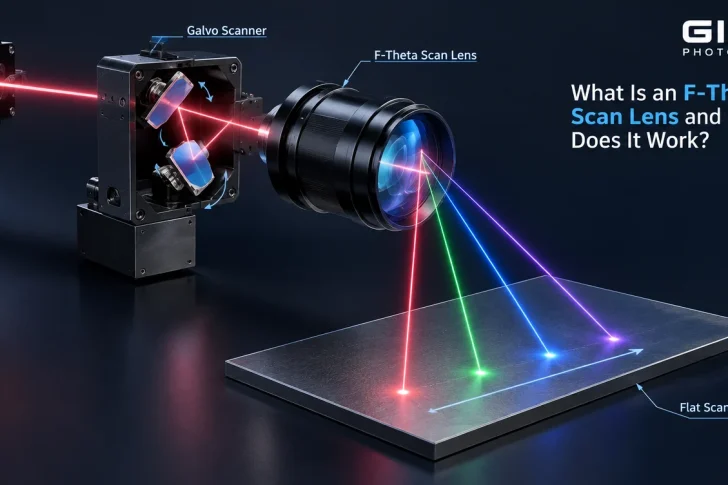
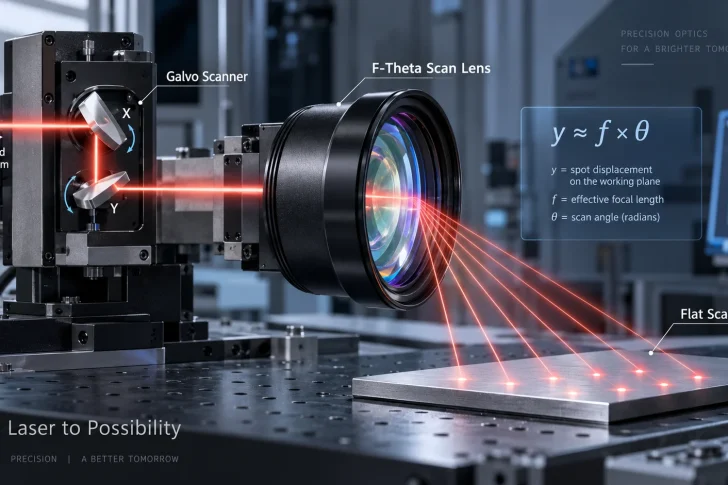
The topic is suitable as a foundational definition page. GIAI already has more specific content covering 1064 nm F-theta lenses, field-size calculation, standard vs. telecentric designs, and F-theta lens selection, so this page should act as the conceptual pillar rather than duplicate those narrower articles.…
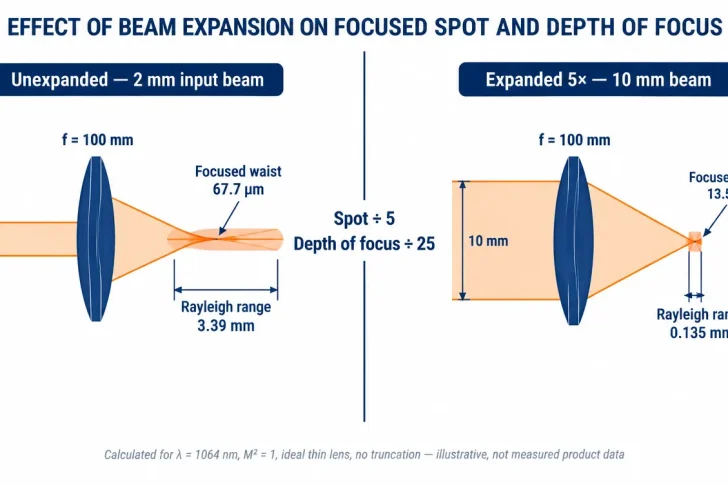
A beam expander is an afocal telescope that scales a collimated beam diameter by M. Far-field divergence scales by 1/M; the diameter-angle product stays fixed at one wavelength. Galilean layouts avoid an internal focus; Keplerian layouts allow pinhole spatial filtering. Focused spot diameter shrinks by…
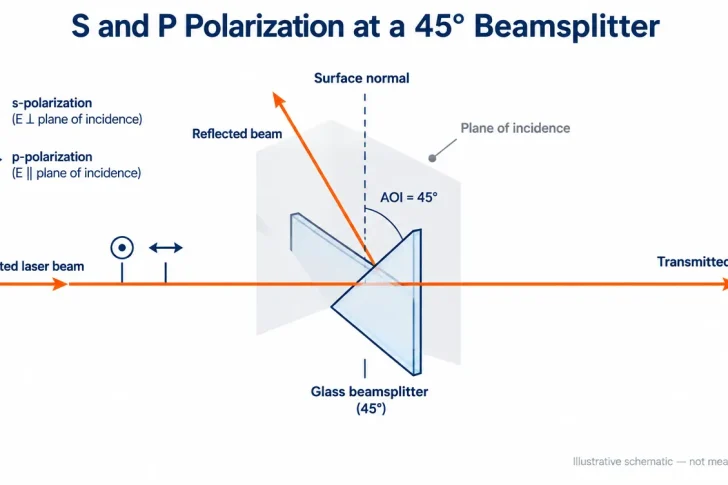
A beamsplitter does not treat s- and p-polarized light the same way. At any angle other than normal incidence, the reflectance of a surface or coating is higher for s-polarization than for p-polarization, and the difference grows with the angle of incidence. At 45°, the…
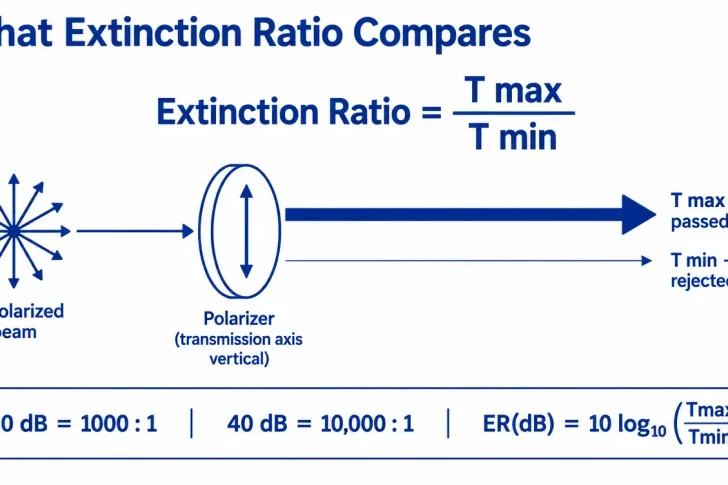
Extinction ratio is the ratio between the transmittance a polarizer gives to the polarization state it passes and the transmittance it gives to the orthogonal state it is meant to block, at a stated wavelength, angle of incidence and aperture. A part specified at 1000:1…
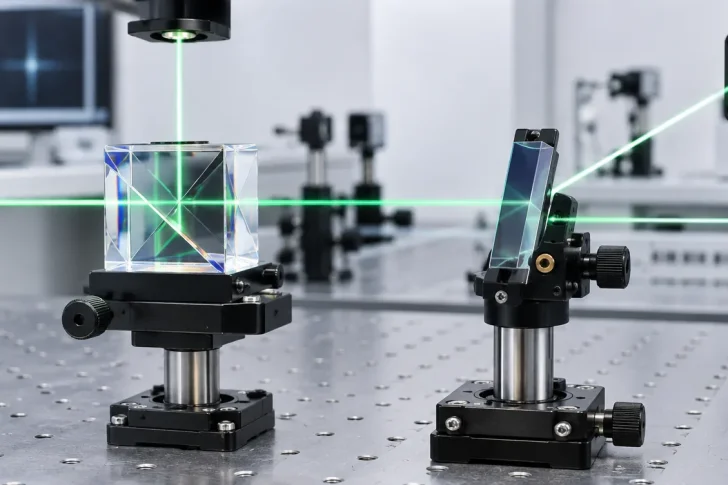
Cube Beamsplitter vs Plate Beamsplitter: Which Design Is Better for Your Optical System? Neither a cube beamsplitter nor a plate beamsplitter is universally better. A cube usually simplifies mechanical alignment and, in its normal-entry geometry, avoids the lateral displacement associated with transmitting through an angled…
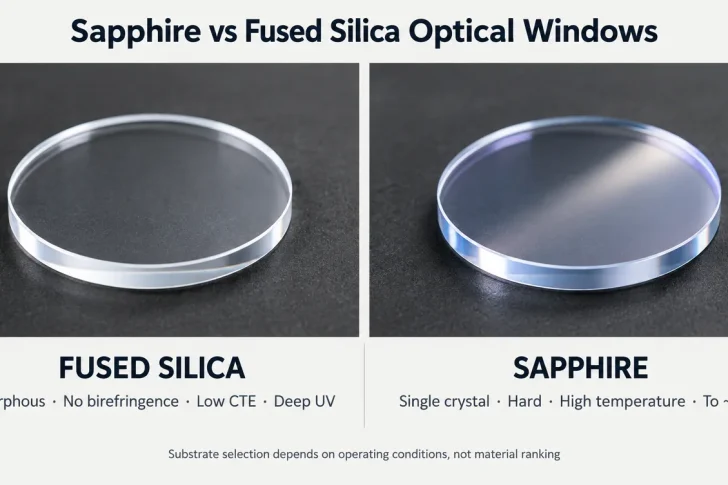
Choose fused silica when the window must work in the deep UV, must not disturb polarization or wavefront, or must survive fast thermal transients; choose sapphire when the window faces abrasion, high pressure, chemical attack or high temperature, or when the band extends past roughly…
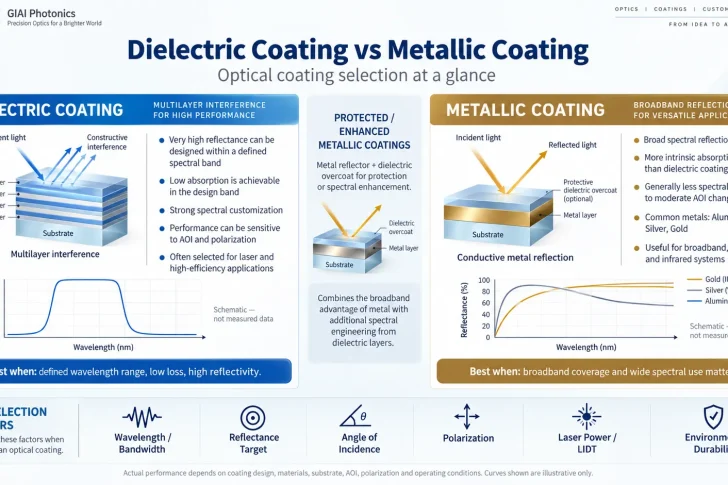
When specifying a mirror, beamsplitter, filter, or other coated optical component, choosing between a dielectric coating and a metallic coating is not simply a question of which one has higher reflectivity. The two coating families produce optical behavior through different physical mechanisms. Metallic coatings are…
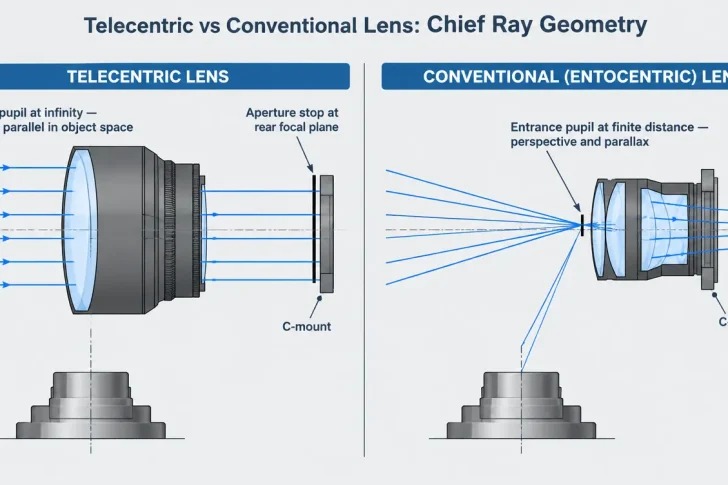
A telecentric lens keeps image magnification essentially constant while the object moves along the optical axis, within a defined telecentric range. A conventional imaging lens does not: as the object moves closer or farther, its image grows or shrinks. That single difference decides most selection…
Choosing an F-theta scan lens manufacturer is not simply a matter of matching a lens to a laser wavelength. An F-theta lens works as part of a complete scanning system. Its practical performance depends on the laser wavelength, input beam diameter, effective focal length, galvanometer…
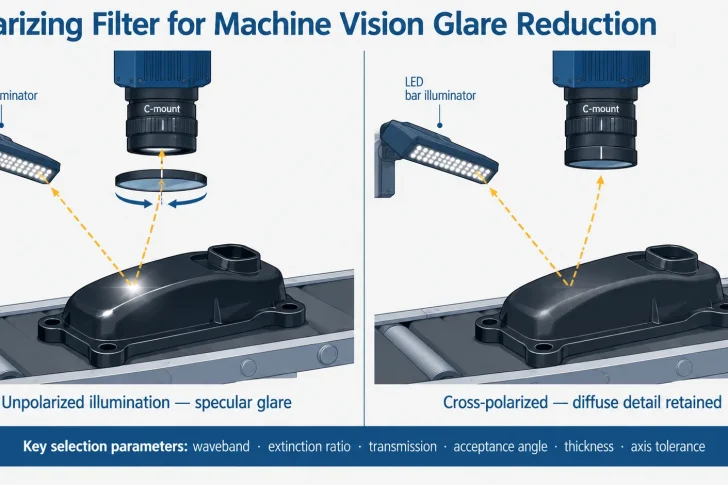
Selecting a polarizing filter for machine vision glare reduction starts with one question that has nothing to do with the filter itself: is the glare a specular reflection from a dielectric surface, or from bare metal? Dielectric glare — plastic, glass, paint, wet surfaces, film…
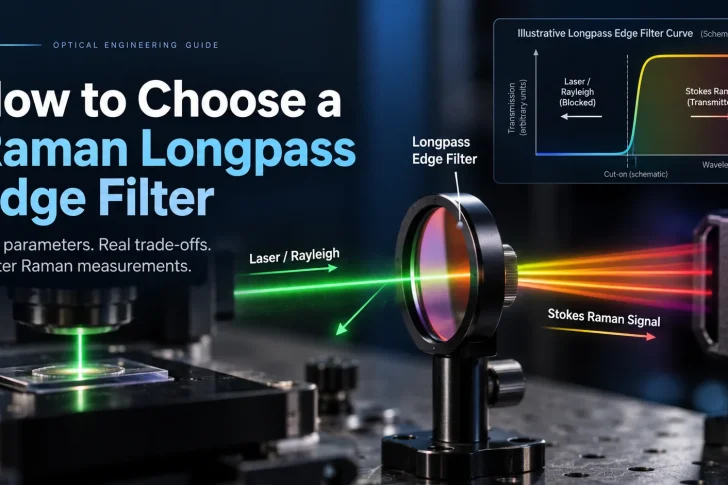
Choosing a Raman longpass edge filter should start with two numbers: the excitation laser wavelength and the lowest Stokes Raman shift you need to measure. The nominal cut-on wavelength alone is not enough. A useful Raman edge filter must simultaneously provide strong rejection at the…
Verifying laser line rejection for Raman spectroscopy means proving three separate things, not one: the optical density at the laser wavelength under the angle and beam geometry the filter actually sees, the spectral distance between the laser line and the point where transmission recovers (expressed…