Here we provide articles about popular science and applications of filters, lenses, prisms, reflectors, ND mirrors and other optical components. You are welcome to read! optical engineering articles, optical engineering guides, optical components, optical design, optics technology, photonics engineering
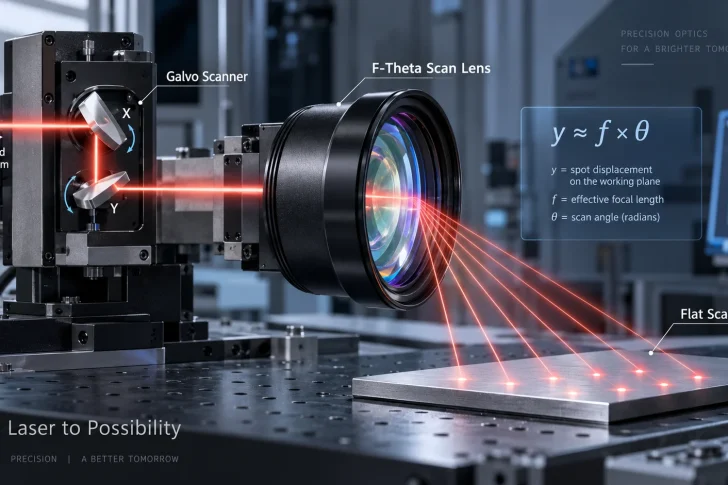
Choosing an F-theta scan lens manufacturer is not simply a matter of matching a lens to a laser wavelength. An F-theta lens works as part of a complete scanning system. Its practical performance depends on the laser wavelength, input beam diameter, effective focal length, galvanometer…
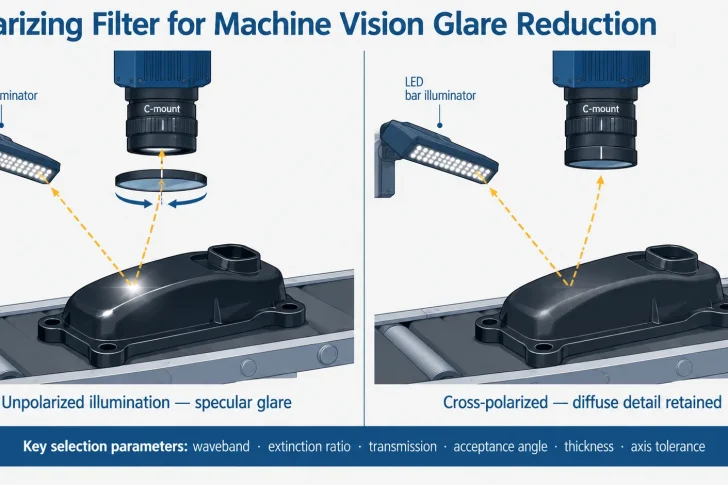
Selecting a polarizing filter for machine vision glare reduction starts with one question that has nothing to do with the filter itself: is the glare a specular reflection from a dielectric surface, or from bare metal? Dielectric glare — plastic, glass, paint, wet surfaces, film…
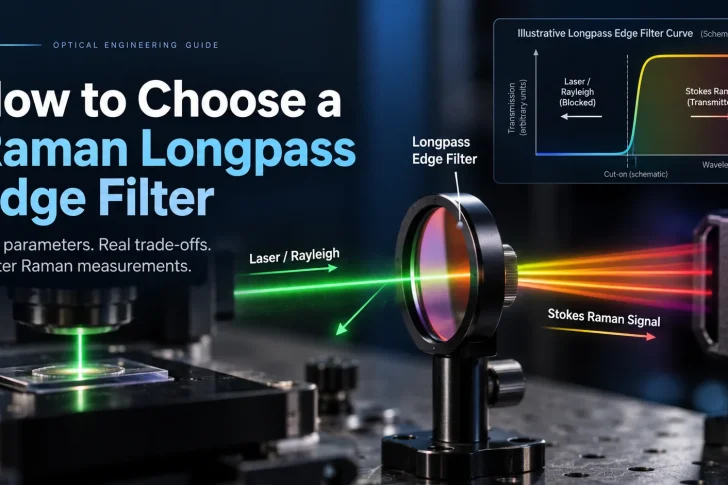
Choosing a Raman longpass edge filter should start with two numbers: the excitation laser wavelength and the lowest Stokes Raman shift you need to measure. The nominal cut-on wavelength alone is not enough. A useful Raman edge filter must simultaneously provide strong rejection at the…
Verifying laser line rejection for Raman spectroscopy means proving three separate things, not one: the optical density at the laser wavelength under the angle and beam geometry the filter actually sees, the spectral distance between the laser line and the point where transmission recovers (expressed…
For a symmetric all-dielectric filter on a non-absorbing substrate, used near normal incidence at low optical power, flipping the part does not change the transmitted spectrum. Transmittance through a non-absorbing multilayer is the same in both propagation directions at the same angle of incidence. Optical…
A filter described as “850 nm,” “550 nm longpass,” or “10 nm bandpass” is not fully specified by those nominal numbers alone. Real optical filters are manufactured and measured against an allowable range. A nominal 850 nm bandpass filter, for example, may require its actual…
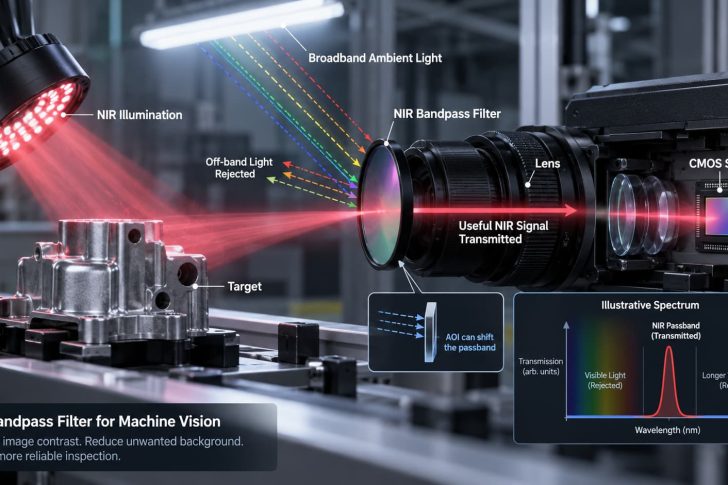
A machine vision system may use an 850 nm or 940 nm LED, a monochrome camera with good near-infrared sensitivity, and stable exposure settings—yet still produce images whose contrast changes with factory lighting, sunlight, or reflections from nearby equipment. The problem is often not the…
A dichroic mirror is a wavelength-selective optical component designed to reflect one spectral region while transmitting another. Unlike a conventional mirror that is intended to reflect a broad wavelength range, a dichroic mirror uses a carefully designed multilayer dielectric coating to control how different wavelengths…
A ghost image in a beamsplitter is a second, weaker image formed by light that reached the detector along an unintended optical path inside the component. In the large majority of cases the path is a reflection from the second surface of a plate beamsplitter,…
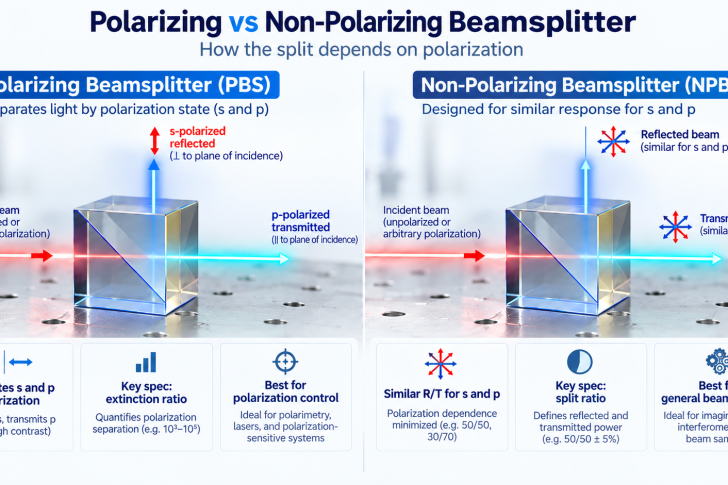
A beamsplitter is often described simply as an optical component that divides one incident beam into transmitted and reflected paths. In an actual optical system, however, an important question comes first: Should the splitting behavior depend on polarization? That question separates two major categories: polarizing…
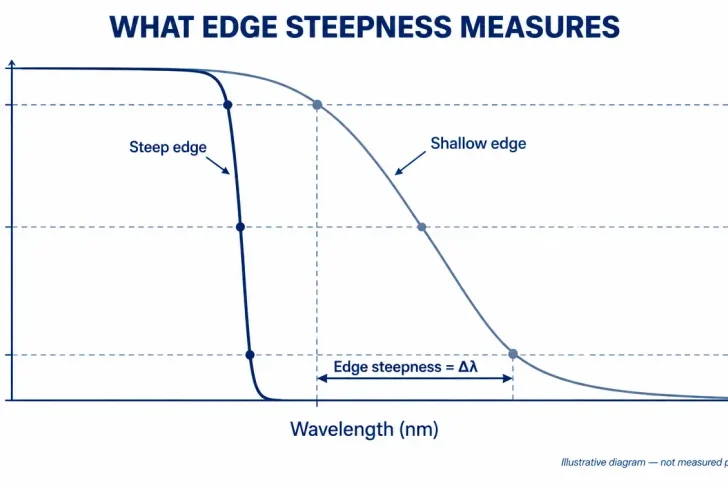
Edge steepness describes how quickly an optical filter transitions between its passband and its blocking region. It is measured as the wavelength interval between two defined reference points on the transition — for example between the 50% transmission point and the wavelength where transmission drops…
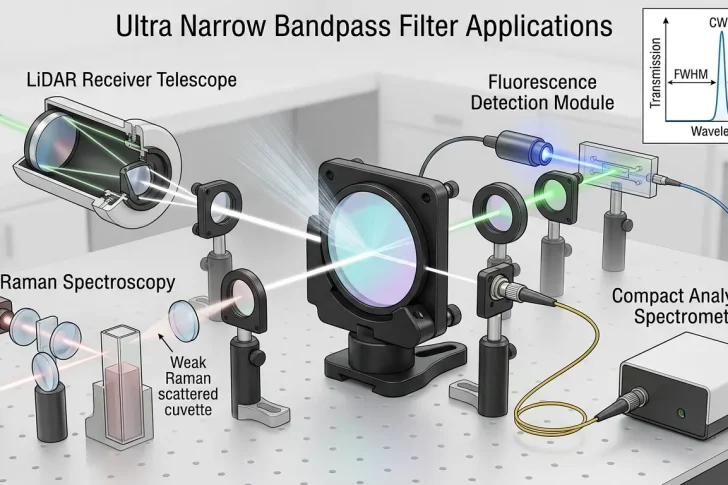
An ultra narrow bandpass filter is used when an optical system needs to transmit a tightly defined wavelength region while strongly attenuating light outside that region. Typical ultra narrow bandpass filter applications include laser-line cleanup, LiDAR and active optical sensing, selected fluorescence channels, analytical spectroscopy,…